

Stop buying the best-selling shirt and calling it the best shirt. Sales charts measure fame, marketing reach and star power. They don't measure stitching, breathability, fit or whether you'll still wear the thing in two years. A top jersey football purchase works the other way around. You start with your purpose, then you judge construction, authenticity and value per wear. Popularity is useful context. It isn't a verdict.
Table of Contents
- Which Top Jersey Fits Your Goal
- The Five Criteria That Make a Jersey Top
- Why Fabric and Construction Beat the Fibre Label
- How to Inspect a Jersey Before You Buy
- How Demand Sets Value
- Mystery Soccer Jersey Boxes for Value and Surprise
- Measuring Value and Buying With Confidence
Which Top Jersey Fits Your Goal
There's no single top jersey. There's only the best type for the job you need it to do, and picking the wrong type wastes money even when the shirt itself is genuine.
| Buyer Goal | Best Jersey Type | Check First | Why It Fits |
|---|---|---|---|
| Current-player fan | Current season player version | Crest and print detail | Matches the on-pitch look |
| Collector | Historic club or tournament shirt | Label, season tag and provenance | Holds long-term cultural demand |
| Parent buying for a child | Kids' fan version | Size chart and comfort | Children grow fast and need easy fit |
| Gift buyer | Premium shirt or Mystery Soccer Jersey Box | Size and excluded clubs | Adds surprise while keeping authenticity |
| Budget buyer | Retro or fan version | Seller return policy and authenticity proof | Better value per wear |
| Group or team | Sharing Box | Quantity and size spread | Splits cost across a shared order |
Use the table in order. Name your goal first, buy the matching type, then apply the quality checks that follow. Parents, for example, should prioritize growth room and soft seams over player-version detailing, a point covered well in this guide to choosing durable children's soccer jerseys from JC Sports Houston.
The factor most likely to change your answer is whether the shirt will be worn weekly or kept. Worn shirts need comfort and wash durability. Kept shirts need provenance and condition.
Player-version shirts fit close and use lighter materials. That's right for playing and wrong for many casual wearers. A fan version gives you room, sturdier print application and a lower price. Neither is superior in the abstract. One fits your body and your use, the other doesn't.
The Five Criteria That Make a Jersey Top
Judge a jersey like a well-built watch. The face gets noticed first, but the case, movement and finish decide whether it lasts. Club colors are the face. Licensing, fabric, detailing and scarcity do the quiet work.
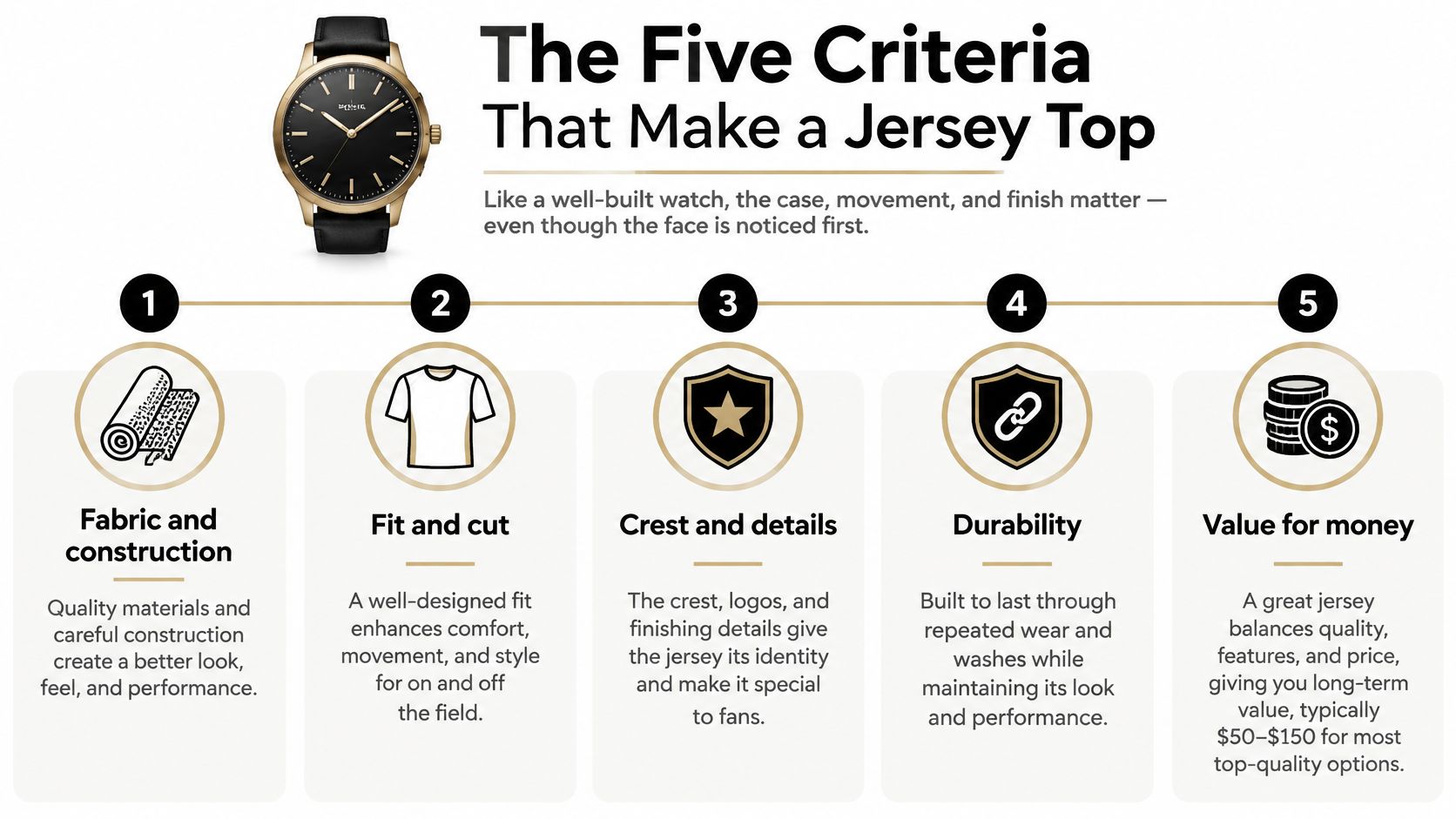
| Criterion | What Strong Looks Like | Red Flag |
|---|---|---|
| Authenticity | Official licensing, correct crest, clean labels and consistent print | Blurred crest, wrong font, missing or copied labels |
| Materials | Knitted lightweight polyester or blend with engineered mesh panels | Heavy, stiff fabric with no visible ventilation zones |
| Design | Accurate kit details, crisp badges, numbers and sponsor placement | Cracking print, uneven badge edges, mismatched colours |
| Rarity | Limited runs, tournament or historic releases, short production windows | Mass-produced shirts sold as limited |
| Retro versus current | Era-accurate retro details or the latest official season kit | Mixed details from several seasons with no clear reference |
How the Criteria Interact
Authenticity comes first because a fake fails every other test eventually. Print cracks, colors fade unevenly and resale value drops to near zero. Materials decide comfort. Look for knitted panels that stretch and recover, mesh under the arms or across the back, and yarn that feels fine rather than plasticky.
Design accuracy sounds cosmetic, but it's a quality signal. Manufacturers who get sponsor spacing and number fonts right usually get seams right too. Rarity matters to collectors, not to a parent buying for Saturday football. Don't pay a scarcity premium for a shirt that'll be outgrown by spring.
Retro and current shirts serve different loyalties. Retro carries an era, a team you remember, a tournament you watched. Current carries this season's squad and player. Pick which story you want to wear.
A shirt that scores well on four criteria can still be a bad buy if the fifth fails for your use. A rare, authentic, beautifully detailed player version in the wrong fit is money sitting in a drawer.
Why Fabric and Construction Beat the Fibre Label
A fibre label names the material, not how a shirt performs. Two jerseys marked 100% polyester can feel very different on the pitch because knit, panels and fabric weight affect how air and moisture move.
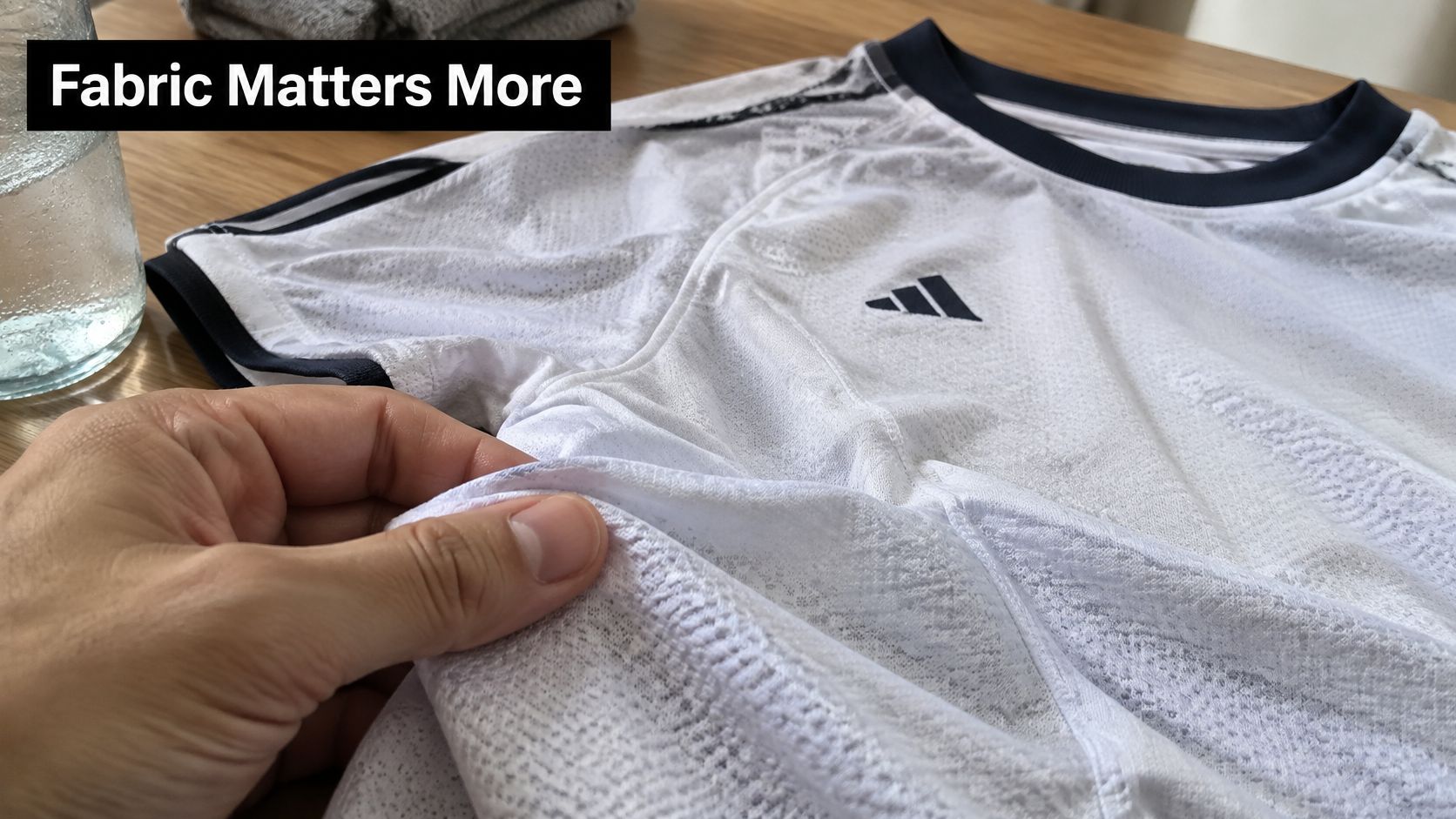
A poorly ventilated jersey holds humid air against your skin and can feel clammy during a match. A technical review of knitted sportswear fabrics reports that knitted constructions generally outperform woven fabrics in flexibility and moisture transport. It also describes how single-jersey polyester can move sweat through capillary microchannels and porous surfaces.
The Four Measures That Matter
- Vertical wicking: How quickly sweat moves away from your skin.
- Drying rate: How quickly the fabric releases moisture.
- Water-vapour permeability: How readily vapour escapes.
- Air permeability: How freely air passes through the fabric.
Better moisture transport and faster drying reduce the humid layer between skin and shirt. You cannot measure these properties in a shop, so check practical signs instead. Hold the fabric up to the light, look for mesh zones and feel whether the yarn is fine and smooth.
Blends involve a trade-off: some feel comfortable at moderate intensity but can hold more water than pure polyester, which may disappoint during a hard game. Choose based on how you will wear the shirt, not the fibre label alone. For more context, this UK jersey fabric buying guide explains jersey fabric, while this guide to what soccer jerseys are made of connects materials with finished shirts.
Practical rule: Choose a lightweight knitted shirt with mesh panels and fine yarns. Construction gives you a better clue to breathability than the label.
How to Inspect a Jersey Before You Buy
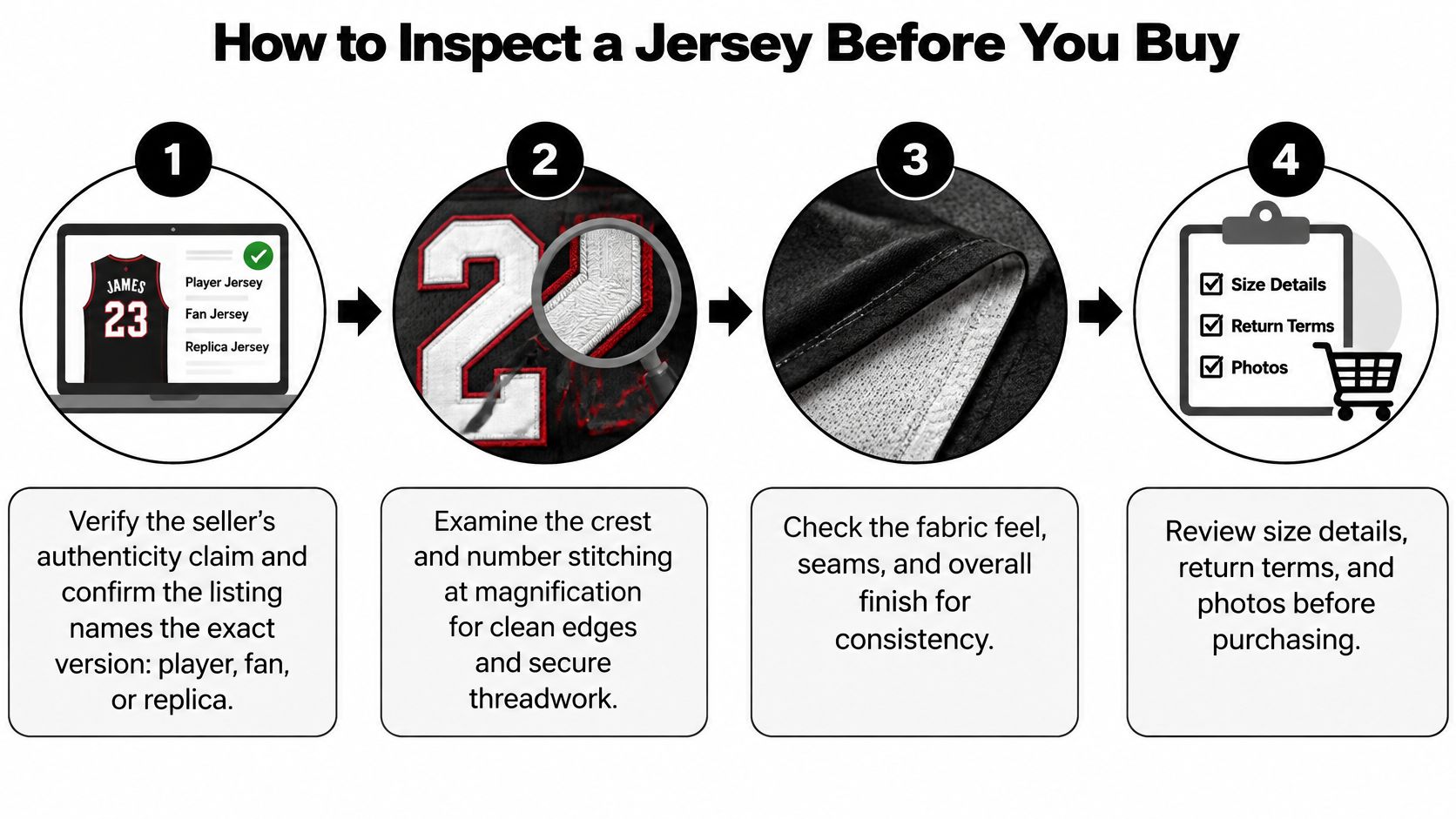
A low price cannot make a questionable shirt a good buy. Inspect the details before paying, and ask for clearer photos if the listing leaves anything uncertain.
- Verify the version. Check that the listing identifies the shirt type, whether it is a player, fan or replica version, and the season. Vague descriptions can conceal a different version than you expect. If the seller will not clarify, choose another listing.
- Examine the crest and numbers. Look closely for even edges, tight stitching, fraying or loose threads. Ask for close-up photos; a wide shot alone does not show enough detail to judge the finish.
- Check the collar and sleeves. The FIFA Equipment Regulations say that a shirt collar opening must be capable of being securely closed for the duration of a match. The Laws of the Game also include a shirt with sleeves in compulsory equipment. For a wearable shirt, check that the collar sits flat and closes securely, and that the sleeves stay in place when you move.
- Inspect seams and panel joins. Look for straight, tight stitching without puckering. Loose seams are more likely to fail with stretching, washing and contact.
- Check sponsor and badge prints. Heat-applied graphics should not show cracking, peeling or bubbling. Compare the labels and size tags with the brand's style, font and placement. This guide to checking whether a football shirt is authentic explains which tag details to inspect.
- Confirm the return window. Ask what you can do if the shirt does not pass your checks when it arrives. Get a clear answer before paying.
The Photo Test
A seller who refuses a close-up photo is telling you what the close-up would show.
Treat that refusal as a reason to walk away, even if the price is low or the listing promises fast shipping. Close-up photos let you assess details that can disappear in a polished, distant image. Use them to inspect the crest, printing, tags and stitching before deciding whether the shirt offers value for your purpose.
How Demand Sets Value
Value comes from demand, rarity and story, and they don't move together. According to Mundo Deportivo, Lamine Yamal-branded Barcelona jerseys sold 1.32 million units in 2025, as reported in this Yahoo Sports summary of the Mundo Deportivo figures. One breakout star can create enormous short-term demand almost overnight.
The wider picture looks like this. A 2025 global ranking of club shirt sales reported Real Madrid at approximately 3.13 million shirts, followed by Barcelona at about 2.94 million and Paris Saint-Germain at 2.54 million.
| Club | Shirts sold (million) |
|---|---|
| Real Madrid | 3.13 |
| Barcelona | 2.94 |
| Paris Saint-Germain | 2.54 |
| Bayern Munich | 2.30 |
| Inter Miami | 2.16 |
| Boca Juniors | 1.90 |
| Manchester United | 1.85 |
| Flamengo | 1.60 |
| Chelsea | 1.40 |
| Al-Nassr | 1.20 |
Those numbers show demand, not quality. A shirt can sell millions because a famous player wears it, then lose resale value the moment he transfers or his form dips. Historic club and tournament shirts behave differently. Their appeal rests on club identity, iconic colors and a remembered era, none of which depend on one player's next contract.
Watch three signals before paying a premium. Production run length tells you how scarce the shirt really is. Era recognition tells you whether buyers will identify it in ten years. Story durability tells you whether the player or moment will still matter after this season ends. Current shirts tied to a forgettable season usually soften in price. Retro shirts with short runs and instantly recognizable details tend to hold up.
Mystery Soccer Jersey Boxes for Value and Surprise
A mystery box trades choice for surprise and a lower entry point. You give up picking the exact shirt. In return you get an authentic jersey selected for you, with prices starting from $33.32. That trade suits some buyers perfectly and frustrates others, so decide which one you are.
The box below shows the format in practice.
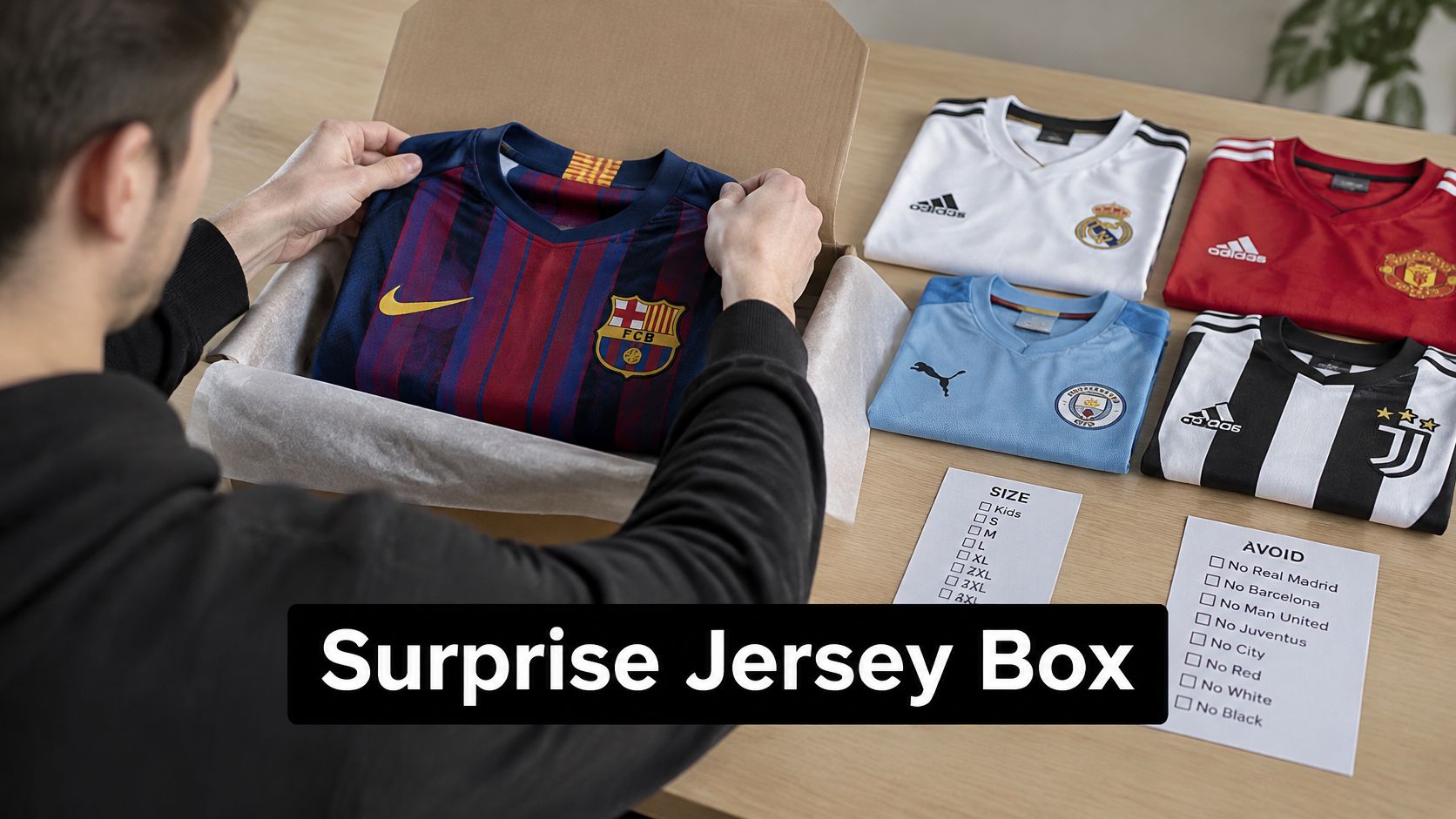
You choose a box type, select a size from children's to 5XL, and list any clubs, leagues or colors to avoid. Every jersey is stated to be 100% authentic and delivered with labels, covered by a 100-day money-back guarantee. Set your exclusions carefully, because they're your only steering wheel.
| Box Option | Best For | Notes |
|---|---|---|
| Premium | Collectors and gift buyers wanting higher-tier shirts | Higher-tier authentic shirts; set exclusions in advance |
| Retro | Collectors wanting classic or historic shirts | Exclude clubs or colours you do not want |
| Kids | Parents buying authentic shirts for children | Choose the children's size range |
| Sharing Box | Friends, teammates and groups | Order quantity and size spread in advance |
| Signed items and shorts | Gift buyers wanting a complete look | Complete-look gift pieces; confirm contents before ordering |
The unboxing below shows how the selection and reveal work.
For a fuller explanation of formats and exclusions, read this guide to the football jersey mystery box. Gift buyers get the most from the format because surprise is part of the present. Groups do well with the Sharing Box because mixed clubs and sizes become a feature, not a problem.
Don't buy a box when you need one specific player, season or match shirt. You'll only be disappointed by a good shirt that isn't the one you wanted.
Measuring Value and Buying With Confidence
Start with cost per wear, which is total cost divided by expected wears. For example, a shirt worn 30 times for 60 pounds costs two pounds per wear, while a shirt worn five times for 40 pounds costs eight. The cheaper shirt is the expensive one. Run that calculation before you chase discounts.
Four Factors Behind the Price
- Expected lifespan: Seam quality and print durability decide how many washes a shirt survives looking sharp. Heat-applied graphics that crack early destroy value fast.
- Resale demand: Rarity, era recognition and condition keep a shirt saleable. Keep labels and receipts if you might resell.
- Counterfeit risk: Unverified marketplaces are where fakes thrive, because photos hide stitching and print flaws. A suspiciously low price on a current shirt is rarely a bargain.
- Return costs: A shirt that fails inspection costs you postage, time and sometimes the full amount. A seller with a clear return policy removes most of that risk.
Environmental cost belongs in the same calculation. A durable authentic shirt worn for years beats three flimsy shirts binned in a season, for your wallet and for waste. Buy once, buy right, wash cold and air dry to protect prints.
Your Purchase Path
- Confirm your goal and match it to the jersey type in the first table.
- Choose a format. Buy direct for a specific player, season or match. Choose a Mystery Soccer Jersey Box for surprise and value.
- Check the seller's terms. Mystershirt sells authentic shirts with labels across Premium, Retro, Kids and Sharing options, with a 100-day money-back guarantee, delivery in Europe typically 1 to 4 days and global delivery 1 to 30 days.
- Confirm size, exclusions and delivery timing before you pay. Most disappointments come from skipping this step, not from the shirt itself.
Follow that order and you'll rarely regret a purchase. Goal first, construction second, price third, popularity last.
Ready to put this into practice with a shirt that is guaranteed authentic? Visit Mystershirt to choose a Premium, Retro, Kids or Sharing Mystery Soccer Jersey Box, set your size and exclusions, and unbox a genuine top jersey football fans want to wear.


