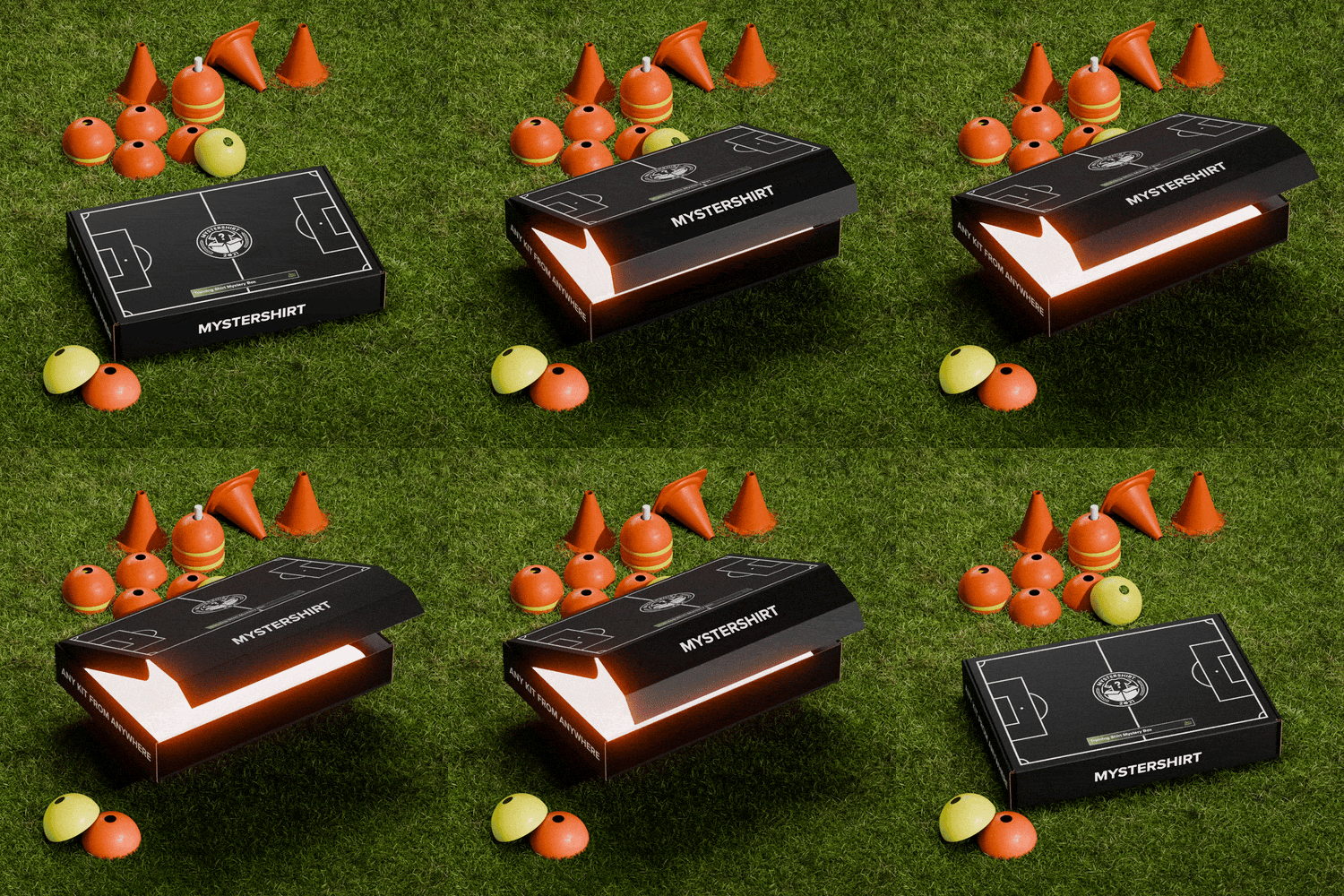
You've found the perfect football shirt for a friend overseas. The club is right, the design feels personal, and the surprise seems guaranteed. Then the tracking stops at a border checkpoint. A customs request arrives, the recipient is asked to pay an unexpected charge, or the parcel is returned because the declaration wasn't clear enough.
That's the uncomfortable side of worldwide gift delivery. Sending a football jersey across borders involves more than choosing a carrier and entering an address. Customs rules, transport networks, tracking coverage, handoff options, packaging, and return arrangements all shape whether the gift arrives as planned.
The good news is that most problems are predictable. Once you understand where international gifts tend to get stuck, you can choose a suitable delivery service, prepare accurate information, and make the surprise easier for the recipient to enjoy.
Table of Contents
- The Reality of International Gift Shipping
- Navigating Logistics Variables and Customs
- The Gift Recipient Control Gap
- Why Mystery Boxes Solve Gifting Friction
- Packaging and Presentation for Impact
- Making Global Gifting Effortless with Mystershirt
The Reality of International Gift Shipping
A sender in Belgium orders an authentic jersey for a friend in Canada. The order confirmation arrives immediately, but the parcel spends several days moving through export processing before it reaches the destination country. The recipient then receives a customs notice asking for more information about the item. The birthday is approaching, and the sender can see only one unhelpful tracking update.
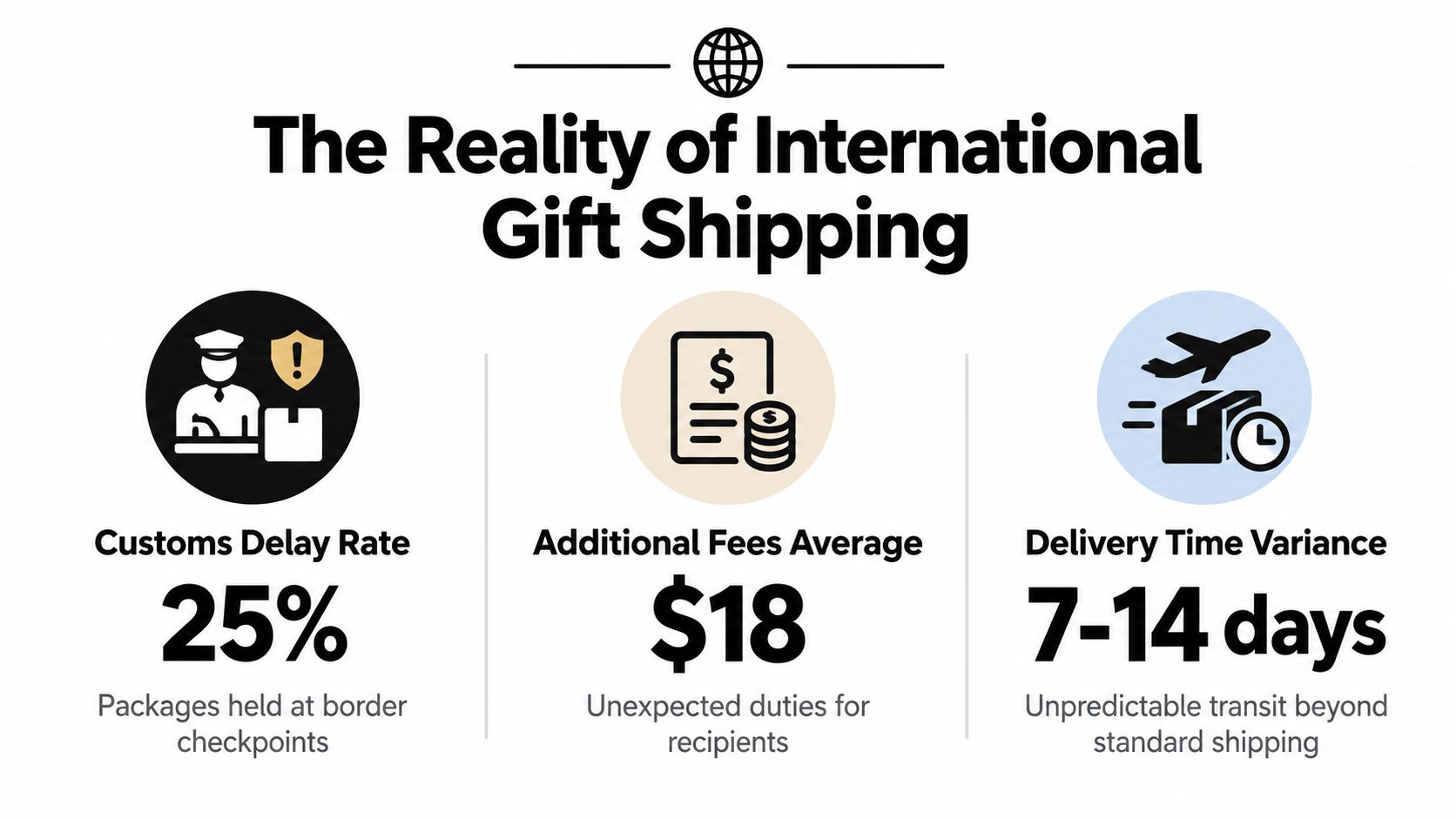
This kind of failure usually starts before the parcel leaves the warehouse. A vague description such as “clothing,” an inconsistent value, or missing recipient details can create questions at the border. Even a correctly packed gift may face delays because international shipments pass through systems with different procedures and capacity.
Postal networks have also changed substantially. Parcels and logistics accounted for more than 32% of postal-service income in 2021, compared with 11% in 2005, according to the Universal Postal Union's analysis of international logistics and e-commerce. That shift reflects the importance of online retail, but it also means gifts enter a high-volume commercial delivery system rather than a simple letter-mail network.
Why delivery promises vary
The Universal Postal Union recorded a 16.5% fall in international parcel volume in 2021, bringing the total to approximately 138 million items, before reporting a later 19.9% recovery after that decline. The organization also estimated a global parcel-post market of 104 billion items in 2022, alongside 326 billion letter-post items. These figures show both the scale and volatility of international physical-goods delivery, not a universal timetable for every destination.
For a gift-giver, the practical lesson is simple. A carrier's advertised service describes a planned route, not a guarantee that customs, local transport, and final-mile delivery will behave identically in every country. Check the delivery window, prepare the shipment information carefully, and leave enough time for a birthday, holiday, or match-day celebration.
For destination-specific planning, a guide to gift delivery to Japan can help clarify how international shipping terms affect the recipient experience. The same principle applies elsewhere: look beyond the product page and understand what happens after dispatch.
Navigating Logistics Variables and Customs
A quoted shipping time tells you only part of the story. The World Bank's Logistics Performance Index evaluates six connected variables: customs-clearance efficiency, transport infrastructure, ease of arranging competitively priced international shipments, logistics-service competence, shipment tracking, and delivery timeliness. Its 2018 survey used a 1–5 scoring scale, drawing on nearly 6,000 country assessments from approximately 1,000 respondents in the freight and logistics sector. The World Bank Logistics Performance Index dataset provides the framework behind these dimensions.
Transit isn't the whole journey
A parcel can travel quickly between airports and still arrive late because it waits at a border. Customs officers may need to verify the item description, assess the declared value, confirm the classification, or request information from the carrier or recipient. That means transport time and border time are separate risks.
The World Bank's newer methodology uses shipment-tracking data from maritime, aviation, and postal systems to examine lead times between supply-chain events, including time spent at or within borders. Its LPI 2.0 framework also separates connectivity and time efficiency across air cargo, maritime shipping, and postal logistics, with additional measures for business-to-consumer postal delivery. The international shipping guidance for football shirts offers useful context for shoppers who need to think about the complete route rather than the checkout estimate alone.
Prepare the customs record before dispatch
Treat the declaration as a technical control, not a minor form. Before the parcel leaves, check the following:
- Item description: Describe the product clearly, such as a football jersey, rather than using a vague term like “gift” or “clothing.”
- Declared value: Enter the required value consistently across the order, customs declaration, and invoice. A gift label doesn't automatically remove duties or inspection requirements.
- Country of origin: Provide the manufacturing or origin information requested by the carrier and destination authorities.
- Harmonized System classification: Use the appropriate HS classification where the shipping process requires it. The correct code helps customs identify the product category.
- Recipient information: Include the recipient's full name, complete address, postal code, telephone number, and email address when requested.
- Invoice consistency: Make sure the description, quantity, value, and recipient details match across all electronic and paper records.
The World Bank's logistics methodology supports a useful operational rule: track milestone events separately. Dispatch, export clearance, import arrival, customs release, and final-mile handoff each tell you something different. If a parcel stops changing status at import, the sender can investigate the border or carrier rather than guessing that the entire shipment has disappeared.
Practical rule: Give customs enough precise information to identify the product without asking the recipient to explain what you bought.
The Gift Recipient Control Gap
The sender controls the purchase, but the recipient often controls the difficult final moments. A friend may work away from home, live in shared accommodation, prefer a locker, or avoid opening a parcel in front of other people. A surprise gift can become inconvenient when the delivery method assumes someone will be waiting at the door.
The 2025 IPC survey found that doorstep delivery represented 44% of cross-border deliveries, followed by parcel lockers at 13% and mailbox delivery at 12%. Those figures show why delivery format deserves attention. Doorstep service may be common, but it isn't automatically suitable for every recipient or every surprise.
Plan the handoff around the recipient
Before ordering, think through the recipient's normal routine:
- Check the address type. Confirm whether the recipient receives parcels at a private home, apartment building, workplace, student residence, or another location.
- Consider discretion. If the sender must remain secret, check whether the package exterior reveals the product, sender name, or store identity.
- Review delivery preferences. Look for carrier options such as a delivery instruction, pickup point, or parcel locker. Availability depends on the destination and carrier.
- Confirm tracking access. Decide whether the recipient should receive tracking notifications or whether the sender should monitor the parcel first.
- Plan for an absence. A missed delivery can be manageable if the carrier offers redirection or collection. It can be stressful if the parcel is returned quickly.
Returns create a second control gap. DHL's 2025 global shopper research reported that 81% of consumers would abandon a purchase when their preferred delivery option was unavailable, while 79% would leave when the returns process failed to meet expectations. The same research found that three in four consumers would avoid a retailer they didn't trust with delivery and returns. The IPC cross-border e-commerce report provides additional context for the delivery-format findings.
Make sizing and returns part of the surprise
Football shirts create a particular gifting problem. The sender may know the recipient supports a club but not whether they prefer a close fit, a relaxed fit, a youth size, or an oversized style. A duplicate shirt can also produce an awkward conversation, especially when returning it internationally requires the recipient to pay postage or complete another customs form.
Before purchase, check:
- Whether the recipient can exchange an incorrect size.
- How long the return window lasts.
- Whether international return postage is covered.
- Whether the return declaration needs special wording.
- Whether a recipient can start the process without revealing the gift's sender.
- Whether the seller accepts returns for surprise or mystery products under its stated policy.
A gift works best when the recipient has enough control to solve a practical problem without damaging the emotional moment.
Why Mystery Boxes Solve Gifting Friction
Buying a specific football jersey gives the sender certainty about the item, but it demands accurate knowledge about the recipient. You need to choose the right club, design, season, size, and fit. If any one of those assumptions is wrong, the surprise may turn into a request for an exchange.
A mystery box changes the decision. Instead of pretending to know every preference, the sender chooses a format that makes discovery part of the gift. The recipient doesn't receive a random excuse for poor planning. They receive an experience with room for anticipation, while the order can still use practical boundaries such as size selection and clubs or colors to avoid.
| Traditional retail choice | Mystery-box approach |
|---|---|
| The sender selects one specific shirt | The recipient discovers a curated shirt |
| The sender must predict exact preferences | The sender can provide exclusions and fit details |
| A wrong size can create an awkward exchange | Size information can guide the selection |
| A duplicate club creates disappointment | The surprise format reduces the need to name one exact SKU |
| The reveal ends when the product is identified | The unboxing becomes part of the gift |
Specific product versus guided surprise
Suppose you know your friend supports a particular team but don't know which shirts they already own. A specific purchase risks duplication. A mystery box lets you communicate relevant exclusions, such as a club, league, or color, without removing the discovery element.
Sizing still needs honest treatment. No mystery product can eliminate the need for a usable size choice, and garment cuts can vary. The advantage is that the sender doesn't have to identify one exact shirt whose fit and design must both be perfect. That makes the return conversation less personal and can reduce the pressure to ask the recipient too many questions before the celebration.
For readers comparing gift formats, an overview of unique mystery boxes for 2025 illustrates why surprise products can work as experiences rather than ordinary merchandise. The same principle applies to football shirts, where discovery and fandom naturally reinforce each other.
Mystery boxes also help separate known constraints from unknown preferences. The sender can know the recipient's size range and exclusions, while leaving the exact club or design open. That is a more realistic form of personalization than guessing every detail.
A football jersey mystery box can therefore act as a logistical safety net, not because it removes customs or carrier rules, but because it reduces the number of decisions that can be wrong before dispatch. The football jersey mystery box guide is useful for understanding how that format works in practice.
Packaging and Presentation for Impact
A successful international gift has two jobs. It must survive handling, moisture, compression, and inspection, then create a satisfying reveal when the recipient opens it. A thin or poorly sealed package can damage the shirt and weaken the emotional impact, while excessive outer packaging can create unnecessary bulk and complications.

Protect the garment first
Fold the jersey carefully, keep it dry, and use internal protection that prevents movement inside the parcel. The outer package should close securely and present customs information in a way that remains readable if the parcel is handled repeatedly.
A flat mailer can be practical for lightweight apparel because it limits unused space and can simplify handling. If you're comparing material choices, this guide to the benefits of flat poly bags explains why flexible protective packaging is often considered for apparel fulfilment. The right choice still depends on the seller's packing process, carrier requirements, and the amount of protection the shirt needs.
Packaging should also support discretion. A recipient who doesn't know a gift is coming may appreciate an exterior that avoids revealing a club, product category, or sender message. The surprise should happen when the parcel is opened, not when it is left in a shared hallway.
The unboxing sequence can be simple: an intact outer package, a clean inner presentation, a note, and the jersey. That sequence turns delivery milestones into part of the experience. The sender has managed the route, while the recipient gets a moment that feels intentional rather than improvised.
A short visual example can help teams and gift-givers think about how presentation, protection, and the reveal work together:
Avoid adding unnecessary objects to an international parcel. Extra cards, liquids, food, or decorative materials may create separate customs or carrier questions. A focused package is easier to describe, easier to protect, and less likely to distract from the main gift.
The best packaging doesn't compete with the jersey. It preserves the item, protects the surprise, and makes the recipient feel that someone considered the entire journey, not only the checkout screen.
Making Global Gifting Effortless with Mystershirt
A practical worldwide gift delivery partner should address more than product selection. It should provide clear size choices, exclusions for clubs or colors, authentic merchandise, a stated returns position, tracking, and delivery information that helps the sender plan around an important date.
Mystershirt offers football-shirt mystery boxes in several formats, including Premium, Retro, Kids, sharing, and bundle options. Customers can select a size from children's choices through 5XL, identify clubs, leagues, or colors to avoid, and receive authentic shirts with labels. The company states that it has more than 40,000 shirts in stock, has sold more than 300,000 jerseys, and provides a 100-day money-back guarantee. These are product and policy details to verify against the current global shipping options before ordering, since delivery coverage and terms can change.
The service also lists express delivery in Europe as typically taking 1–4 days, while global delivery is stated as ranging from 1–30 days. Those windows should be treated as planning guidance rather than a replacement for checking the destination, customs requirements, and the selected service at checkout.
For groups, Sharing Boxes can reduce the need to coordinate several separate gifts. Friends, teammates, or relatives can contribute to one football-focused surprise while keeping the order and delivery process together. That arrangement doesn't remove border risk, but it can make the purchase easier to organize.
Mystershirt offers authentic football-shirt mystery boxes with size selection, club and color exclusions, worldwide delivery, sharing formats, and a 100-day money-back guarantee. If you want a football gift that turns sizing uncertainty and the reveal into part of the experience, visit Mystershirt and choose a box that fits your recipient, destination, and deadline.