The popular advice says you should buy a 90s football jersey because it reminds you of a club, a player, or a tournament. That's only half the story now. The strongest demand comes from shape, graphics, and styling potential, which is why a baggy mid-90s shirt can work on someone with no connection to the team at all.
A good original still matters, but nostalgia alone won't tell you whether a shirt is worth buying. You need to understand the decade's materials, sponsor design, construction, sizing, authenticity clues, and the difference between a collectible and an easy-to-wear fashion piece.
Table of Contents
- The Streetwear Takeover of 90s Football Jerseys
- Design Revolutions and Fabric Technologies
- The Golden Era of Shirt Sponsorship
- How to Authenticate Vintage 90s Kits
- Sizing and Styling the Oversized Silhouette
- Sourcing Authentic Retro Jerseys Responsibly
- Care and Maintenance for Heavy Polyester
The Streetwear Takeover of 90s Football Jerseys
90s football jerseys aren't confined to display cases or match-day wardrobes anymore. They've become styling tools. The decisive change is that buyers increasingly want the oversized mid-90s silhouette and loud graphic language, not merely a famous badge.
Recent independent fashion reporting describes demand moving from 1980s rarities toward mid-90s shirts, with shoppers favoring baggier XL and XXL fits and wearing football jerseys in bars, on runways, and across social media. Pinterest searches for styling national-team jerseys have also risen by as much as 840 percent, according to The Guardian's coverage of the football jersey fashion trend. That tells you what the modern buyer is chasing: a recognizable shape with enough visual impact to carry an outfit.
Blokecore changed the buying brief
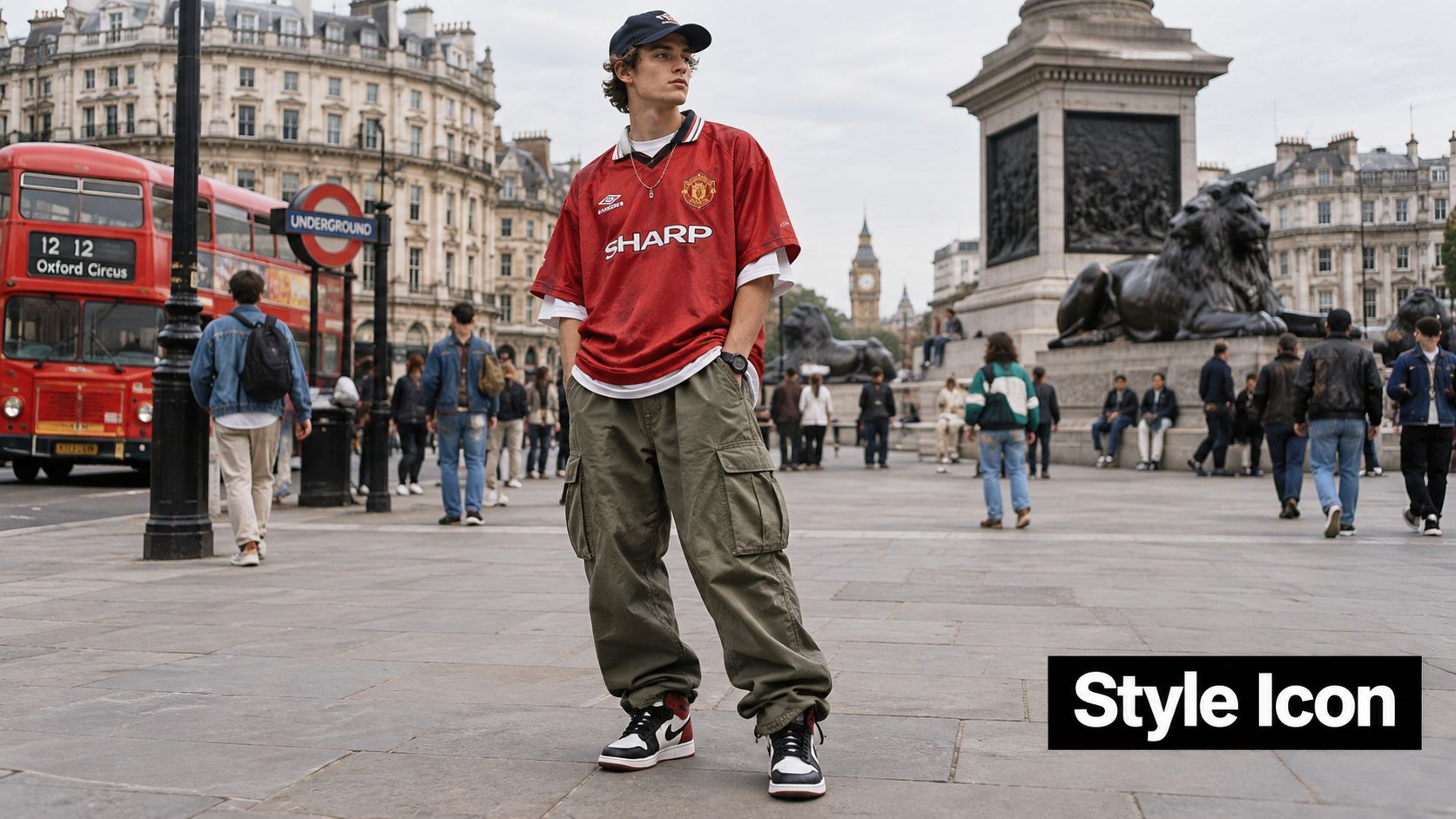
The blokecore movement made the football shirt legible as everyday clothing. Pairing a retro jersey with loose denim, track pants, terrace trainers, or cargo trousers strips away the idea that the shirt needs a full football outfit around it. The jersey becomes the loudest item in a deliberately relaxed look.
That shift favors 90s designs because the decade delivered what modern streetwear needs:
- Roomier cuts that sit over a T-shirt without clinging.
- High-contrast graphics that remain visible under a jacket.
- Large sponsor marks that function like graphic branding.
- Structured polyester that gives the garment shape.
- Unusual color combinations that turn a basic outfit into a considered one.
The result is a different hierarchy of desirability. A plain shirt from an enormous club can be less useful than a visually strange shirt from a less obvious team. Collectors may value history, scarcity, or a player association. Style-focused buyers often begin with the question, “Will this work with my wardrobe?”
Buy the silhouette before the story
A shirt should still have a story, but don't let the badge make every decision for you. If you want a wearable piece, start with the shoulder width, body length, collar, sleeve opening, and graphic scale. A bold shirt with a generous cut usually delivers more outfit value than a rare but narrow top that looks like modern training wear.
My practical recommendation is simple: choose the mid-90s shape first, then decide how much club history you want. Use this guide to 90s fashion jerseys when comparing the fashion appeal of different eras, but judge every listing by measurements and construction rather than the seller's nostalgia.
The best 90s football jerseys now sit between two worlds. They can be meaningful sports objects, but they also work as graphic outerwear. That crossover is why the decade's baggier shirts keep winning over buyers who aren't traditional collectors.
Design Revolutions and Fabric Technologies
The 90s football jersey became streetwear because manufacturers gave designers more control over the fabric. Polyester and sublimation printing allowed gradients, textures, and geometric patterns to sit across the shirt instead of remaining limited to simple panels or surface graphics. That freedom produced the bold visual language now driving blokecore styling and vintage-kit demand, as shown in this history of football jersey design.
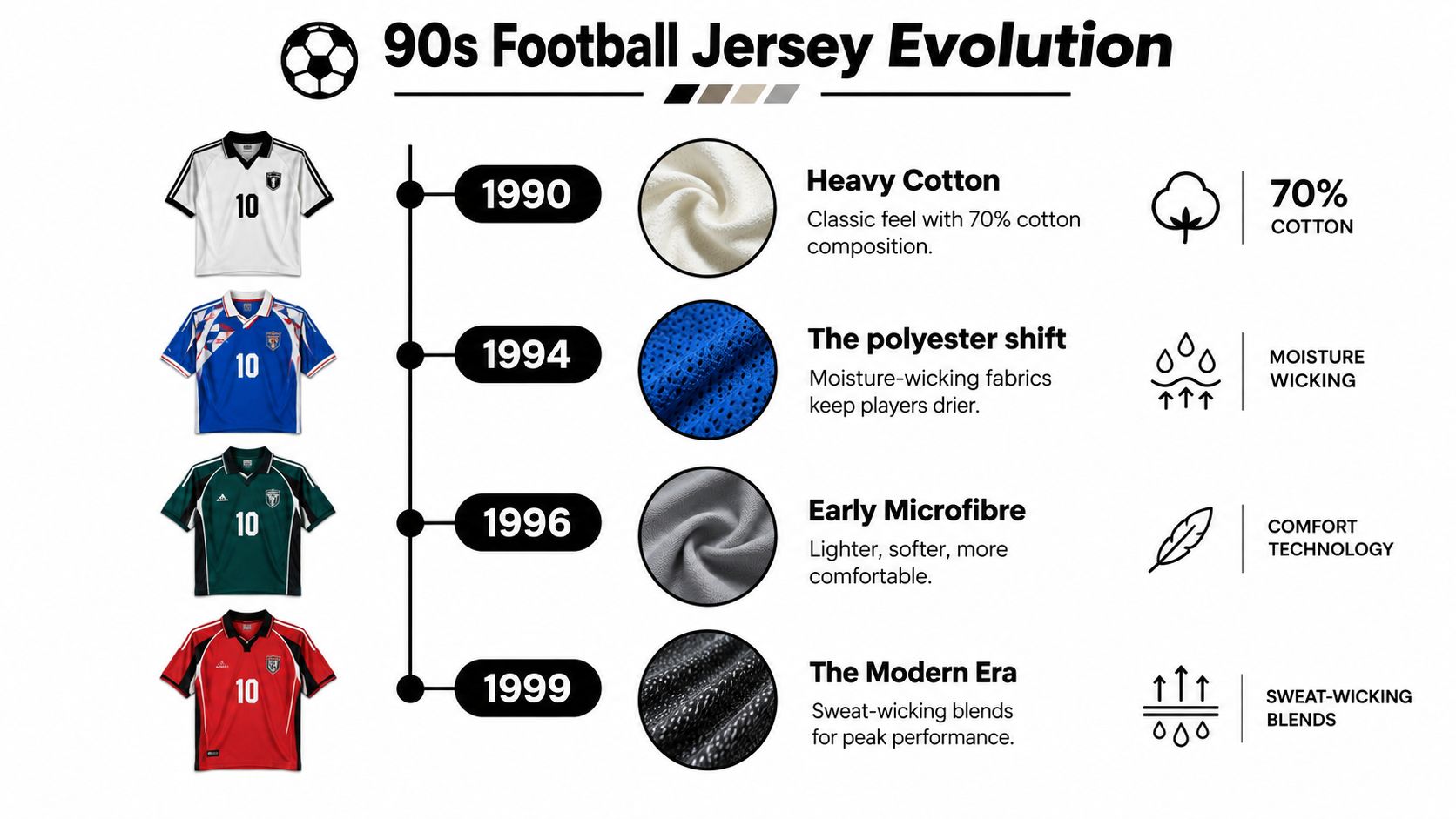
Earlier shirts commonly used simpler cotton or cotton-polyester constructions. Many 90s football jerseys instead used polyester fabrics that feel noticeably heavier and more structured than modern lightweight match shirts, a character also visible in Classic Football Shirts Sweden's overview of iconic 90s designs. That construction helps explain the decade's oversized appeal. The body hangs away from the torso, the sleeves keep their shape, and the shirt reads as clothing rather than a thin performance layer. For a deeper breakdown of these materials, see this guide to what materials soccer jerseys are made of.
Why sublimation matters
Sublimation changed how artwork could interact with fabric. Manufacturers embedded dye into polyester fibers, allowing all-over graphics, shadow effects, gradients, and abstract geometry to become part of the cloth rather than a separate coating.
That distinction matters when you inspect a vintage shirt. A genuine sublimated pattern should feel integrated into the material, not like a thick plastic layer sitting on top. Age, sunlight, washing, and chemical exposure can still fade it, but sublimation does not behave like a basic heat-applied graphic. The resulting depth is one reason an original can look more convincing than a later reproduction.
The decade also used woven and textured treatments. Some shirts seem restrained from a distance, then reveal crests, tonal patterns, or fine details up close. That shift from clean outline to visual overload gives a good 90s jersey its character and makes it effective with simple jeans or wide trousers.
Heavy polyester versus late-decade microfibre
Technology changed throughout the decade. Early and mid-90s shirts often feel dense, warm, and slightly stiff because heavier polyester retained more moisture and breathed less effectively than later performance fabrics. The looser cut improved the silhouette, but it did not make these garments feel like modern lightweight athletic wear.
Late in the decade, manufacturers moved toward microfibre performance fabrics. Nike's 1998 Dri-FIT used polyester microfibres around 0.5–1.0 denier, according to this history of football shirt technology. Finer fibers improved softness, moisture transport, and evaporation.
Use fabric feel as one authentication clue, never as the verdict. Check labels, stitching, badge construction, sponsor application, and measurements alongside it. For styling, heavier polyester gives the strongest oversized drape. Later microfibre feels better for active wear and layering, but its lighter hand can look closer to a modern sports top.
The Golden Era of Shirt Sponsorship
The sponsor wasn't an afterthought on a 90s football jersey. It was often the central graphic element. Following the Premier League's 1992 launch, shirt sponsorship became a defining feature of the new visual scene, with front-of-shirt partners ranging from chemical companies to electronics brands and beer brewers, as outlined in Sportfive's history of Premier League shirt sponsorship.
That commercial variety gave the decade its character. A sponsor could make a shirt feel industrial, glamorous, regional, or unexpectedly playful. The logo's typography, color, scale, and placement had to coexist with stripes, gradients, woven textures, and large manufacturer marks. When those pieces aligned, the sponsor became inseparable from the shirt's identity.
Manchester United's relationship with Sharp is a useful example. The deal ran from 1982 to 2000, making the electronics logo part of the visual memory of several different kit eras. Bayern Munich carried Opel throughout the 1990s, while Inter Milan began its Pirelli relationship in 1995, a partnership that lasted until 2021. These long-running arrangements gave sponsors the same kind of recognition usually reserved for club colors or badges.
Why sponsor details matter to collectors
A shirt can have the correct crest and still be wrong because the sponsor treatment doesn't match the period. Check the following before you buy:
- Lettering proportions: Compare the sponsor's typeface, spacing, and line weight with reliable period photographs.
- Application method: Look for whether the original used flock, print, embroidery, or another finish.
- Placement: A logo that sits too high, too low, or too close to the badge can indicate a reproduction or incorrect version.
- Age behavior: Fading, cracking, or softening can be normal, but artificial distressing often looks uneven and superficial.
- Season details: A shirt may share a template with another season while using a different sponsor or competition patch.
The strongest designs make the sponsor part of the composition. Sharp on a Manchester United shirt, Opel on Bayern, and Pirelli on Inter aren't merely commercial marks today. They help locate the shirt in football's visual history.
Collector's rule: Treat the sponsor as evidence, not decoration. A wrong logo treatment can undermine an otherwise convincing shirt.
For streetwear, the sponsor adds another layer of graphic energy. That's why large, period-correct branding remains so desirable. It gives the shirt the visual authority of a vintage advertisement without needing additional artwork.
How to Authenticate Vintage 90s Kits
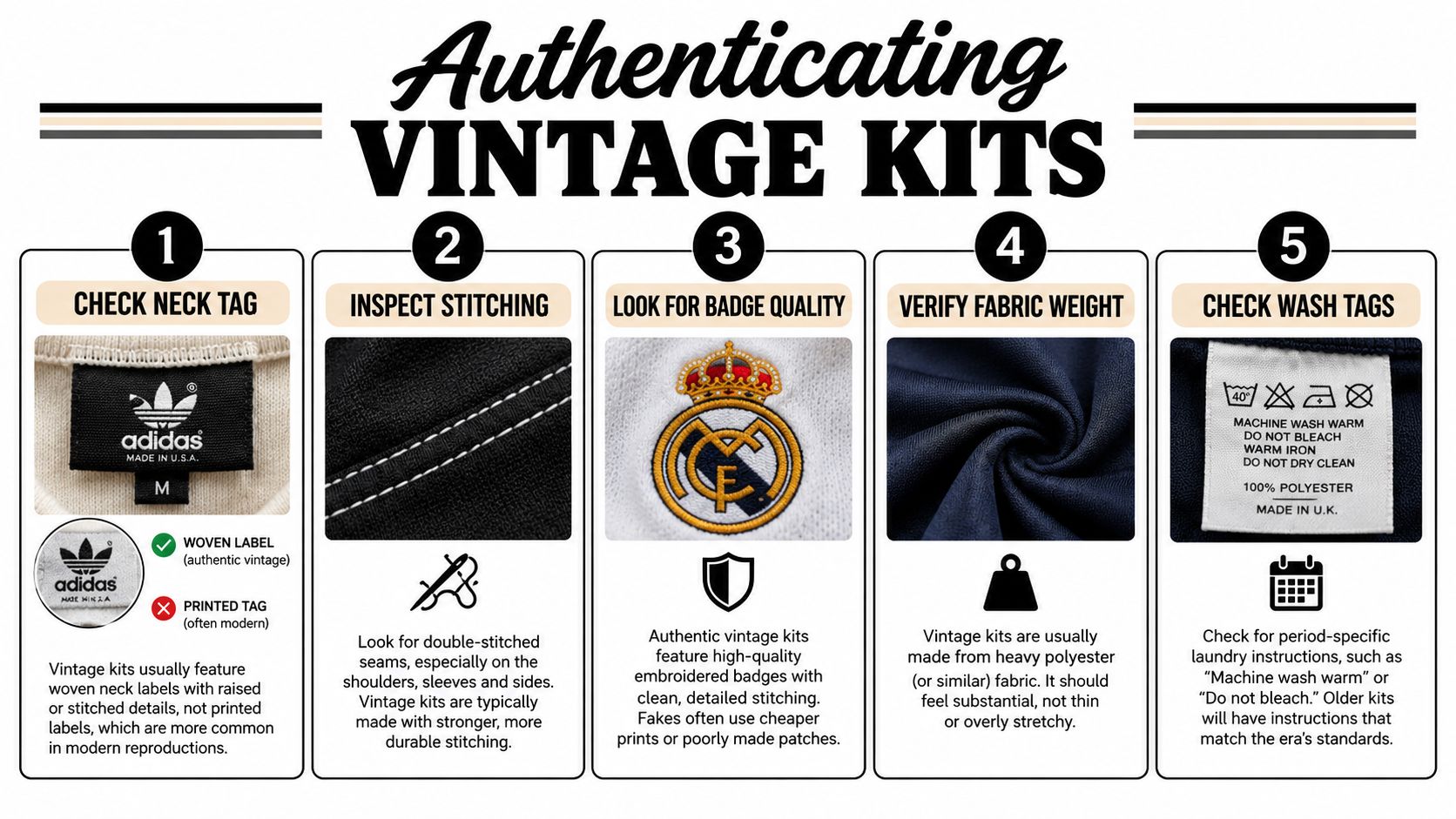
A convincing fake can copy a crest. It rarely gets the whole garment right. Judge the shirt as one object, checking its label, fabric, seams, badge, sponsor, proportions, and wear before paying. This matters even more in the current blokecore market, where bold graphics and the broad mid-90s shape attract buyers who may overlook construction flaws.
Start inside the shirt
Request clear photographs of every internal label. Original 90s production commonly uses woven labels, separate composition information, and care instructions that fit the period. A modern printed label or unusually clean barcode does not prove fraud, but it demands closer checking.
Inspect the seams next. Look for even stitching, clean joins around the collar and cuffs, and manufacturer details that suit the shirt's construction. Loose threads can appear on an old garment. Random, uneven workmanship across the whole shirt is a stronger warning.
Use this order:
- Check the neck tag. Confirm that its style matches the claimed manufacturer and era.
- Inspect the stitching. Examine shoulder seams, sleeve bands, collar joins, and hem finishing.
- Study the badge. Embroidery should show convincing texture, clean edges, and suitable proportions.
- Assess the fabric. Many originals feel substantial because heavier polyester was used at the time. Compare the hand feel with verified period shirts rather than relying on a precise fabric-weight claim.
- Read the wash tags. Check language, typography, composition details, and washing instructions against the claimed period.
Compare the design, not just the logo
Find photographs of the shirt being worn or displayed during its claimed period, preferably from a reputable archive. Compare the collar shape, stripe width, sleeve graphics, crest size, sponsor placement, and overall color balance. Counterfeits often capture the broad concept while missing the small relationships that make the original recognizable.
The fabric should support the graphics. Sublimated patterns should appear embedded, not pasted over the surface. A badge that feels unnaturally flat, a sponsor with thick plastic edges, or a design that looks excessively sharp and uniform can indicate a modern reproduction.
Judge condition separately from authenticity. Faded graphics, worn collars, small pulls, and softened fabric can be honest signs of age. The important question is whether the wear fits the shirt's history and the asking price. Artificial distressing often looks shallow, uneven, or concentrated in unlikely areas.
Use listing behavior as evidence
Be wary of supposedly rare originals offered across a broad run of sizes with identical condition. Genuine vintage stock is uneven. One shirt may have a clean body and a worn sponsor, while another has strong graphics but a stretched collar.
Ask for measurements instead of trusting the size label. Ask where the seller sourced the shirt, request close-ups of the inner tags and sponsor, and leave if basic questions receive vague answers. For a fuller checklist, use this guide to checking whether a football shirt is authentic.
Never let urgency replace verification. A desirable shirt can return to the market. A rushed fake usually becomes an expensive lesson.
Sizing and Styling the Oversized Silhouette
Modern football shirts are often cut for an athletic, close-to-body appearance. Original 90s football jerseys usually behave differently. They tend to have broader bodies, more generous sleeves, and a less aerodynamic shape, which is exactly why they work so well with contemporary streetwear.
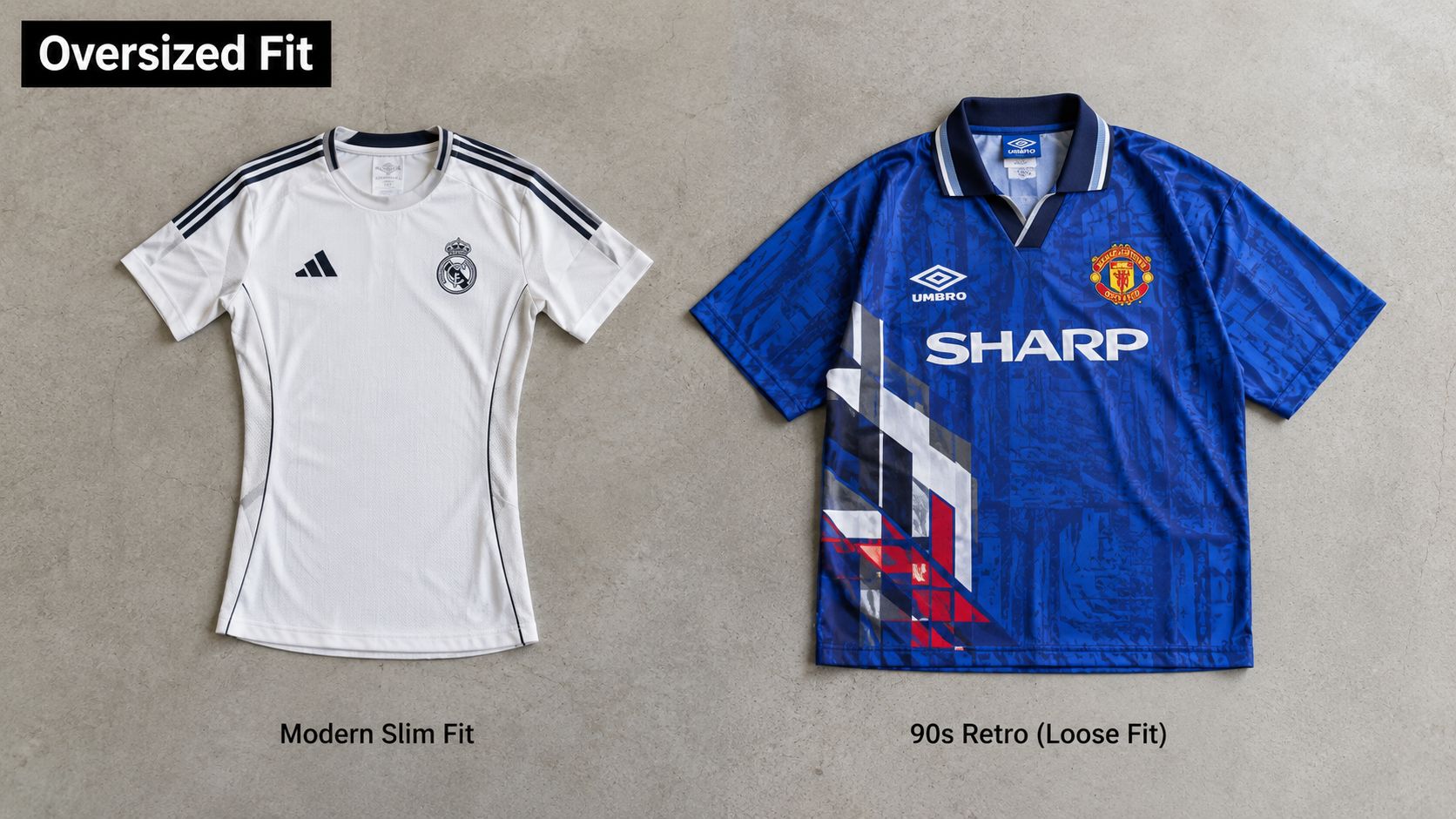
Don't automatically size up. Vintage sizing already varies between manufacturers and countries, and an original shirt may be wide enough without moving into theatrical territory. Measure a shirt you already like, then compare pit-to-pit width, back length, shoulder width, and sleeve length with the listing.
Choose the shape you actually want
There are three useful fits:
| Desired look | What to prioritize | What to avoid |
|---|---|---|
| Relaxed everyday fit | A body that sits comfortably over a tee | Excess length below the hip |
| Deliberate oversized fit | Broad shoulders and roomy sleeves | Narrow shoulders with a long body |
| Authentic match-style drape | Heavy fabric and loose construction | Thin fabric with a modern slim cut |
For most wearers, the sweet spot is a shirt that looks loose through the chest but doesn't swallow the hands. The hem should sit around the upper hip or slightly lower, depending on your trousers. A big shirt with too much length looks like sleepwear. A broad shirt with controlled length looks intentional.
Fit advice: Buy for shoulder width first, then adjust the rest of the outfit around the volume. A long, narrow jersey rarely looks oversized in a good way.
Build the outfit around one loud piece
Let the shirt carry the graphics. Pair a busy sublimated design with plain loose denim, washed cargo trousers, or simple track pants. Neutral footwear keeps the silhouette grounded, while terrace-inspired trainers reinforce the football reference without turning the outfit into costume.
Layering works best when the underlayer is quiet. A white or black T-shirt under an open jersey gives structure, but another competing graphic usually creates clutter. In colder weather, use the shirt under a work jacket, bomber, or short overshirt so the collar and sponsor remain visible.
You can also use contrast deliberately. A flamboyant shirt with clean trousers looks sharper than a flamboyant shirt with equally loud trousers. Women's styling often pushes the proportions further, pairing a large jersey with a short skirt, fitted denim, or boots. The principle remains the same: balance the shirt's volume elsewhere.
See the fit and styling difference in motion before buying:
The goal isn't to look as though you borrowed a player's kit. It's to make the shirt feel like part of your wardrobe. That means respecting its oversized character without letting every proportion expand at once.
Sourcing Authentic Retro Jerseys Responsibly
The retro market rewards patience. Auction sites can offer the thrill of discovery, but they also bring unclear condition, counterfeit risk, inflated asking prices, and pressure to decide before you've checked the details. Specialist dealers are easier to evaluate, but their strongest pieces can disappear quickly.
I prefer a three-part sourcing approach. Use authenticated dealers for specific grails, trusted marketplaces for research and comparison, and surprise-led options when you want the fun of discovery without pretending every purchase is an investment.
Decide whether you're collecting or dressing
A collector should prioritize provenance, exact season, condition, player specifications, and original sponsor details. A streetwear buyer can reasonably prioritize color, measurements, comfort, and visual impact. Confusing those goals is how people overpay for a shirt they do not enjoy wearing.
The market itself is uneven. Vintage jerseys can range from about $100 to $500 depending on rarity and era, while iconic match-worn shirts can reach millions at auction, according to the Sydney Morning Herald's reporting on the football jersey market. Those extremes don't make every 90s replica an investment. Demand concentrates around a narrow group of iconic designs, strong condition, and genuinely scarce originals.
Money rule: Buy an ordinary shirt because you like wearing it, not because you expect it to appreciate.
Consider lower-pressure ways to discover shirts
Mystery boxes can make sense for buyers who want a wearable football shirt without chasing one specific grail. They also work well for gifts, group orders, and people who enjoy the surprise more than the auction process. Mystershirt offers authentic football shirt mystery boxes, including a Retro option, with size selection and preferences for clubs, leagues, or colors to avoid.
That isn't a substitute for authentication when you're buying a named collectible. It is a different purchase format, one that suits discovery and wardrobe building. If you're shopping for younger fans, compare fit and budget with this cheap youth soccer jersey guide before choosing a size or style.
Responsible sourcing also means accepting that wear is part of the object. Don't demand deadstock condition from every vintage shirt, and don't pay a premium for “investment potential” without clear evidence of authenticity, condition, and market demand. The shirt you wear repeatedly may be a better purchase than the one that stays folded in a drawer.
Care and Maintenance for Heavy Polyester
A 90s jersey needs garment care, not gym-kit treatment. Heavy polyester tolerates regular wear, but heat, harsh detergent, friction, and poor storage can damage collars, seams, sponsor graphics, and the fabric's original shape. Care protects both its streetwear fit and its vintage value.
Read the care label before washing. Turn the shirt inside out, fasten any closures, and wash it separately or with similar lightweight clothing. Use cool water and mild detergent. Skip bleach, fabric softener, and strong stain removers unless the label clearly permits them.
Wash gently and dry without heat
Hand washing is the safest choice for a valuable shirt. For machine washing, select a gentle cycle and place the jersey in a mesh laundry bag. Treat early heavy-polyester shirts and later microfibre shirts with the same low-friction approach, but give older, softer microfibre extra care because its surface and printed details can be more vulnerable.
Do not scrub sublimated panels directly or leave the shirt soaking. Prolonged water exposure can loosen ageing prints, labels, and adhesive details. Dab stains with diluted mild detergent, work from the outside toward the centre, then rinse thoroughly.
Air-dry the jersey flat or on a broad hanger, away from direct sunlight. Avoid the tumble dryer. Heat can stress old seams, distort elastic sections, and speed up cracking or lifting on sponsor applications. Never iron directly over a badge, sponsor, or printed graphic. If creases remain, place a clean cloth over the area and use the lowest suitable heat setting, provided the care label allows ironing.
Store it clean, dry, and supported
Never fold a damp shirt. Moisture can remain in seams and folded sections, causing stale odours and gradual fabric damage. Let it dry completely before storing it in a cool, dry place with room for air circulation.
Use a wide hanger that supports the shoulders for shirts in regular rotation. Fold valuable pieces along their natural seams, and avoid stacking heavy garments on top. Keep jerseys away from sunlight, radiators, damp wardrobes, and rough boxes that can catch embroidery or sponsor edges.
Stop using stronger chemicals if a stain refuses to lift. A small mark is safer than a bleached panel or damaged graphic. Vintage wear records the shirt's history, and preserving the original finish matters more than making it look new.
Mystershirt offers authentic football shirt mystery boxes, including Retro options, with size selection and preferences for clubs, leagues, and colours to avoid. Visit Mystershirt if you want a surprise vintage-style piece without chasing uncertain listings.