You're browsing your club's official store, enjoying the new colours, then you reach the product options and stop at the price difference. One shirt is described as the authentic version, another as the stadium or replica version, and both carry the same crest. Which one should you buy?
The answer depends less on status than on how you'll wear, wash, store, and value the shirt. Authentic player-issue shirts are fascinating pieces of technical sportswear, but high-quality football replica kits often make more sense for supporters who want comfort at matches, casual wearability, and a garment they won't be afraid to use. The smartest purchase isn't automatically the most expensive one.
Table of Contents
- The Evolution of the Modern Fan Uniform
- Replica vs Authentic Shirts Explained
- Material and Fit Differences That Matter
- Spotting Fakes and Ensuring Authenticity
- The Sustainability Reality of Modern Kits
- Smart Buying Strategies for Collectors
- Washing and Caring for Your Collection
The Evolution of the Modern Fan Uniform
The modern football shirt started as a team garment, not a fashion category. Supporters watched players wear shirts that were difficult to buy, often poorly suited to everyday life, and rarely designed with a mass fan audience in mind. The idea that an adult could own a club shirt for the pub, the terrace, or a weekend outfit had to be created commercially.
Historical accounts trace the first major push toward replica football shirts to children's products, including Umbroset for Boys in 1959. Adult replica shirts then emerged as a commercial product in the early 1970s, with Leeds United widely cited as the first major adult replica-kit case in 1973-74, after Admiral redesigned the club's shirt so it could be copyrighted and sold to supporters. The story is documented in this history of when football fans first started wearing replica kits.
That shift changed the meaning of a football shirt. Clubs and manufacturers stopped treating supporters as spectators who might occasionally buy a souvenir. They became part of the visual identity of the match. The replica shirt let a fan participate without needing the same garment worn by a professional player.
Why the replica became the standard
Adult adoption was gradual. One study of English football found that only 3-4% of spectators wore replica shirts to matches between 1980 and 1987, followed by rapid growth from 1987 to 1991 and a sharp surge in 1992-93, as recorded in the Guardian's historical account. That timeline explains why older collectors often remember replica shirts as unusual, while younger supporters grew up treating them as normal match-day clothing.
The appeal was practical. A fan version could be cut for ordinary bodies, made durable enough for repeated wear, and styled for life away from the pitch. It also offered a way to own a club's identity without pretending to be a professional athlete.
Collector's perspective: The authentic shirt tells you how a player was equipped. The replica tells you how a club was experienced by its supporters.
That distinction still matters. If you're building a historical collection, a player-issue shirt may have unique appeal because of its construction and scarcity. If you want something for a child, a match-day outfit, or regular casual use, the replica usually reflects the original purpose of fan merchandise more accurately.
Football shirts also sit alongside practical match-day equipment. Fans comparing footwear, comfort, and everyday support may find a useful starting point in the football selection from Insoles.com, particularly when planning what to wear for long days around a stadium. The shirt is only one part of a comfortable supporter's kit.
Replica vs Authentic Shirts Explained
A stadium replica and an authentic shirt may share the same club colours, sponsor artwork, and broad visual design, but they solve different problems. The replica is built for supporters. The authentic version is engineered around the demands of elite football, where a close athletic fit, low weight, and technical ventilation can matter more than relaxed comfort or easy care.
Marketing language can make the difference sound mysterious. It isn't. You're generally paying for construction, fit, fabric engineering, finishing details, and proximity to the player specification, not just for a better-looking crest.
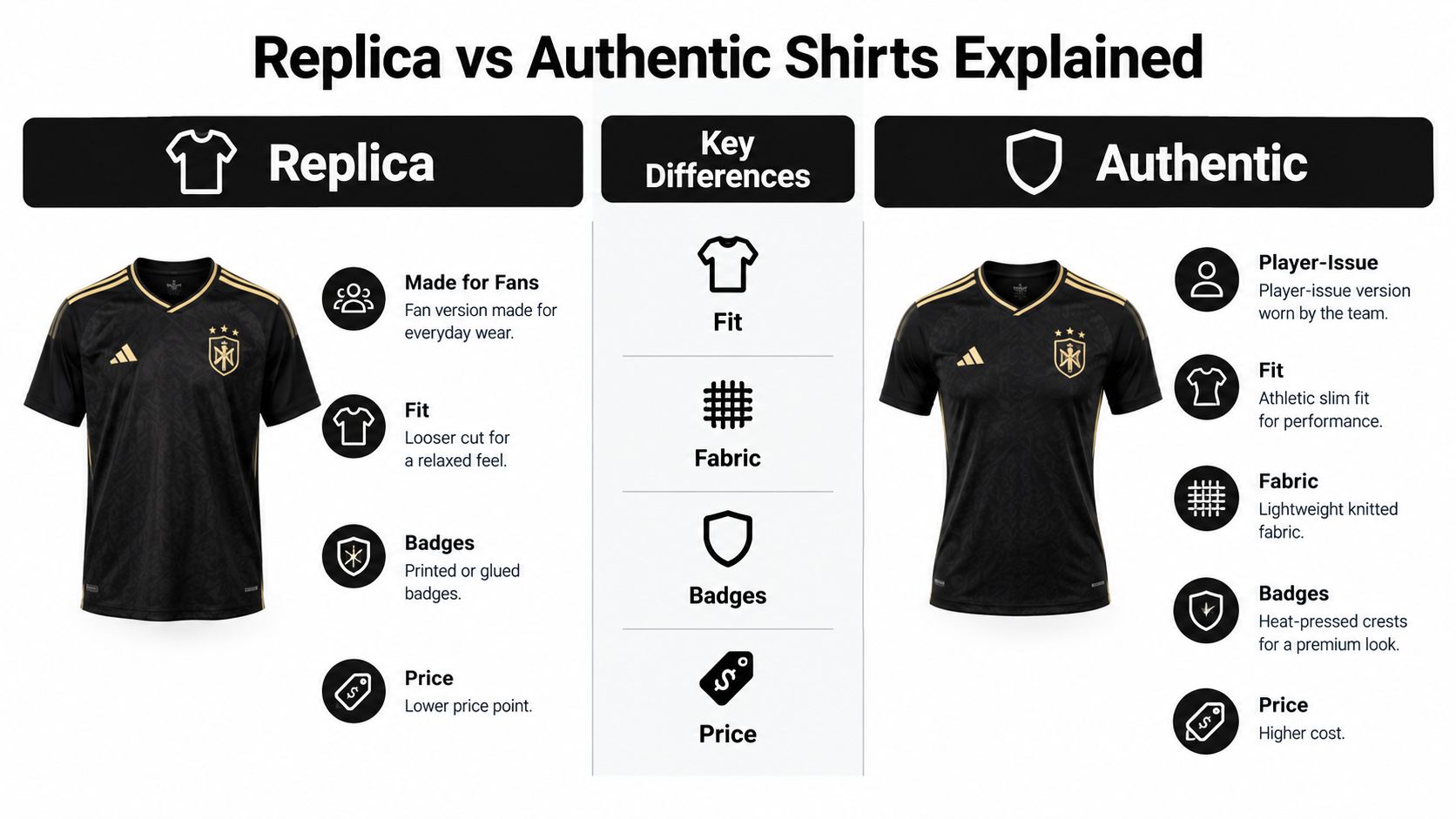
| Feature | Stadium Replica | Elite Authentic |
|---|---|---|
| Intended use | Match days, casual wear, and regular supporter use | Elite training, match play, and collector display |
| Fit | More relaxed and forgiving | Slim, athletic, and closely shaped |
| Fabric | Usually slightly heavier and more durable | Lightweight, highly technical, and performance-focused |
| Badge and detailing | Often embroidered, printed, or bonded depending on the product | Commonly heat-applied or engineered to reduce weight |
| Comfort away from sport | Better suited to layering and everyday movement | Can feel restrictive outside athletic use |
| Durability | Generally more practical for frequent wear | Requires more careful handling |
| Price position | Lower than the authentic tier | Higher because of specialist construction |
| Best buyer | Supporter who wants to wear the shirt often | Collector, player-fit enthusiast, or technical apparel buyer |
What you're really buying
The authentic shirt's slim shape can reduce loose fabric during movement. Its lightweight panels and bonded details may replicate what players wear, but those same choices can make the garment less forgiving across the shoulders, chest, or stomach. It often looks sharp in a product photograph and less relaxed when worn with jeans or over a base layer.
The replica makes a different compromise. Its looser cut accommodates everyday bodies, while its heavier construction tends to tolerate repeated use better. You may lose some of the extreme technical refinement, but you gain a shirt that works at a match, in a pub, or under a jacket.
A production detail can also explain why badges feel different from one shirt to another. Supporters interested in decorated polyester garments can learn more about applying DTF to polyester uniforms, which provides useful context for how heat-applied graphics interact with synthetic fabrics. That knowledge helps you judge a shirt's finish without assuming that every non-embroidered detail is inferior.
Match the tier to the use
Choose the authentic version when the player-spec construction itself is the reason for the purchase. It can be a worthwhile object for a serious collection, a design study, or someone who specifically wants the closest available version to the on-pitch garment.
Choose the replica when you plan to wear the shirt repeatedly. It's normally the safer choice for gifts, travel, crowded stadiums, outdoor viewing, and supporters who want a comfortable fit without treating every outing as a preservation exercise.
For another perspective on ownership, resale, and the question of whether a shirt should be treated as apparel or an asset, see this guide to branded football jerseys. The useful question isn't whether one tier is universally superior. It's whether the shirt's construction matches your reason for buying it.
Material and Fit Differences That Matter
The difference becomes obvious as soon as you handle both versions. An authentic shirt often feels almost weightless, with a close cut that follows the body and technical panels that can feel more like specialist training equipment than a normal T-shirt. A replica usually has more substance in the hand and more room through the torso.
A comparison of modern shirt construction places replica material around 150-165 g/m², while player versions sit around 110-130 g/m², according to this comparison of player-version and replica soccer jerseys. Those figures aren't a universal specification for every club or season, but they explain the tactile trade-off. The lighter shirt can improve moisture transfer and reduce air resistance, while the heavier shirt can feel more durable and comfortable for ordinary wear.
Lightweight doesn't mean more comfortable
On a hot pitch, low weight and close tailoring have obvious advantages. Away from the pitch, the same properties can expose weaknesses. An authentic shirt may cling to the body, reveal every layer beneath it, and leave little room for movement when you're sitting, eating, or wearing a hoodie.
The replica's relaxed shape works better for the way most supporters use football shirts. It allows airflow without demanding a professional athlete's physique, and it layers more naturally over a vest or under a coat. That makes it a better everyday garment even when its fabric is technically less extreme.
The shirt that performs best for a professional may not be the shirt that feels best for a supporter spending four hours in the stands.
Fabric composition matters too. Modern replicas are typically made from 100% polyester or recycled polyester, while major brands increasingly treat sweat-wicking and breathability as standard features rather than premium extras. Nike describes its Stadium replica shirts as 100% recycled polyester, with Dri-FIT sweat management and ventilated mesh panels designed to move sweat away from the skin and support quicker evaporation, as explained in its England Stadium replica kit product details.
Read the size chart, not the label alone
Sizing is where many buyers lose the practical benefit of a replica. A relaxed fan cut can still vary between men's, women's, and youth patterns, while an authentic cut may require sizing up for anyone who dislikes close clothing.
Before ordering, compare the garment measurements with a shirt you already own. Check chest width, body length, and sleeve length rather than relying on a familiar letter. If you plan to wear a layer underneath, allow for it. If you're buying for a child, account for growth without choosing a size so large that the shoulders and sleeves become awkward.
Supporters exploring unusual designs, custom patterns, or all-over graphics can also look at all-over print football jerseys from FLYP LTD to understand how decoration and fabric choice affect the final feel. Style attracts the eye, but cut determines whether the shirt becomes part of your regular rotation.
For a broader explanation of polyester, recycled fibres, and the materials used in football shirts, this guide covers what material soccer jerseys are made of. The main buying rule is simple. Choose the fabric and fit you'll enjoy wearing, not the specification that sounds most impressive.
Spotting Fakes and Ensuring Authenticity
Counterfeit football shirts have become difficult to identify from a product photograph alone. Some copies reproduce colours, sponsor marks, and overall silhouettes convincingly, while poor sizing can create a problem even when a buyer thinks they're receiving an official product. Recent coverage also highlights that counterfeit shirts can differ materially in sizing from official versions, making authenticity and fit connected concerns rather than separate checks. The issue is discussed in this guide to fake football kits and consumer buying risks.
A practical inspection sequence
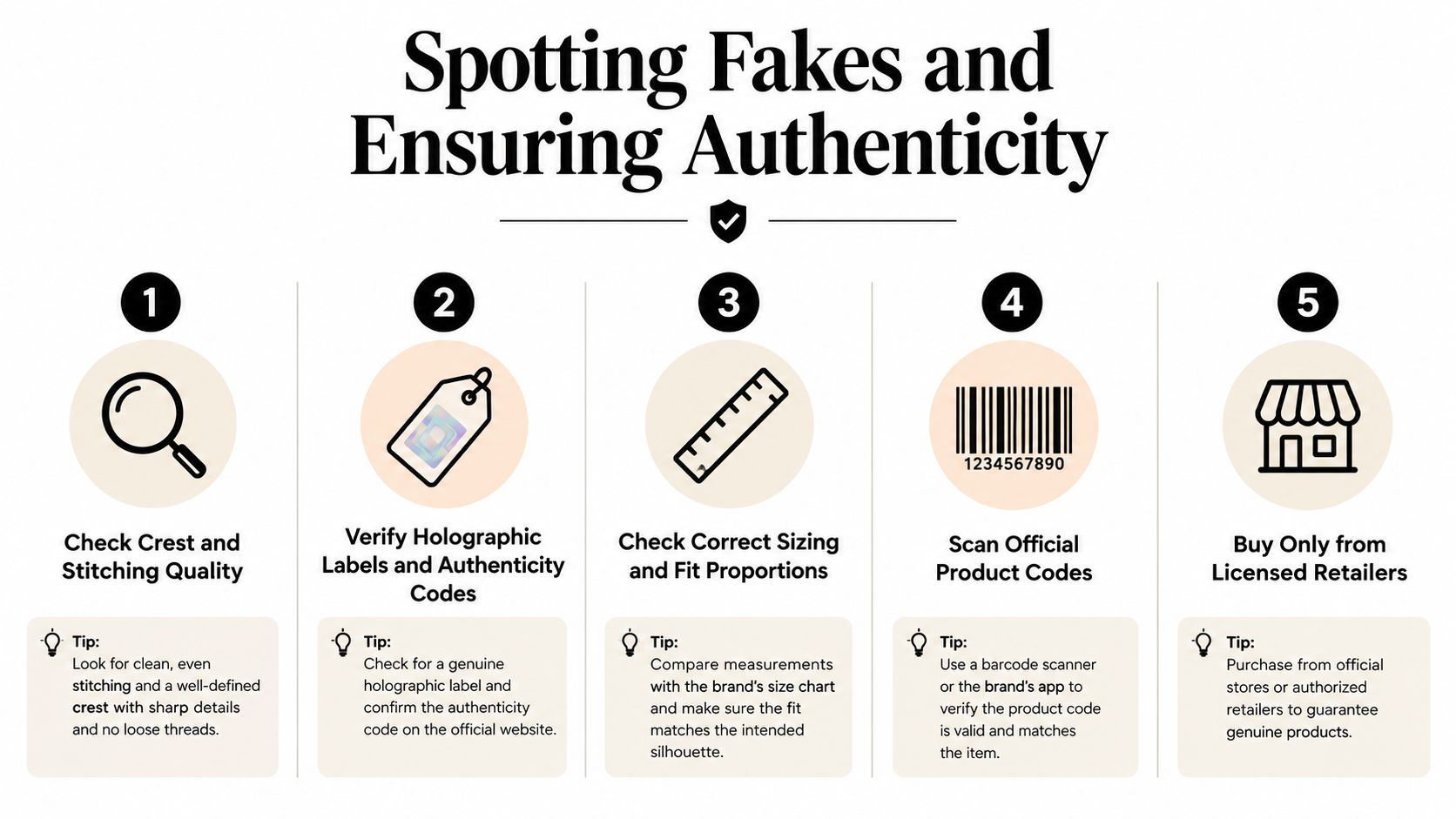
- Start with the seller. Look for a clear business identity, consistent product photography, return terms, and a believable explanation of where stock comes from. A seller who avoids basic questions about provenance should make you cautious.
- Examine the crest and stitching. Check whether the badge sits straight, whether the edges are clean, and whether the stitching or bonding matches the finish expected from the stated product tier. Loose threads, uneven lettering, and distorted shapes are warning signs, although a single minor flaw doesn't prove a shirt is fake.
- Inspect internal labels. Wash tags, product codes, country-of-origin information, and sizing details should be consistent with the brand and season. Compare them with reliable photographs of the same release, but remember that counterfeiters can copy visible labels.
- Compare proportions. Measure the shirt against the seller's stated size chart. A suspiciously narrow body, unusually short length, or inconsistent sleeve shape can reveal a copy before you pay.
- Treat price as one clue, not a verdict. A low price may reflect clearance, second-hand condition, or an older release. A high price may just be a seller's markup. Authenticity depends on several matching signals, not the number on the listing.
Buying rule: Provenance, physical construction, and accurate measurements are stronger evidence than price alone.
A product code can help, but it shouldn't be treated as a magic pass. Counterfeiters may reproduce codes, and database results can be incomplete. Use codes alongside the crest, labels, fabric, seller history, and return protection.
For a more detailed checklist before purchasing, consult this guide on how to check if your football shirt is authentic.
When buying a gift, ask for exact measurements and clear close-up photographs before ordering. A genuine shirt that doesn't fit is still a poor purchase, and a convincing copy can create an expensive problem when the buyer has no meaningful return route.
The Sustainability Reality of Modern Kits
The newest shirt is often presented as a celebration of the season, but the release cycle can encourage supporters to treat football clothing like fast fashion. Clubs may release three or more replica shirt designs per season, and independent reporting places the shelf life of some shirts at around 10 months. The same reporting estimates that up to 60% of professional kits are destroyed at the end of the season, rather than finding a second life through resale or reuse. These figures are discussed in The Interline's reporting on football and circular fashion.
That makes the most sustainable shirt an uncomfortable answer. It may be the one already in your wardrobe. Wearing an existing replica for another season avoids the material, manufacturing, packaging, and shipping demands attached to replacing it because a new design has arrived.
Recycled polyester needs a closer look
Recycled polyester sounds like a complete solution, but the material stream matters. Around 98-99% of recycled polyester used in clothing still comes from plastic bottles rather than old garments, while only about 1% of post-consumer textiles are recycled into new clothing, according to the same Interline report. Bottle-based recycling can reduce reliance on new polyester feedstock, but it doesn't create a closed loop for worn-out football shirts.
That distinction changes how a collector should read sustainability claims. A recycled-fibre shirt may be preferable to one made entirely from new material, but the label doesn't automatically mean the garment can become another shirt after use. Nor does it address overproduction, short ownership periods, or the fate of unsold stock.
Better decisions for supporters
A practical approach has three parts:
- Buy for use. Select a shirt you'll wear repeatedly rather than collecting every colourway by default.
- Extend its life. Wash carefully, repair small faults, and pass it on when it no longer suits you.
- Use existing markets. Vintage replicas, second-hand shirts, and older fan versions can preserve club history without depending on the newest release.
Textile-to-textile recycling is a more convincing long-term direction. PUMA says it's scaling replica shirts made with at least 75% recycled textile waste, a development reported by The Interline. Until that approach becomes more widespread, restraint remains more reliable than a green label.
Smart Buying Strategies for Collectors
A good buying strategy starts by separating the shirt you want to own from the shirt you want to wear. The first may be a rare authentic, a historic design, or a piece with player connection. The second should fit comfortably, survive normal use, and remain affordable enough that you won't hesitate to take it to a match.
Retail is the obvious route, but it isn't the only one. Official club stores offer clarity around provenance, though the newest releases can carry a premium and sell through quickly. Licensed retailers, reputable vintage dealers, second-hand marketplaces, and mystery football shirt boxes each suit different priorities.
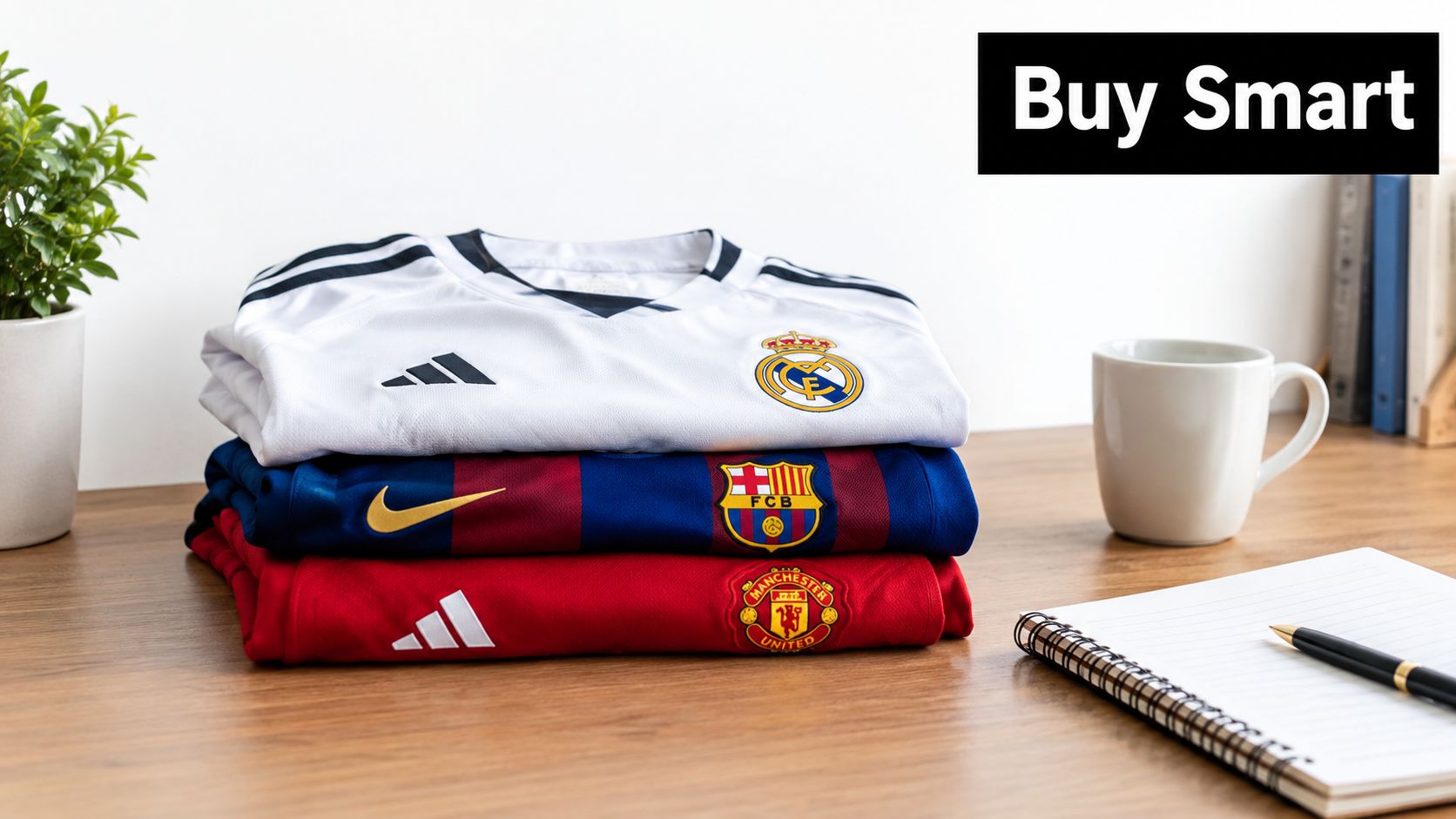
Pick the buying route that fits the goal
For a specific club or player: Buy through an official shop or established specialist retailer. You'll have the greatest control over design, season, size, and personalisation.
For a vintage collection: Prioritise provenance and condition. Ask whether the shirt has been altered, repaired, or reproduced, and inspect sponsor and name-set details closely.
For a gift: A mystery box can add surprise while avoiding the problem of choosing a club the recipient already owns. Confirm the available size range, preferences, exclusions, return policy, and whether shirts are stated to be authentic before ordering.
For a group: Sharing boxes can make sense for friends, teammates, or family members who enjoy different clubs and colours. The key is agreeing on sizes and exclusions in advance.
A mystery box isn't the right tool when you need a precise shirt. It is better suited to the collector who values discovery and accepts that the final club or design won't be fully known before delivery. That trade-off can turn a routine purchase into an unboxing experience, but buyer protections still matter.
Avoid the common value traps
Don't pay authentic-shirt money for a garment you'll use as ordinary casual wear unless the player specification is important to you. Don't assume a rare-looking shirt is valuable because the seller describes it as collectible. Condition, authenticity, demand, design, and provenance all influence long-term appeal.
For children, growth and activity should shape the decision. A durable replica with room for movement is usually more useful than a delicate fitted shirt that becomes uncomfortable after a short period. For adults, measure a preferred shirt and compare it with the listing rather than buying the same nominal size you wear in another brand.
The practical target for most supporters is a genuine fan-version shirt with a comfortable fit and a realistic plan for repeated wear. That combination offers more daily value than a technically advanced shirt left in a wardrobe because it feels too fragile or restrictive.
Washing and Caring for Your Collection
A single careless wash can shorten a football shirt's useful life. Heat, harsh detergent, direct sunlight, and rough drying may damage printed numbers, sponsor marks, bonded crests, and colour, particularly on lightweight technical fabrics.
Start with the care label and choose the gentlest routine it allows. Manufacturers use different materials and finishes, so the garment's own instructions should guide your decisions. Avoid unnecessary heat, even when the shirt appears durable.
A low-risk washing routine
- Turn the shirt inside out. This limits friction against names, numbers, sponsors, and surface graphics.
- Use a cool, gentle wash. Cold water or a setting at 30 degrees maximum is safer for prints and colour.
- Choose mild detergent. Avoid bleach, strong stain removers, and fabric softener unless the label specifically permits them.
- Skip the tumble dryer. Air-dry the shirt away from direct sunlight, which can fade colour and stress applied decoration.
- Never iron prints directly. If ironing is allowed, turn the shirt inside out and keep heat away from logos, numbers, and badges.
- Store it folded. Folding prevents the shoulder stretch that can develop when a polyester shirt hangs for long periods.
Treat authentic shirts more cautiously
Authentic shirts need closer attention because their lightweight fabrics, bonded details, and close-cut construction are less forgiving. Do not scrub printed areas, twist the shirt aggressively, or pull at a loose edge. If a sponsor or number starts lifting, stop applying heat. A specialist garment repair service is safer than household glue, which can stain fabric and make later repairs harder.
Replicas are generally easier to wear and maintain, but they still benefit from careful handling. Wash a shirt after heavy use, remove it from a kit bag while damp, and let it dry fully before storage. Keep signed pieces separate from shirts used regularly, since repeated washing and handling can reduce their condition and long-term appeal.
A practical collection should remain wearable. Clean, dry, folded shirts protected from unnecessary heat can stay in regular rotation for years. That makes a durable replica a sensible everyday choice, while an authentic shirt may be better reserved for careful wear or display.
If you want to add genuine football shirts without choosing every club in advance, Mystershirt offers mystery boxes containing authentic shirts across premium, retro, kids, and bundle options. Choose your size and preferences, then use the experience to build a collection you will actually wear rather than leaving another delicate shirt in the wardrobe.