There's no international standard that tells you how big a shirt gift box should be. ISO 8559-1:2017 defines how to measure a human body, and ISO 8559-3:2018 defines how to build body-measurement tables and intervals, but neither prescribes a physical box dimension, as the documented history of clothing sizes shows. Shirt sizing is an industrial artefact. Mass-produced military uniforms created the small, medium, large and extra-large categories, and ready-to-wear clothing built on chest measurements had spread through European and North American cities by the late 1800s.
That history explains the awkward position a gift box occupies. The garment inside carries a label, but the label doesn't describe the folded object. A heavyweight retro shirt in size small can fold thicker than a summer jersey in size large, and the box has to hold the folded object, not the label.
The useful question isn't "what size is a shirt box". It's "what does my shirt measure once it's folded, and what does the recipient need if it doesn't fit". The reference values below come from published packaging sources that rarely agree with each other, and everything that follows treats the box as a gift that may travel back, not only as a container that goes out.
Table of Contents
- Shirt Gift Box Size Chart at a Glance
- How to Measure a Shirt for the Right Box
- Common Sizing Mistakes and Their Fixes
- Matching Box Size to Kids, Adult and 5XL Shirts
- Choosing a Box Size for Gifts and Exchanges
- Presentation Boxes Versus Shipping Cartons
- Packing and Labeling Each Shirt Size
- Confirm Your Box Size and Order the Right Shirt
Shirt Gift Box Size Chart at a Glance
Published references for a shirt gift box size disagree by more than an inch in every direction, and that disagreement is the most useful thing on this page. One supplier specs a slim interior of 9.75 × 7.75 × 1.75 in for a single folded T-shirt (Packwire's box size optimizer). Another puts the same garment at 10–11.5 × 7–8.5 × 1.25–1.6 in (Easybox Packaging's apparel box guide). A third calls 8 × 6 × 3 in a common single-shirt box (UPrinting's mailer box sizes), while a fourth quotes a presentation range of 11 × 9 × 2 to 13 × 10 × 3 in (Gentlever's gift box dimensions). Every one of those numbers was measured against a different shirt, folded a different way, with a different amount of tissue inside.
Set them side by side and the pattern is clear. The tight rows are for thin cotton folded flat. The generous rows are for a gift that has to look considered when the lid comes off.
| Source benchmark | Internal size (in) | Internal size (mm) | Best fit |
|---|---|---|---|
| Single folded T-shirt starting fit | 10 × 13 | 254 × 330 | Folded football shirt, starting point |
| Packwire single T-shirt | 9.75 × 7.75 × 1.75 | 248 × 197 × 44 | Slim single shirt |
| Easybox apparel range | 10–11.5 × 7–8.5 × 1.25–1.6 | 254–292 × 178–216 × 32–41 | Folded tee or thin top |
| UPrinting common single | 8 × 6 × 3 | 203 × 152 × 76 | Small or thin shirt, tight fit |
| Gentlever gift range | 11 × 9 × 2 to 13 × 10 × 3 | 279 × 229 × 51 to 330 × 254 × 76 | Presentation gift with tissue |
| Colour Creative unisex standard | 9.8 × 7.9 × 2.0 | 250 × 200 × 50 | Standard adult shirt |
| Colour Creative plus-size | 11.8 × 8.7 × 2.4 | 300 × 220 × 60 | Larger sizes and heavy retro shirts |
| Multi-shirt sharing benchmark | 14 × 12 × 5 | 356 × 305 × 127 | Two or more folded shirts |
Colour Creative Packaging is the only source here that splits its own catalogue by garment size, listing a standard unisex T-shirt box at 250 × 200 × 50 mm and a plus-size T-shirt box at 300 × 220 × 60 mm (Colour Creative apparel boxes). That split is the most honest row in the table, because it admits the obvious: one set of numbers can't serve a child's jersey and a 5XL shirt.
How to Read the Table
Work in the unit your supplier quotes. Retail listings speak inches, factories speak millimetres, and the conversion is 25.4 mm to the inch. A box quoted as 10 × 13 in is 254 × 330 mm, and a box quoted as 250 × 200 × 50 mm is roughly 9.8 × 7.9 × 2 in. Mixing the two is how buyers end up ordering a box that's a full centimetre short in one direction.
Then read the depth column before anything else. Width and length failures are obvious on the first fold. Depth failures show up later, as a lid that bows over a badge or a sponsor print that arrives creased.
Every row is a starting point, not a guaranteed fit. Fabric weight, folding method, an embroidered crest, a folded collar and a card all change the required internal volume.
Fit expectations move with the garment as well. A polo cut for shoulder movement folds to a different shape than a trim football shirt, and this explanation of how bold golf polos should fit is a reminder that cut and drape decide the footprint before the box is even chosen.
The rule the table implies is simple. Choose the row that fits the largest shirt in the order, not the smallest. A box that swallows a small shirt looks untidy; a box that pinches a large one damages the gift.
How to Measure a Shirt for the Right Box
Measure the parcel, not the person. Body measurements tell you which shirt to buy. Folded dimensions tell you which box to buy, and they're the numbers almost nobody writes down. Apparel-packaging guidance puts a folded T-shirt or lightweight top at a starting internal footprint of roughly 10 × 13 in (254 × 330 mm), and treats that as a fit point rather than a ceiling (Vistaprint's clothing packaging guide).
The sequence below is the one to follow before committing to a print run. It takes about fifteen minutes with one shirt and a ruler.
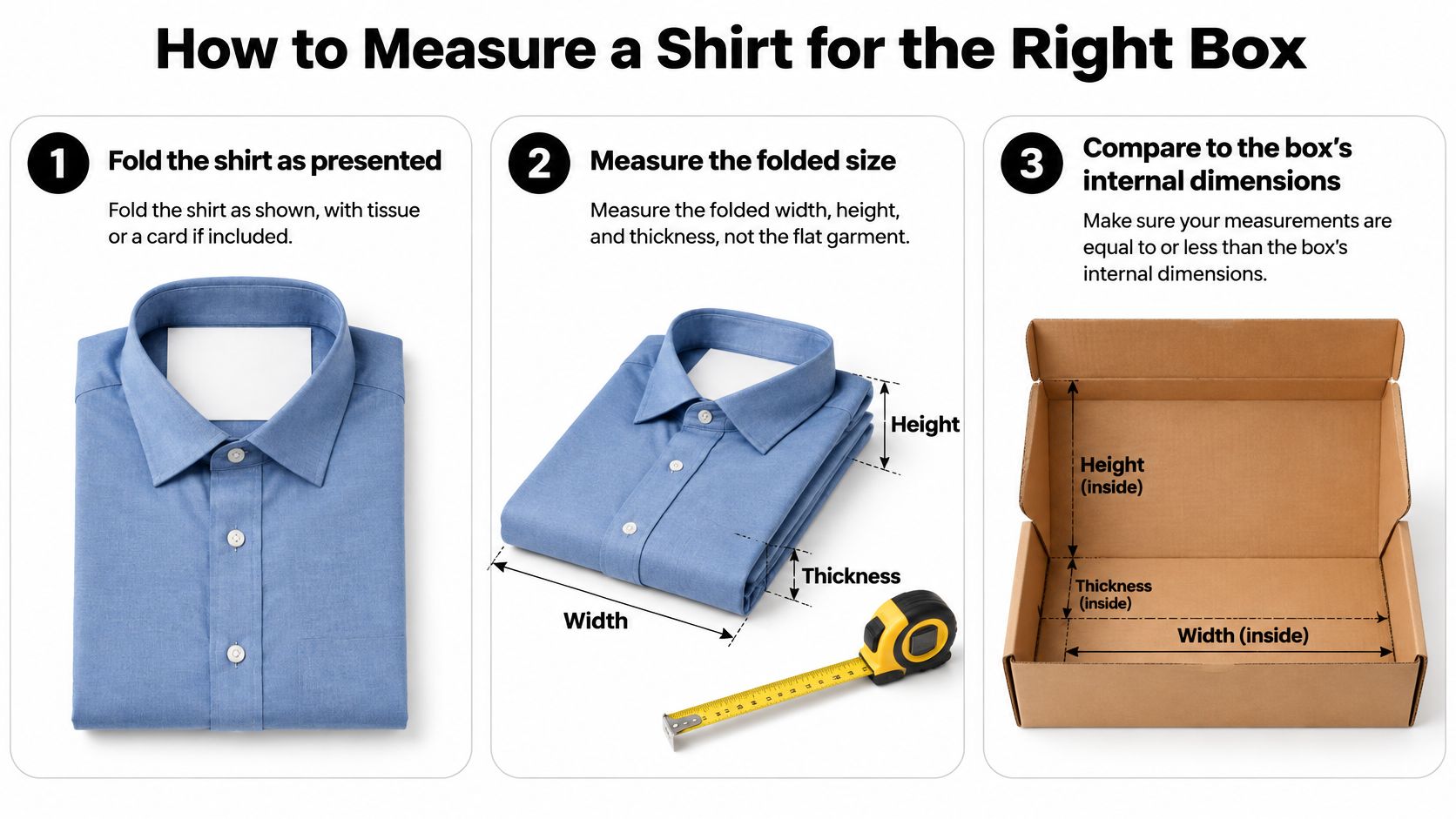
- Fold the shirt the way it will ship. Include the tissue, the card and any insert that goes inside, because each layer adds thickness at the fold. A shirt measured flat and then boxed with two sheets of tissue and a card is a shirt measured wrong.
- Measure folded width, height and thickness. Square the edges on a table and take three numbers with a rigid rule rather than a soft tape. Thickness is the step people skip, and it's the one that decides whether the lid closes.
- Repeat with the largest and thickest shirt in the order. Long-sleeve shirts and heavyweight retro jerseys fold out bigger than short-sleeve cotton. Confirm the size you're packaging against an authentic football jersey size chart first, then measure the actual garment rather than trusting the collar.
- Add 10–20 mm of clearance on each planar side. The same packaging guidance calls for roughly 10–20 mm per side to clear seams, tissue and manufacturing tolerance, plus enough vertical space to keep badges, sponsor prints and tags uncompressed.
- Match the result to the chart and take the first row that fits. Not the closest row. If the folded thickness is 55 mm, the 50 mm row is out, whatever the label says.
- Confirm the supplier's internal dimensions. External dimensions include the board and the lid, so an 11 in outside box can easily give you 10 in of usable space. Fold a sample into a stock box before you buy a full run.
Testing across sizes matters more than any single measurement. If a box has to cover children's sizes through 5XL, no single format does it well: apparel-packaging guidance recommends testing the smallest, thickest and largest target shirts, and notes that two or three box formats generally give better presentation and lower dimensional-shipping cost than one.
The Two-Minute Fit Check
The two-minute check: the shirt slides in with a finger's width of room on each side, the lid closes without pressure, and nothing shifts when you turn the closed box over.
Run that check with the thickest shirt you sell. If it passes there, it passes everywhere else in the range.
Common Sizing Mistakes and Their Fixes
The costliest mistake is also the first one many first-time buyers make. They measure the shirt flat on a table, order a box to match, then discover the folded shirt with a card and two sheets of tissue is 15 mm thicker than the number they wrote down. The lid bows, the crease sets in, and the gift looks handled before it's opened.
The rest of the errors follow the same shape. Each one is a small shortcut that only shows up after the boxes are printed.
| Mistake | What it causes | Fix |
|---|---|---|
| Measuring the shirt flat | Box too tight once folded | Measure the folded shirt as it will be presented |
| Using external box dimensions | Shirt pinched at the lid | Use the supplier's internal dimensions |
| One box for kids and 5XL | Void space or creasing | Use two or three tiers by size band |
| Ignoring thick retro or long-sleeve styles | Crushed badges and prints | Add vertical clearance and test the thickest shirt |
| No room for a return card | Recipient cannot exchange | Leave 10–20 mm extra clearance for a card |
| Mislabelling size from memory | Wrong shirt sent or exchanged | Copy the size from the shirt label |
| Shipping a presentation box as a parcel | Transit crushing and higher carrier charges | Run drop and compression tests before production |
Notice how many of these are measurement failures and how many are communication failures. Two of the seven, the missing return card and the mislabelled size, have nothing to do with millimetres at all. They're the errors that turn a gift into a customer service ticket.
Every fix in that table can be validated in an afternoon. Fold your largest shirt with a card and tissue, drop it into the candidate box, close the lid and shake it gently. If the shirt moves or the lid bulges, the row is wrong, not the shirt.
Matching Box Size to Kids, Adult and 5XL Shirts
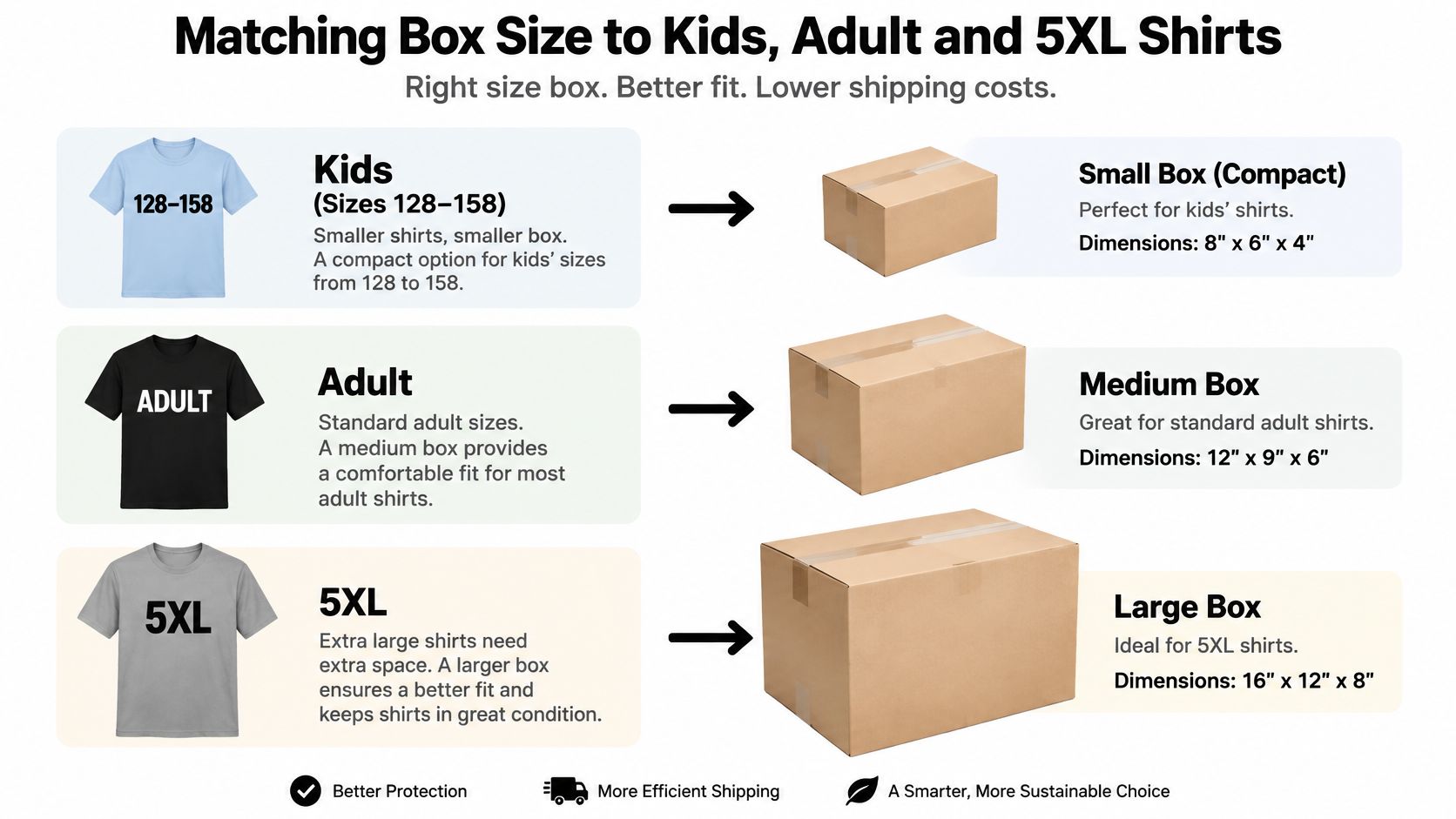
A single box fails at both ends of the size range, for opposite reasons. In a child's size the shirt slides around in the void and arrives creased against the lid. In a 5XL it compresses against the walls and the fold lines set permanently. Apparel-packaging sources make the same point from the retail side: the largest shirt in an order should set the box size, and internal recommendations belong by shirt category rather than by S, M or L (Vorex Packaging on shirt box sizes).
The tiering below works from the reference chart in the first section, applied by size band instead of product name.
| Size band | Shirt sizes | Box tier | Watch for |
|---|---|---|---|
| Kids | 128–158 | Single compact box from the smallest reference row | Void space; add tissue to stop movement |
| Adult standard | XS to XL | Unisex standard, 250 × 200 × 50 mm | Long-sleeve or heavy retro may need the next tier |
| Adult plus-size | 2XL to 5XL | Plus-size box, 300 × 220 × 60 mm | Check depth for thick fabric and badges |
| Mixed order | Kids and adult | Separate box for each size band | Never share one box across bands |
| Sharing order | Two or more shirts | Multi-shirt benchmark, 356 × 305 × 127 mm | Validate with real folded samples |
Children's sizing needs its own note. Kids' shirts in sizes 128 to 158 are usually described by height, so the number on the shirt means less to a parent than the age range it corresponds to. Pack those in the small end of the chart and write both numbers on the box.
Mixed Orders and Sharing Boxes
When one order contains a child's shirt and an adult's, the box tier is decided per parcel, not per order. Put the kids' shirts together and the adults' shirts together. The largest shirt inside each box sets that box's tier.
Sharing boxes are a different problem. A multi-shirt box at roughly 14 × 12 × 5 in (356 × 305 × 127 mm) is a benchmark only, because separately folded layers of heavy fabric stack higher than three thin cotton shirts. Fold a real sample of the actual shirts before you seal it.
When in doubt, test the thickest shirt in the order against the chosen box before the tape goes on.
Choosing a Box Size for Gifts and Exchanges
A box can hold the shirt perfectly and still fail as a gift. Online apparel returns are driven by fit, and the numbers are blunt: a 2025 estimate cited by Texfash puts U.S. online apparel returns at 23.4%, with European clothing returns reported around 20% and poor fit or style accounting for 70% of those European returns. Fit risk is the dominant variable in whether a gifted shirt ends up worn.
That changes the specification. If there's a meaningful chance the shirt gets exchanged, the packaging has to survive being opened, inspected, refolded and sent back.
The Three Questions a Size Chart Never Answers
Should the box include a removable size and return card? Yes, and it should be separate from the shirt so it can be removed without unfolding anything. A card that names the size, the exchange window and the return steps turns a surprise gift into something the recipient can act on.
How much headroom does tissue and a care note need? More than a folded shirt alone. Packaging guidance adds clearance for tissue, inserts and handling rather than matching the folded garment exactly, and 10–20 mm of extra clearance is enough to fit a card and a folded note without compressing the fabric.
Can the original packaging be reused for an exchange? Only if the seal comes apart without tearing the board. Heavy tape across a printed lid ends that possibility on the first opening, and the recipient is left hunting for a mailer.
These questions matter most in three situations: parents buying for children, international gift buyers shipping to an address they can't inspect, and any surprise purchase where the buyer can't verify the recipient's measurements beforehand. In all three, exchange flexibility beats a tight, attractive box.
If the shirt is a gift for someone whose taste you're guessing at anyway, the wider question of jersey gift ideas is worth settling before the packaging: which club, which era, which size. Getting those right removes most of the fit risk before the box is sealed.
Gifting rule: fit the box to the shirt, then leave room for the exchange.
Presentation Boxes Versus Shipping Cartons
A shirt gift box has two jobs pulling in opposite directions. It has to look considered when the lid lifts off, and it has to survive a sorting belt. Packaging standards treat those as different problems, and a box designed only for the first one usually fails the second.
ISTA 3A classifies a package as a small parcel when its volume is below 13,000 cm³ (800 in³), its longest dimension is no more than 350 mm (14 in) and its weight is no more than 4.5 kg (10 lb) (ISTA 3A overview). A box around 330 × 254 × 50 mm (13 × 10 × 2 in) has an outside volume of about 4,191 cm³, comfortably inside that threshold while still holding a folded shirt and a thin protective wrap. Staying small keeps you out of oversize handling and out of the worst of dimensional-weight pricing.
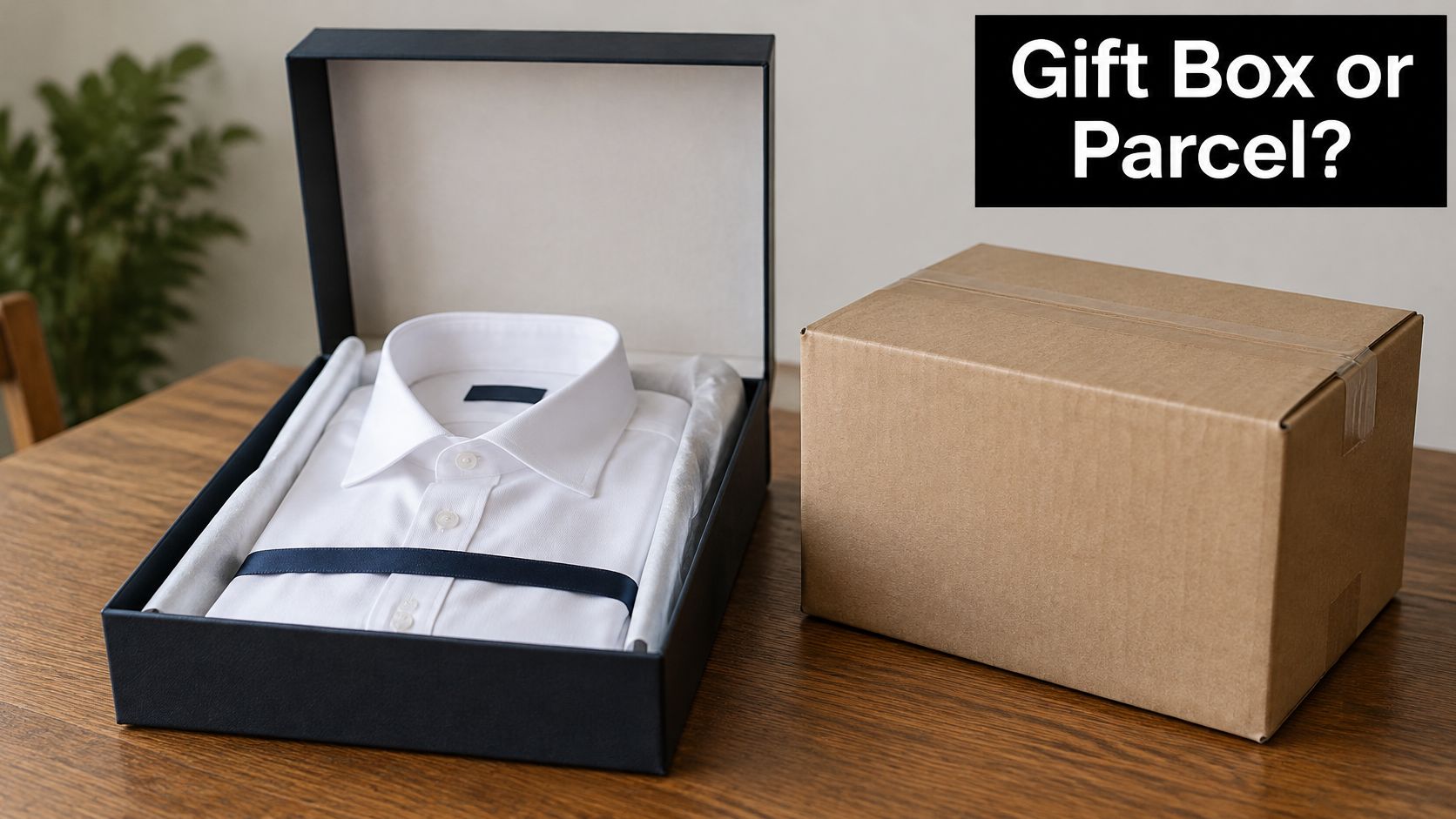
Fill matters as much as size. The USPS mailer standards classify clothing and other textiles as soft goods and state that packages of soft goods weighing up to 5 pounds should be filled to capacity (USPS mailing standards). The same document scales required board strength for heavier parcels, with a minimum 70-pound outer-ply basis weight for packages of 5–20 pounds and at least 275-pound-test board for 45–70 pounds. A single folded shirt sits far below those weights, so the strength thresholds don't apply to it. The capacity rule does. Tissue or a fitted insert stops the shirt moving, and movement is what creases fabric.
Presentation work is where the design budget belongs when the box is the gift itself. Printed outers with fitted inners carry the emotional weight, which is why personalised bridesmaid proposal boxes lean on exactly that split between what protects and what presents.
What to Record Before a Production Run
Validate the fully packed box, including void fill, labels and any gift insert, against the carrier's dimensional-weight rules. Then run drop, compression and vibration testing appropriate to the network the parcel travels through.
For any order crossing a border, gross packed weight and outside dimensions decide the cost before the shirt does, so it's worth reading an international shipping guide before locking a format.
The specification sheet should carry six numbers and two decisions: internal dimensions, external dimensions, packed mass, board grade, closure method, maximum garment thickness, plus who folds and who seals. For multi-shirt or international orders, a plain corrugated outer carton with a separate presentation sleeve usually beats a rigid gift box sent bare.
Packing and Labeling Each Shirt Size
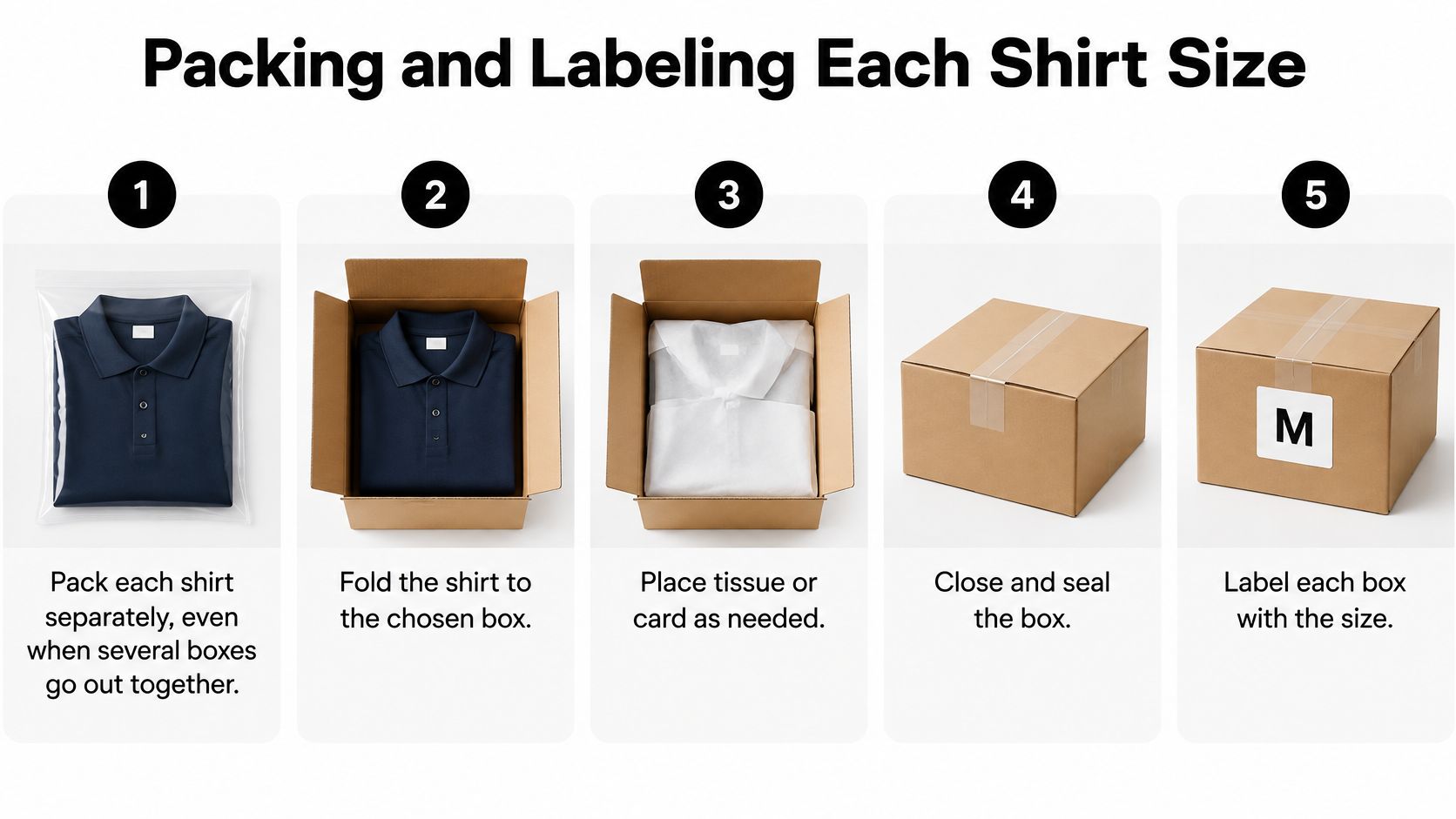
Packing order matters more than packing speed. A shirt folded to the right box, cushioned so it can't shift and labelled inside and outside arrives in the condition it was packed, and one wrong step in that sequence shows up as a crease or a complaint.
Work through it in this order. Choose the box tier from the size band, fold the shirt to that box rather than to a generic rectangle, then add tissue at the edges where the fold meets board. Place the card inside the lid so it doesn't press on the fabric, close the box, and seal it with something that opens again.
Label the Outside, Not Just the Card
The label on the outside is the one that survives the card being removed. Write the size exactly as it appears on the shirt, not as you remember it, and add the club or season when the shirt is a surprise. For children's shirts, put the size number and the age range it corresponds to, because sizes 128 to 158 mean height to a manufacturer and very little to a parent.
Sharing boxes need a different approach. Label each inner wrap by recipient name, since the box is opened once and divided immediately, and a misplaced shirt in a five-shirt gift is a problem nobody wants to solve by refolding.
Keep the seal reusable and tape sparingly. A lid that opens without tearing means the same box can carry the shirt back for an exchange.
The printable checklist for every parcel:
- Size confirmed against the shirt label, not from memory
- Shirt folded to the chosen box, with no pressure on the lid
- Tissue placed at the folds so the shirt doesn't shift
- Card inside the lid, separate from the fabric
- Size labelled inside and outside the box
- Exchange note added, with the window and a reminder to keep the packaging
For the postal side of the job, this walkthrough of packing and measuring your parcel covers weight, dimensions and labelling conventions that carriers expect to see.
Confirm Your Box Size and Order the Right Shirt
Pick the box tier from the largest shirt in the order, then test a folded sample before you buy a run. That single decision prevents most of the failures described above, because every other rule follows from it.
Three checks close it out. Confirm the box has room for a return card and a resealable closure, since exchange flexibility is what makes a gifted shirt usable. Check the store's current size range and exchange terms on the product page, because this guide doesn't verify any retailer's policies. And pack each shirt in its own box even when several ship together, so a size error affects one parcel rather than the whole order.
Mystershirt covers sizes from children's sizing up to 5XL senior sizes, packages every shirt separately even in multi-box orders, and offers a free exchange within 14 days of delivery on Premium Mystery Box subscriptions if the size is wrong or the wrong shirt arrives, subject to stock availability. That combination is what a size chart can't give you: a box that fits, and a route back if it doesn't.
Match the box to the largest shirt in your order, leave room for a card and tissue, and keep the seal reusable so the gift can be exchanged without a fight. Mystershirt puts an authentic football shirt in every Mystery Box, from kids' sizes up to 5XL, packs each one separately so a single size error stays a single parcel, and backs Premium boxes with a 14-day free exchange window. Visit Mystershirt to choose a box, pick your size and tell us which clubs or colours to avoid.