You're scrolling between two football shirts that look almost identical. One costs $35, the other $120. The cheaper listing says “replica,” the expensive one says “authentic,” and a third seller offers what looks like the same shirt for even less. The labels alone don't tell you what you're buying.
There are three categories to keep straight: the officially licensed replica, made for supporters; the officially licensed player-issue authentic, built for match performance; and the counterfeit, an unauthorized imitation of either. The right choice depends on how you'll wear the shirt, what you can spend, and whether you can verify the seller and product. Fabric matters, but it isn't the whole decision.
Table of Contents
- The Real Choice Behind Replica vs Authentic
- What Counts as a Replica, an Authentic, and a Counterfeit
- How Replica and Authentic Differ in Build and Fit
- Price, Resale Value, and Total Cost of Ownership
- A Practical Verification Sequence Before You Pay
- Which Category Suits Which Buyer
- The Sustainability Question That Has No Winner Yet
- Decision Checklist and Common Questions
The Real Choice Behind Replica vs Authentic
A licensed replica isn't a fake. It's an official fan shirt, usually cut for everyday wear. An authentic shirt is also official, but it's made to a player-performance specification. A counterfeit is neither of those things, even if its photos, badges, or tags look convincing.
That distinction changes the shopping decision. If you want a shirt for the pub, the stands, or a child who'll outgrow it, a licensed replica may be the sensible buy. If you play in your shirt, collect a particular season's kit, or care about a closer match to what players wear, an authentic version may suit you better. A counterfeit can appear to solve the price problem, but it comes without authorized production or reliable provenance.
The scale of counterfeiting makes the distinction more than a matter of terminology. A study covering five major sports brands identified more than 6,000 retailers selling an estimated 1.2 million counterfeit jerseys and shirts, with estimated revenue exceeding $25 million during the research period. A separate analysis cited by The Athletic estimated the counterfeit football-shirt market at £180 million, or about $233 million, with roughly 16.2 million shirts sold annually (counterfeit merchandise research).
Don't let the price tag decide for you
A low price doesn't prove a shirt is counterfeit, and a high price doesn't prove it's genuine. Decide what the shirt needs to do, then verify that the listing matches the category it claims to sell.
The practical trade-offs are fit, comfort, construction, resale, and authenticity. For casual use, a fan-version replica can make more sense than paying extra for performance details you won't use. For collecting or playing, those details may be worth the premium. For either purchase, the seller and product code deserve more scrutiny than a polished product photo.
What Counts as a Replica, an Authentic, and a Counterfeit
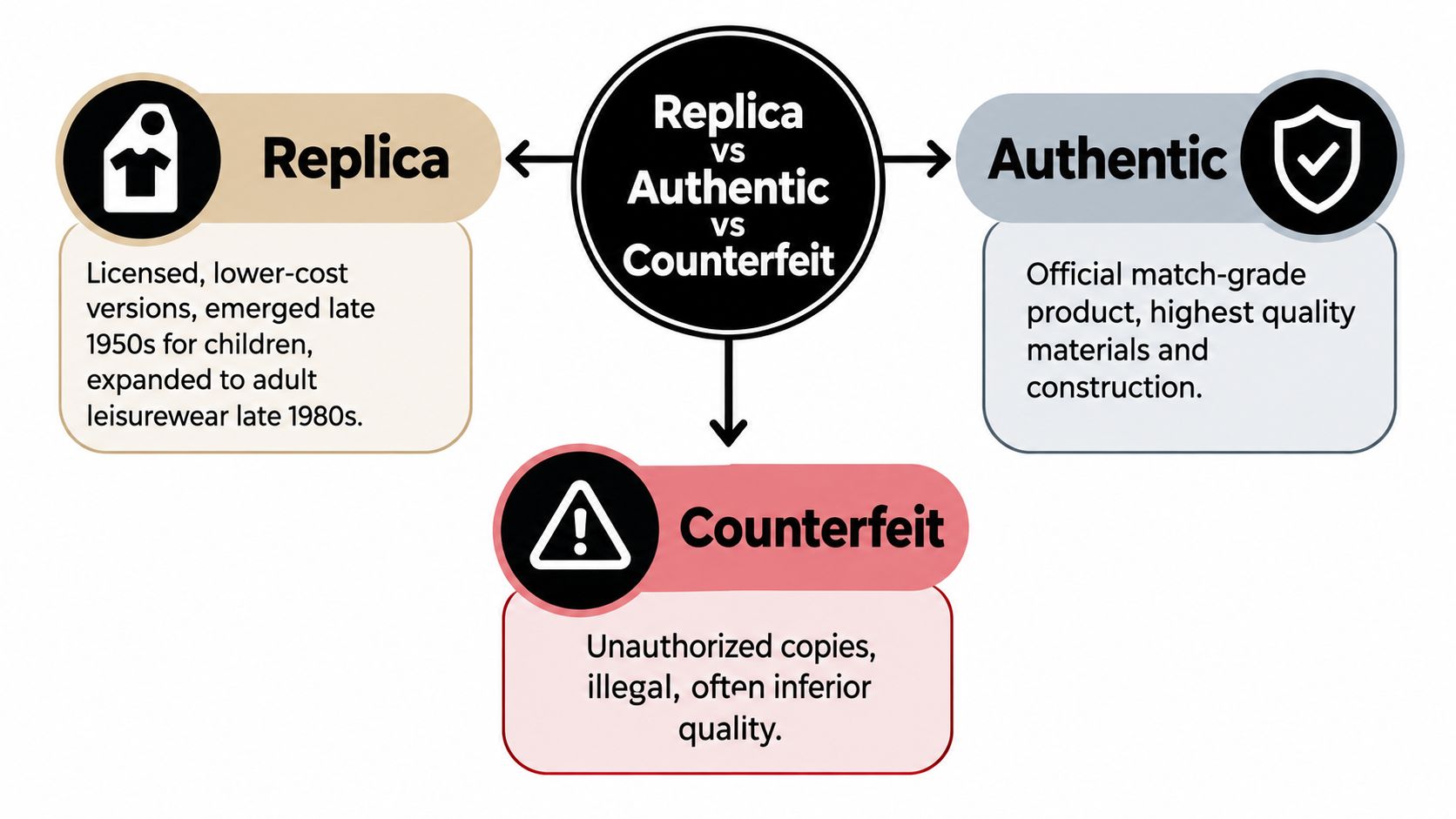
The word “replica” causes confusion because it sounds like a copy. In football merchandising, though, a licensed replica is an official fan product that reproduces a club's design. A counterfeit imitates protected branding without authorization. Those aren't interchangeable labels.
Replica kits began appearing in the late 1950s, initially aimed mainly at children and commonly sold as complete playing strips. The market expanded as manufacturers formed more formal club agreements and promoted copyrighted designs. Between 1975 and 1980, the use of contrasting colored trim on shirts rose by 40%; adult demand developed substantially later, with replica shirts becoming established leisurewear in the late 1980s and early 1990s. A consumer study found that 63% of respondents had owned a child-sized replica and 92% had purchased at least one adult-sized replica (history of replica football shirts).
Three terms, three different buying implications
Licensed replica: An authorized supporter shirt. It's official merchandise, even though it may differ from the player version in fit and construction.
Player-issue authentic: An authorized product designed around match-performance needs, with a closer-to-athlete fit and more technical construction.
Counterfeit: An unauthorized imitation. It may mimic an authentic or replica design, but it isn't an officially licensed version.
The distinction matters to clubs and rights holders because counterfeit sales infringe intellectual-property rights and divert revenue from authorized merchandise. For a buyer, it also matters for confidence in the product's origin, construction, and resale description. Calling a counterfeit a “cheap replica” blurs a line that should stay sharp.
When you're shopping for a child or buying across unfamiliar sizing systems, don't treat the word “replica” as the main sizing clue. Check the garment's measurements and cut; for another example of how team apparel sizing advice can be presented, see these custom Rattler gear sizing tips.
How Replica and Authentic Differ in Build and Fit
The meaningful difference isn't “good shirt versus bad shirt.” Both licensed versions can be well made. They're designed for different jobs: a player-issue authentic prioritizes performance, while a fan replica generally favors relaxed everyday wear.
| Criterion | Authentic (Player Issue) | Replica (Fan Version) |
|---|---|---|
| Fabric | Lightweight stretch polyester | Somewhat heavier fabric |
| Ventilation | Zoned micro-mesh or laser-cut ventilation | Simpler ventilation |
| Seams and details | Often heat-pressed or bonded to reduce bulk and friction | More conventional stitched construction |
| Fit profile | Slim, athletic, closer to the body | More relaxed, with greater sizing tolerance |
| Typical price band | Don't assume a fixed band; compare current listings | Don't assume a fixed band; compare current listings |
Check the whole construction, not one badge
On an authentic shirt, lightweight stretch fabric, ventilation zones, and bonded details can matter during high-intensity activity. The closer fit can also affect comfort, so check measurements rather than assuming your usual size will work. A replica's more relaxed cut and conventional construction often suit casual wear better, particularly if you want room to move or layer.
Those differences are useful when you can inspect the garment in person, but a listing photo may not reveal fabric behavior, seam finishing, or how ventilation panels are placed. Ask for clear pictures of the inside seams, underarm areas, labels, and product code. Compare the claimed shirt with the manufacturer's product information for the exact club, season, and version.
Don't mistake custom printing for proof of authenticity. A name and number can be added to either a licensed replica or an authentic shirt, so judge the base garment and its identifiers. Fit matters just as much in other performance clothing, and this guide to which golf clothing fits you offers a useful reminder to match the cut to how you'll move in it.
If you're ordering online, use the brand's size chart and compare garment measurements with a shirt you already own. This authentic football jersey size chart can help you assess fit before choosing a player-version cut.
Price, Resale Value, and Total Cost of Ownership
A sticker price tells you what you pay today. It doesn't tell you what the shirt will cost to own, wear, care for, or replace. Compare the purchase against your actual use: a performance shirt worn for sport has a different job from a replica worn occasionally on matchday.
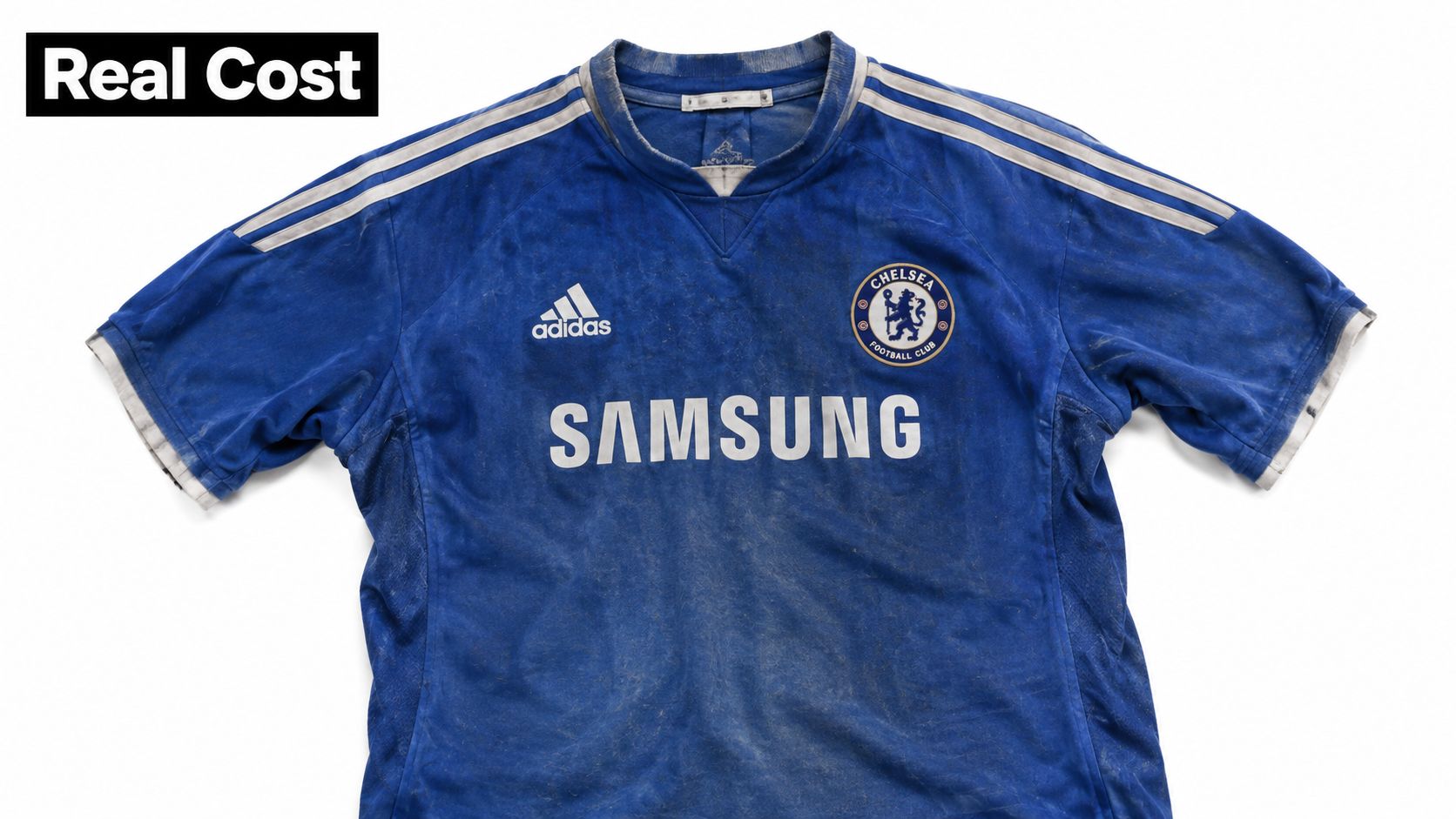
A licensed replica usually asks less up front and may be easier to wear without fuss. An authentic shirt costs more to justify only if its performance construction, season-specific appeal, or collector interest matters to you. Don't assume either version will last longer or resell for more without checking the garment's condition, demand, and provenance. For a worn shirt, fading, damaged prints, and missing labels can matter more than the original category.
Count the hidden costs
Returns, shipping, care, and the risk of buying from an unverified seller all affect the total outlay. A suspiciously cheap listing can become an expensive mistake if you can't return it or discover it isn't what the seller claimed. Buying from a seller with clear return terms and a credible record gives you a practical remedy if the shirt doesn't match its description.
For collecting, keep the purchase documentation and photograph the labels and condition while the shirt is new. Those records help you describe the item accurately if you later sell or trade it. If you're comparing budgets, this overview of soccer kit prices can help you think beyond the first number on a listing.
A useful rule is to buy the version you will use, not the one whose specification sheet sounds most impressive. If you will wear the shirt casually, the replica easier fit may be the better value. If you will play in it or want the player-version construction, authentic can earn its higher price through use, not just appearance.
The shirt's care needs also deserve attention before you pay. Follow the garment's care label, and be especially cautious with bonded or heat-pressed details. A shirt you're willing and able to care for is more likely to remain wearable and retain its appeal.
A Practical Verification Sequence Before You Pay
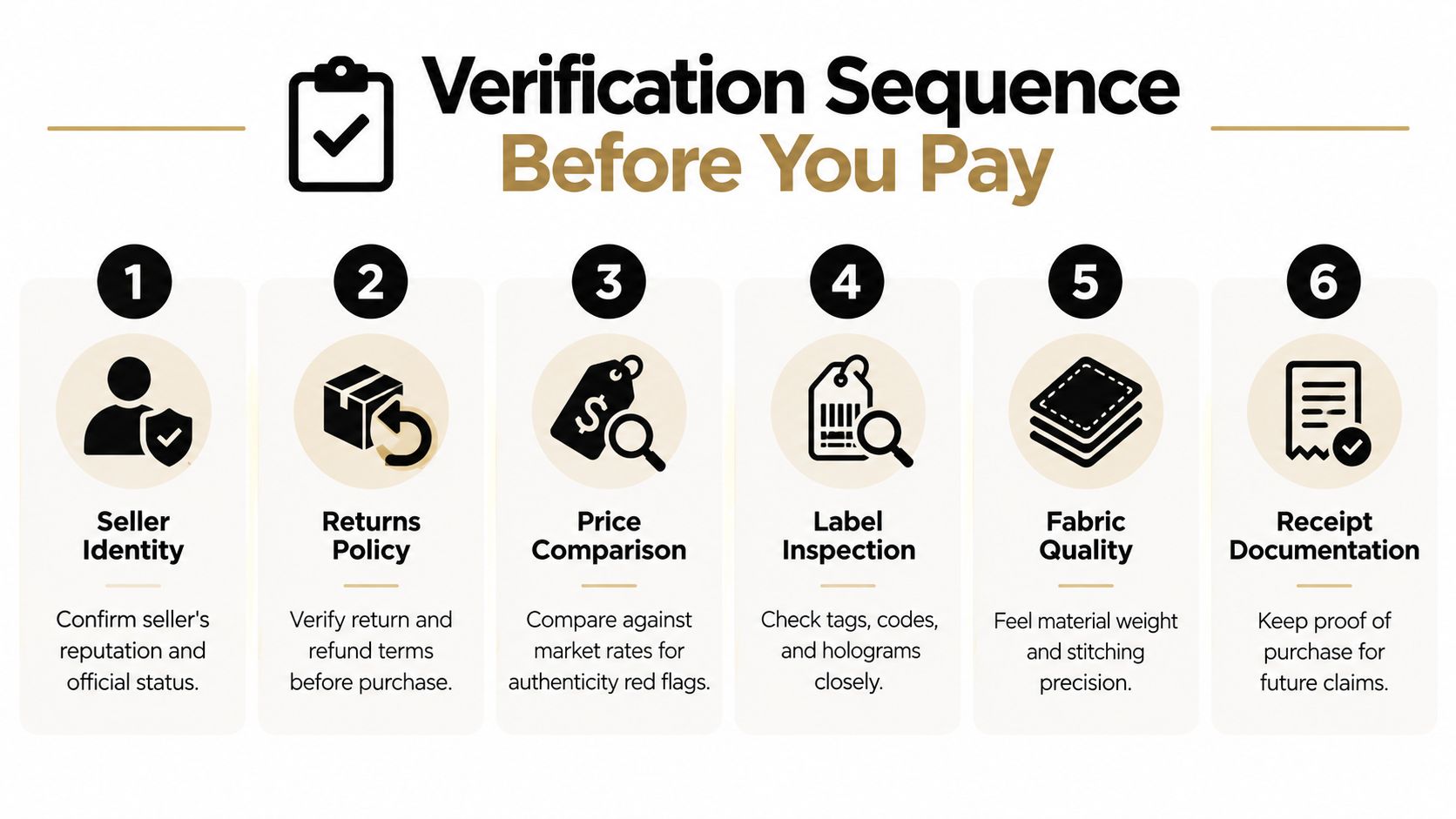
Treat authentication as product-identity checking, not a contest to see whether a shirt looks convincing. Start with the seller, then confirm the garment's identifying details, then use construction as supporting evidence. A QR code, hologram, or swing tag can help, but no single marking works across every manufacturer and season.
Work from seller to product code
- Check the seller. Look for a clear business identity, consistent product descriptions, and a returns policy you can understand before paying.
- Ask for label photos. Request clear images of the sewn-in care label and manufacturer product code, not just a swing tag.
- Match the code. Check that it identifies the exact club, season, colorway, and home, away, or third version in the listing.
- Inspect the construction. Look at the side seams, stitching consistency, badge application, sponsor alignment, and the way the fabric and ventilation are described or shown.
- Review packaging and sourcing. Check whether labels and packaging make sense for the claimed item, and ask for proof of authorized sourcing if the seller's status is unclear.
- Protect the transaction. Keep your purchase record and use a payment method with applicable purchase protections.
The sequence matters because counterfeits can imitate visible authentication features. A code that resolves to a different garment, or doesn't match a credible product record, should make you stop even if the shirt feels light and looks tidy. Likewise, neat stitching alone can't establish authorization.
Verification should be routine, not reserved for unusually expensive shirts. Online searches for fake football shirts rose 518% between 2021 and 2024, and an EU anti-fraud operation in Spain seized 1.5 tonnes of counterfeit sportswear worth roughly €570,000 in April 2025 (research on counterfeit football shirts). The practical lesson is simple: check the seller and product details before paying, not after a problem appears. For a comparable approach to checking branded goods, see these ECI Jewelers watch authentication tips. This football-shirt authenticity checklist can also help you apply the same checks to a listing.
Which Category Suits Which Buyer
Match the shirt to the person who'll wear it. Paying for player-grade construction doesn't make sense if the shirt will spend most of its life in a drawer, and saving money on an unverified imitation is a poor trade if authenticity matters.
- The dedicated collector: Choose an authentic shirt when you're building a season-specific collection or want the player-version construction. Keep the labels, proof of purchase, and condition photos. For a vintage or retro item, check whether it's an original shirt or an officially licensed retro remake before describing it as collectible.
- The casual fan: A licensed replica is usually the practical pick for watching matches, going out, and regular wear. You get an official design without paying for a closer athletic fit you may not want.
- The parent buying for a child: Favor a verified licensed replica. A comfortable cut and a trustworthy seller matter more than performance details, and a child may outgrow the shirt before those details justify extra cost.
- The gift shopper: Buy from a seller with clear product identity and a workable return policy. If you choose an authentic shirt, confirm the size and version; if you choose a surprise, make sure the recipient's preferences and the seller's exchange terms are clear.
- The budget-conscious buyer: Look for a legitimate replica from a seller who identifies the product accurately. A lower price is a valid reason to choose a fan version, not a reason to gamble on an unauthorized one.
Where to draw the line
Don't buy a counterfeit to save money. You can't rely on its product claims, and you won't be buying an authorized club or league product. Anyone planning to resell should avoid counterfeits entirely, since passing an unauthorized shirt off as genuine misleads the next buyer. I'd also skip one as a child's gift or a surprise present: the low price isn't worth the uncertainty about what arrives or whether the recipient can return it.
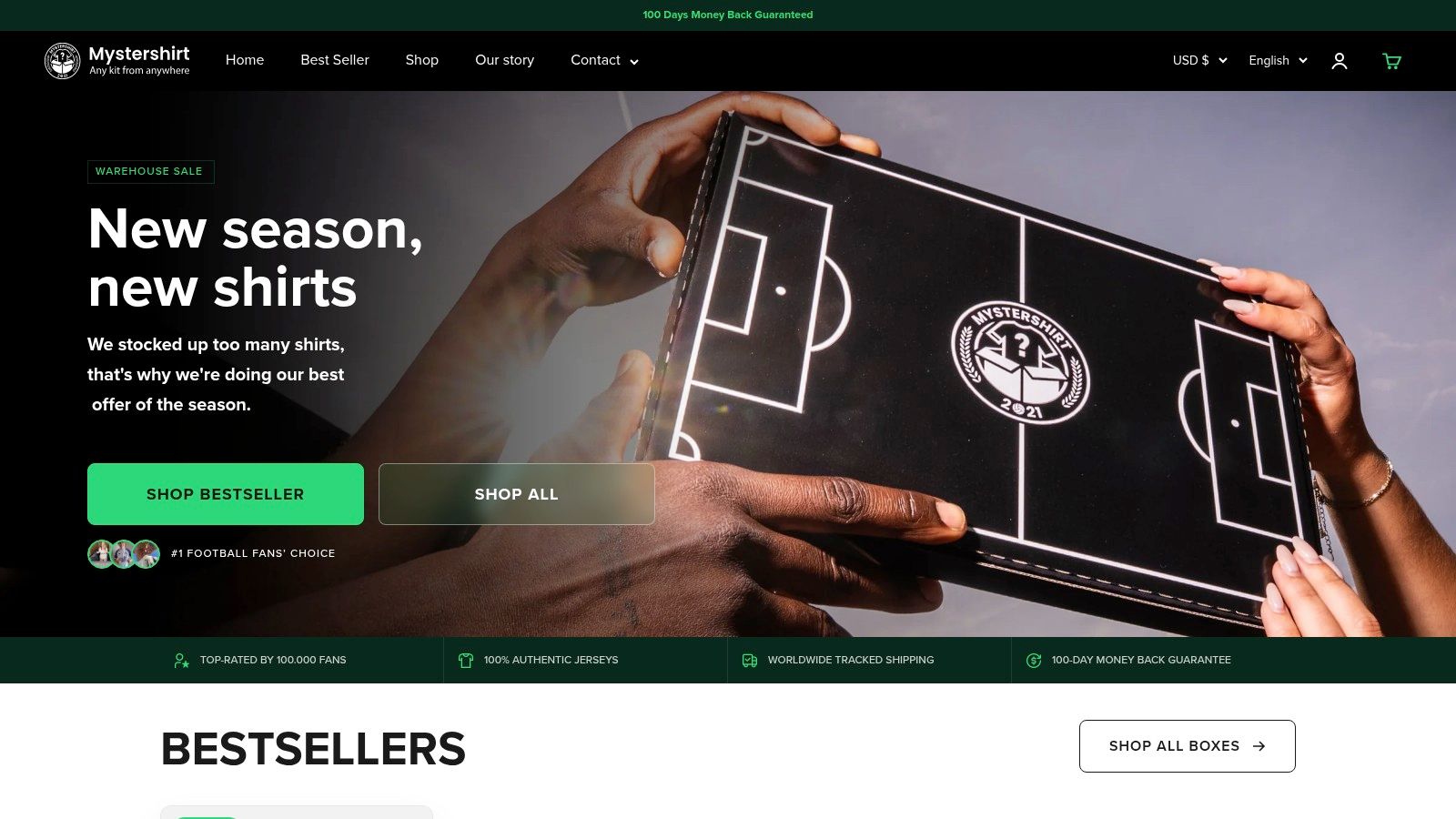
A mystery purchase still needs clear terms. Mystershirt offers mystery boxes containing authentic football shirts, with options for different audiences and sizes; check the product details and return terms before ordering. Whatever seller you choose, prioritize verified sourcing and a return route over a deal that only looks attractive in a listing photo.
The Sustainability Question That Has No Winner Yet
Authentic doesn't automatically mean greener. Legal authorization and environmental performance are separate questions, and a shirt's label can't tell you its full lifecycle impact.
The evidence needed to compare products is still incomplete. A University of Portsmouth project supported by the UK Intellectual Property Office is investigating whether counterfeit shirts shed more microplastics or have a higher carbon footprint than authentic shirts, with results still pending (coverage of the ongoing research). Until comparative lifecycle data is available, claims that one category is always environmentally superior go beyond what's established.
Focus on the choices you control
Buy a shirt you expect to keep wearing. Look at construction and care instructions, repair damage when practical, avoid unnecessary replacements, and consider second-hand options when the garment's identity and condition can be checked. Washing frequency and how long a shirt stays in use matter to its overall footprint, but don't assume a particular product wins on sustainability without evidence.
Counterfeiting raises real legal and commercial concerns, but that doesn't settle the environmental comparison. Separate the questions: verify whether the shirt is authorized, then assess its materials, condition, durability, and likely use. For budget-conscious fans, keeping one well-chosen shirt in rotation is a more grounded approach than repeatedly buying replacements based on an unverified green claim.
Decision Checklist and Common Questions
Before you check out, run through this short list:
- Decide whether you need a fan shirt, a player-performance shirt, or a collectible.
- Set a budget that reflects how you'll use it.
- Verify the seller and its return terms.
- Match the product code to the exact shirt.
Is buying two replicas better than one authentic? If you want shirts for regular casual wear, two licensed replicas may be more useful. If performance construction or a specific player-version release matters, buy the authentic you'll wear.
What if the listing has no product code? Ask for label photos and a credible explanation. If the seller can't provide useful product details, don't treat appearance as a substitute for verification.
What should I do if a gift's authenticity is uncertain? Keep the packaging and purchase record, ask the seller for product details, and use the return process if the item can't be verified.
How can I resell without feeding the counterfeit market? Describe the shirt accurately, include clear label and condition photos, and don't list an unverified item as authentic. If you can't establish what it is, say so or don't sell it as an official product.
Mystershirt sells mystery boxes containing authentic football shirts with original labels and tags, including options for collectors, children, and shared gifts. If you want a verified shirt without choosing a specific design in advance, visit Mystershirt and check the box details, sizing, and return terms before ordering.