You've found a shirt online that looks like the one your favourite player wore, but the listing says little about where it came from. Is it an official product, a match-used item, or a replica with a compelling story attached? In soccer memorabilia, those distinctions matter: they affect both what the shirt means to you and what a reasonable price looks like.
The safest way to judge a shirt is to treat authenticity as a spectrum of evidence, not a yes-or-no label. Start by identifying the kind of item, then weigh how directly it connects to a real match and how well that connection can be proved.
Table of Contents
- Soccer Memorabilia Categories Compared
- What Makes a Shirt Collectible and Valuable
- Evidence That Proves a Shirt Is Authentic
- Deciding When an Unproven Shirt Is Worth Buying
- How to Store and Protect Your Collection
- Start Your Collection With One Verified Shirt
Soccer Memorabilia Categories Compared
Soccer memorabilia includes football objects tied to a club, player, match or tournament. That can mean a shirt bought in a shop or a garment shown to have been worn in a competitive game. The category tells you what an item is; the evidence tells you how confidently you can describe its history.
| Category | What It Is | Typical Buyer |
|---|---|---|
| Official replica shirt | Store-bought shirt sold to the public | Casual fans and kids |
| Authentic retail shirt | Official product from a recent season with labels attached | Fans starting a collection |
| Match-issued shirt | Supplied to a team for use in competition | Serious collectors |
| Match-worn shirt | Actually used by a player in a game | High-end collectors and museums |
| Signed shirt | Autographed by a player or staff member | Gift buyers and fans of a specific player |
| Customised shirt | Printed with a real player's name and number | Fans of a particular player |
| Retro or vintage shirt | Shirt from an earlier era or season | Nostalgia collectors |
| Accessories | Shorts, scarves and other team items | Collectors building a themed set |
The table moves from widely available fan merchandise toward items with a more direct connection to competition. A match-issued shirt was prepared for a player or team, but that alone doesn't prove it was worn during a game. A match-worn shirt has a stronger claim, provided evidence connects that specific garment to a particular appearance.
Other categories can overlap. A signed shirt might be a retail replica, and a customised shirt may have been printed with a player's name after purchase. A retro shirt can be a modern reissue or an original from its season, so check what the seller means rather than relying on the word “vintage.”
Start with your purpose: A family buying a child's first team shirt, a fan searching for a favourite season, and a collector pursuing match-used items aren't shopping for the same thing.
Choose two categories that fit your budget and reason for collecting. A guide to expensive football memorabilia can help show how far the rarest items sit from everyday fan shirts. Once you've chosen your categories, compare their evidence and condition before comparing prices.
What Makes a Shirt Collectible and Valuable
A standard replica is a little like a stadium ticket. A shirt connected to a particular match is more like a ticket stub kept as proof of a specific experience: its story is tied to a moment, not just a team.
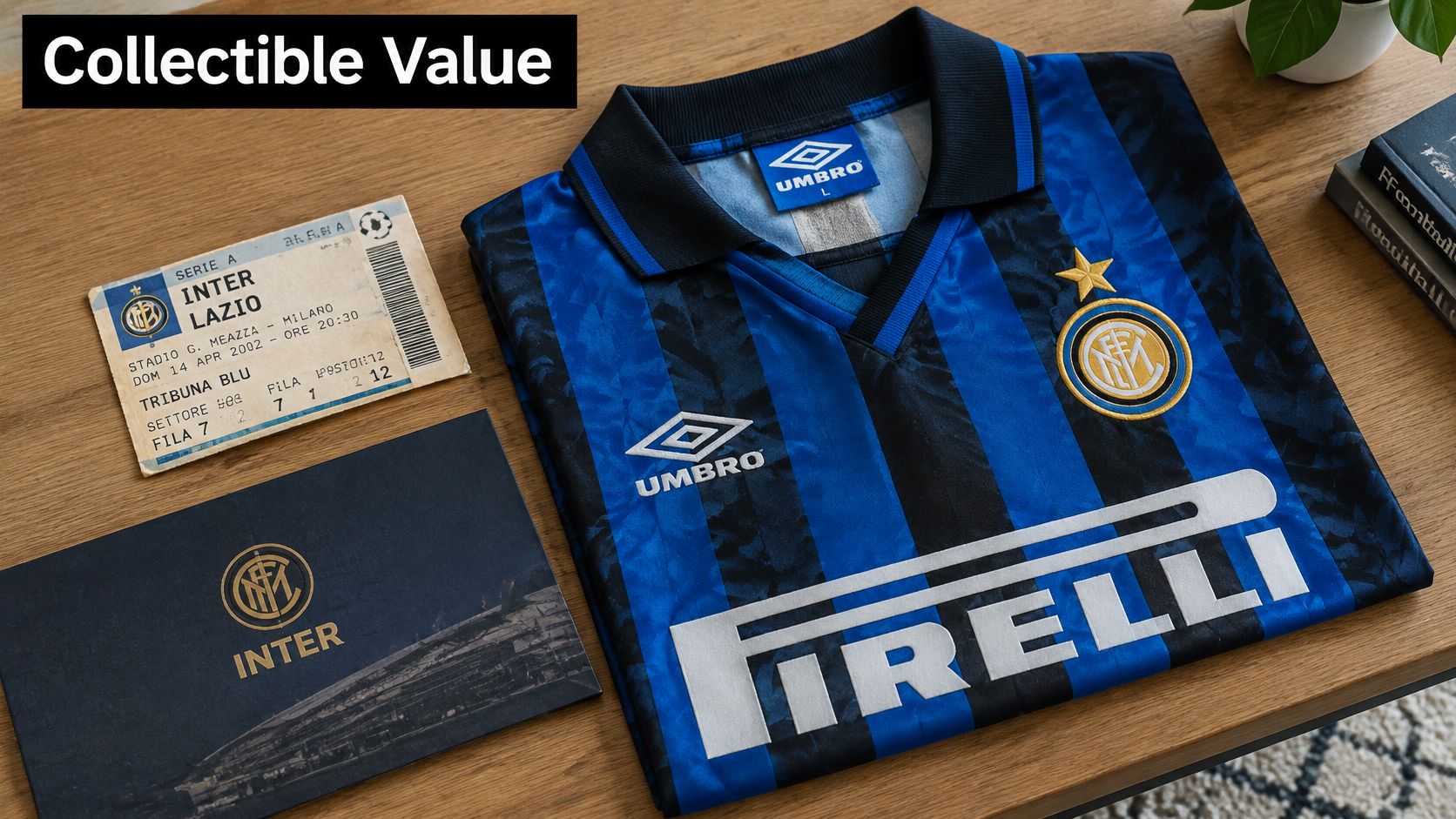
That connection can come from a season, an important result, a change in kit design, a limited production run, or a documented owner. Condition and provenance matter too: a rare shirt with an unclear history or severe damage may be less appealing than a well-preserved example with a credible record. Cultural significance can add meaning even when an item doesn't feature a global superstar.
Look beyond famous players
A collection doesn't have to centre on trophy-winning stars. Women's and youth shirts, lower-league kits, tournament training wear, sponsor variations and shirts featuring new materials can all have stories worth collecting. A particular design transition or local connection may matter more to an individual collector than broad market demand.
The football-merchandise market analysis estimates annual growth of 7.0% for collectibles and memorabilia as a category. It also reports that elite-club jersey prices rose from about €80 in 2010 to more than €120 in 2025, a trend that can encourage buyers to look at pre-owned shirts and alternative editions. Those figures describe market context, not a promise that any particular shirt will appreciate.
The record sale is an outlier, not a price guide
Diego Maradona's No. 10 Argentina shirt from the 1986 World Cup quarter-final against England shows what can happen when an item's story and evidence converge. He wore it while scoring both the “Hand of God” and “Goal of the Century” goals in Argentina's 2–1 victory. Sotheby's sold the match-worn shirt in London on May 4, 2022, for $9.28 million, above the previous reported sports-memorabilia record of $8.8 million and the earlier jersey record of $5.64 million for a Babe Ruth Yankees shirt, according to ESPN's account of the auction.
That result reflects an extraordinary combination of player, match, historical importance and direct provenance. A 2025 market analysis identifies provenance, condition, rarity and third-party authentication as key valuation factors, and notes that authenticated items can command substantial premiums over uncertified ones. For a useful way to think through pricing factors, consult this sports memorabilia pricing guide.
The Maradona sale shows what drives exceptional value; it doesn't forecast what an ordinary shirt will sell for. Most shirts are best collected for their personal, sporting or cultural meaning, rather than as guaranteed investments.
Evidence That Proves a Shirt Is Authentic
Authenticity is about proof of origin and history, not how convincing a shirt looks in a photograph. A label may help establish that a shirt is an official product, but it doesn't show that a player wore it in a match. Rank evidence by how directly it connects the item to the claimed use, and note what each piece still can't prove.
| Evidence | What It Shows | Weak Point |
|---|---|---|
| Match photographs and team sheet | Shirt is linked to a specific game | Photos may show a similar shirt, not this one |
| Auction receipt or invoice | Purchase history and price paid | Shows a sale, not the original use |
| Certificate of authenticity | Independent opinion on the item | Depends on the issuer's reputation |
| Serial or hologram code | Item can be traced to a production record | Codes may be duplicated or unverified |
| Manufacturer and size labels | Item is an official club or brand product | Labels can be copied or reused |
| Seller's written description | Claimed history of the shirt | No independent weight on its own |
The strongest case usually combines different kinds of evidence. For example, match photographs and a team sheet may help connect a shirt to a game, while an auction record documents its sale and a certificate records an expert opinion. A certificate of authenticity guide can help clarify what such a document is intended to support.
Build a file for the individual shirt
Before storage, photograph the front and back, labels, badges, sponsor application, stitching, wear marks and any authentication identifiers. Keep the original invoice, certificate and relevant messages, and write down why the wear seems consistent with the claimed match history. Don't present a plausible-looking mark as proof by itself.
Keep digital copies and physical paperwork together in one file linked to the shirt's identifying details. A documented chain of custody helps you answer later questions, reduces disputes and supports insurance or resale checks. The practical guidance on documenting a match-worn shirt's provenance describes a similar approach to recording identifiers and ownership.
A club or brand label can support a claim that a shirt is an official product. It never proves match use on its own.
Deciding When an Unproven Shirt Is Worth Buying
Most second-hand shirts don't arrive with a complete history. That doesn't make every undocumented shirt suspicious, but it does mean you should separate what the item is from what the seller claims it did.
A practical check has five parts:
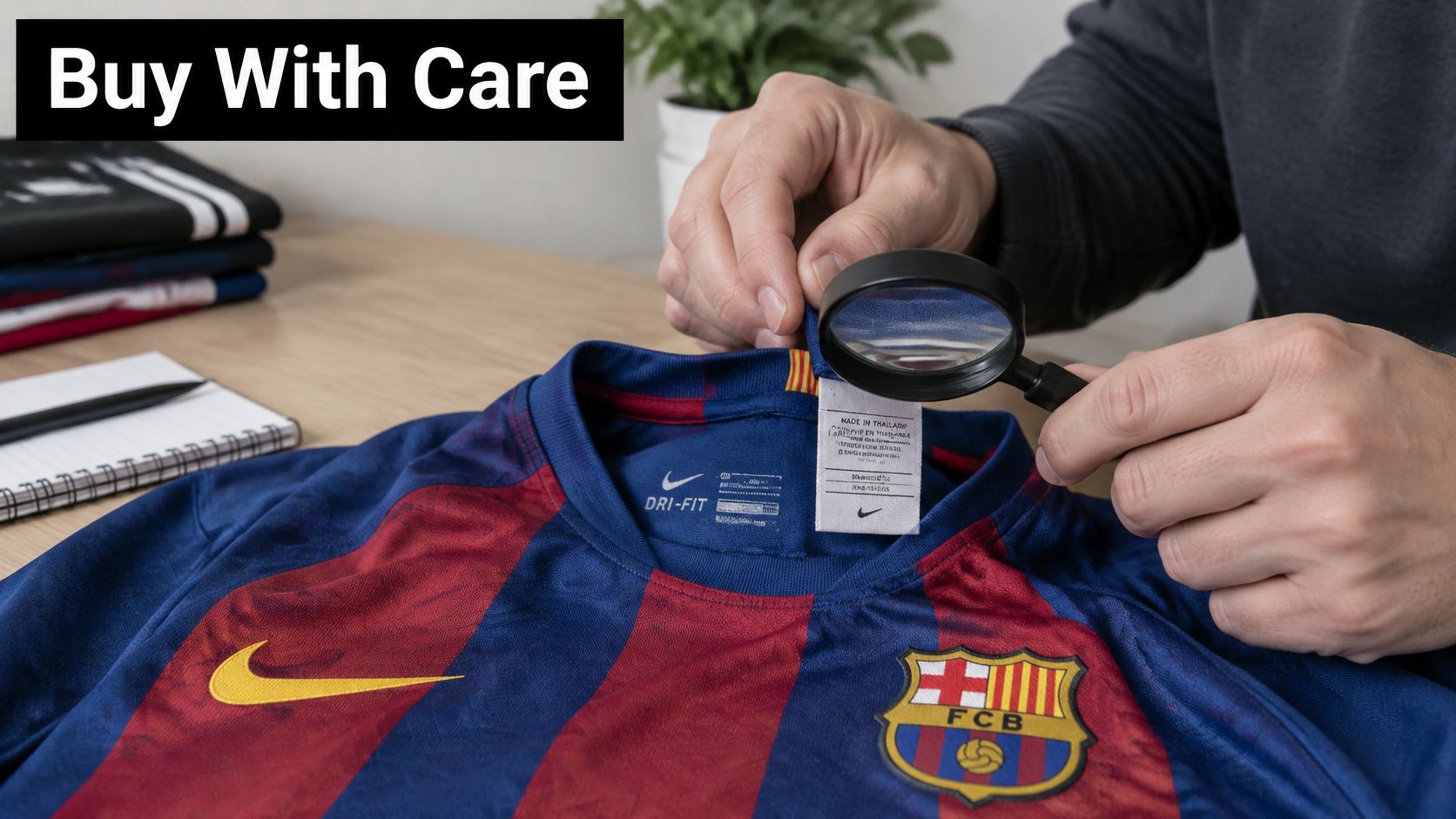
- Confirm the product category. Inspect labels, tags, manufacturer details and season markings. This can help establish whether the shirt is an official product, but not whether it was supplied to or worn by a player.
- Test the claimed status. Ask what supports “match-issued” or “match-worn.” A retail shirt doesn't become match-used because a seller writes that description in a listing.
- Allow for genuine variation. Older shirts may have faded labels, factory differences between batches, licensed-replica versions or altered namesets. A single visual difference isn't enough to decide that a shirt is fake.
- Record what history exists. Save dated messages, seller details, listing photographs and any earlier ownership information you receive. If the story is incomplete, make a note of the gap rather than filling it with assumptions.
- Consider independent verification. Paying for a third-party opinion is most useful when a high price or a match-worn or signed claim depends on the item being as described.
A 2025 academic article estimates counterfeit football shirts at roughly one-third of legitimate shirt sales per season, linking demand partly to resistance to rising authentic-shirt prices, as described in the article on counterfeit football shirts. That estimate makes careful checks important, but it doesn't mean every second-hand shirt without a receipt is counterfeit.
Set the price according to the evidence you have. An official retail shirt with incomplete ownership history may still suit a fan, while a costly match-worn claim needs much stronger support. Refusal to show label close-ups, stock photos instead of the actual shirt, or a match story with no dated records are reasons to pause.
A shirt bought with honest uncertainty is still a fair purchase when the price reflects that uncertainty.
How to Store and Protect Your Collection
Light, changing humidity, compression, unsuitable plastics and staining can all harm jerseys. The fabric may look sound while screen prints, sponsor marks, signatures or adhesive badges begin to deteriorate. Follow these museum textile-storage recommendations to reduce the risks.
| Factor | Recommended Condition | Common Mistake |
|---|---|---|
| Temperature and humidity | Cool, dry, well-ventilated and stable | Storing in damp or heated spaces such as attics or near radiators |
| Light exposure | Protected from direct and intense light, UV-filtered glazing for display | Displaying under spotlights or in a sunny window |
| Enclosures | Uncoated polyester, polypropylene, polyethylene or unbuffered archival paper | Using PVC containers or ordinary dry-cleaning bags |
| Support during storage | Laid flat or padded without crushing or sharp creasing | Folding tightly into a box |
| Drying before boxing or framing | Completely dry before any enclosure | Boxing or framing while still damp |
| Handling | Clean, dry hands and limited handling | Repeated handling of badges, prints and signatures |
A shirt must be completely dry before you box or frame it. Trapped moisture can lead to staining, mold and mildew, so don't enclose a shirt just because its surface feels dry. For display, use UV-filtering glazing and acid-free support, and keep the frame away from heat and damp areas.
Two simple habits help you notice slow damage. Rotate displayed shirts so the same garment isn't exposed to light year after year, and keep a condition log with dated photographs. That record can show when a change appeared and provide useful documentation for insurance or resale. For more on the practical choices, see this guide to preserving football shirts.
Start Your Collection With One Verified Shirt
A focused collection is easier to document and care for than a pile of shirts bought without a plan. Start with a club, era, country or player, then set a per-shirt budget that leaves room for verification or suitable storage.
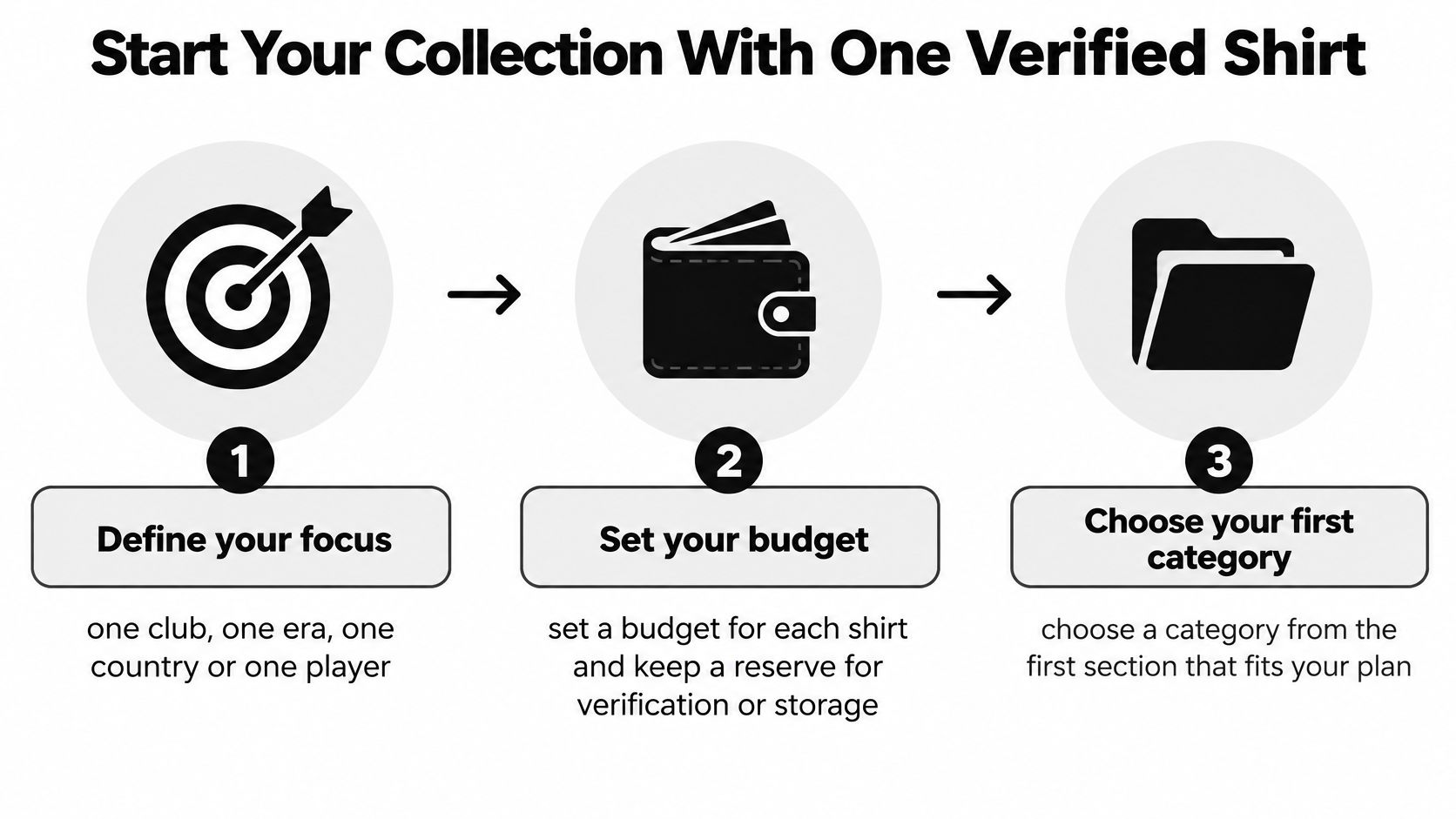
- Define your focus. Pick one club, era, country or player. A clear theme makes it easier to judge whether a shirt belongs in your collection.
- Set your budget. Decide what you can spend on each shirt and keep a reserve for verification or storage.
- Choose a category. An official retail or retro shirt can be a sensible starting point if it fits your purpose and budget.
- Check the listing. Buy from a seller who shows the actual shirt, labels and season details, and explains the return policy. Mystershirt sells official products from clubs or brands with their original labels and tags still on; check the listing details to make sure the shirt category fits your plan.
- Create a record on arrival. Photograph the shirt and retain the invoice and any documents that came with it.
- Store it carefully. Use a clean, dry, stable place and support the garment without crushing it.
- Add the next piece later. Document the first shirt before expanding the collection.
Choose one shirt that fits your focus, verify what it is before you buy, and document it before you shop for a second.
Mystershirt offers Premium and Retro mystery boxes, as well as signed shirts, shorts and sharing boxes for fans building a collection or choosing a gift. Compare the shirt categories and evidence in this guide with what each listing says, then visit Mystershirt to find an option that fits your collecting plan.