You did the sensible thing. You measured your chest, checked the size chart, saw 4XL lined up with your number, and ordered. Then the shirt arrived and the trouble started: the chest fits, but the hem climbs to your waistband every time you raise your arms, or the sleeves hang past your knuckles while the body pulls across your stomach.
None of that means you bought the wrong size, exactly. It means you matched one measurement out of four. Big and tall soccer jerseys get sold as a letter on a label, but fit is decided by chest circumference, torso length, shoulder breadth and sleeve length, and most size guides hand you the first number and stop there.
The audience for these shirts is neither small nor uniform. Nielsen's 2017 World Football Report, which surveyed 18 markets, found that 43% of respondents were interested or very interested in football, roughly 736 million people, with interest reaching 80% in the United Arab Emirates and 78% in Thailand.
The short version: the label is a filter. Your measurements, the shirt's cut, and whether your size exists in the design you actually want are what decide the order.
Table of Contents
- How to Measure Yourself for a Jersey
- Soccer Jersey Sizes by Chest and Length
- Big Tall or Both and How to Fix a Bad Fit
- Fan Cut or Authentic Cut for Bigger Bodies
- Finding Your Size When Stock Runs Thin
- Confirm Your Measurements Before You Order
How to Measure Yourself for a Jersey
A jersey chart only works when your numbers come from the same measuring points the chart uses. That sounds obvious until you compare two listings: one quotes the wearer's chest, the other measures the flat garment from pit to pit. Same shirt, two numbers, and one of them sends you to the wrong size.
The apparel standards draw that line explicitly. ISO 8559-1 sets out how body dimensions are defined and taken for clothing development, and ISO 8559-2 bases a garment's size designation on the intended wearer's body dimensions, with primary measurements such as height or chest girth plus optional secondary ones. Sizes are supposed to describe bodies, yet each brand grades its own patterns and proportions, so a 4XL is not a universal measurement.
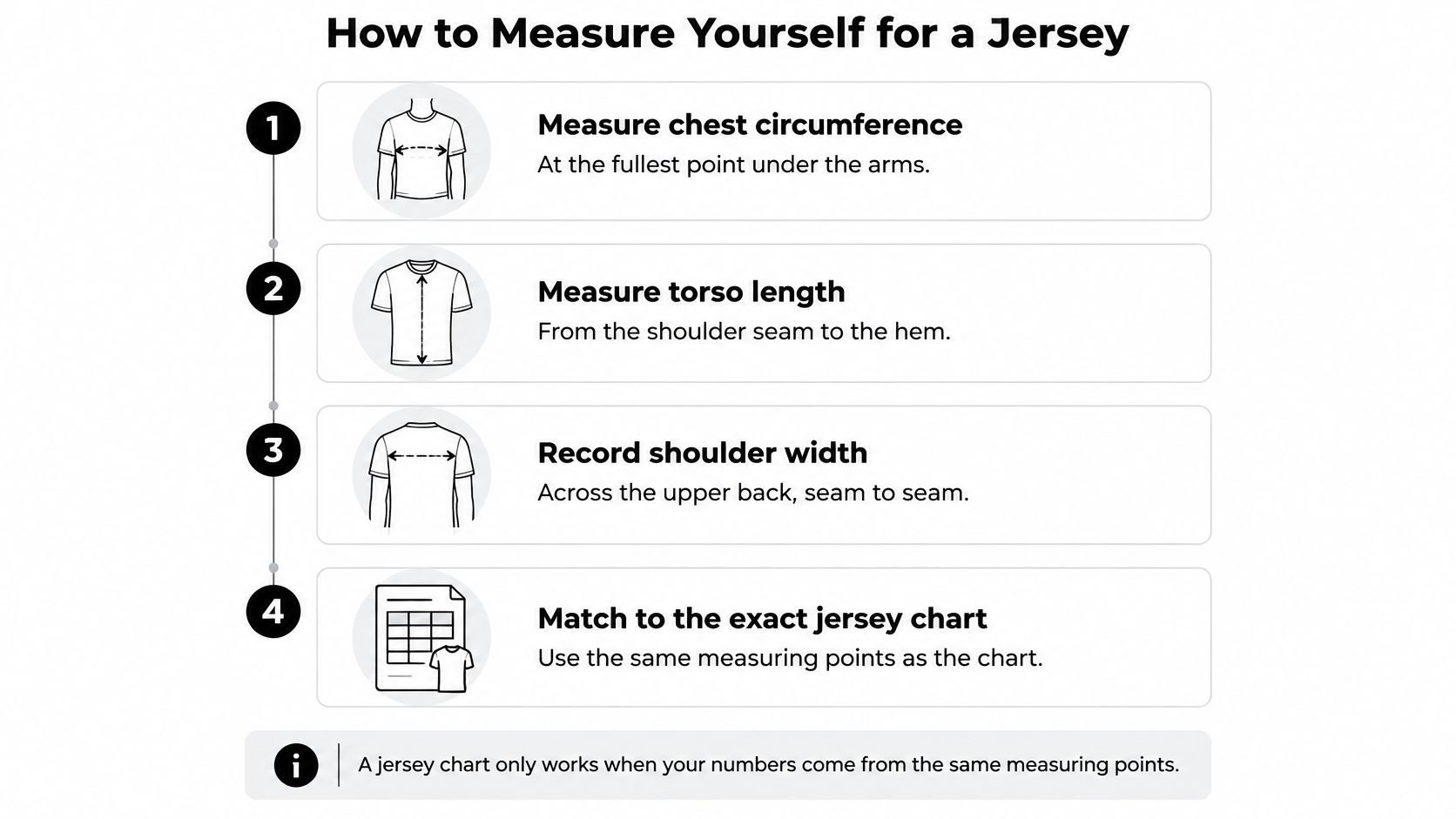
Measure in a thin shirt or none, standing relaxed, with a soft tape held level. Work through these six steps in order and write every number down.
- Chest circumference at the fullest point. Wrap the tape around the widest part of your chest, under the arms, keeping it level across the back. A tape pulled tight reads falsely small and gives you a shirt that strains at the seams.
- Natural waist at the narrowest point. Measure the narrowest part above the navel. This number decides whether a jersey hangs cleanly or pulls across your midsection the moment you sit down.
- Shoulder breadth across the back. Run the tape from the edge of one shoulder bone to the other, across the upper back rather than the front. Shoulder width sets how the armholes sit and how freely your arms move.
- Height, without shoes. Standardized sizing anchors garment dimensions to the wearer, and height is one of the dimensions a chart can key to directly.
- A jersey you already own, laid flat. Measure pit to pit, then shoulder seam to hem. Those two figures show what a good fit looks like in numbers, which is far easier to match than an abstract letter.
- Your between-sizes fallback. Size up to release seam tension and allow layering, then go back to the length column, because extra width adds no length.
A good result is unglamorous. Your chest and your length both sit inside the chart's range for one size, and the shirt moves with your arms when you raise them.
Practical rule: if your chest fits a size and your torso length doesn't, you're not between sizes. You need a different cut.
Soccer Jersey Sizes by Chest and Length
Letter sizes are a filter, not a promise. A 5XL from one brand can fit like a 4XL from another, because every manufacturer builds its own pattern and the neck label describes a size run rather than your body.
Most adult charts still follow a recognizable convention. Academic research on the history of replica football kits documents XL at roughly 42-44 inches of chest, XXL at 44-46, XXXL at 46-48, 4XL at 48-50, 5XL at 50-52, and 6XL at 52-56. The same research explains how those runs took shape: child-sized replica kits appeared in the late 1950s, and sizing expanded sharply through the mid-1970s as clubs began selling shirts as merchandise rather than issuing them as equipment.
Chest is only half the table. Length decides whether a shirt that fits your chest also reaches your waistband, and published charts show how widely it varies. A standard-cut 5XL measures about 85 cm (33.5 in) long, while a U.S. tall-chart 4XL Tall pairs a comparable chest with 37 in (94 cm). The typical ranges below reflect that grading, with each size step adding roughly an inch of length.
| Label | Chest (inches) | Chest (cm) | Typical length |
|---|---|---|---|
| XL | 42-44 | 107-112 | about 27-29 in (69-74 cm) |
| XXL | 44-46 | 112-117 | about 28-30 in (71-76 cm) |
| XXXL | 46-48 | 117-122 | about 29-31 in (74-79 cm) |
| 4XL | 48-50 | 122-127 | about 30-32 in (76-81 cm) |
| 5XL | 50-52 | 127-132 | about 31-33.5 in (79-85 cm) |
| 5XL (published example) | 54 | 137 | 85 cm (33.5 in) |
| 6XL | 52-56 | 132-142 | about 32-34 in (81-86 cm) |
| 4XL Tall (U.S. tall chart) | 54-57 | 137-145 | 37 in (94 cm) |
Read down the chest column and the reason letters fail becomes concrete. The difference between XL and 5XL can represent roughly 8-10 inches of chest circumference, and manufacturer cuts, fabric stretch and shirt length shift that window further.
Length is the column shoppers skip, and the last two rows show why it matters. The published 5XL and the 4XL Tall sit in similar chest territory yet differ by nearly 9 cm of garment length. Two shirts, two very different places for the hem to land.
How to use the table: find the row closest to your chest, then check the same row's length before you commit. Treat the result as a rough filter only.
Confirm the filter against the specific jersey's own chart, and read why football jerseys run big or small between brands and seasons before you assume a familiar label means a familiar fit.
Big Tall or Both and How to Fix a Bad Fit
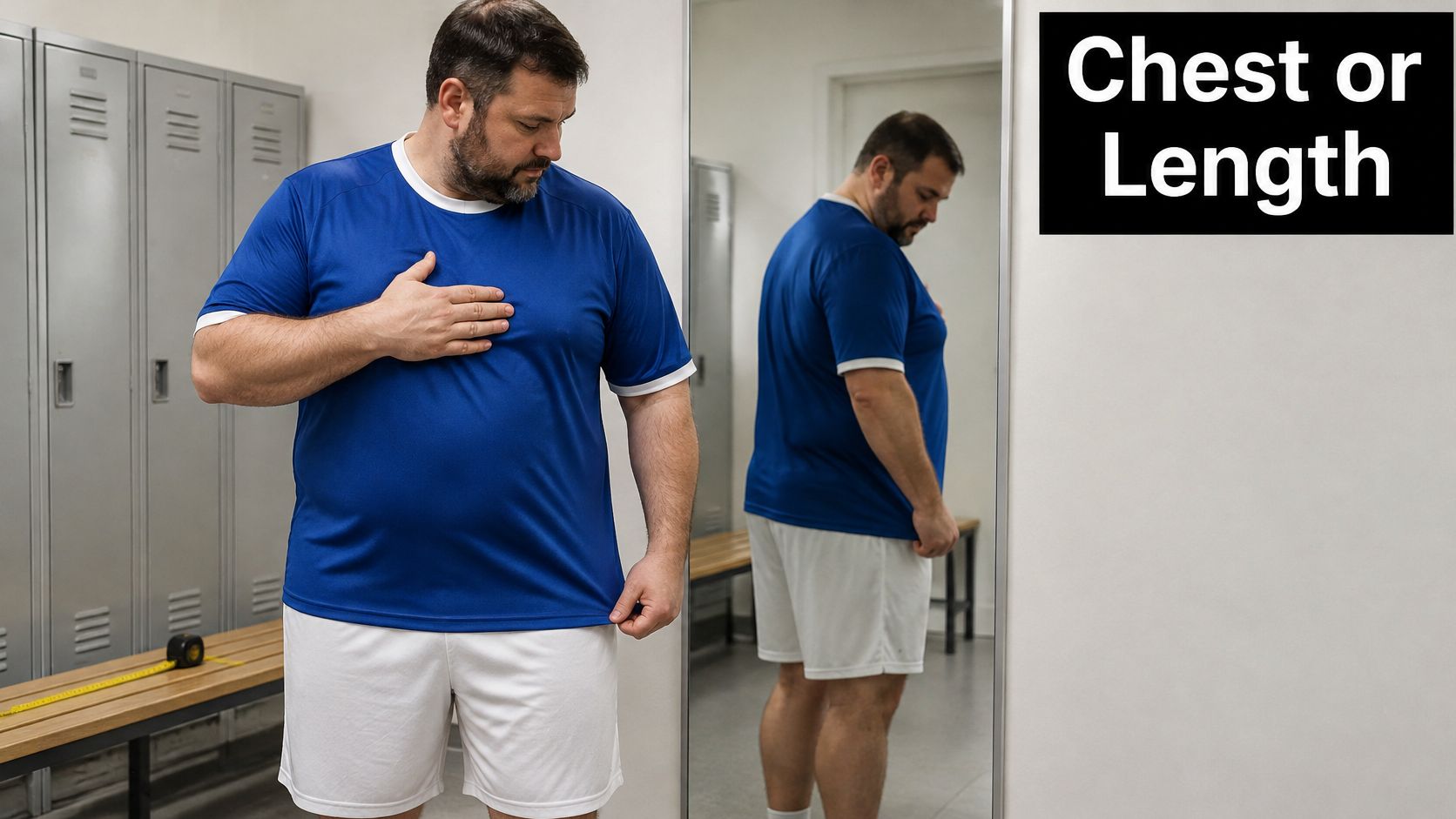
Sizing up is the most common advice for big and tall soccer jerseys, and it's the advice that fails most often. Going one size up solves one problem, circumference, and creates another by adding sleeve and body length you never asked for.
Big and Tall Are Two Separate Problems
Big is a circumference issue. It shows on the chest, across the shoulders and around the abdomen, and a wider garment fixes it.
Tall is a vertical issue. It shows as a hem that rides up, a sleeve that stops above the wrist, and a shoulder seam sitting forward of your shoulder bone.
An independent apparel guide on plus-size football jerseys draws the same line, noting that manufacturers frequently add width without enough length, or length without sufficient room through the body, and that an XL can vary substantially between brands. Most shoppers carry both problems in different proportions, which is why a single letter can never settle it.
A Worked Example on a 52-Inch Chest
Say your chest measures 52 inches and your torso runs long. Sizing up buys circumference you may not need, and it only adds length if that particular size was graded longer. A tall or extended-length cut in the smaller width gets you both, because the pattern was drawn for a longer torso rather than a wider one.
Now take a buyer whose chest is the only limit, at 46 inches with an average torso. One size up handles the width, and the length will almost certainly land fine, but you still read the length column before paying.
Decision sequence: measure chest and torso length, compare each against the chart separately, then name the one that's actually limiting you. Width, length or both. Buy for that.
Diagnose the Fit After Delivery
A shirt that arrived is data. Match the symptom to the cause, apply the single fix, and check where the shoulder seam sits on the worn garment before you reorder anything.
| Symptom | Likely cause | Fix |
|---|---|---|
| Tight across the chest or pulls at the buttons | Chest measurement too small for the size | Choose the next size up, then check length |
| Sleeves reach past the wrist after sizing up | Sleeve length too long for your arm | Choose a tall or sleeve-correct cut, not a larger chest size |
| Hem rises when you raise your arms | Body length too short for your torso | Look for a longer body length or a tall cut |
| Fabric bunches under the arms | Armhole too deep or shoulders too wide | Choose the size whose shoulder width matches yours |
One more trap. European, Japanese, U.K. and U.S. labels can't be compared by letter alone, so convert everything to centimeters or inches and compare those figures instead of the label you wore last season.
Fan Cut or Authentic Cut for Bigger Bodies
A fan or replica cut is built loose through the body, with extra room over the midsection. An authentic or player cut follows the shirt a professional wears: closer to the torso, shaped at the waist, and cut for a trim athlete.
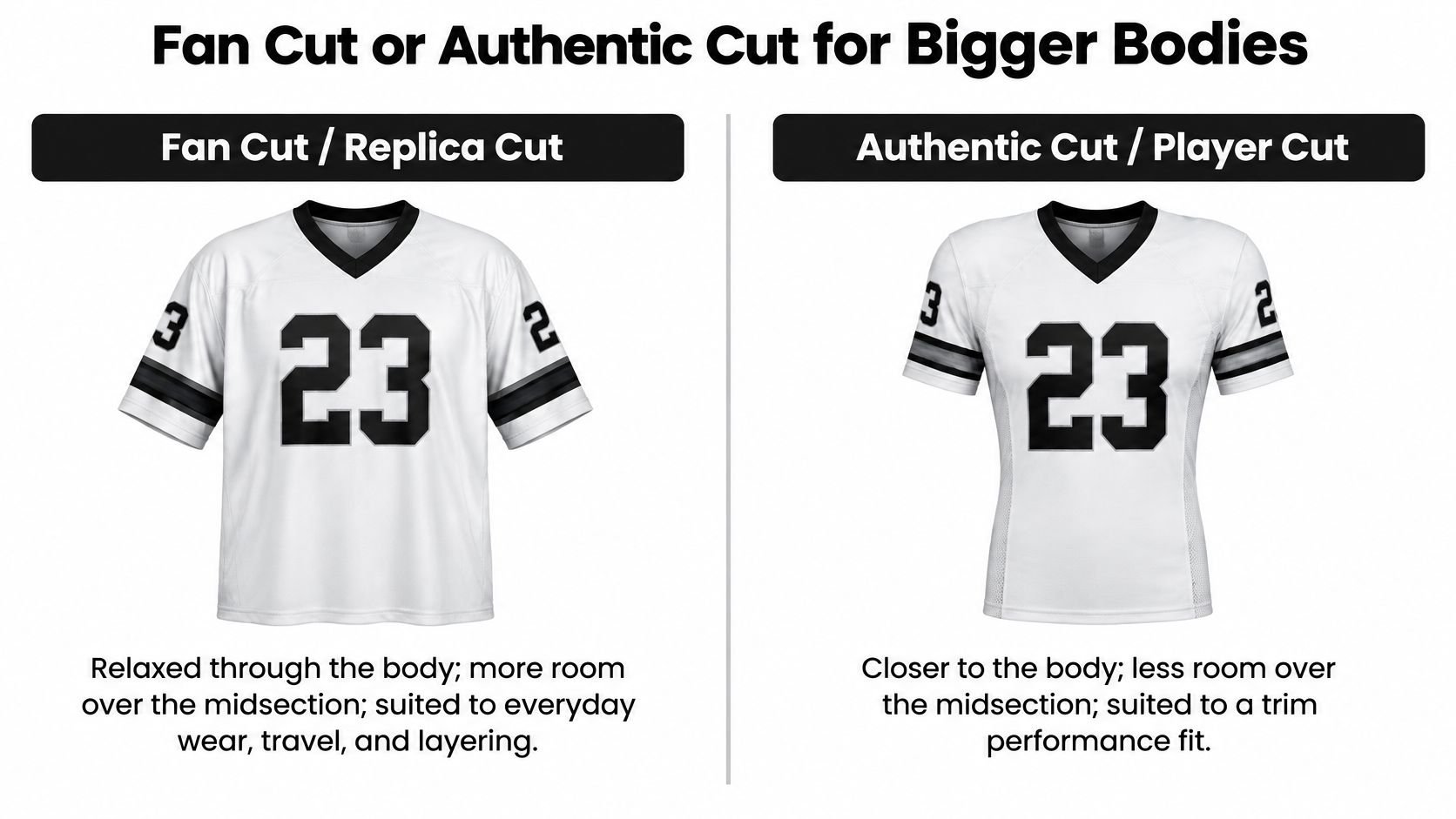
That difference lands harder on extended sizes than on anyone else. A player cut built for a 40-inch chest can pull across the belly of a buyer with the same chest and a fuller waist, because the garment narrows at the waist instead of falling straight from the chest. ISO 8559-3 describes the use of population-specific body measurement tables and intervals to improve ready-to-wear fit, on the principle that extended sizes should be graded from real body-shape data rather than a scaled-up small.
For everyday wear, travel and layering, a relaxed fan cut in your measured size is usually the more useful shirt. For a player cut, your waist measurement decides, not your chest.
| Criterion | Fan (replica) cut | Authentic (player) cut | What big and tall buyers should do |
|---|---|---|---|
| Fit through the midsection | Relaxed, more room | Close to the body, less forgiving | Choose by waist measurement |
| Best use | Everyday wear, travel, layering | Match-day look and close fit | Pick the cut by where you will wear it |
| Risk when sized wrong | Excess fabric and lift if length is off | Pulls across the belly if too small | Check body length on the chart |
Cuts and their charts also differ by brand and era, so read the product's own measurements rather than assuming a player cut is a fixed amount tighter. If you're weighing up which version earns its price, this comparison of replica vs authentic football shirts covers the materials and detailing differences.
The rule: pick the cut by where you'll wear the shirt, then pick the size by chest and length.
Finding Your Size When Stock Runs Thin
Extended sizes are a selection problem before they're a sizing problem. A club may produce your size in the home shirt and not the away shirt, and retailers restock standard sizes faster than larger ones, so the shirt you want in the size you need may not exist this season. 4X Apparel's guide to big and tall soccer jerseys is blunt about it: a store can advertise up to 5XL while offering very few designs in that size.
A wide size run on a listing page doesn't prove much either. Printerval's 2026 jersey listing shows unisex soccer jerseys in sizes S through 5XL at $22.95 for designs including USA, Cruz Azul, Guatemala and Portugal. Broad availability isn't the same as your club's shirt in your size.
When the exact design isn't there, work through this order.
- Search the exact design first. Combine club, season, home or away and kit type, not just the club name.
- Decide whether you'll wait. If the design is the whole point and a restock is likely, set a reminder and buy nothing yet.
- Trade design for fit when fit wins. A different season of the same club, or another club in the same cut, gets you a wearable shirt now.
- Read the return policy before you substitute. A shirt you can send back is a cheap experiment. One you can't is a permanent one.
Older and retro shirts use their own cuts and fabrics, so a modern chart may not apply to a shirt from a previous decade. Keep authentic licensed shirts separate from generic fan apparel as well: the generic version may come in wider sizes, but without the original cut or labels a low-priced 5XL is not automatically the same garment.
For collectors: track extended-size stock by shirt category, not by store, and accept that each purchase trades exact design against reliable fit.
Confirm Your Measurements Before You Order
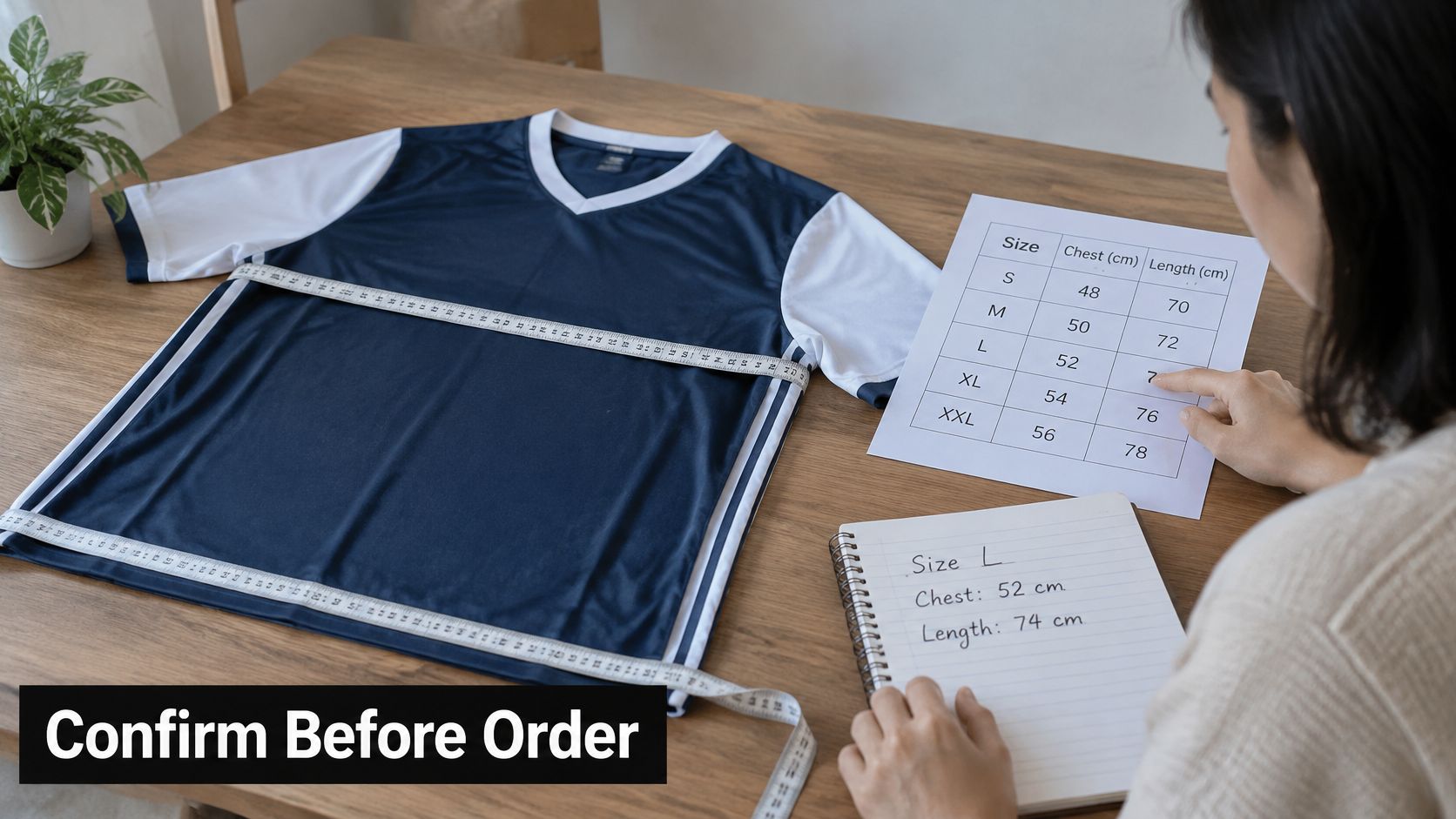
The last step isn't another measurement. It's matching the numbers you already have to the exact shirt in front of you, on that product's own chart, rather than to the general guide you read first.
A surprise box raises the stakes, because you choose a size range rather than a design. Mystershirt's boxes run from children's sizes up to 5XL senior, and requests for a specific team or shirt in a box are ignored, so if one design is essential, buy a listing that shows it in your size. Read the returns and refunds policy before you pay, not after.
Three checks before checkout:
- Chest and length both match the same row on that jersey's chart.
- The cut is the one you want for where you'll wear it.
- The size range on the product page includes your size today.
Here's the measuring routine in motion if you'd rather watch it once before you pick up the tape.
Then take your measurements today, find the row that matches both chest and length, and place the order only when the listing confirms that size.
Mystershirt sells authentic mystery football shirt boxes in sizes from children's up to 5XL senior, so the numbers you just wrote down have somewhere to land instead of being guessed at from a label. You choose your size range and any clubs or colours to avoid, and the shirt arrives with its original labels, backed by a 100-day money-back guarantee. Visit Mystershirt to see the current boxes and check the size range on each listing before you order.