The most confident answer to which design is the Best Selling Shirt of All Time is often the least trustworthy one. Football has produced shirts that sold out at extraordinary speed, clubs that shifted millions of units in a year, and retro designs reproduced for decades, yet those achievements aren't measured the same way. Once you separate a completed sale from a pre-order, and a single edition from a lifetime of reissues, the familiar league table falls apart. What remains is more useful, a set of source-qualified records that tells you what happened.
Table of Contents
- Why the Best Selling Shirt of All Time Is Unclear
- How Football Shirt Sales Are Measured
- Leading Football Shirt Sales Claims Compared
- Examining the Contenders Behind the Claims
- What Drives Massive Football Shirt Demand
- Supporter Demand Meets Football Shirt Fashion
- How to Judge Shirts Before You Buy or Collect
Why the Best Selling Shirt of All Time Is Unclear
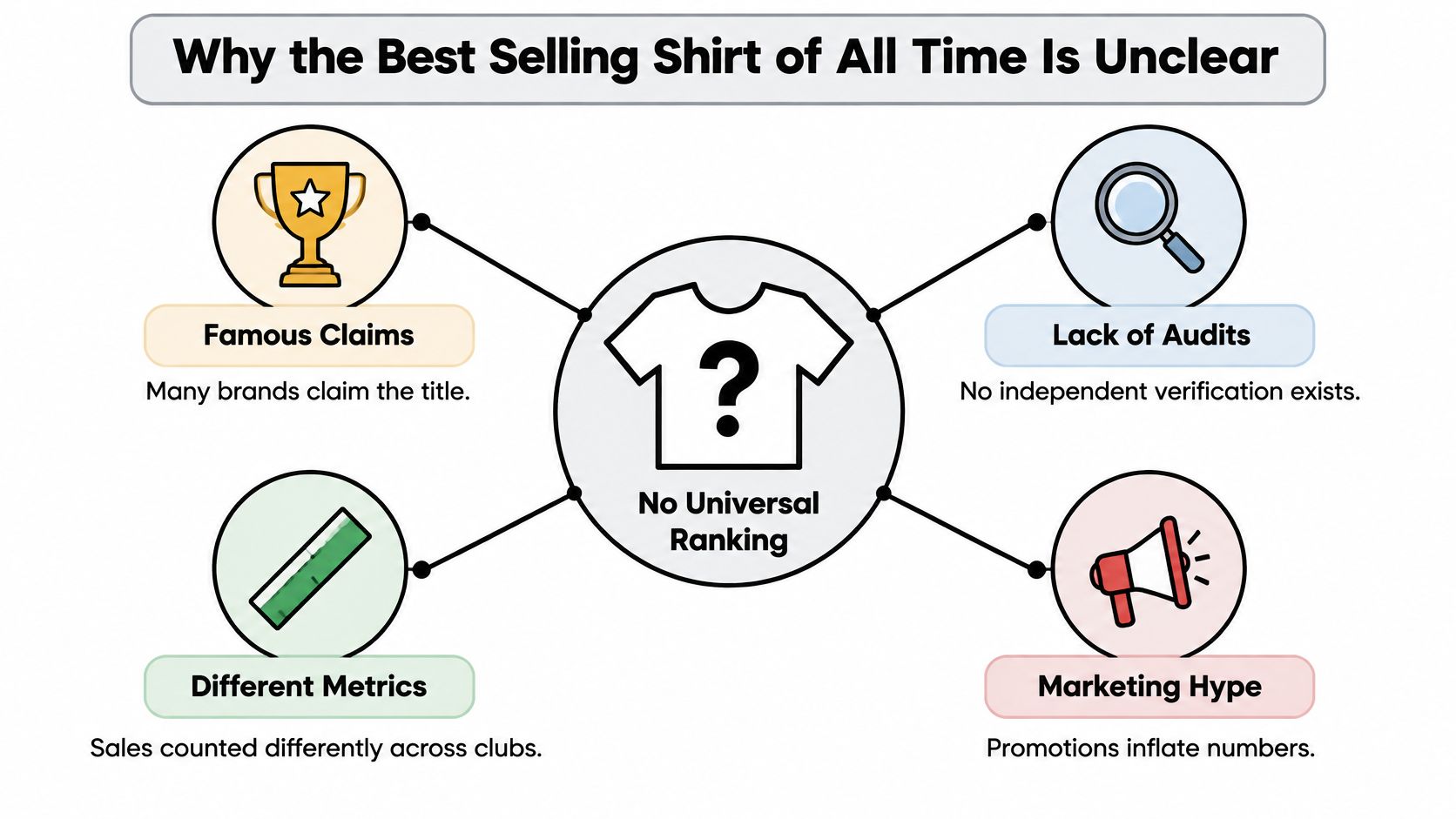
There's no universally audited ranking that definitively identifies one Best Selling Shirt of All Time. That isn't a minor gap in the record books. It's the central problem with the question, because competing claims describe different commercial events while using the same celebratory language.
One claim might cover a club's shirt sales across a full year. Another might describe one home design from one season. A third might count pre-orders placed before release, licensed replicas produced over many years, or every later retro reissue of an older classic. Those totals can't be placed in a single ranking without first agreeing on the unit being counted.
The diagram below maps why confident headlines and credible evidence so often diverge.
A Milestone Is Not a Championship
A credible sales milestone answers a narrow question well. It identifies the shirt or club, the period, the sales channel, and whether the figure represents completed purchases or another measure. A verified global champion would need much more, consistent reporting across brands, clubs, national teams, territories, and eras, checked against a shared audit standard.
That standard doesn't exist in the available evidence. Commercial analyses also produce mutually inconsistent leaders when they mix product definitions, time windows, sports categories, and verification standards, a problem visible in the conflicting all-time jersey claims compared by Alibaba's product analysis. A ranking built from incompatible inputs doesn't become reliable because its numbers look precise.
Treat every all-time claim as incomplete until it names its period, product definition, sales channel, and treatment of reissues.
This distinction does not make famous shirts less important. A design can shape football culture, define a player era, or dominate a tournament launch without holding a provable lifetime sales record. The analytical task is to preserve that cultural story while refusing to convert fame into an invented unit total. For fans and collectors, the better question is not which shirt supposedly won. It is what kind of success each reported figure proves.
How Football Shirt Sales Are Measured
Think of a shop counter on launch morning. Some customers have already reserved a shirt, some pay and leave with one, and some join a queue after the rail is empty. The shop can report reservations, completed transactions, revenue, or the speed at which stock disappeared. Each number is real in its own terms, but they don't answer the same question.
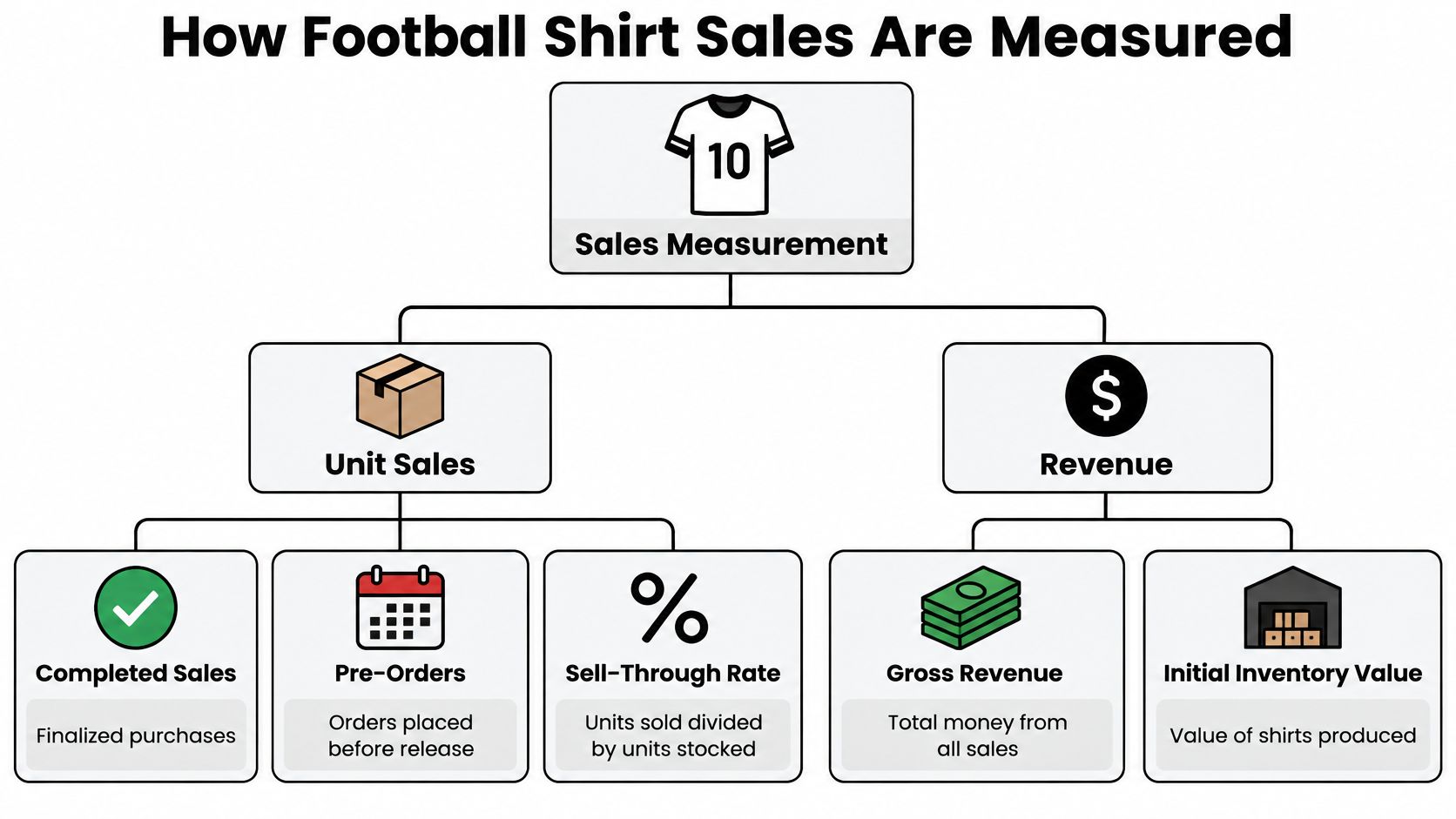
The measurement hierarchy below separates the terms that all-time rankings routinely blur together.
Units, Orders, and Stock
Completed unit sales count finalized purchases. That's the closest measure to what most readers mean by shirts sold, although the figure still needs a defined period and channel. It matters whether it includes only official retail, all licensed sellers, player-name versions, women's and children's cuts, or every related replica.
Pre-orders measure demand before release. They show urgency and expected popularity, but an order placed isn't automatically evidence of a completed lifetime total. Cancellations, allocation limits, later production runs, and unsatisfied demand can all sit behind the same launch headline.
Sell-through rate compares units sold with units stocked. A small release can sell through completely while moving fewer shirts than a mass-market design that remains available for months. Speed therefore proves intensity, not necessarily scale. A sold-out shirt may have had constrained inventory, exceptional demand, or both.
The short video below is useful context for how release mechanics can make early scarcity look larger than total market volume.
Revenue and Cumulative Editions
Revenue adds price into the equation. A premium authentic shirt can generate more money from fewer units than a lower-priced replica, so a revenue leader isn't necessarily the unit leader. Discounting, regional pricing, and bundled merchandise widen that gap further.
Cumulative sales create the hardest comparison. An original season shirt competes during a limited retail window, while an iconic design may return through anniversary editions, retro ranges, and licensed reproductions. Adding decades of reissues to one candidate and only one season to another produces a winner by definition, not by like-for-like performance.
Use this checklist before repeating any record claim:
- Product: Is it one design, one season, one player version, or a club's full range?
- Period: Does the figure cover a launch, a season, a calendar year, or a lifetime?
- Transaction: Are these completed sales, pre-orders, shipments, or units produced?
- Scope: Which countries, retailers, sizes, and licensed channels are included?
- Reissues: Are later retro editions counted with the original release?
- Verification: Can the methodology be inspected independently?
That commercial context matters beyond record hunting, which is why the business structures behind football shirt production and retail are relevant whenever a headline reduces a complex supply chain to one sales number. A claim that survives those questions may still not crown a global champion, but it becomes a record you can interpret responsibly.
Leading Football Shirt Sales Claims Compared
The strongest available figures describe different kinds of commercial success. Bayern Munich reportedly sold approximately 3.25 million football shirts in 2021, Real Madrid's 2014 shirt associated with Cristiano Ronaldo, Gareth Bale, and Sergio Ramos was reported at more than 1.8 million units, and Barcelona's 2019–20 checkered shirt from Lionel Messi's era was reported at more than 2 million units, according to reported club and shirt sales compiled by Accio. Those are reported estimates, not entries in an audited all-time table.
Nigeria's 2018 World Cup home shirt belongs in a different category. Nike reportedly received about 3 million pre-orders, online stock sold out in roughly three minutes, and the flagship London store reportedly sold out in about an hour, based on reporting of Nigeria's 2018 launch demand by SportsMonkie. That is exceptional evidence of launch demand. It isn't the same evidence as finalized lifetime unit sales.
Reported Football Shirt Sales Claims
| Shirt or club | Reported figure | What the figure represents | Key limitation |
|---|---|---|---|
| Bayern Munich, 2021 | Approximately 3.25 million shirts | Club-wide annual shirt sales | Not attributable to one single design |
| Real Madrid, 2014 | More than 1.8 million units | A specific high-profile shirt edition | Reported estimate without a common audit standard |
| Barcelona, 2019–20 | More than 2 million units | A specific checkered home shirt | Scope and channel definitions aren't standardized |
| Nigeria, 2018 World Cup | About 3 million pre-orders | Pre-release demand for a national-team shirt | Pre-orders aren't completed lifetime sales |
| Brazil, 1970 reproductions | Disputed cumulative claims | Later official reproductions and replicas | No clearly inspectable independent audit |
How to Read the Table
Bayern's row demonstrates annual club scale. A major club can move enormous volume across home, away, third, training-related, and player-specific products, depending on how the underlying count is defined. It would be misleading to transfer that whole annual result to one shirt design unless the source explicitly did so.
Real Madrid and Barcelona offer closer examples of single-edition strength. Their figures suggest that a globally supported club, a recognizable design, and era-defining players can push one shirt into seven-figure reported sales. Even there, inconsistent auditing standards prevent a clean ranking between them, let alone against every shirt in football history.
Nigeria demonstrates velocity. Pre-orders and rapid sellouts reveal concentrated demand at launch, especially when initial supply is limited. That can be culturally and commercially remarkable while still leaving the final lifetime total unresolved. Brazil's 1970 design demonstrates duration, because reproductions extend the counting period far beyond the original tournament era.
Decision rule: Compare annual club volume with annual club volume, launch demand with launch demand, and cumulative reissues only with cumulative reissues.
No row can responsibly be promoted into an absolute Best Selling Shirt of All Time from this evidence. Each row wins a different contest. The useful conclusion is narrower and stronger, elite football shirts can reach multimillion-unit reported scale, but the metric attached to the number determines what that scale means.
Examining the Contenders Behind the Claims
A contender's story often explains both its popularity and the weakness of its record claim. Nigeria's 2018 shirt became a global talking point before the World Cup because the design was instantly recognizable and the release created visible scarcity. Supporters weren't just buying national-team equipment. They were competing for a limited cultural object at the moment tournament attention peaked.
That context makes the launch historically significant, but it also defines the limit of the evidence. Pre-release demand measures how many people tried to secure the shirt early. It doesn't, by itself, establish how many units were ultimately manufactured, delivered, discounted, returned, or sold across later restocks. Calling it a landmark demand event is defensible. Converting it automatically into the Best Selling Shirt of All Time isn't.
Brazil 1970 and the Reissue Problem
Brazil's 1970 shirt has the opposite profile. Its power comes from endurance, the association with Pelé and one of football's most celebrated teams, and the design's continued life through reproductions. A shirt can remain commercially present for decades because each new generation rediscovers the original story.
That long life creates a counting problem. Original-period sales, officially licensed replicas, anniversary products, and modern retro editions aren't interchangeable units. If they're combined, the result measures the design's cumulative merchandising footprint. If they're separated, the original shirt must be judged within the retail conditions of its own era.
One commercial account attributes more than 4.1 million official replicas to FIFA licensing data, but the Alibaba-hosted analysis of the Brazil claim provides no independently inspectable FIFA report, methodology, or audited sales trail. The missing audit trail matters more than the size of the number. Without it, readers can't verify which products were counted or whether production, licensing, and retail sales were treated as the same event.
Production Is Not Proof of Purchase
Manufacturing language adds another layer of confusion. A production run tells you what was made, not what consumers bought. Retailers may receive stock that later sells at full price, moves through outlets, or remains unsold. Licensed production can also cover multiple territories and product grades.
For readers trying to understand how a design becomes a physical garment at scale, reviewing factory-ready fashion specs clarifies why tech packs, size runs, materials, and production quantities belong to manufacturing evidence rather than consumer sales evidence. A factory can document output precisely while the final retail result remains unknown.
Three conclusions must stay separate:
- Iconic status: The shirt occupies a lasting place in football memory.
- Large-scale availability: Many units or reproductions entered the market.
- Verified sales leadership: Audited completed sales exceed every comparable rival.
Nigeria clearly supports the first conclusion and provides striking launch evidence. Brazil clearly supports the first and plausibly the second. Neither case, on the available evidence, proves the third. That's not a downgrade. It's a more accurate account of why each shirt matters.
What Drives Massive Football Shirt Demand
Massive demand rarely comes from one cause. It appears when identity, visibility, timing, and availability reinforce one another until buying feels urgent. A supporter may want the shirt eventually. A launch becomes exceptional when thousands of people decide they need it immediately, before sizes disappear or the cultural moment passes.
The flow below shows how those forces build momentum rather than operating as isolated marketing tricks.
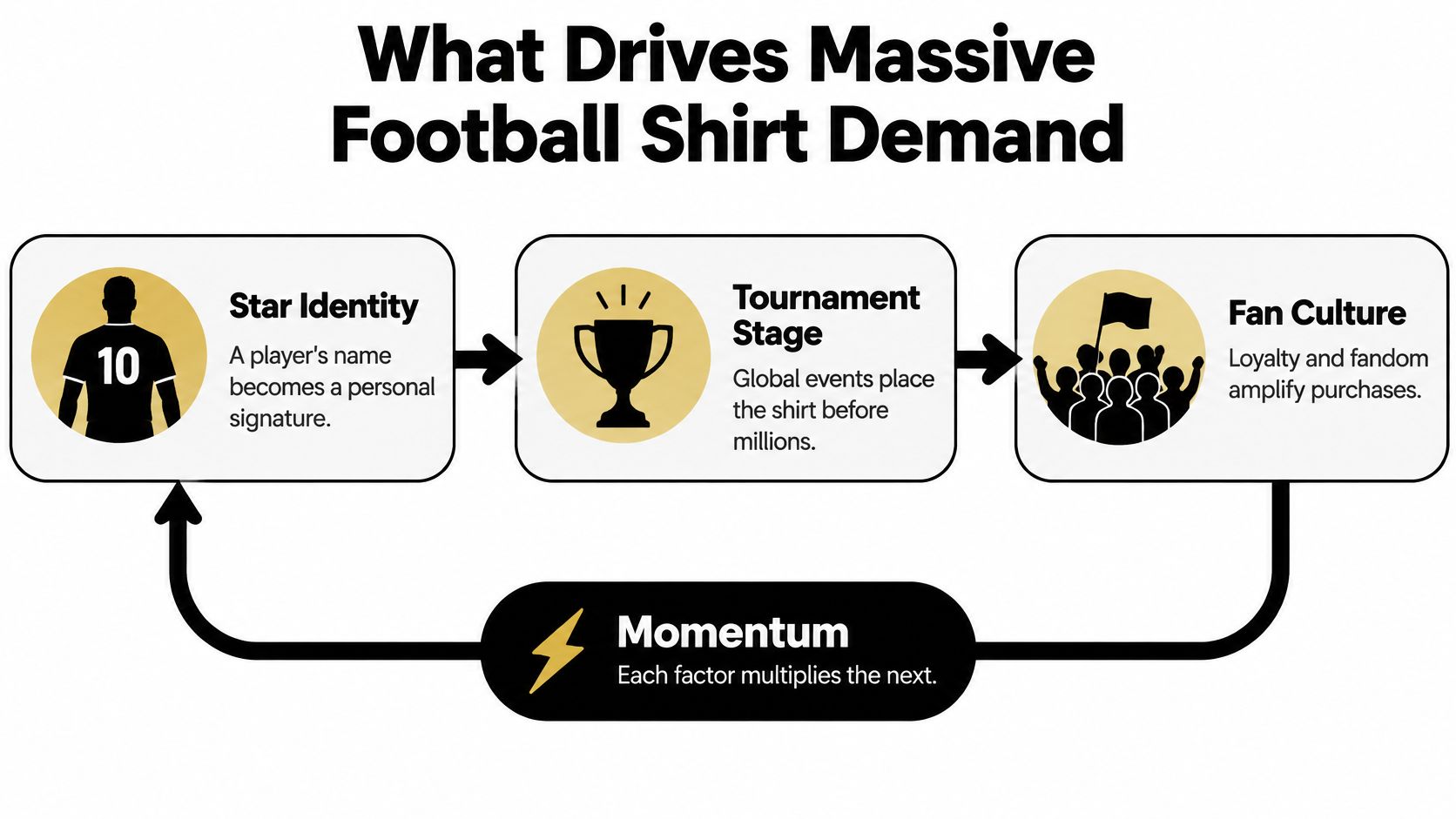
Star Identity Turns a Team Shirt Personal
A famous player's name changes the product. The buyer isn't only affiliating with a club or country; they're wearing a specific career, playing style, and set of memories. Ronaldo, Messi, Bale, Ramos, and Pelé give shirts narrative anchors that survive a single match. Player identity also travels across borders more easily than local club loyalty, allowing one edition to reach supporters who follow the individual first.
That effect explains why a shirt associated with a defining era can outperform a technically similar design from a quieter season. The garment becomes a signature. For collectors, the player association may matter more than whether the club's total annual volume was larger in another year.
Tournaments Compress Attention
A World Cup or continental championship concentrates global attention into a short window. Casual viewers encounter the same shirt repeatedly, social sharing amplifies distinctive details, and national identity gives non-club supporters a reason to participate. Nigeria's launch shows how tournament visibility and scarcity can accelerate purchasing before the competition fully unfolds.
Design distinctiveness is the multiplier. A shirt that looks like every previous edition may sell steadily to committed supporters, while a bold pattern can be recognized in a thumbnail, photographed well, and discussed by people who don't normally buy football merchandise. Analysts who find POD niches use a related principle in apparel research, looking for visual themes with immediate recognition and a clearly defined audience rather than relying on generic demand.
Scarcity then changes timing. Limited initial inventory doesn't create interest from nothing, but it can turn interest into immediate orders. Once early stock disappears, queues, resale listings, and sold-out notices become further evidence of desirability, even though they don't reveal total production.
The resulting framework is simple:
- Club annual volume rewards a large, durable supporter base and a broad product range.
- Player-era editions reward personal attachment to globally recognized stars.
- Tournament launches reward visibility, national identity, and compressed urgency.
- Retro designs reward memory, repeat exposure, and long-term cultural relevance.
These categories produce different peaks. Comparing them as if they were one market behavior obscures the reason each shirt succeeded.
Supporter Demand Meets Football Shirt Fashion
A shirt bought for a stadium and a shirt bought for an outfit can be physically identical while serving different markets. The supporter asks whether it represents the right club, country, season, and player. The fashion buyer may care first about color, silhouette, retro graphics, scarcity, or how the shirt works with everyday clothing. A collector adds condition and provenance. A reseller watches speed and premium.
Recent fashion-market signals show why those missions shouldn't be merged. Depop searches for football shirts rose 294% during the 2024 European Championship, StockX sales increased 68% year on year, and fashion-oriented jersey sales reportedly rose more than 328% year on year, according to NSS Magazine's analysis of football shirts as fashion. Search growth, resale activity, and fashion sales are meaningful, but none is a direct substitute for official club unit disclosures.
Popularity Has More Than One Scoreboard
A retro shirt can dominate social feeds because it photographs well and carries nostalgia, even if its original production was modest. A current replica can sell heavily through club stores without becoming a streetwear reference. Cross-gender styling and collaborations can also move a design beyond the supporter's usual buying cycle, creating visibility that traditional merchandise reports don't capture cleanly.
This split explains a common collector mistake. High resale attention doesn't automatically mean high original sales. In some cases, it means the opposite, limited supply met renewed fashion demand. Conversely, a mass-selling modern shirt may remain easy to find because production was large, even though its completed unit total was stronger.
The cultural history in football shirt culture and collecting helps explain why garments move between terrace identity, personal archive, and fashion wardrobe without losing their football meaning. That movement makes shirts richer cultural objects, but it makes single-metric rankings weaker.
Ask four questions when a shirt is described as hugely popular:
- Support: Are committed fans buying it to represent a team?
- Style: Are fashion buyers wearing it away from matchday contexts?
- Collecting: Are buyers preserving specific editions, sizes, or player versions?
- Resale: Is visible demand driven by scarcity and expected premiums?
A Best Selling Shirt of All Time claim based only on official volume can miss fashion influence. A claim based only on searches or resale can miss mass supporter purchases. The datasets don't merely disagree; they measure different forms of desire. Serious buyers should name which form they're paying for before treating popularity as evidence of rarity or long-term collectability.
How to Judge Shirts Before You Buy or Collect
Start with identity, not the headline attached to the listing. Establish the team or country, season, tournament, competition, manufacturer, and player association. Then determine whether the product is an original-period release, a later reissue, a supporter replica, an authentic match-specification version, or a modern fashion edition inspired by an older design.
Those categories affect both meaning and price. An original shirt connects directly to the season it represents. A high-quality reissue can celebrate the same design, but it shouldn't be priced or described as though it came from the original retail cycle. Cumulative fame doesn't erase edition history.
A Practical Verification Sequence
- Match the SKU and labels: Compare internal codes, wash labels, manufacturer marks, sizing, and country-specific details with reliable references for that exact release.
- Separate the sales story from the object: A famous tournament or player can explain demand, but it doesn't authenticate the individual shirt in front of you.
- Inspect completeness and condition: Check sponsor prints, badges, name sets, sleeve patches, fabric wear, odors, repairs, and whether any element was added later.
- Interrogate rarity language: Ask whether scarcity refers to original production, surviving examples in good condition, one size, or simple resale hype.
- Record provenance: Keep receipts, seller details, photographs, and any documentation that connects the shirt to its source.
The detailed checks in how to verify whether a football shirt is authentic are especially useful when a listing relies on broad claims about popularity instead of product-level evidence. Popularity can justify interest. It can't substitute for labels, construction, and traceable seller information.
Personalization deserves the same care. Adding a name or number can deepen the connection to a player era, but it can also alter collectability if the print style doesn't match the season. Before customizing, review how to personalize your football kit so the lettering, placement, and intended use fit the shirt rather than undermining its identity.
Surprise-format buying solves a different problem. Mystershirt states that every jersey is authentic, customers can choose sizes from children to 5XL, specify clubs, leagues, or colors to avoid, and receive a 100-day money-back guarantee. That model prioritizes discovery and authenticity controls when the exact SKU isn't known in advance, rather than asking the buyer to chase a supposed all-time ranking.
Buy the record you can verify, the edition you can identify, and the story you actually want to own.
The strongest conclusion isn't a false champion. It's a source-qualified record matched to your purpose, whether that purpose is supporting a team, preserving a player era, wearing a design as fashion, or building a documented collection.
If you want to discover an authentic football shirt without getting lost in unverifiable Best Selling Shirt of All Time claims, explore the mystery boxes at Mystershirt, choose your size and exclusions, and let a genuine club or national-team design find you. It's a practical way to build a collection around real shirts, real stories, and the fun of not knowing exactly which piece of football culture arrives next.