You've just found the shirt you've been hunting for. The club is right, the season matters, and the listing calls it authentic. You pay, wait for delivery, and open the parcel expecting the same player-version jersey you saw in the photographs. Instead, the badge feels wrong, the fit is unusually loose, or the inside label offers no useful proof at all.
That's the risk with buying authentic football jerseys for sale online. You can't handle the fabric, inspect the crest, or question the seller before money changes hands. The answer isn't just “buy from a reputable seller.” You need a repeatable inspection process, a clear understanding of shirt tiers, and a return policy that gives you time to check what arrived.
Table of Contents
- The Unboxing Moment Every Collector Worries About
- Player Version vs Licensed Replica Explained in Plain English
- A Home Inspection Checklist for Tags, Codes, and Stitching
- Realistic Price Ranges and What Cheap Really Signals
- Sizing From Kids to 5XL Without the Guesswork
- Where to Buy Safely, From Club Stores to Mystery Boxes
- How Mystershirt's Model Reduces Buyer Risk
- Returns, Shipping, and Payment Questions Answered
The Unboxing Moment Every Collector Worries About
The first few seconds matter. Keep the packaging, invoice, product description, and order confirmation beside you before you remove the shirt. If the listing promised a player-version shirt and the parcel contains a comfortable fan replica, you'll need evidence of what was advertised, not just a vague impression that something feels off.
Start with the basics. Compare the club, manufacturer, season, color, size, and version against the listing. A genuine licensed replica can be legitimate merchandise, but it still isn't the same specification worn by players. That distinction is where many expensive misunderstandings begin.
Collector's rule: Don't wear, wash, personalize, or remove tags from a questionable shirt until you've documented it and decided whether you'll keep it.
Football shirts have carried club identity for more than a century. Standardized shirts became commonplace throughout England during the 1890s, and the garment later developed into licensed replica merchandise and collectible evidence of specific seasons, sponsors, players, competitions, and manufacturers, as explained in the institutional history of the football jersey. That history is why collectors care about more than color and appearance. A shirt can preserve a particular football moment.
This guide focuses on the practical question most buying articles avoid: what proof should you expect when purchasing a shirt sight unseen? You'll learn how to distinguish player versions from replicas, inspect tags and codes at home, interpret suspicious prices, choose a safer buying channel, and use a documented guarantee to reduce your financial exposure.
Player Version vs Licensed Replica Explained in Plain English
The first mistake is treating “authentic” as a complete product description. Ask the seller which construction you're getting. In most cases, you're choosing between a player-version shirt and an officially licensed replica.
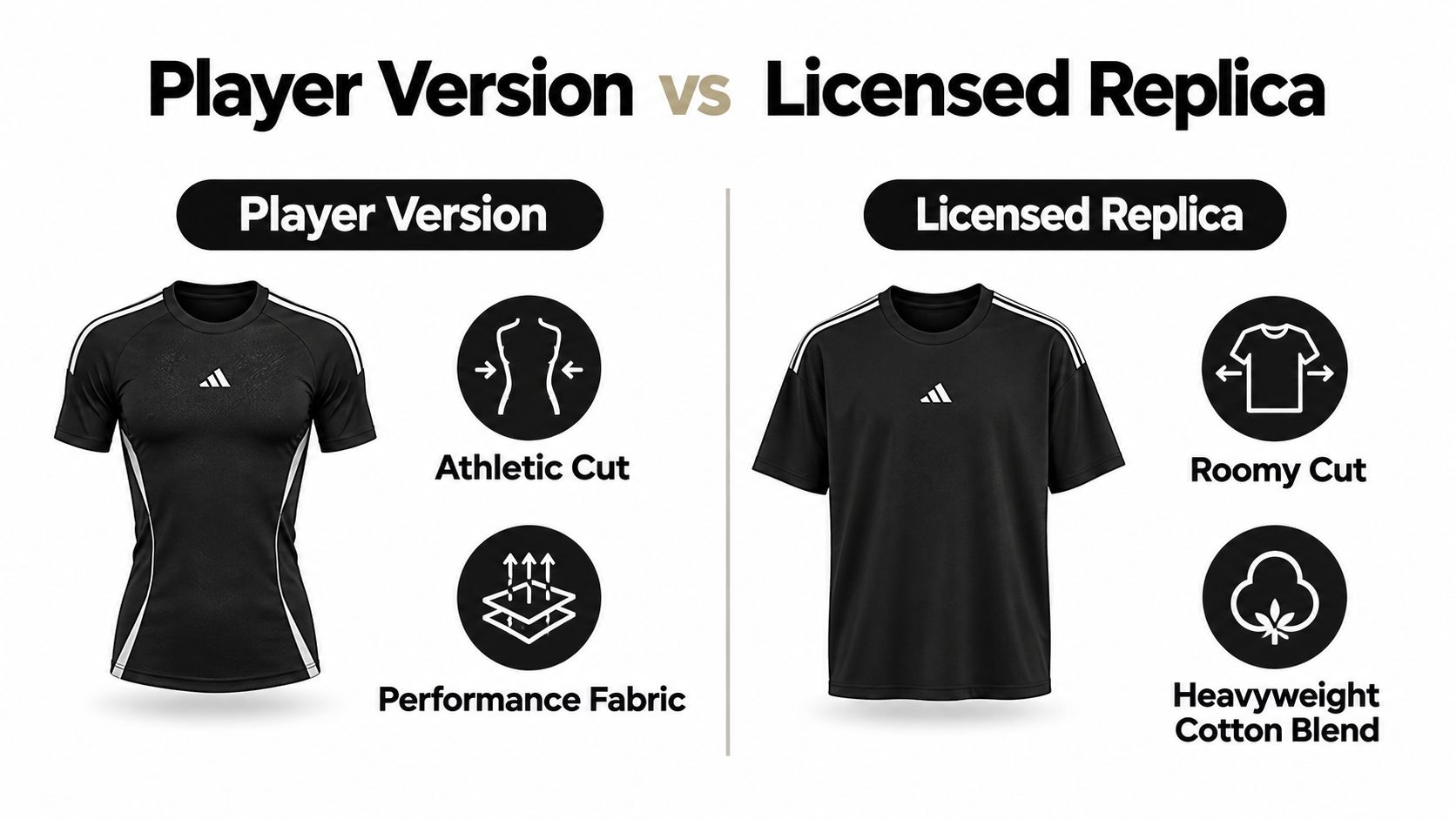
A player-version shirt is built around athletic performance. It generally has a slimmer cut, lighter fabric, bonded or heat-applied crests and logos, and laser-cut ventilation. The design reduces bulk and supports breathability during intense use. It's closer to the specification worn on the pitch, though the exact details vary by manufacturer and release.
A licensed replica is also genuine merchandise, but it's designed for supporters rather than match performance. It normally has a roomier fit, heavier fabric, embroidered or stitched badges, and more conventional panels. That extra structure can make it better suited to everyday wear, especially if you prefer a relaxed shirt over a close athletic fit.
Read the listing like a product specification
Look for four details before ordering:
- Cut: “Slim,” “athletic,” or “match” usually indicates a closer fit. “Fan,” “stadium,” or “replica” generally points to a roomier shape.
- Fabric: Player versions use lighter performance materials, while replicas typically feel heavier and more substantial.
- Crest and logos: Bonded or heat-applied applications are common on player versions. Embroidered or stitched badges are common on replicas.
- Ventilation: Laser-cut or zoned ventilation suggests a performance construction. Standard panels don't automatically indicate a fake, but they support a replica classification.
Don't reject a shirt because it's a replica. Reject a listing that hides the distinction while charging you for the higher tier. The practical comparison of authentic and replica football shirts describes these construction differences in buyer-friendly terms.
Ask customer service a direct question: “Is this a player-version shirt or an officially licensed replica, and how are the crest and manufacturer logos applied?” A seller who can't answer that clearly hasn't given you enough information to spend collector-level money.
A Home Inspection Checklist for Tags, Codes, and Stitching
Inspect the shirt on a clean, dry surface under bright, neutral light. Don't rely on one feature. Counterfeit products can imitate a hologram, copy a label, or reproduce a convincing badge. Authenticity comes from several details agreeing with one another.
Four checks to complete before wearing it
- Photograph the arrival. Capture the parcel, packaging, front and back of the shirt, neck label, wash-care label, crest, sponsor application, and product code. Keep the images original and dated.
- Read the brand details. Check the woven or holographic brand tag, manufacturer name, licensing language, fabric information, and care symbols. Blurred printing, spelling errors, inconsistent type, or flimsy labels deserve attention.
- Match the product code. Find the style or SKU code on the inner label and compare it with the manufacturer's official catalog or product information. The code should correspond to the club, colorway, season, and shirt type. A code that belongs to a different design is a serious warning.
- Inspect construction. Examine the crest edges, sponsor print, seams, collar, sleeve ends, and inside finishing. Look for clean alignment, even stitching, consistent material, and an application method that matches the advertised tier.
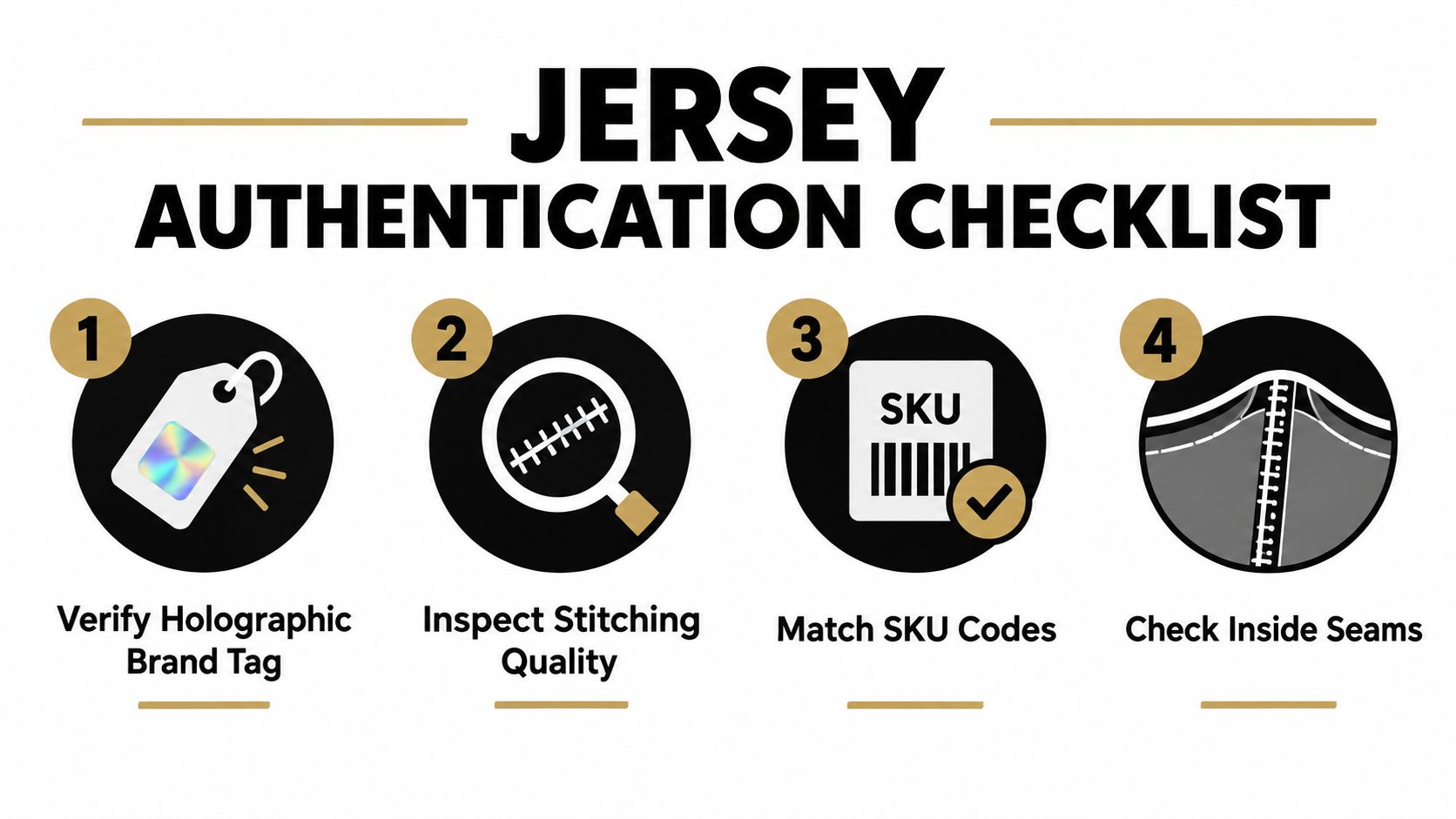
The code check is useful, but it isn't conclusive by itself. Counterfeiters can copy valid codes from real shirts, so compare the entire garment rather than treating one matching number as a guarantee. The football shirt authenticity checklist can support this inspection, particularly if you're unfamiliar with a manufacturer's labeling system.
Preserve your return evidence
If something fails inspection, stop handling the shirt unnecessarily. Photograph the issue close up, save screenshots of the original listing, and write down exactly what differs from the description. Contact the seller in writing and ask for a clear resolution.
U.S. Customs and Border Protection has documented the consequences of counterfeit football shirts. In one Rochester seizure, officers confiscated 80 counterfeit soccer jerseys, including 40 FIFA-branded shirts, with an estimated genuine MSRP of approximately $12,200, according to the CBP release on counterfeit FIFA jerseys. The lesson for buyers is simple: sourcing and trademark legitimacy matter just as much as fabric quality.
Realistic Price Ranges and What Cheap Really Signals
Price needs context. A current player-version shirt, a licensed replica, and an older retro release aren't interchangeable products, so a single “normal jersey price” is useless. Ask what tier the seller is offering, whether the item is new or pre-owned, and whether the discount has a documented explanation.
A useful benchmark comes from European football merchandising. Across England, Spain, Germany, Italy, France, the Netherlands, Poland, Russia, Turkey, and Ukraine, one study recorded 13.7 million replica shirts sold during the 2009–10 season. The research covered 182 top-flight clubs and more than 10,000 consumers, while Adidas and Nike together held approximately 83% of the shirt-manufacturing market, as reported in FourFourTwo's coverage of European merchandise income. This is a large, structured licensed market, not an informal category where every low-priced listing is equally plausible.
| Tier | Typical Price Range (USD) | Red Flag Price |
|---|---|---|
| Player-version shirt | Premium pricing | A deep discount with no sourcing explanation |
| Licensed replica | Mid-range pricing | A price that undercuts comparable official shirts without clear clearance details |
| Retro release | Varies by age, condition, and licensing | A supposedly rare shirt offered cheaply with no provenance |
A $30 current-season player shirt should make you stop and investigate. It may be a used item, a clearance product, a misdescribed replica, or a counterfeit. The number itself doesn't prove fraud, but the seller needs to explain why the price is so far below comparable legitimate stock.
A mystery-box discount works differently. The buyer accepts uncertainty about the exact club, season, or design, while the seller can move varied inventory through a curated format. That means a low entry price isn't automatically suspicious if the retailer identifies the product as authentic, provides labels, and offers meaningful returns. You can see how product tiers and pricing are discussed in this guide to authentic soccer jersey costs.
Price test: Cheap is acceptable when the seller can explain the discount. Cheap plus vague product details plus no usable return route is a bad purchase.
Sizing From Kids to 5XL Without the Guesswork
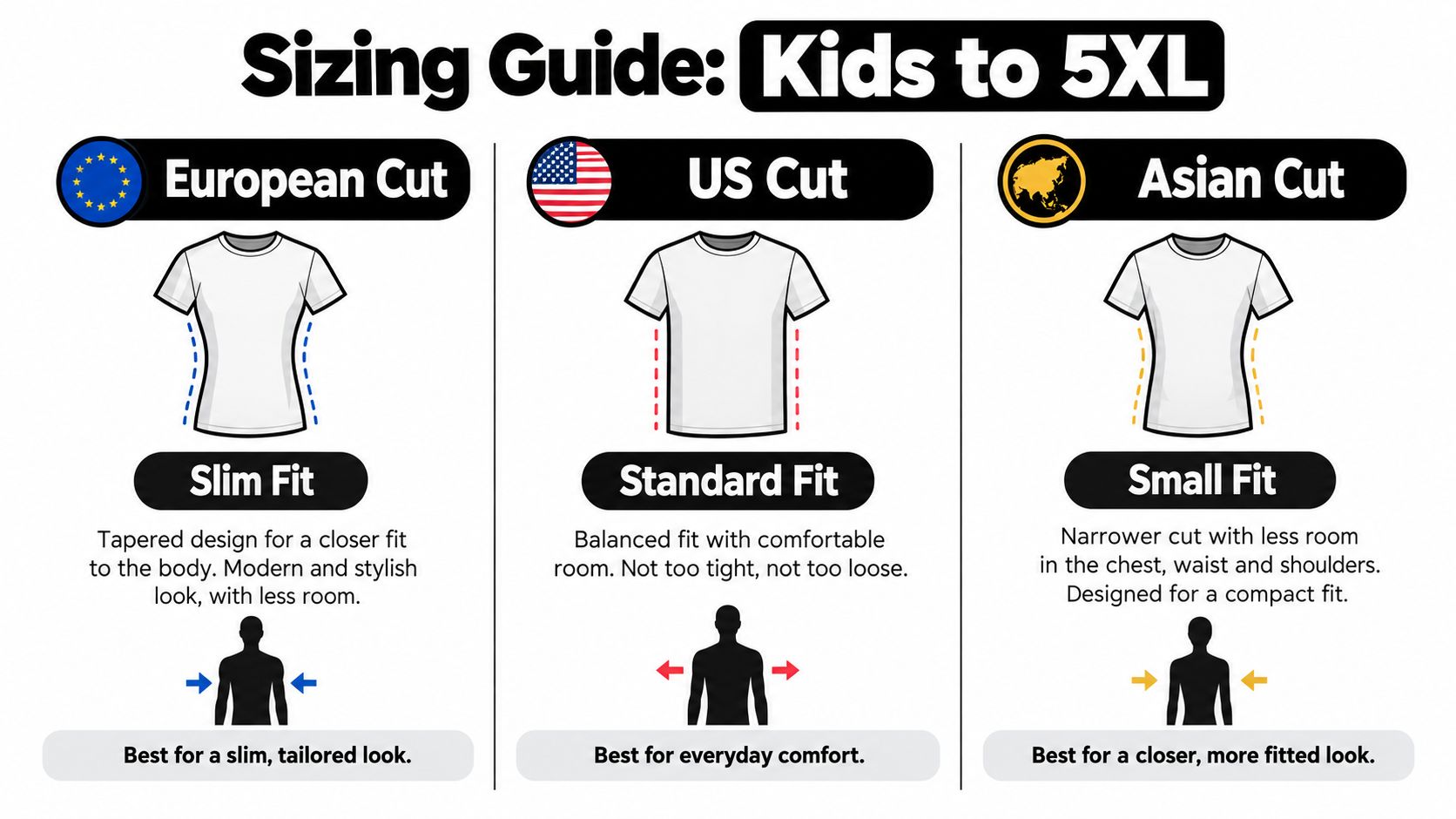
Sizing is where an otherwise genuine shirt can still become a disappointing purchase. A “large” doesn't describe a universal measurement. European cuts often feel slimmer, U.S. cuts are commonly roomier, and Asian cuts can run smaller. The label matters less than the garment's actual chest width, body length, and shoulder shape.
Measure a shirt you already own and like. Lay it flat without stretching it, measure across the chest from armpit to armpit, then measure the length from the highest shoulder point to the hem. Compare those numbers with the seller's chart for the exact shirt and version, not with a generic chart copied across an entire store.
Choose by use, not ego
A player-version cut should fit close without pulling across the chest or restricting movement. If you plan to layer the shirt over a base layer, or you prefer a relaxed streetwear fit, size measurements may point you toward a larger option. A replica often provides more room at the same nominal size, so never transfer your player-version size automatically.
Parents should measure the child's current shirt rather than buying only by age. Children grow quickly, but an oversized jersey can become unwearable before it becomes comfortable. For adults, check sleeve length and body length as carefully as chest width, especially if you need big-and-tall sizing.
Use this conversion routine:
- Record measurements: Chest, length, shoulder width, and sleeve length.
- Identify the construction: Player version and replica cuts can differ substantially.
- Check the region: Confirm whether the chart uses European, U.S., or Asian measurements.
- Ask before ordering: Send the seller your measurements if the chart is unclear.
- Keep the packaging: Don't remove tags until you've tried the shirt over the intended base layer.
A broad range from children's sizes through 5XL is useful only if the retailer gives garment measurements and explains the cut. The authentic football jersey size chart is a sensible reference point before you commit.
Where to Buy Safely, From Club Stores to Mystery Boxes
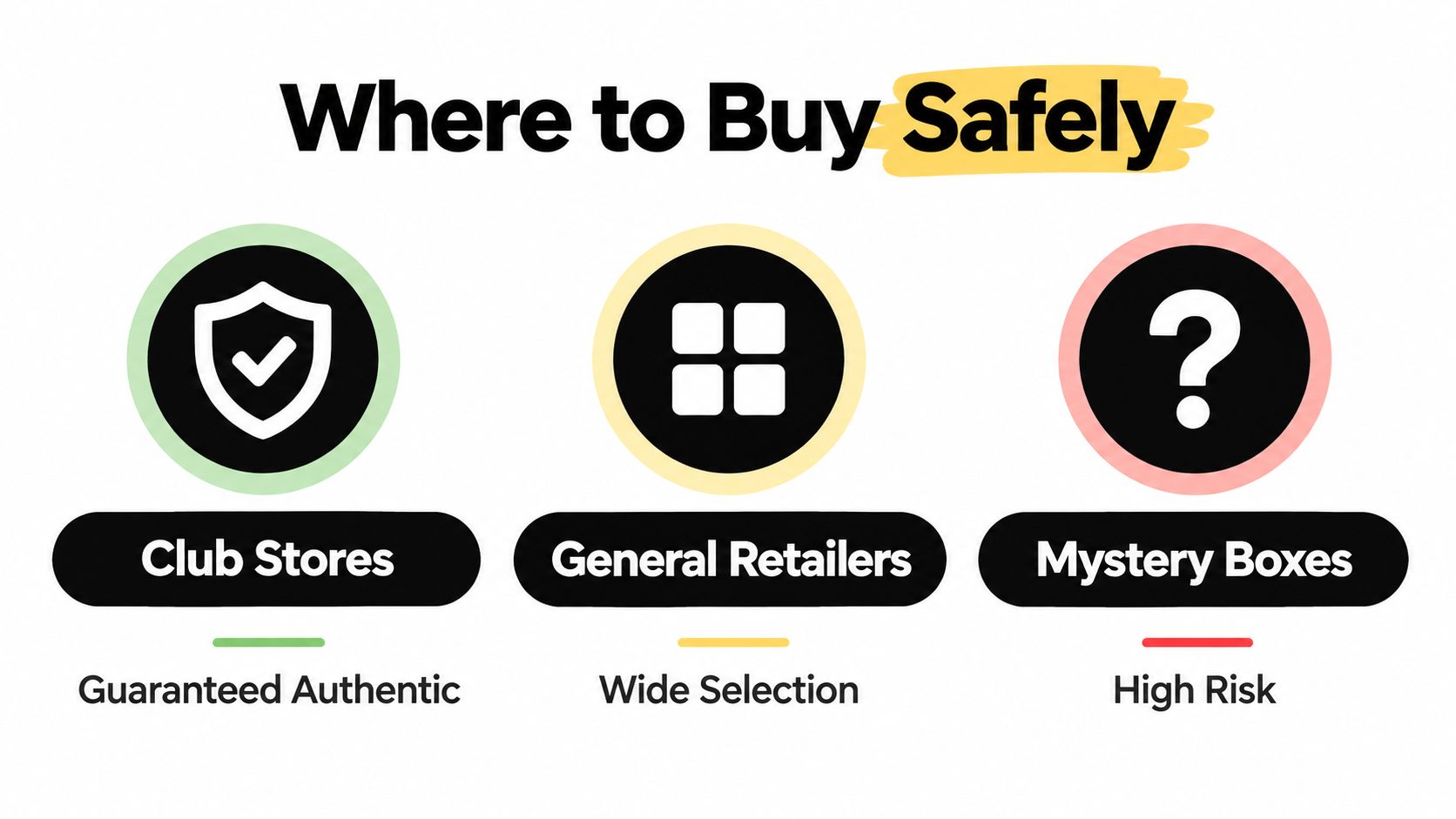
The safest channel depends on what you're buying. A club store is the straightforward choice for a current shirt when you know the exact club, season, and size. You get a clear product identity and an official retail relationship, but selection may be narrower for older designs or unusual leagues.
General retailers offer convenience and breadth. They're useful for current kits, common sizes, and straightforward exchanges. Read the product title carefully, though. A large retailer can still list separate player-version and replica products, and the photograph alone won't tell you which one is in the cart.
Resale marketplaces require the most discipline. They can surface discontinued shirts, rare colorways, and pre-owned pieces, but seller quality varies. Demand close-up images of labels, product codes, crests, sponsor marks, and seams. Treat stock photos, pressure to pay outside the platform, and “no returns” language as reasons to leave.
Match the channel to the job
| Buyer priority | Most suitable channel | What to verify |
|---|---|---|
| Exact current club shirt | Club store or established retailer | Version, size, customization, return terms |
| Discontinued or collectible shirt | Resale marketplace | Provenance, condition, code, seller protection |
| Surprise gift or group order | Specialty retailer or box format | Authenticity promise, exclusions, sizing, guarantee |
| Lowest possible price | Clearance or resale | Why the discount exists and whether returns remain available |
A specialty retailer can make the mystery format less risky when it publishes its authenticity policy and gives buyers a real inspection window. That's different from a faceless marketplace listing where the seller's only assurance is a caption.
For club managers, fan communities, and organized supporters, a Sports Club App can also help centralize club communication and coordinate group activity around orders or events. It doesn't authenticate a shirt, but organized buying gives groups a better way to record sizes, preferences, and delivery details.
How Mystershirt's Model Reduces Buyer Risk
Mystershirt offers mystery football shirt boxes beginning at $33.32, with Premium, Retro, Kids, and sharing or bundle options. The buyer chooses a size and can identify clubs, leagues, or colors to avoid, while the exact shirt remains part of the unboxing experience.
The useful part of the model is the documentation. The company states that every jersey is 100% authentic and delivered with labels, which gives you specific items to inspect rather than asking you to trust an unexplained “genuine” claim. Its 100-day money-back guarantee also changes the purchase calculation. You can receive the shirt, compare the listing with the garment, check the labels and code, assess the fit, and raise an issue before the decision becomes irreversible.
Mystershirt reports 40,000+ shirts in stock, 300,000+ jerseys sold, and a 4.3/5 rating across 1,000+ reviews. Those figures don't prove that every individual shirt will suit your taste, but they give a buyer operational signals to consider alongside the written guarantee and inspection process.
The practical advantage: Mystery removes the need to choose a specific shirt, but the guarantee preserves your ability to verify what you receive.
That makes the model suitable for fans who value discovery, gifts, and group orders more than selecting one precise current kit. It isn't the right format if you need a particular player version or exact season. In that case, buy the identified product and inspect its specification before paying.
Returns, Shipping, and Payment Questions Answered
How should the 100-day guarantee work in practice? Treat it as an inspection window, not permission to ignore the product condition. Photograph the parcel and shirt on arrival, compare the item with the order, inspect the tags and construction, and contact the seller promptly if the description or authenticity evidence doesn't match. Keep the shirt unworn and retain its packaging while you decide.
How long should delivery take? Mystershirt states that express delivery in Europe typically takes 1–4 days, while global shipping ranges from 1–30 days. Use those windows when ordering a gift or planning a group unboxing, and remember that international delivery timing can vary by destination and customs handling.
Which payment methods are available? The listed options include Apple Pay, Google Pay, PayPal, major cards, Shop Pay, and Klarna buy now, pay later. Choose a method that gives you a clear transaction record, then save the confirmation with the product description and any correspondence.
What are Sharing Boxes and signed items for? Sharing Boxes suit friends, teammates, and family members who want several shirts in one order. Signed items and shorts can add variety to a gift, but confirm exactly what the box contains before checkout, especially when recipients have different sizes or club preferences.
The routine is simple: document delivery, inspect before wearing, compare the promised tier with the actual construction, and use the return process if the evidence doesn't add up. That's how you turn online buying from a blind gamble into a controlled purchase.
If you want the surprise of a mystery box without giving up authenticity checks, Mystershirt offers labeled football jerseys across Premium, Retro, Kids, and sharing formats, backed by a 100-day money-back guarantee. Choose your size, set exclusions, and inspect the shirt properly when it arrives.