You've bought the shirt that started it all. It might be the kit from your first match, a favourite player's number, or a retro design you spotted while scrolling late at night. Then another arrives, followed by a current-season release, a bargain from a resale platform, and perhaps a mystery box shirt you'd never have chosen yourself. Suddenly, the rail is filling up, but the collection still feels accidental.
The best football shirt collection isn't necessarily the largest or most expensive. It has a point of view. Each shirt has a reason for being there, its authenticity has been checked, and its condition is recorded accurately. The market is now large enough to support serious collecting across club, national-team, retro, replica, and limited-edition categories. One estimate places the global football shirts market at USD 6.84 billion in 2025, with a projection of USD 11.74 billion by 2035, while another report estimates USD 6.4 billion in 2025 and growth to USD 11.2 billion by 2034. These differing estimates still point to the same conclusion, football shirts have become a substantial global collector market. (Business Research Insights)
Table of Contents
- What Makes a Football Shirt Collection Truly Great
- Choosing Your Collecting Philosophy and Budget Tier
- How to Authenticate Any Football Shirt Before You Buy
- Comparing Where to Buy Authentic Football Shirts
- Grading Shirt Condition the Way Dealers Do
- Storing, Displaying, and Caring for Your Collection
- Your 12-Month Plan to Build a Collection You Love
What Makes a Football Shirt Collection Truly Great
Stand in front of a new collector's first display wall and the difference between individual shirts becomes obvious. A signed match-worn piece may sit beside a faded replica, while a beautiful retro shirt occupies space next to an impulse purchase that already feels forgettable. The issue isn't variety. It's that the shirts haven't been given a shared purpose.
A serious collection should answer three questions before the next purchase:
- What drives it? Nostalgia, personal memories, design, club loyalty, historical importance, or resale potential?
- What's the boundary? One club, several clubs, a national team, a manufacturer, a decade, or a tournament?
- What matters most? Rarity, condition, provenance, wearability, or emotional meaning?
Coherence gives the collection its identity
A coherent collection doesn't need to follow one club exclusively. It might focus on World Cup winners, 1990s goalkeeper designs, shirts associated with a particular player era, or unusual collaborations. Public archives now document championship shirts year by year, including Spain's 2026 World Cup title kit, France's 2018 shirt, and Germany's 2014 shirt. That kind of historical record gives collectors a useful foundation for building around tournament moments and national identity. (The Market Intelligence)
Club jerseys remain the largest product-type segment in the football shirts market, and apparel has been estimated at 42.0% of total football merchandise market share. (The Market Intelligence) The commercial scale helps explain why club shirts dominate collections, but personal meaning should decide what earns a place on your wall.
Authenticity and condition protect the story
A shirt's history only adds value if the shirt itself is genuine. A rare-looking design with no reliable tag, inconsistent details, or an implausible seller story is a risk, not a centrepiece. Match-worn memorabilia also belongs in a different category from mass-produced replicas, even if both carry the same player name.
Condition discipline matters just as much. A small pull, sponsor crack, yellowing mark, or stretched collar can change how a dealer values a shirt. Washing a valuable piece carelessly can erase the very condition premium you paid for.
Collector's rule: Buy fewer shirts when necessary, but make sure each one has a clear reason, a credible identity, and a condition grade you can defend.
The practical framework is straightforward. Decide what the collection means, set buying limits, authenticate every meaningful purchase, source through the right channel, grade condition consistently, preserve the fabric and print, then review the whole collection over a planned cycle. That sequence prevents the familiar traps, chasing every new release, treating mystery boxes as a complete strategy, and confusing scarcity with significance.
Choosing Your Collecting Philosophy and Budget Tier
Before browsing listings, choose a primary collecting lane. Without one, every attractive shirt looks like a priority and your storage quickly becomes a record of impulse rather than taste.
Four lanes work particularly well:
- Club-focused: Build depth around one team, moving through different eras, manufacturers, competitions, or iconic players.
- National-team: Follow tournament shirts, home and away designs, winners, hosts, or a particular country's visual history.
- Era-focused: Concentrate on a period such as 1990s excess, early Premier League design, or the 2000s template era.
- Designer and collaboration: Follow cultural crossovers involving fashion labels, specialist manufacturers, or limited creative partnerships.
Your lane should match how you want to own the shirts. A club-focused starter may prioritise accessible current shirts and player-issue retail versions. An era-focused enthusiast may ignore current releases entirely and spend time comparing specialist resale listings for a specific template year.
Match ambition to a budget tier
A useful working structure is:
- Starter, £25 to £60 per shirt: Current retail, sale stock, entry-level vintage, and lower-risk experiments.
- Enthusiast, £60 to £200: Stronger-condition vintage, desirable retro designs, signed retail items, and carefully selected player versions.
- Serious, £200 to £800: Rare templates, important club or national-team shirts, and match-worn pieces only where evidence supports the claim.
- Trophy, £800 and above: Authenticated match-issue, documented match-worn, or unusual one-of-one material.
These are planning bands, not promises of market value. A shirt's price can change sharply with provenance, size, condition, player association, and seller credibility.
| Tier | Club-Focused | National Team | Era-Focused | Designer and Collaboration |
|---|---|---|---|---|
| Starter | Current or recent club shirts | Accessible tournament replicas | Common designs from the chosen period | Entry releases and wearable collaborations |
| Enthusiast | Better-condition shirts across selected seasons | Significant tournament editions | Specialist-dealer finds with clear labels | Scarcer designs with documented release details |
| Serious | Player-issue or rare club examples | Historically important shirts | Hard-to-find templates and variants | Limited pieces with strong ownership records |
| Trophy | Authenticated match-worn or match-issue | Documented match-used shirts | Exceptional archive examples | One-off or provenance-rich pieces |
Set a hard ceiling
Cap any single purchase at 10% of your annual collecting budget. That rule keeps one exciting listing from consuming the money intended for the rest of the year. If a purchase would break the ceiling, pause and seek independent authentication before paying.
A budget should also include storage, framing, cleaning, shipping, and occasional authentication. Keep a simple inventory with the club, season, size, category, seller, purchase price, condition, and evidence collected. The record will show whether your spending follows your stated philosophy or whether hype keeps pulling you into other lanes.
How to Authenticate Any Football Shirt Before You Buy
Authentication is the skill that protects every other collecting decision. A good photograph can reveal design details, but it can't prove a shirt's complete history. Start with evidence, not excitement.
Begin with the internal labels
Inspect the inner jock tag or care label for a valid product code. Compare that code with the manufacturer's format rules, then search the exact code alongside images of the shirt. For Nike shirts, matching product codes on both the jock tag and care label are an important verification point. For shirts from the 2000s onward, reverse-image lookup of the product code is described as the strongest single test in the referenced authentication guidance. (Classic Football Shirts Sweden)
Look for consistency across the neck label, wash label, country-of-origin information, size marking, crest, sponsor, fabric, and stitching. The construction should make sense for the manufacturer and period. A modern heat-pressed badge isn't automatically suspicious, just as a stitched crest isn't automatically proof of an older original. Compare the shirt with high-quality historical photographs and trusted kit archives rather than relying on one visual clue.

Treat red flags as reasons to stop
Pen or pencil marks on a wash label, incorrect fonts, odd spacing, poor crest alignment, and inconsistent print quality deserve close attention. A seller offering several sizes of a supposedly rare pre-2000 shirt at the same low price is an especially serious warning sign, and the cited guidance describes that pattern as almost always counterfeit. (Classic Football Shirts Sweden)
Ask for photographs of the labels, inside seams, sponsor print, crest, numbering, and every stated defect. Compare the evidence with at least two independent references. Don't let a compelling player name or low price replace verification.
Match-worn requires provenance
Visual similarity isn't enough for a match-worn claim. The strongest documentation is a club-issued letter naming the exact match. A recognised auction-house certificate supported by photo evidence linking the shirt to that match is a secondary level of support. (XFootball)
Check sweat staining, pressure-point wear, competition patches, sleeve length, material feel, and sizing consistent with club-issued stock rather than standard retail sizing. Price anomalies are also an early warning sign in sports-memorabilia buying. (BBC)
For a practical visual checklist, use this guide on checking whether a football shirt is authentic. If a seller won't provide extra photographs or refuses a sensible return arrangement, walk away.
A short demonstration can help you recognise labels, prints, and construction details before you inspect a valuable shirt.
Comparing Where to Buy Authentic Football Shirts
The right buying channel depends on what you're trying to secure. Official retail is strongest for current-season certainty. Specialist dealers are better suited to older shirts where condition and authenticity need informed scrutiny. General resale platforms offer the widest search field, but they also demand the most work from the buyer.
Four channels, four different risk profiles
Official club stores and licensed retailers are the cleanest route for current shirts. You'll usually have purchase records, predictable sizing information, and a clear returns process. The trade-off is limited access to older eras and little opportunity to negotiate.
eBay, Vinted, and Depop provide breadth and price discovery. You can find a shirt that has disappeared from retail, compare multiple examples, and contact sellers directly for photographs. The risks are inconsistent descriptions, altered shirts, counterfeit stock, and sellers who don't understand the difference between replica, player issue, and match-worn.
Specialist vintage dealers and auction houses generally offer better cataloguing and more useful condition descriptions. Their prices can be higher, but the cost may reflect research, returns, authentication procedures, and a clearer chain of ownership. For a significant historical shirt, that extra structure can be worth more than a superficially cheaper marketplace listing.
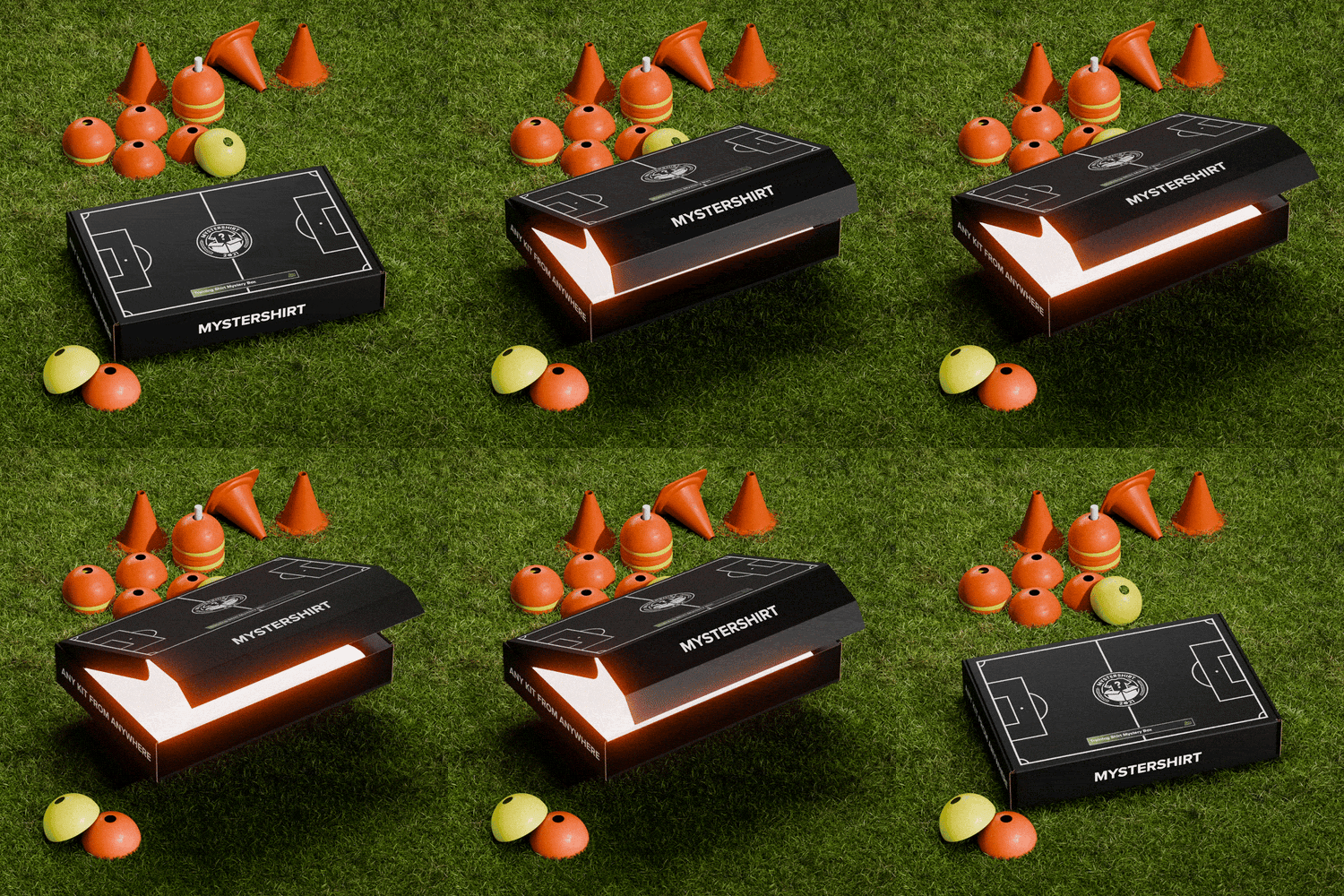
Mystery or surprise boxes work as controlled discovery rather than targeted acquisition. They can introduce you to clubs, leagues, and designs outside your normal search, but they won't reliably deliver a specific season, player, or rare variant. Use them to widen taste, not to fill a precise archive gap.
| Channel | Typical Price Range | Authentication Safeguards | Selection Variety | Fake Risk |
|---|---|---|---|---|
| Official retail | Retail pricing and sale pricing | Purchase record, licensed stock, returns | Current and recent releases | Low |
| General resale | Highly variable | Seller history, detailed photos, platform protection, returns | Very broad | Medium to high |
| Specialist dealer | Usually a premium for expertise | Dealer guarantees, cataloguing, provenance, returns | Strong for vintage and archive | Lower, but still verify |
| Auction house | Variable, often competitive for important pieces | Certificates, catalogue records, provenance | Rare, historical, and match-related items | Depends on the house and lot evidence |
| Mystery box | Set box price | Authenticity guarantee and returns where offered | Broad, but not fully selectable | Low where the provider guarantees authenticity |
For online buying, this guide to where to buy football jerseys online is useful as a channel checklist. Match the venue to the goal: official retail for certainty, specialists for older templates, auction houses for documented memorabilia, resale platforms for patient hunting, and mystery boxes for low-commitment discovery.
Grading Shirt Condition the Way Dealers Do
Condition language only helps when everyone uses it consistently. Sellers often describe the same shirt differently, so create your own standard and record the evidence rather than accepting a label such as “very good” without inspection.
A practical five-grade scale
| Grade | Visual Criteria | Approx. % of Retail |
|---|---|---|
| Mint | Fabric is clean and intact, crest and print are sharp, collar and cuffs retain their shape, and there are no visible pulls, stains, odours, or repairs | Not fixed |
| Excellent | Minimal handling or wear, with only slight signs that don't affect display quality | Not fixed |
| Very Good | Minor bobbles, light print wear, or small marks, but the shirt remains attractive and structurally sound | Not fixed |
| Good | Noticeable wear, fading, pulls, stains, or reduced elasticity that remains acceptable for wearing or casual display | Not fixed |
| Fair | Significant marks, cracking, stretching, repairs, fabric weakness, or odour that materially affects desirability | Not fixed |
There isn't a reliable universal percentage of retail value for each grade. Vintage demand, provenance, shirt importance, size, and scarcity can outweigh condition, so attaching a fixed percentage would create false precision.
Use the same inspection every time
Lay the shirt flat on a clean white surface in bright daylight. Check the front and back, then turn it inside out and inspect seams, underarms, cuffs, collar, and the reverse of the print.
Count bobbles and pulls rather than writing “some wear.” Look for sponsor cracking, lifting numbers, loose threads, colour transfer, sweat marks, storage odour, and repairs. Photograph every defect before purchase and add it to your inventory after the shirt arrives.
Condition should also reflect intended use. A lower-grade shirt may be the sensible choice for regular wear, while a display or investment piece deserves the cleanest example you can afford. Don't pay a premium for a condition grade the photographs don't support.
Storing, Displaying, and Caring for Your Collection
A football shirt can be authentic, historically important, and valuable, yet still deteriorate through poor care. Heat, sunlight, damp, harsh detergent, and unsupported hanging all create avoidable damage.
Wash shirts inside out in cold water with mild detergent. Skip fabric softener, avoid the tumble dryer, and air-dry the shirt flat away from direct sunlight. Never put a worn shirt into storage while sweat, body oils, or moisture remain in the fabric.

Choose storage by importance
For investment pieces, fold the shirt with acid-free tissue and place it in an archival box. Tissue reduces sharp creasing and keeps prints from rubbing against fabric. Use padded hangers for shirts you display, but don't leave heavy garments on narrow wire hangers that place stress on the shoulders.
Breathable cotton bags work for medium-term storage. Clear frames or shadow boxes suit hero shirts, provided they offer UV protection and don't press directly against raised sponsor prints or badges. Avoid sealed plastic bags for long-term storage because trapped moisture can encourage mildew.
A useful reference on how to store clothes long term covers broader principles around clean, dry, protected textile storage. Apply those principles to football shirts, with extra care around heat-pressed graphics and delicate vintage fabric.
Control the room, then inspect the shirts
Aim for stable conditions around 18 to 22°C and 40% to 55% relative humidity. These ranges help reduce the risk of yellowing, mildew, and material stress, particularly in rooms that experience sharp changes in temperature or moisture.
Every quarter, inspect moth activity, fading, loose stitching, label legibility, sponsor lifting, and new odours. Check displayed shirts for sun exposure and rotate them when appropriate. Record any change with photographs, because a condition log makes it easier to decide whether a shirt needs cleaning, repair, reframing, or professional conservation.
More preservation guidance is available in this football shirt preservation techniques guide. The central habit is simple, clean the shirt properly before storage and inspect it before a minor defect becomes permanent.
Your 12-Month Plan to Build a Collection You Love
A year gives a new collector enough time to develop taste, learn authentication, test buying channels, and correct early mistakes. Don't treat the roadmap as a shopping quota. Treat it as a sequence of decisions that makes each later purchase more informed.
Quarter one, establish the foundation
Write a one-page collecting brief. Name the primary lane, the clubs or countries that qualify, the eras you're interested in, your preferred sizes, and the conditions you won't accept. Buy one foundational current or recent shirt with a clear personal connection, then add one accessible retro piece that introduces the period you want to study.
At this stage, spend more time comparing labels, measurements, photographs, and seller histories than hunting for a dramatic bargain. The foundation should teach you what you like, not lock you into an expensive mistake.
Quarter two, buy knowledge with the shirt
Build an authentication folder containing reference photographs, product-code examples, purchase records, and notes about common variants. Add one vintage shirt from a specialist dealer, preferably a piece whose construction and condition you can inspect closely.
Use the purchase to practise your grading system. Record the shirt's defects, measurements, provenance, and display decision. If the collection reaches the £200 checkpoint, it should already have a theme rather than several unrelated purchases.
Quarter three, test discovery and resale
Try a broader sourcing channel only after you understand your own standards. A curated mystery box can test your openness to unfamiliar clubs and designs, while a resale listing can teach you how condition, photography, seller confidence, and return terms affect a buying decision.
Don't use either route to justify overpaying. If a shirt doesn't fit the collection, sell or trade it instead of keeping it out of guilt. The £500 checkpoint should represent a stronger edit, with at least one meaningful club, national-team, or retro shirt supported by clear evidence.
Quarter four, preserve and review
Set up archival storage, review whether displayed pieces need UV-protective framing, and check that your inventory is complete. Review insurance arrangements for higher-value items and keep purchase documentation somewhere separate from the shirts themselves.
At the £1,000-plus checkpoint, slow down. The next purchase should improve the collection's historical depth, authenticity, condition, or emotional meaning. A higher spend doesn't automatically create a better collection.
| Quarter | Starter, £200 | Mid-Tier, £500 | Serious, £1,000+ |
|---|---|---|---|
| Q1 | Foundational current shirt and accessible retro | Better-condition club or national-team base | Carefully researched archive target |
| Q2 | Authentication practice and inventory | Specialist-dealer vintage purchase | Provenance review before a major acquisition |
| Q3 | Affordable discovery purchase | Resale-market experiment and collection edit | Rare or documented piece only after verification |
| Q4 | Basic storage and written collection theme | Improved display and condition records | Archival storage, insurance review, and provenance file |
Finish the year by writing down what you got wrong. Note which channels produced reliable sellers, which defects you missed, which shirts still feel essential, and which purchases no longer fit. Repeat that review annually, because a great collection grows through editing as much as buying.
Mystershirt offers authentic football shirt mystery boxes in Premium, Retro, Kids, and sharing formats, making it a practical discovery channel when you want to add variety without choosing a specific club or season. Visit Mystershirt to explore the available boxes and use one as a controlled part of your wider collecting strategy.