
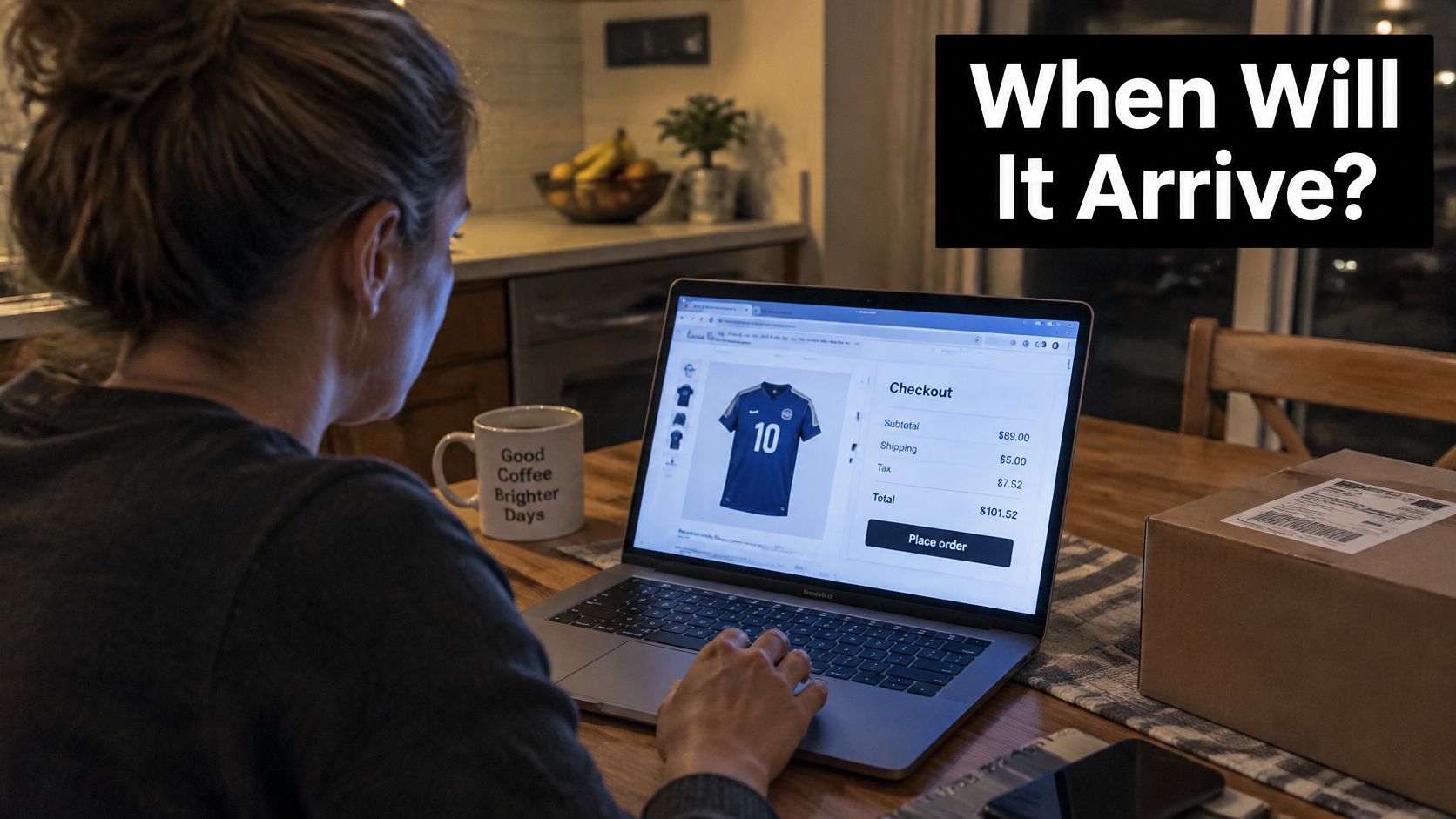
You've got a shirt in the basket, the total reads €62, and the checkout offers two shipping lines. One promises 1 to 4 days, the other says 1 to 30 days. Neither number answers the two questions you care about. When will it land on my doorstep, and what will it cost by then?
The gap exists because three separate clocks run on every international parcel. The carrier's transit clock covers the flight and the depots. The customs clock covers release at the border. The cost clock covers duties, tax and handling that get collected after the parcel arrives. A delivery promise usually describes only the first one.
The three clocks run on different schedules, and knowing which one you're buying is the whole game.
Table of Contents
- What Worldwide Express Shipping Really Means
- Service Levels and Delivery Windows at a Glance
- How Express Delivery Moves From Pickup to Doorstep
- Customs Holds, Duties and Fees Explained
- How Reliable Is Express?
- Matching Express to Your Purchase
- Confirm Your Delivery Window Before You Order
What Worldwide Express Shipping Really Means
Say the order goes in on a Tuesday evening and the confirmation promises express delivery. What you've bought isn't a plane seat. It's a chain of custody: a pickup, a label, an export release, a flight, an import release and a van.
The easiest way to picture the difference between standard post and worldwide express is transport. Standard post is a shared bus that stops in every town along the way. It's cheap, and it gets there eventually. Worldwide express is a taxi. One carrier takes responsibility from pickup to your doorstep, runs the parcel through its own network with priority handling, and scans it at every handover so you can see where it is.
That taxi lane is now how ordinary retail moves. Global parcel volume rose from 64 billion items in 2016 to 161 billion in 2022, which works out at about 5,102 parcels shipped every second, according to the Pitney Bowes Global Parcel Shipping Index. Express stopped being a niche for documents and urgent commercial freight a long time ago.
Three terms come up constantly, and mixing them is where buyers get confused:
- Express transit time is the carrier's clock, the movement between depots and hubs.
- The door-to-door window adds export clearance, import clearance and final-mile delivery on top of that.
- Landed cost adds the shipping fee you pay at checkout, then import VAT, duties and any brokerage on arrival.
Those three numbers are what you're really comparing when you pick a shipping method, and they don't move together.
Service Levels and Delivery Windows at a Glance
A shirt addressed to Germany and the same shirt addressed to Australia do not share a clock. Germany uses Mystershirt's European express window, 1 to 4 days. Australia falls in the worldwide range, 1 to 30 days. Mystershirt ships to the address entered at order, wherever the customer is. Distance changes the wait, and so does that destination's clearance procedure. The shipping fee at checkout is a different number from any duty or import charge on arrival. Neither number is a promised arrival date.
Carrier labels are not standardised, so "express" from one network is not "express" from the next. A neutral industry study sorts express services into three tiers, same-day, next-day or 24-hour, and deferred delivery of roughly two to three days, and identifies customs clearance as a major determinant of delivery speed, in the Global Express Association report on express services. Those tiers sit beside the windows Mystershirt shows for a jersey order.
| Service level | Typical delivery window | Best for | Availability note |
|---|---|---|---|
| Same-day | Within hours of pickup | Local urgent consignments | Rarely available for cross-border parcels |
| Next-day (24-hour) | 1 day | Documents and urgent gifts | Limited to major city pairs |
| Express deferred | 2 to 3 days | Most cross-border shop orders | Standard express window |
| Mystershirt European express | 1 to 4 days | Jerseys to Europe | Estimate shown at checkout |
| Mystershirt other destinations | 1 to 30 days | Global orders | Distance and the destination's clearance rules set the outer edge |
Read the Typical delivery window column carefully. Every figure in it is an estimate for a parcel moving under normal conditions, not a guaranteed date. The carrier's transit clock is the movement between depots and hubs. Clearance time sits beside that clock and can push the door-to-door result toward the high number. Periods shown on the site are estimates only. Mystershirt is not responsible for delivery delays caused by carriers or customs.
At checkout you choose the shipping method, and the page shows how long delivery to that destination should take. European express is the tighter band when the address is in Europe. Once the address leaves that lane, 1 to 30 days is the range to plan around. Same-day service almost never applies across a border, and next-day service stays limited to major city pairs.
Plan against the short end: if a birthday or a match day sets the deadline, treat the low number as your working date and the high number as the buffer you hope not to need.
The extra days come from distance and border procedure. For the way one carrier turns its own network into published windows, this breakdown of UPS worldwide shipping times walks through the mechanics.
The word "express" also shows up outside parcel retail. National Car Transport on express shipping uses it for vehicles, a different job from moving a boxed shirt.
How Express Delivery Moves From Pickup to Doorstep
Door-to-door express as a category is older than barcode tracking. DHL was founded in 1969 to build the world's first international door-to-door express delivery service, as DHL's 50-year retrospective records, and every modern promise about expedited transit, tracking and coordinated customs descends from that same proposition.
Six stages make up the chain today. The flight is only one of them.
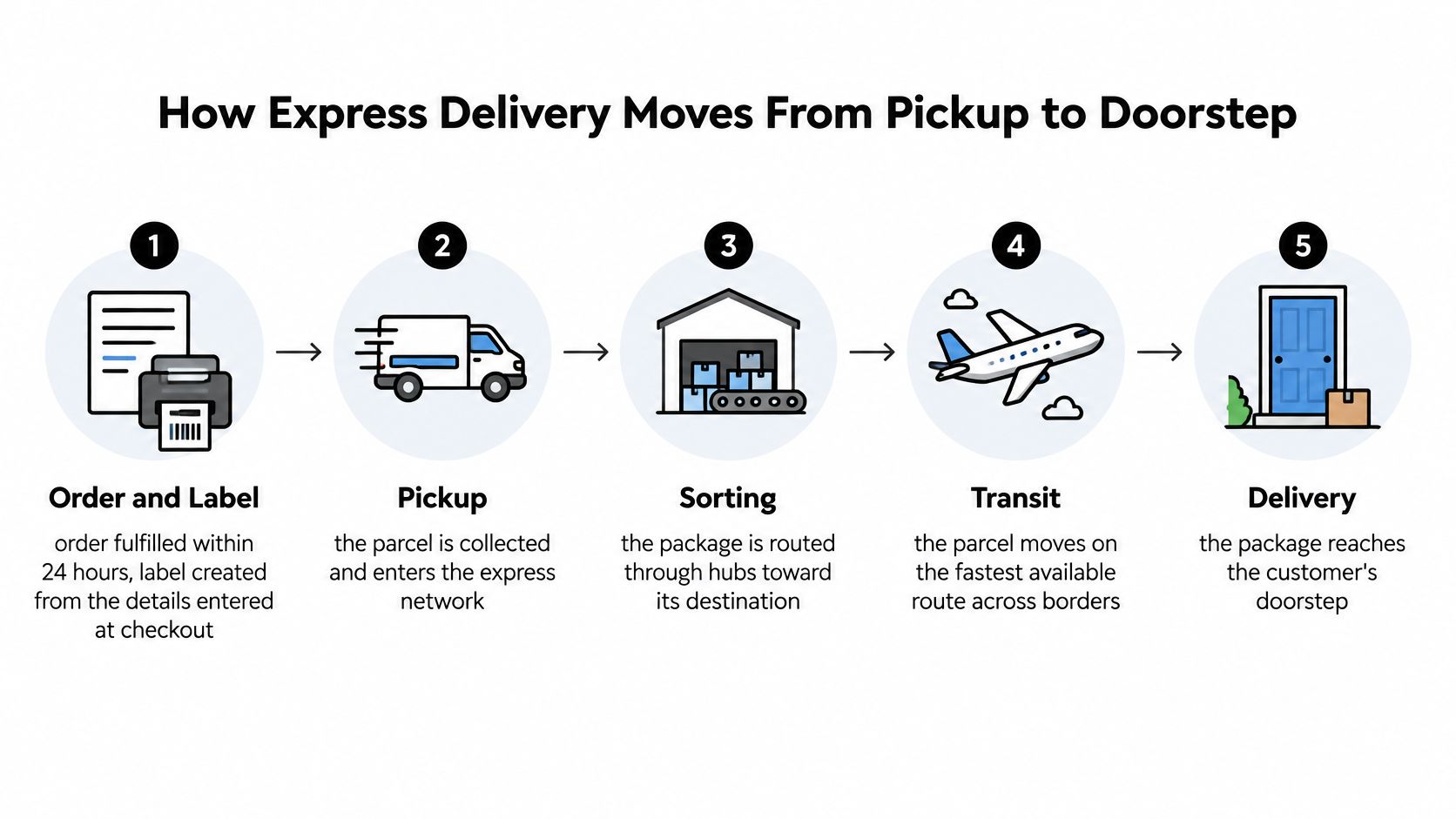
- Order and label. Every order is fulfilled within 24 hours. The label is built from the details entered at checkout, so the address you type becomes the address on the parcel.
- Pickup. Our fulfilment centres sit in Belgium, the United Kingdom and the United States, so most parcels enter a domestic network before they enter an international one.
- Export clearance at origin. Complete electronic data, meaning product description, quantity, value, country of origin and tariff classification, lets the parcel release automatically. A vague description stalls this stage and nothing downstream can start.
- Line-haul. Air or road between hubs, on the fastest route with capacity. A missed uplift pushes the parcel to the next available flight, which is why weather at a hub can move your date.
- Import clearance at destination. Here the parcel is released, selected for inspection, or held pending documents or payment. Missing data at stage three reappears here as a delay.
- Final-mile delivery. A courier delivers to the address you gave us, with a signature where the route requires one. A wrong or incomplete address turns this into a second attempt on another day.
A 1 to 4 day window to Germany sounds generous for a two-hour flight until you count what the clock covers. It starts at pickup and stops on the doorstep, with two border gates in between.
Tracking tells you which gate you're at. Look for the pickup scan, the export release, arrival in the destination country, the customs release, and out for delivery. If the last scan you see is an arrival notice with no customs release after it, the parcel is waiting on a border process rather than a van.
Customs Holds, Duties and Fees Explained
The shipping fee is the only cost most checkouts display, and it's usually the smallest of the four layers.
| Cost component | Typical payer | When it applies |
|---|---|---|
| Shipping fee | Customer | Paid at checkout on every order |
| Import VAT or GST | Recipient, often at delivery | Orders from outside the EU, depending on destination rules |
| Import duties | Recipient | Above the destination's threshold, depending on tariff classification |
| Brokerage or handling fee | Recipient, often | When the carrier clears the parcel on the customer's behalf |
| Customs-hold or re-inspection charge | Recipient | Billed by the carrier or the customs authority after a physical inspection |
This is the gap that catches buyers out. In DHL's 2025 e-commerce trends report, 53% of global online shoppers say delivery is too expensive and 36% cite customs as a shopping problem, while 60% of U.S. consumers surveyed said additional duties would change their purchasing behaviour, including 44% who would cut back on international purchases. The complaint isn't really about speed. It's about not being able to predict the final figure before paying.
What a customs hold actually costs you in time
A hold isn't a single event. The parcel can be selected for inspection, asked for extra documents, or parked until tax is paid. UNCTAD measured the spread: during the early-2020 disruption, average inbound customs and border-clearance time rose 97%, with observed clearance times running from 2 to 64 hours, in its report on the pandemic's customs impact. Two days of border dwell can double a 2 day transit window, and no carrier can absorb that.
The World Customs Organization's time release methodology exists precisely because that dwell is measurable, and the fix is usually data quality rather than luck.
Why a faster parcel can cost more
Here's the counterintuitive part. Express networks tend to trigger formal customs clearance and brokerage more consistently than low-value postal routes do, so the faster option can arrive with a bigger invoice attached. A parcel that slips through as ordinary mail often escapes the formalities a properly cleared express shipment generates.
Work one example. A €50 shirt landing in a country that applies a 20% import charge adds €10 at the door. Double the order to two shirts and the charge follows the value, not the parcel count. Thresholds and rates differ by destination, so the arithmetic matters more than the percentage.
Who pays what, by region
The European Union charges VAT on goods entering from outside the bloc, which means a shirt shipped from our UK or US fulfilment centre can attract a charge at delivery while one shipped from within the EU doesn't cross a border at all. Orders from outside the EU may be subject to customs or import fees depending on your country's regulations. The United States, the United Kingdom, Canada, Australia and the major Asian markets each set their own threshold and rate, and the question to ask is always the same: does my order value sit above this destination's duty-free limit?
Three practical steps. Check your destination's rule before checkout rather than after. Keep the order description accurate, since a mislabelled parcel invites inspection. Budget for fees the way you'd budget for postage, because refusing a parcel sends it back to the sender and delays any refund while the return moves. If you're on the sending side of a cross-border project, this guide to customs documentation for backers from PledgeBox covers the paperwork that prevents most holds. And if you want the clearance sequence in detail, our walkthrough of the customs clearance process follows a parcel through both gates.
How Reliable Is Express?
Shoppers want speed and doubt it at the same time. An industry survey reported by MHD Supply Chain found that 53% of shoppers expect delivery within two to four days, but only 34% are very confident the package will arrive by the expected date.
That confidence gap is rational. An estimate describes transit and clearance under normal conditions. It can't control weekend handling, a remote-area handoff between two depots, or the inspector who pulls your parcel for a look.
So here's the honest version of what a seller promises. Delivery periods shown on our site are estimates only, and we aren't responsible for delays caused by carriers or customs. What sits inside our control is fulfilment within 24 hours, accurate declaration data, and a tracking number that works from the first scan.
Signals that a parcel is moving normally
- Scan at each hub. Progress appears as handovers, not as a single status that never changes.
- Export release. A cleared export status means the paperwork passed at the origin gate.
- Customs cleared. This is the one that matters most on a cross-border order, because everything after it is domestic.
- Out for delivery. The final scan before the doorstep.
Warning signs that need action
No scan for several days past the estimated date, a customs hold notice, or a direct request for documents. Any of those means pick up the tracking number and act the same day.
Three steps when something stalls. Check tracking at the first sign of a hold rather than waiting a week. Respond to any customs request immediately, since documents sent late push you to the back of the queue. And if nothing updates, contact the carrier with the tracking number, because the scan history is what they'll trace.
This short video shows the delivery side of the process in practice.
For anything time-critical, plan against the far end of the range and treat an early arrival as a bonus.
Matching Express to Your Purchase
Speed is a purchase decision, not a default. Match the service to what the order is for.
| Your situation | Recommended option | Why it fits |
|---|---|---|
| Birthday or gift with a fixed date | Express, ordered early | Speed matters more than the premium |
| Match-day kit or event shirt | Express to a European address | The window is short and tracking matters |
| Several shirts for one household | One order, shipped to one address | One tracking history, though each shirt is packed separately |
| Sharing Box for a group | One order to one address | Items can be split locally after delivery |
| Flexible timing, budget focus | Standard international, 1 to 30 days | Avoids the express premium when no date matters |
| Destination outside the EU | Express, with import fees planned | Recipient-side charges can apply at delivery |
A gift with a fixed date is the clearest case for paying for speed. The one detail worth planning is the doorstep itself. We deliver to the address provided at ordering where possible, and some deliveries require a signature, so a surprise sent to an empty house can end in a second attempt. Send it to a workplace or tell the recipient to expect a courier.
Match-day orders are the second clear case. If the shirt needs to be worn at a specific fixture, the 1 to 4 day European window leaves room, but only if you order early in the week rather than the day before.
Multi-shirt orders behave differently from what most buyers expect. Each shirt is packaged separately, including when you order several boxes, so ordering three shirts doesn't cut packaging. What it does cut is admin: one order, one payment, one tracking history, one delivery window instead of three.
For groups, the Sharing Box math works best when one person orders and ships to one address, then hands the shirts out at training or in the pub. Splitting a group order across five addresses means five tracking numbers and five chances of a customs query.
If nothing about the order is time-bound, the 1 to 30 day range costs you nothing but patience. A meaningful share of shoppers actively prefer a slower option for environmental reasons, and a flexible buyer loses only days. To compare the lanes side by side before you commit, our breakdown of global shipping options sets out what each one changes.
The rule of thumb: pay for speed only when a specific date matters. If you'd shrug at a late arrival, express is a premium you don't need.
Confirm Your Delivery Window Before You Order
Four checks, run in order, take about two minutes and prevent most of the disappointment that follows a late parcel.
- Read the estimate for your destination and method. At checkout you'll see how long delivery to your address will take, and it changes with the country and the service you pick. That figure is the one that applies to you, not the average on a marketing page.
- Order before 4:00 PM. Orders placed before that cut-off ship the same day, which is often worth a full day on the far end.
- Compare the estimate with the date that matters. If the fixed date sits inside the window, choose express. If it sits comfortably outside it, save the premium.
- Check the returns terms before you need them. Returns are processed online only, and the delivery address isn't a place where a return can be arranged in person. Return shipping is on us when the return is down to our mistake.
The 100-day money-back guarantee covers everything in an order, so the risk sits with the contents rather than the clock. That's why the delivery window is worth two minutes of checking before you pay, and why the cost table above is worth a second look if your address is outside the EU.
Pick the shipping method that matches your date rather than the one that sounds fastest. Mystershirt sends authentic football shirts worldwide, from Premium and Retro boxes to Kids and group Sharing Boxes, with express delivery across Europe in 1 to 4 days and tracked worldwide shipping of 1 to 30 days, all backed by a 100-day money-back guarantee. Check the delivery estimate for your own address at checkout, then start your order at Mystershirt and let the shirt do the rest.


