

The usual advice for international shopping is to choose a fast courier and trust the arrival date at checkout. That's incomplete. A courier's transit estimate might not include packing, the first carrier handoff, customs review, or the local delivery attempt. And free shipping doesn't necessarily mean there's nothing left to pay.
A better way to understand the international shipping process is to follow the parcel through its separate stages, then check who pays any border charges. For a football shirt bought as a gift, that gives you something more useful than an optimistic date: a delivery window you can plan around and a clearer picture of the final cost.
Table of Contents
- Stage by Stage Times for an International Order
- The Path From Warehouse Shelf to Front Door
- Duties VAT and Who Pays at the Border
- Reading Tracking Scans That Do Not Move
- Destination Windows for a Football Shirt Order
- Delays Customs Holds and What to Do Next
- Confirm the Delivery Window Before You Order
Stage by Stage Times for an International Order
International delivery time is the sum of separate stages, not just the number beside a courier logo. Start at the top of this table and follow the parcel downward. The timing rules distinguish our fulfillment commitments from carrier and customs steps that don't have a universal deadline.
Time ranges by stage of an international parcel
| Stage | What happens | Best case | Typical | When it slips |
|---|---|---|---|---|
| Acceptance and packing | Payment accepted, item picked and packed | We ship orders placed before 4:00 PM the same day | We fulfill orders within 24 hours | An order needs acceptance or a stock issue needs resolving |
| Export handoff | Label created and parcel enters the carrier network | Collection follows dispatch promptly | Tracking information can take 2 to 3 business days to update | The expected first physical scan hasn't appeared |
| International transit | Air or road transport toward the destination country | The shortest estimate for the selected route | Use the destination and service estimate at checkout | A connection is missed or the carrier changes the route |
| Import clearance | Customs checks value, charges, and documents | Release without a request for information | Follow the destination's clearance process | Release waits for payment, documents, or inspection |
| Final mile | Local carrier delivers, sometimes with a signature | Delivery on the first attempt | Follow the local carrier's delivery notice | An inaccessible address or missed signature prevents delivery |
Don't treat a transit range as though it measures every row. Cross-border shopper findings covered by Digital Commerce 360 included commonly reported windows of 10 to 14 days for 20% of respondents and four to five days for 19%. Those are reported shopping experiences, not promises for your destination or estimates to insert into every parcel journey.
Build a usable arrival window
Write down what the seller's estimate covers. Does the clock start when you pay, when the warehouse dispatches, or when the carrier collects? Also check whether the carrier counts business days or calendar days before adding anything together.
Use these planning cases:
- Best case: Prompt dispatch, smooth connections, straightforward clearance, and a successful delivery attempt.
- Typical case: The route-specific estimate, plus any preparation or delivery steps explicitly excluded from it.
- Exception case: The carrier's delayed-service guidance, with extra allowance for unresolved customs requests or a failed delivery attempt.
Avoid double-counting. If an estimate explicitly includes final delivery, don't add another final-mile allowance automatically. Conversely, an airport arrival estimate doesn't mean the recipient can open the parcel that afternoon.
Larger exports make this distinction especially visible. For a comparison beyond parcels, vehicle export timelines with Sunmax Motors provide a useful companion resource when considering how shipment type changes the planning questions.
Planning rule: Add only the stages excluded from your quoted estimate. Never add together unrelated averages and call the result a delivery promise.
Our published delivery periods are estimates only. For an event, plan around the delayed case rather than assuming every stage will achieve its best outcome.
The Path From Warehouse Shelf to Front Door
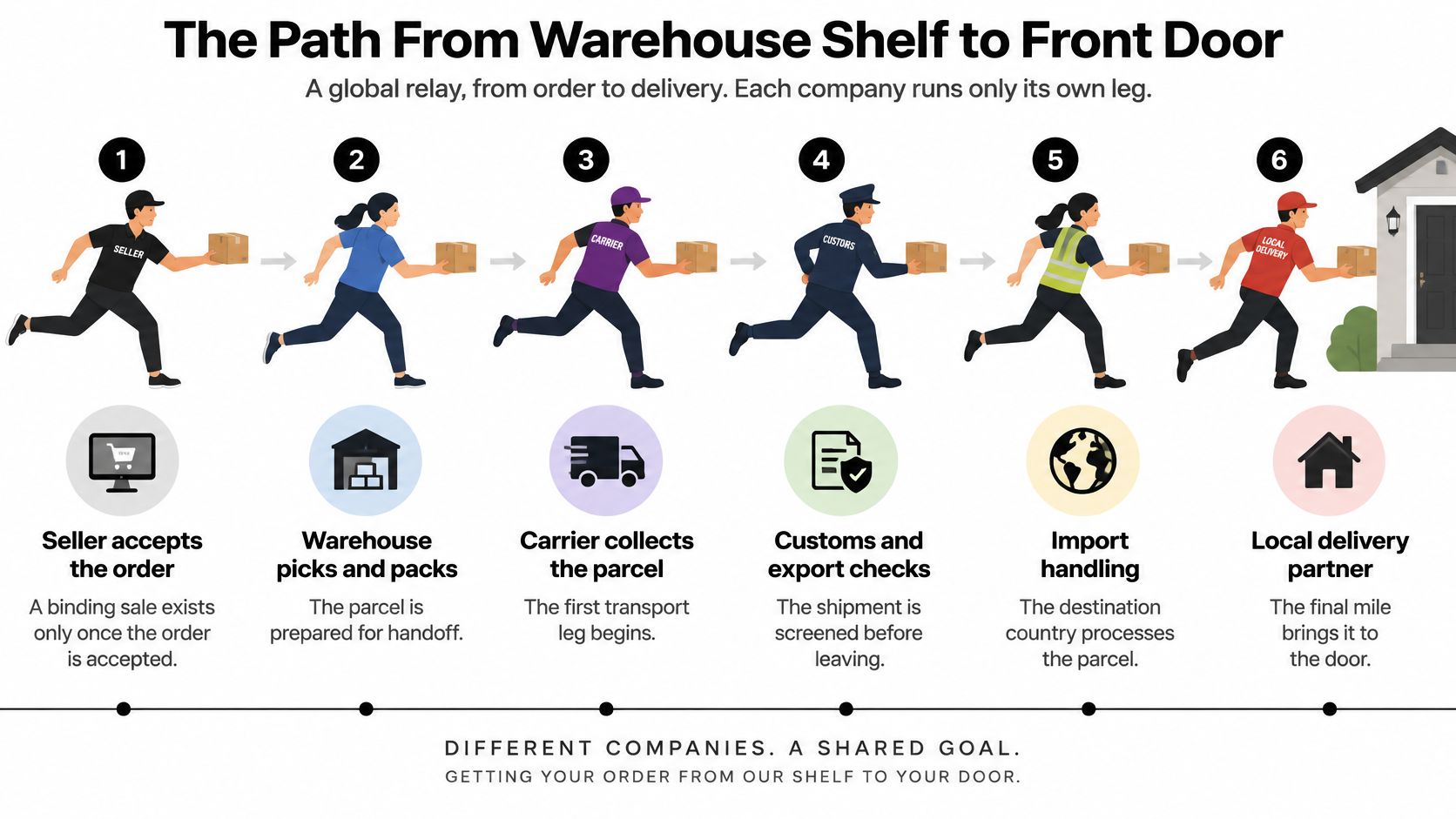
Think of the journey as a relay. The parcel is the baton, and the warehouse, transport operators, customs representatives, and local delivery partner each handle a different leg. A familiar carrier name on the tracking page doesn't mean that company performs every task itself.
Follow a shirt through the handoffs
- The seller accepts the order. With us, a binding agreement for the supply of products forms once we accept your order. Submitting an order and receiving acceptance aren't necessarily the same event.
- Warehouse staff prepare the parcel. They pick the item, pack it, and record shipment details. The weight, description, and paperwork should describe the actual contents, not a generic package.
- The carrier collects it. This transfers the parcel into the transport network. Creating its shipping label is an administrative step, distinct from collection.
- Export handling prepares the outbound movement. The parcel passes through sorting and any applicable export checks. A hub in another country can be a normal routing choice rather than evidence of a mistake.
- The main transport leg moves it toward the destination. A small apparel parcel commonly follows an air or road network. Its route is different from a retail stock shipment booked as ocean freight.
- Import clearance determines whether it can enter. Customs authorities review the declaration and any applicable requirements. A carrier or broker can submit information, but it can't overrule the destination authority.
- A local depot arranges delivery. The delivery partner sorts the parcel onto a local route and attempts delivery to the address supplied.
The distinction between parcel shipping and bulk trade matters. Approximately 80% of global merchandise trade by volume travels by sea, according to UNCTAD's Review of Maritime Transport. That explains the importance of ports to international commerce, but it doesn't make a ship's schedule the right guide for your individual shirt order.
What stays within your control
Give the seller a complete address, including the apartment or unit, a reachable phone number, and the recipient's name as it should appear on delivery records. If a signature is required, arrange for someone to receive the parcel.
Ownership and delivery risk are also different. Under our terms, title stays with us until the price is paid in full, and risk passes to you on delivery. A carrier handoff doesn't itself mean that delivery has occurred.
Duties VAT and Who Pays at the Border
| Question | Delivered Duty Paid | Delivered Duty Unpaid |
|---|---|---|
| Who pays duty and tax | Seller pays the border charges, potentially collecting them through checkout | Recipient pays the carrier or customs authority |
| When the cost is known | Before payment when checkout fully includes the applicable charges | When the parcel is assessed, unless an estimate was supplied |
| Surprise at the door | Lower when the checkout arrangement is complete | Possible when import charges weren't collected |
| If the charge is refused | Seller must resolve an unexpected demand under the agreed terms | Parcel may be returned or abandoned |
| Fit for a surprise gift | Recipient shouldn't need to settle covered import charges | Recipient may need to pay before receiving the gift |
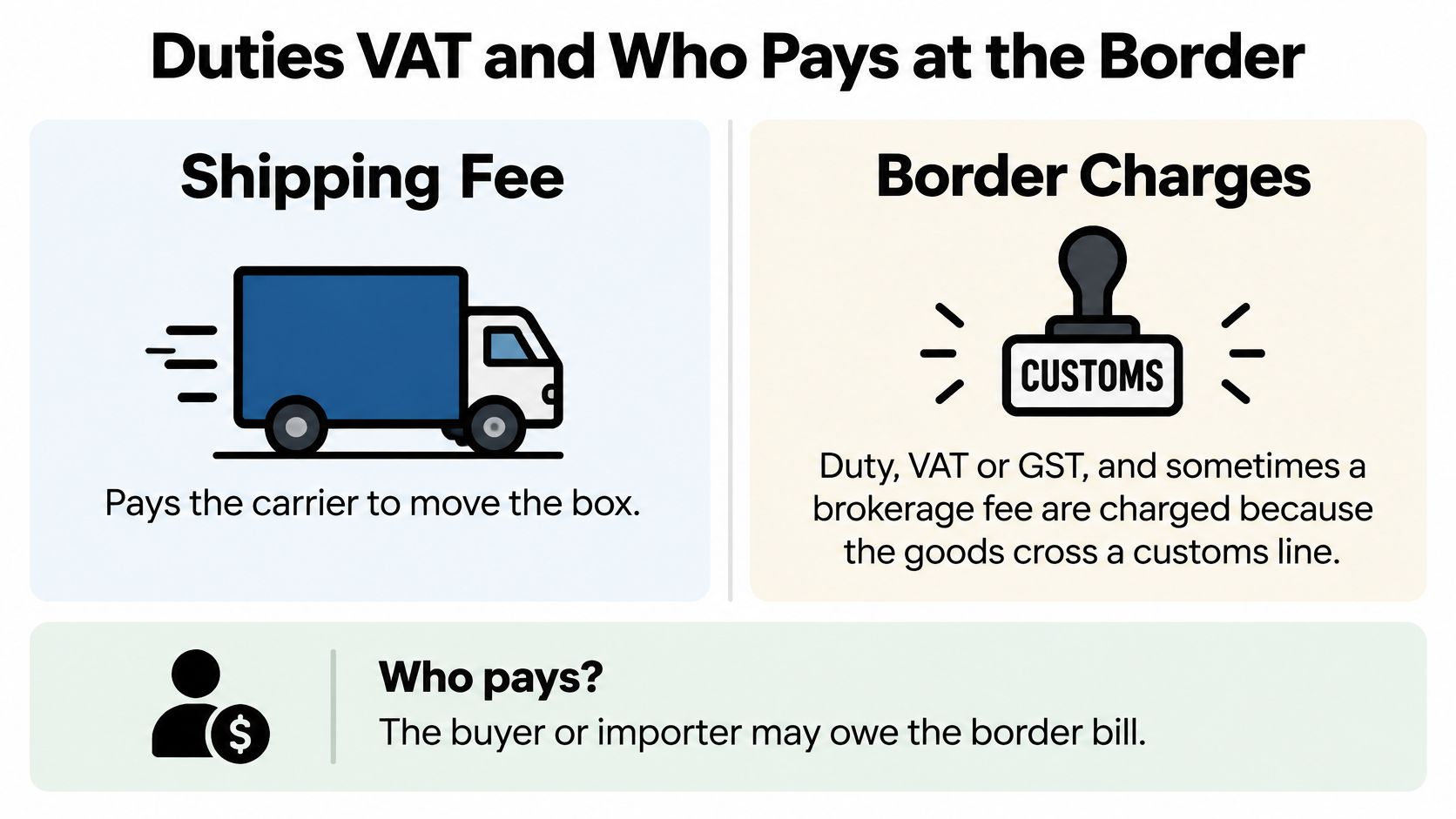
Shipping fees and border charges pay for different things. Shipping pays for moving the parcel. Duty, VAT or GST, and possible brokerage or handling fees arise from importing it.
Follow the total for a shirt
Say you buy a football shirt and pay its price plus freight at checkout. If the seller hasn't collected import charges, that checkout receipt may not represent the landed cost, meaning the total expense of getting the purchase to its destination.
Customs assesses the shipment using the destination's rules, declared value, product classification, and other applicable details. The carrier or broker may then request payment before releasing it for delivery.
Use this calculation rather than assuming a universal clothing tax rate:
Landed cost = item price + freight + applicable duty + import tax + applicable handling fees.
The tax base matters as much as the rate. A destination may include freight or duty when calculating import tax, so multiplying the shirt price alone can produce the wrong answer. A useful estimate must identify both the destination's rate and what that rate applies to.
The shopper consequences are substantial: consumer research cited by ePost Global found that 58% of cross-border shoppers had experienced surprise customs charges, and 75% of those shoppers reconsidered buying from the businesses involved. That finding concerns cross-border shoppers generally, not specifically recipients using a particular shipping term.
Read the payment arrangement
Delivered Duty Paid, or DDP, places the import-payment responsibility with the seller. Delivered Duty Unpaid, or DDU, is commonly used in shopping guidance to describe an arrangement where the recipient faces the import bill. Ask what the checkout includes rather than relying on an abbreviation alone.
For a merchant-side explanation of how responsibilities differ, Supply Automate's guide to DDP shipping terms for Amazon sellers offers additional context. For apparel purchases, our guide to import tax on clothing helps frame the destination-specific questions.
A refusal isn't the same as an agreed return. If the recipient declines an assessed charge, the carrier may return or abandon the shipment, and refund eligibility must still be resolved under the purchase terms.
Free shipping describes the transport price. It doesn't establish that duty, tax, or brokerage is included.
For a surprise gift, check this before paying. If checkout says nothing about import charges, treat that as an unanswered question, not confirmation that the recipient owes nothing.
Reading Tracking Scans That Do Not Move
A tracking page is a message log, not a live map. It records events received from warehouses, carriers, brokers, and delivery partners. A progress bar can stay still while someone reviews paperwork, and a new electronic message doesn't always mean the box has physically moved.
Our worldwide shipping is tracked. Tracking information can take 2 to 3 business days to update, so an initially quiet page isn't, by itself, evidence that a parcel is lost.
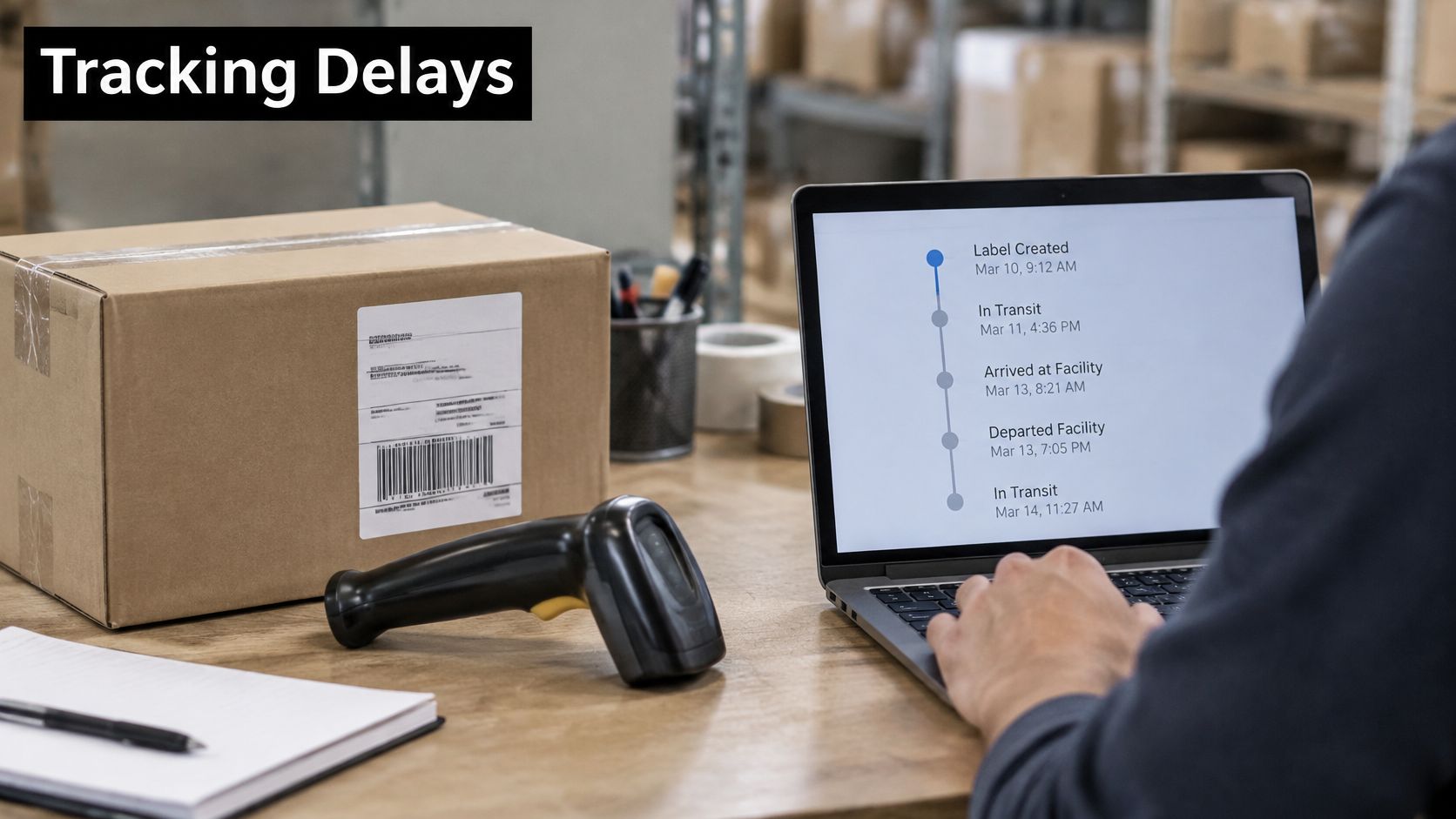
What each tracking status means and does not mean
| Tracking status | What it means | What it does not mean |
|---|---|---|
| Label created | Shipping paperwork exists | The parcel has been picked up |
| Picked up or arrived at facility | A physical checkpoint has been recorded | The parcel has crossed a border |
| In transit or departed hub | The carrier reports progress between network locations | The parcel has cleared customs |
| Held for customs or clearance | A government or broker step is in progress | The carrier has lost the parcel |
| Out for delivery | The parcel is assigned to today's local route | Delivery is guaranteed today |
| Delivered | The carrier has recorded a delivery event | The intended person necessarily received it personally |
Read the event rather than the progress bar
Label created tells you that a shipment record exists. A pickup or facility scan supplies stronger evidence that the parcel has entered physical handling.
In transit is broad. Read the location and accompanying event text before concluding that the parcel has left the origin country or arrived in yours. A departure from a sorting hub might precede another domestic stop.
Clearance delay belongs to the import stage, even if the parcel is already geographically close to the recipient. Distance remaining and work remaining aren't the same thing.
Understand the last delivery messages
Out for delivery describes an intended route, not a completed handover. Driver access, route disruption, and recipient availability can still affect the outcome.
We deliver to the address supplied when ordering, where possible, and some deliveries require a signature. A delivered event may include a timestamp, signature, photograph, or safe-place note, depending on the service. Our explanation of delivery confirmation helps distinguish those records.
Save the order number, latest event text, location, and timestamp. Those details identify the stage that needs attention much more clearly than a screenshot of an unchanged progress bar. Use the relevant delay action when that stage exceeds its stated allowance, or immediately if the carrier requests information.
Destination Windows for a Football Shirt Order
Take an authentic football shirt intended for a friend's birthday. The item is the same whether the recipient lives nearby or across the world, but the route, border requirements, and local delivery network aren't.
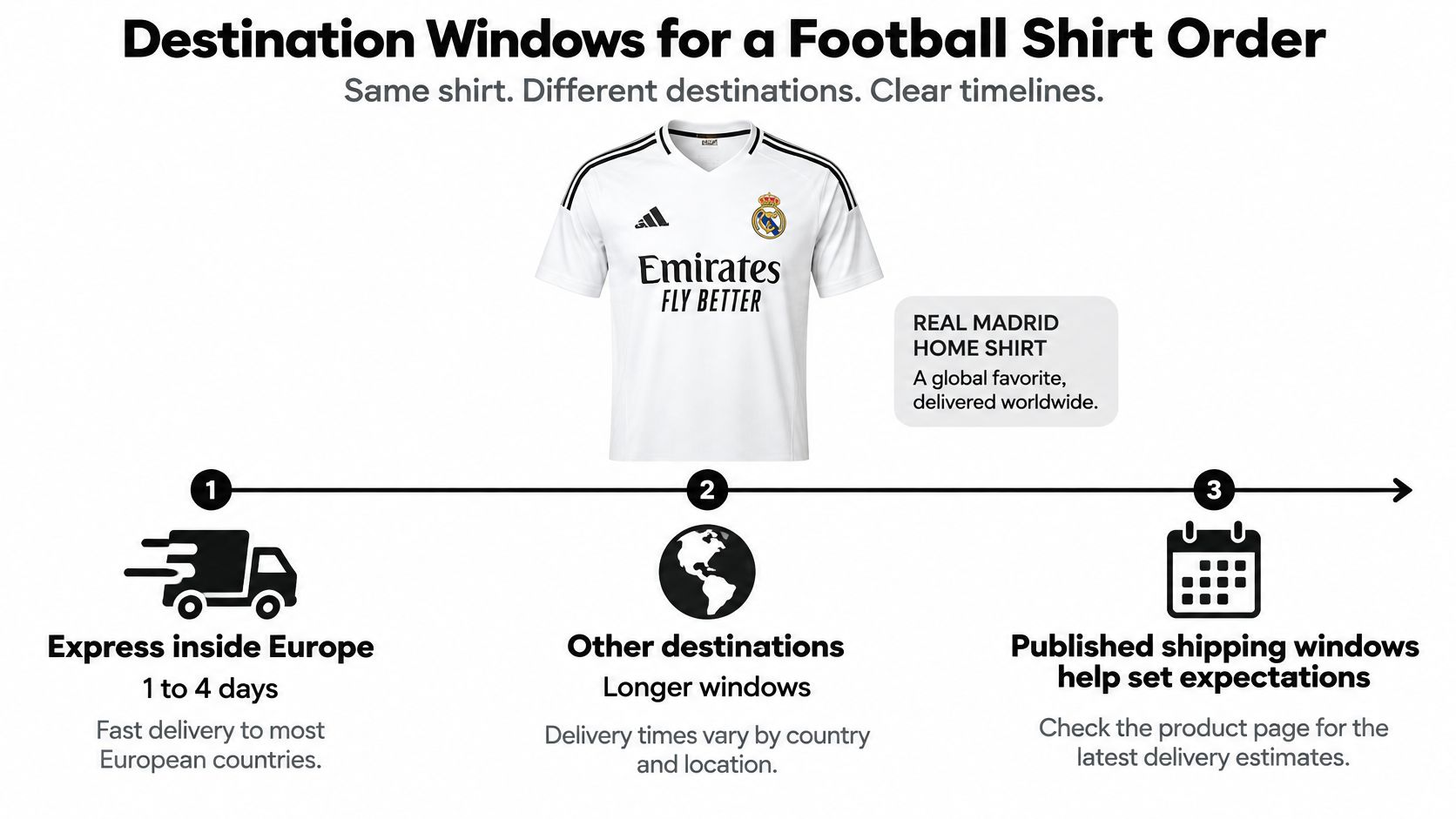
We ship worldwide. Our published windows are 1 to 4 days for express shipping within Europe and 1 to 30 days for other destinations worldwide. The destination estimate shown at checkout is the relevant starting point, rather than whichever shortest range appears elsewhere on the site.
Apply the window to the actual recipient
For a European express order, check the service offered to the precise postcode. A central-city address and a remote address can require different local arrangements, even when both fall within the same broad destination region.
For a worldwide order, examine the longer end of the published range before choosing a gift date. Connections, destination processing, and the receiving carrier's network can make a geographically distant delivery less predictable.
Orders outside the EU may be subject to customs or import fees under the destination country's regulations. That's a destination effect, not proof that the buyer selected the wrong shipping method.
- For a home delivery: Confirm the unit number and whether the recipient can receive a signature shipment.
- For a workplace: Include the business name and check whether reception accepts personal parcels.
- For a gift: Make sure the recipient can respond to a genuine carrier request without spoiling the surprise unnecessarily.
Why a destination changes the calendar
The World Bank's Logistics Performance Index findings reported an average of 44 days between a container entering the exporting country's port and leaving the destination country's port, representing about 60% of total international trade time. Those are container-trade measures, not delivery estimates for a shirt.
The relevant lesson is about boundaries: the main transport leg doesn't include every task needed to complete a delivery. At parcel scale, the destination's clearance procedures and local delivery arrangements still need their own place in your plan.
Keep the declaration accurate rather than requesting a lower value to avoid charges. The seller supplies shipment information, while you can prevent address and contact errors.
Gift deadline check: Choose an order date that leaves room beyond the optimistic arrival, including time to respond if the carrier needs something.
If the event can't tolerate a delayed arrival, an estimated window alone isn't a guarantee that the gift will be there.
Delays Customs Holds and What to Do Next
A blank tracking page is unsettling, but not every quiet parcel needs the same response. Identify the last confirmed stage, then contact the person who can change what happens next.
Late parcel symptoms and the next action
| What you see | Likely cause | What to do |
|---|---|---|
| No scan yet | Label exists but the first carrier event hasn't posted | Allow the stated tracking-update period, then email the seller with the order number |
| Customs or clearance hold | Duty, tax, inspection, or missing declaration data | Check the official carrier notice and respond through a verified channel |
| Delivery attempt failed | Incomplete address, nobody available, or signature required | Rearrange with the local carrier using the tracking notice |
| Marked delivered, box missing | Safe-place drop, household receipt, or delivery discrepancy | Check the household and delivery evidence, then request a trace |
| Quiet after clearance | Connection disruption or local backlog | Ask the seller for a carrier investigation when the applicable delivery window is exceeded |
| Returned to sender | Refused charges, address problems, or unsuccessful attempts | Contact the seller about the return outcome before placing another order |
Route the request to the right person
For an absent first scan, send the seller your order number and ask whether collection has been confirmed. Opening another order doesn't resolve the original shipment and can leave you managing duplicate purchases.
For a customs hold, read what the notice requests. The recipient may need to confirm identity or pay an assessment; the seller may need to correct an invoice or product description. Our explanation of the customs clearance process provides context for those requests.
Verify a payment demand through the carrier's official tracking portal or independently located contact details. Don't enter card information into an unexpected message just because it mentions a parcel.
For a failed delivery, the local carrier usually controls redelivery or collection arrangements. Contacting the warehouse alone won't reserve a new place on the driver's route.
Separate the cause from the resolution
We aren't responsible for delivery delays caused by carriers or customs. That doesn't make every delay the same: a seller's incorrect shipment details require a different response from an authority's inspection or a carrier disruption.
Some problems begin before dispatch. Packaging Panda's guide to packing overseas orders as a UK SME is a useful seller-side resource for understanding preparation, while a shopper should photograph visible damage and retain the packaging if a claim may be needed.
For a delivered-but-missing parcel, check reception, household members, and the recorded delivery location before requesting an investigation. For a returned parcel, establish whether it has reached the seller and what resolution applies. Don't assume a replacement or refund is automatic.
Set an escalation date before a group celebration so there's time to make an alternative arrangement. Ask the seller to confirm the next action and what event or deadline will trigger further review.
Act when the relevant delivery allowance expires, or when someone requests action, not merely because an afternoon passes without a scan.
Confirm the Delivery Window Before You Order
Before payment, you still control the choices that are hardest to repair once a parcel enters the carrier network. Use checkout to test whether the order fits the recipient and occasion, rather than searching for the fastest-looking promise.
Make the final checks
- Compare the estimate with the event date. Our checkout shows the shipping method and destination estimate, and you choose the available shipping option there. Leave room for the delayed case if arriving late would defeat the purpose.
- Read the duty and tax wording. Establish whether import charges are included or could fall to the recipient. For a surprise gift, decide whether asking that person to handle a border bill is acceptable.
- Verify the address and phone number. Check the postcode, building details, recipient name, and contact information before submitting. Once dispatched, address changes may be restricted by the carrier.
We package each shirt separately, including orders containing multiple boxes. Don't assume everything will arrive in the same parcel or receive identical tracking events; keep any shipment confirmations associated with the order.
After payment, retain the acceptance and dispatch messages. Follow the shipment using the actual carrier events, and contact us with the order number when there's a clear issue to investigate.
The useful next step isn't buying a stronger-sounding promise. It's confirming that the delivery estimate, border-payment arrangement, and recipient details all work before you place the order.
Mystershirt offers authentic football shirts in mystery boxes, with tracked worldwide shipping and destination estimates at checkout. Visit Mystershirt to choose a box, review the available shipping method, and check the delivery window and possible import charges before ordering.


