The fastest carrier is often the wrong recommendation. For a lightweight apparel order, speed is only one input, and it's rarely the one that causes a failed delivery, a refused parcel, or a support ticket. Destination, deadline, documentation quality, and who pays import charges matter more than a headline transit promise. Judged properly, the best international shipping option is the one with the lowest total landed cost for an acceptable level of delay risk on that specific lane. That framing changes the ranking on almost every route.
Table of Contents
- Why the Best International Shipping Depends on Your Route
- How International Shipping Works Behind the Scenes
- Comparing Speed, Reliability, Cost and Coverage
- How Customs Clearance Shapes Delivery Times
- Calculating the True Landed Cost by Destination
- Choosing Economy, Standard or Express for Each Order
- Your Next Step Toward Reliable Delivery
Why the Best International Shipping Depends on Your Route
A shipping service that performs well on one lane can create extra cost and delivery risk on another. Cross-border delivery times have improved: ClickPost's analysis of 37 countries and 30,970 shoppers found that the share of parcels taking at least 15 days fell from 29% in 2020 to 7% in 2025 (economy versus standard delivery times). That shift makes a blanket express upgrade harder to justify. Express is most useful when a buyer has a firm deadline or a delay would carry a clear cost.
Route-level decisions need to account for more than transit time. A nearby European destination and a long-haul market can differ in customs requirements, delivery coverage, and the cost of a return. Merchants building country- and postcode-specific checkout promises can browse destination routing definitions.
Five Criteria That Actually Rank an Option
- Speed: quoted transit time, with a buffer for clearance and last-mile delivery.
- Reliability: tracking updates that continue after the parcel leaves the origin network.
- Cost: transport charges plus duties, taxes, brokerage, and surcharges.
- Coverage: confirmed service to the specific destination, not just the country.
- Customs handling: whether import charges are prepaid and the carrier can resolve a hold.
A low shipping fee can lead to a higher total cost if the buyer refuses a parcel after receiving an unexpected import bill. Paying for express can also fail to prevent a customs hold caused by incomplete address or declaration details. For a long-haul example, see this guide to shipping a football shirt to Australia. Rank options by destination, buyer expectations, and the likely cost of failure, then choose the carrier.
How International Shipping Works Behind the Scenes
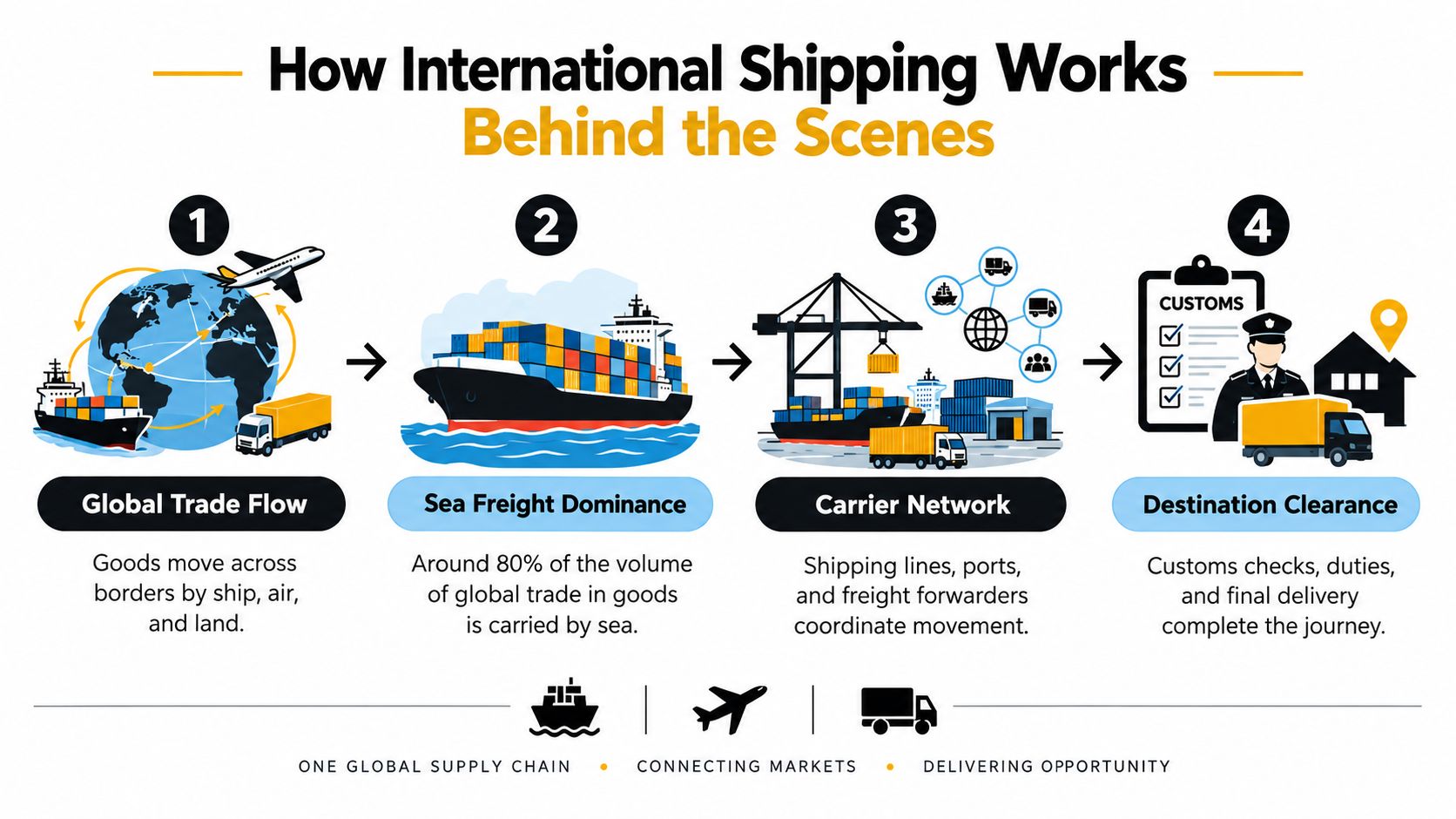
Your parcel rides on infrastructure built for bulk trade, not on an isolated courier route. Around 80% of the volume of global trade in goods is carried by sea, and international maritime trade reached approximately 12.292 billion metric tons in 2023, as reported in UNCTAD's Review of Maritime Transport. UNCTAD has published that review annually since 1968, which makes it a useful long record rather than a snapshot.
The visual below maps how that bulk system connects to a single doorstep delivery.
What Containerisation Changed for Parcels
Standardised containers move between ships, ports, railways, and trucks without handlers opening and resorting individual packages at each stage. That standardisation is why a retailer can promise global reach at all. It also means capacity and timing depend on shared networks. When a chokepoint such as the Suez Canal or Panama Canal slows traffic, the effect spreads beyond bulk freight into inventory positions, warehouse dispatch dates, and ultimately the day a parcel can leave.
Parcel services sit on top of that base layer. Express networks lean heavily on air capacity and their own sorting hubs, so they can bypass some port congestion. Economy and postal products rely more on partner handoffs, which lowers price but adds points where tracking can pause. Neither model removes the border step. Every cross-border parcel still needs electronic customs data, a clearance decision, and a local delivery partner or network in the destination country.
A carrier promise describes movement through a network. It doesn't guarantee what happens at the border or at the recipient's door.
Treat transit quotes as network estimates, then add clearance and last-mile reality for the destination. That's why two services with similar flight times can deliver days apart.
Comparing Speed, Reliability, Cost and Coverage
Headline coverage looks almost identical across the major express brands, so it tells you little. DHL Express Worldwide, FedEx International Priority, and UPS Worldwide Express generally quote 1 to 3 business days across major international lanes, while economy services commonly extend to approximately 2 to 5 business days for UPS and FedEx and 4 to 14 days for postal-standard products, based on EasyPost's comparison of international ecommerce services. The useful comparison is what each tier buys and what it gives up in exchange.
| Service type | Typical transit | Coverage signal | Main trade-off |
|---|---|---|---|
| Express | 1 to 3 business days on major lanes | Broad headline coverage, fewer destinations on early-delivery variants | Highest price, plus fuel and residential surcharges |
| Economy tracked | 2 to 5 business days for major carrier economy products | Strong on core lanes, weaker on remote postal codes | Lower cost in exchange for a longer, less precise window |
| Postal standard | 4 to 14 days | Widest reach through postal partners, variable tracking after handoff | Cheapest entry price, least control over delays and charges |
Where Each Tier Earns Its Price
Express earns its premium when a missed date destroys the value of the order. You get end-to-end tracking within one network, in-house customs brokerage, and faster exception handling when a parcel is queried. For a lightweight shirt, though, the premium and surcharges can approach a meaningful share of the basket value. You're paying for certainty, and certainty only matters if the date is fixed.
Economy tracked is the rational default for most apparel orders. Transit is slower, but tracking usually survives the handoff well enough for a buyer to follow the parcel, and the saving can fund prepaid duties instead. That's often a better use of the same money. A buyer who receives a parcel two days later with nothing extra to pay is usually happier than one who gets it quickly and then faces a charge.
Postal standard suits flexible, price-sensitive orders where the buyer accepts a wide window. Its weakness isn't only speed. Tracking events can thin out after the origin postal operator hands the parcel to the destination operator, and resolving a customs query across two postal systems is slow.
Coverage warning: a claim of roughly 220 countries and territories doesn't mean every product variant serves your postal code at your parcel weight. Validate origin, destination, postal code, weight, and customs requirements before you publish a promise.
If you're documenting this comparison for a store or a content hub, a practical SEO competitor comparison framework is a sensible way to keep criteria consistent across carriers instead of rewriting the rules for each brand. Keep at least two live carrier options per major lane. A single carrier strategy leaves you with no fallback when a product is unavailable to a specific address.
How Customs Clearance Shapes Delivery Times
Customs can add several days to a parcel's journey, and the risk varies by destination. Published clearance benchmarks put typical processing at about 1 to 5 days, with longer delays possible when documentation is incomplete or a shipment needs inspection (Branvas cross-border ecommerce statistics). The practical implication: separate carrier transit from customs processing in delivery estimates, and set windows by destination rather than promising one global timeline.
A parcel's progress at the border depends on the accuracy of its shipment data. The customs clearance process for jersey orders shows the steps involved, from submitting shipment details to customs release.
The Failure Points You Can Control
Many avoidable holds begin with missing or inconsistent shipment information:
- Product description: Describe the item plainly, such as a textile garment. Vague descriptions like “gift” give customs little to work with.
- HS classification: An incorrect Harmonized System code can lead to a duty calculation query or further review.
- Value and currency: Declare the transaction value accurately. Undervaluation can result in penalties or seizure.
- Country of origin: Include origin details so customs can assess the shipment against applicable rules.
- Recipient details: Provide a complete name, address, phone number, and email so customs or the carrier can request clarification.
Treat data quality as part of order fulfilment. Express brokerage can help resolve a query, but it cannot supply information the sender never collected. At checkout, state whether duties and taxes are prepaid or collected on delivery. Tracking should also explain when a parcel is awaiting customs review or release; otherwise, buyers may mistake a hold for a lost shipment.
Calculating the True Landed Cost by Destination
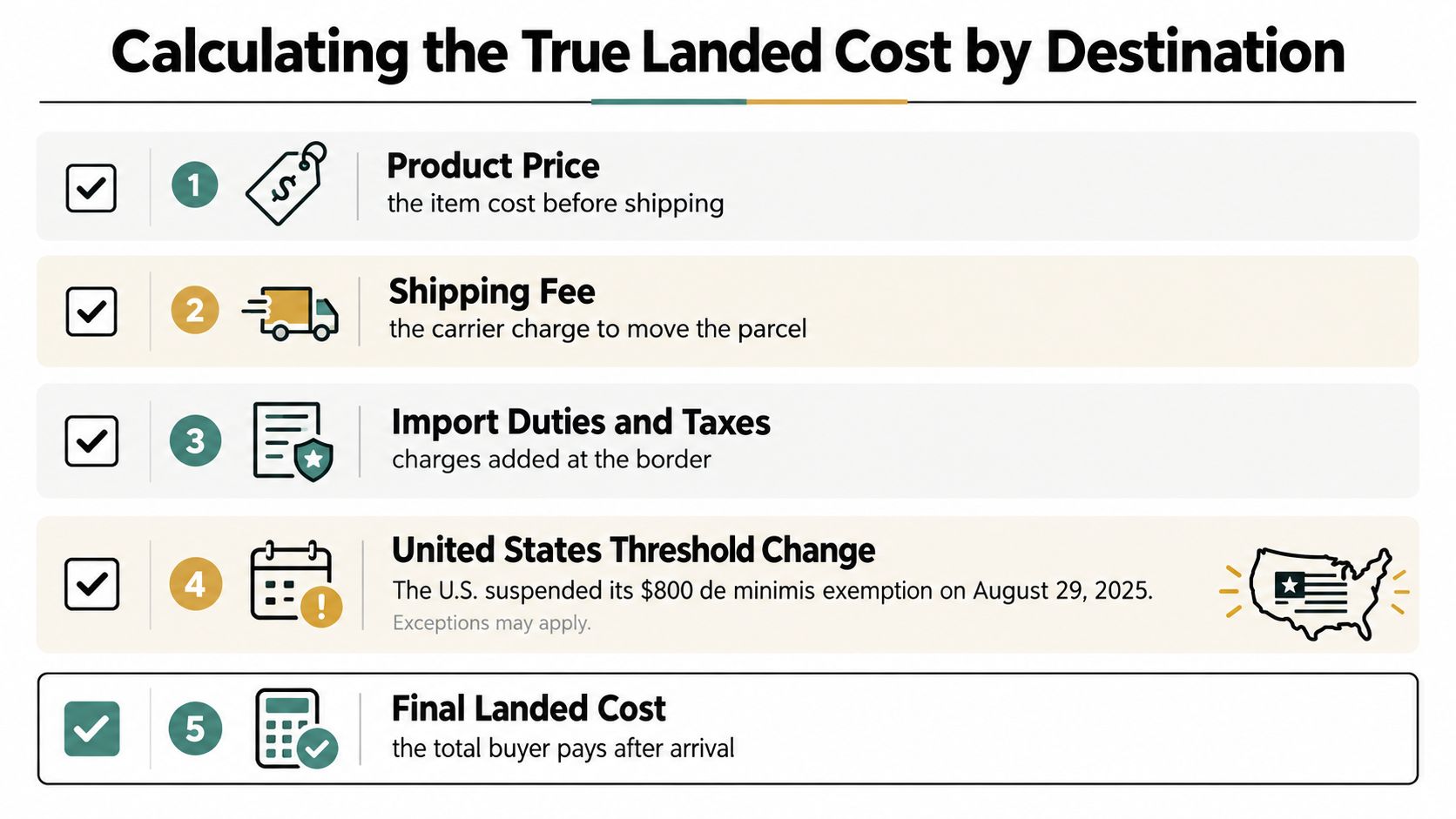
A low shipping quote can still produce an expensive delivery. Compare each route by adding transport, duties, taxes, and carrier fees, then account for the cost of a refused or returned parcel. The United States suspended its $800 de minimis exemption on August 29, 2025, so commercial imports can face duties, taxes, and fees regardless of value, according to The Gaming Boardroom's analysis of holiday shipping and trade shifts. That changes the economics of low-value orders: a small parcel is no longer automatically a low-cost import.
DDP Versus DDU in Plain Terms
Under delivery duty paid (DDP), duties and taxes are calculated and collected at checkout. Under delivery duty unpaid (DDU), the carrier or customs collects charges from the recipient, sometimes adding a brokerage or handling fee. DDU can make the checkout total look lower, while shifting an uncertain cost to delivery. If the recipient refuses the charges, the parcel may be returned or abandoned, leaving the seller with additional transport and inspection costs.
For clothing orders, this guide to import tax on clothing explains why garment category and declared value affect the import bill. Build a destination matrix for the US, EU, UK, Canada, and Australia. Record the landed-cost estimate and answer three questions for each market:
- Will the buyer owe anything after checkout? State whether the order is DDP or DDU.
- What happens if the recipient refuses the charges? Explain the return, refund, and redelivery terms.
- Does marking the parcel as a gift change its tax treatment? Do not assume so. Declare a commercial sale accurately where applicable.
Rank services by the buyer's likely total, not the checkout shipping fee alone. A prepaid option can cost more upfront yet reduce refusals and support queries. The right choice depends on the destination's charges and the seller's ability to collect them before dispatch.
Choosing Economy, Standard or Express for Each Order
Speed is only one part of the service choice. A low shipping fee can be outweighed by separate customs entries, weak tracking, a failed delivery attempt, or a return. Match the service to the buyer's deadline and the order's likely failure points.
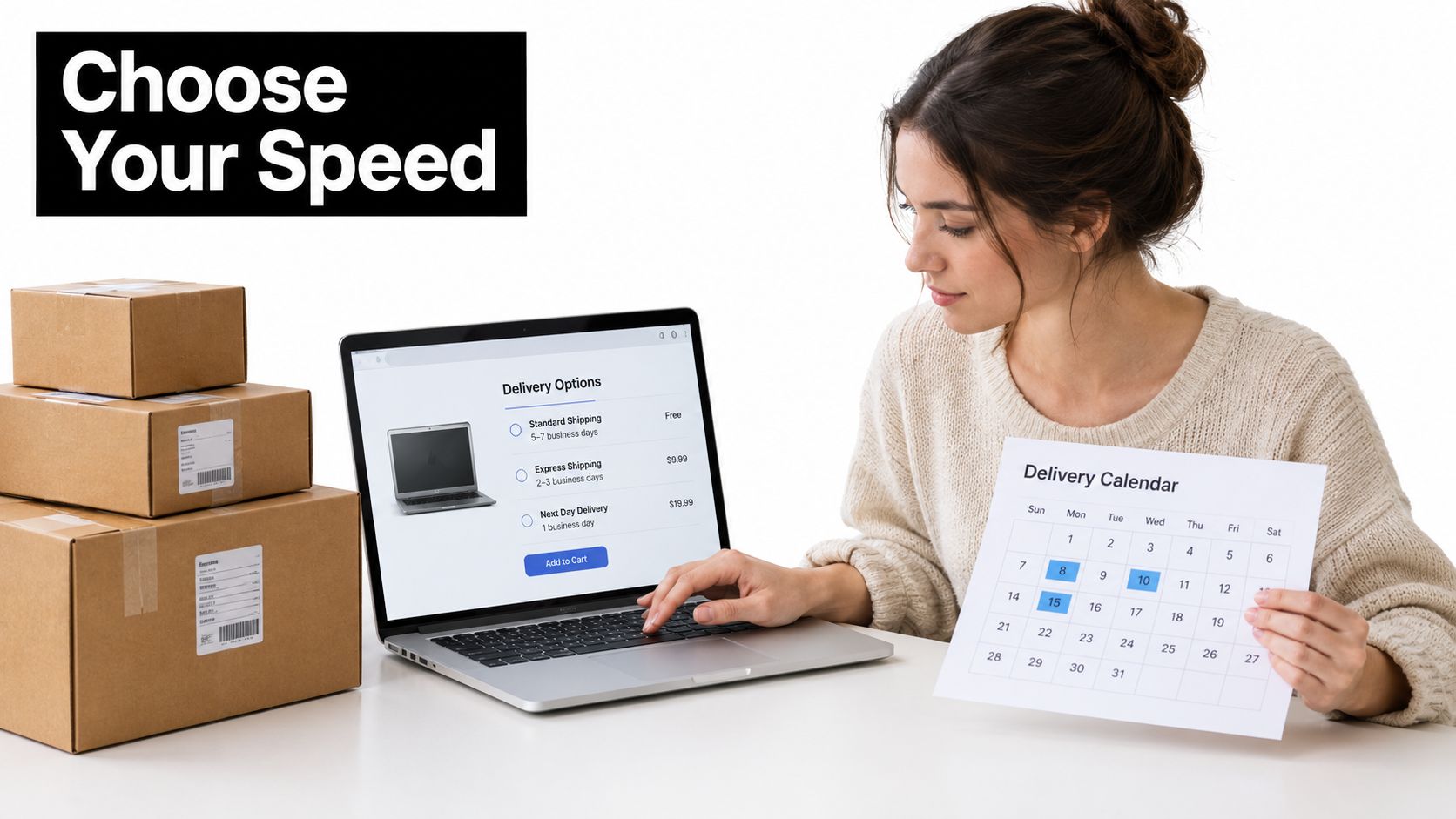
A collector adding a shirt to a wardrobe may have no fixed delivery date. Economy with tracking can suit that order if the buyer accepts a wider delivery window and the tracking remains useful through the final-mile handoff. For a budget-conscious buyer, the lower fee matters only if delays or limited tracking do not create a greater risk of a missed delivery.
Combining items into one parcel may reduce shipping cost per item and the number of delivery attempts. It also concentrates the order in one shipment: if customs holds it, every item is delayed. Compare the consolidated parcel's total cost and likely clearance risk with separate shipments before choosing.
Matching the Service to the Buyer
A parent ordering a jersey for a child's birthday has a fixed date, but may have enough lead time for tracked standard shipping. Express is justified when the standard estimate plus a safety margin no longer fits the deadline. A customs query can still delay an express parcel, so paying for speed does not remove clearance risk.
Friends or teammates splitting a group order may pay less per item with one delivery address, but the organiser takes on the delivery and customs coordination. Confirm who will receive carrier messages and how any charges will be handled. For context, Mystershirt ships mystery football shirt boxes internationally and shows destination delivery estimates at checkout. Look for that kind of lane-specific estimate rather than relying on a single global promise.
The video below illustrates the service choices after an order leaves the warehouse.
Returns belong in the cost comparison too. A likely size exchange can add international transport and inspection costs, so check sizing before dispatch. Consolidated standard shipments can avoid rush transport and reduce repeat parcels, while express may make sense when an event deadline outweighs its higher cost. Choose economy when the buyer accepts a longer window, standard for planned purchases, and express only when the deadline warrants the premium.
Your Next Step Toward Reliable Delivery
A reliable shipping choice starts with the destination and the buyer's tolerance for delay or extra charges. For a planned gift, tracked standard often balances transit time and shipping cost. Express suits a fixed deadline, though it cannot prevent a customs hold. Economy fits orders with flexible arrival dates, especially if the buyer accepts limited tracking after the parcel changes carriers.
Set a latest safe order date for each destination, allowing time for customs processing beyond the carrier's transit estimate. Check the full landed cost before paying, including whether duties and taxes are prepaid. Confirm the recipient's name, complete address, phone number, and email. Missing contact details can leave a customs query unresolved.
A Short Pre-Order Checklist
- Date: Is the deadline fixed, and is there time for a delay?
- Destination: Does the estimate match the country and postal code?
- Charges: Are duties and taxes prepaid, or will the recipient pay on delivery?
- Details: Are the size, recipient's contact information, and any clubs or colours to avoid recorded correctly?
- Fallback: Would the gift still be useful if it arrived late, or is a backup needed?
Sellers should show destination-specific estimates and final charges at checkout, and explain customs holds in plain language. On major routes, offering more than one service level gives buyers a choice between price and delivery speed. Clear tracking updates also help distinguish a customs delay from a parcel that has stopped moving.
Reliability depends on setting expectations before dispatch. Match the service to the deadline, settle border charges upfront where possible, and send complete recipient details. The right choice varies by route and buyer: a flexible collector may value lower landed cost, while someone buying for a fixed event may accept a higher price for faster delivery.
Ready to choose a gift or add to your collection? Explore the Premium, Retro, Kids, and Sharing Box options at Mystershirt, select a size, and list any clubs, leagues, or colours to avoid. Check the delivery estimate for your destination and the final charges at checkout before paying.