

You have a checkout page open, three shirt tabs bookmarked, and no idea whether he still follows the club he had plastered across his bedroom wall at fifteen. That's the problem with soccer gifts for him. Finding something football-shaped isn't hard. Finding something that doesn't end up folded in a drawer because you got the crest, the size or the authenticity wrong is the hard part.
Say you buy a current home shirt for a man who stopped following that club two seasons ago. He'll thank you, wear it once to the gym, and your money is gone. Buy a plain club scarf instead and he'll have it round his neck in December. The gap between a great football gift and an awkward one is almost never about price. It's about how much you know and how much risk you're willing to carry.
Treat the club and the fan type as the main risk in this purchase and the rest gets simple. What follows is how to rank your options when your knowledge is thin, and what to buy when it isn't.
Table of Contents
- Quick Picks for Soccer Gifts by Budget and Type
- How to Match the Shirt to His Fandom and Size
- How to Check Authenticity Before You Buy
- Boots, Accessories and Experiences Beyond the Shirt
- Wrapping, Shipping and Timing the Gift
- Choose the Gift and Order It in Time
Quick Picks for Soccer Gifts by Budget and Type
Buy an authentic club shirt in his adult size when you know which club he follows. When you don't, buy a scarf, a stadium tour or a surprise box and skip the guessing. That's the whole decision in two sentences. Everything below is detail on how to execute it.
Treat the ranges in the table as typical market ranges, not quotes. Prices shift with season, printing, stock and retailer, so confirm the current figure at checkout before you commit.
| Gift type | Typical price range | Best for | Sizing needed |
|---|---|---|---|
| Authentic current-season club shirt | €80-120 | Fan who follows one club closely | Yes, adult size |
| Retro club shirt | €45-90 | Collector or nostalgic fan | Yes, check the cut |
| Replica fan shirt | €25-50 | Casual wear on a tight budget | Yes, adult size |
| Name-and-number shirt | €100-150 | Fan of one named player | Yes, check the player still plays for the club |
| Club scarf or badge set | €15-35 | Low-risk gift for any fan | No |
| Training ball or boot bag | €20-60 | Active weekend player | No |
| Signed shirt or memorabilia | €150-500 | Collector who values provenance | No |
| Stadium tour or match ticket | €40-150 | Match-goer | No |
| Novelty item (mug, socks, keyring) | €10-25 | Stocking filler or office gift | No |
| Mystery jersey box | €40-70 | Buyer who wants a surprise | Yes, adult size |
Read that in three passes. The price column sets your ceiling. The sizing column tells you whether you need his shirt size before you order, which is the step most buyers skip and the reason half of football gifts get exchanged. The best-for column tells you whether the item survives a wrong guess about his loyalties.
Shirts cover the most ground and carry the most risk. A current-season authentic shirt is the strongest single gift the sport offers a committed fan. A retro shirt does the same job for a man whose loyalty peaked in a previous decade, and it never dates.
Accessories sit well below the risk line. A scarf in club colours works on almost any supporter, because nobody rejects a scarf. Memorabilia is for collectors who care about provenance, and at those prices you need documentation rather than a story. Experiences, a stadium tour or a match ticket, beat merchandise for the man who already owns three shirts and complains about the price of a pie.
The wider market backs the shirt as a genuine gift category rather than a novelty: one estimate valued football merchandise at about $26.0 billion in 2025, with men accounting for 58.0% of consumer spending, according to DataIntelo's football merchandise market report. You're buying into a mainstream category, not a niche shelf.
One distinction decides how long the gift stays wearable. A name-and-number shirt ties the present to one player, and a transfer or a retirement can date it overnight. A plain club shirt with no name survives every squad rebuild.
Run three questions before you pay. Which club? What size? What budget? A gift that answers all three is easy to choose.
How to Match the Shirt to His Fandom and Size
Three answers decide the shirt. Which club or national team he follows right now, whether he has a favourite player he names without being asked, and whether he wears shirts to watch matches or to play in. Home or away, brand and price are secondary to those three.
Match the Shirt Style to His Fan Type
The stadium regular goes to games or watches every one. He wants the current club shirt in a relaxed stadium fit, the looser cut sold for casual wear rather than the tight on-pitch version.
The weekend player needs an athletic cut he can move in, and he'll get more use from a training top or a mid-layer than a match shirt he's afraid to sweat into.
The collector checks the season, the sponsor and the label before anything else. A retro shirt from a specific era beats a new one, because he already owns the new one.
The casual supporter watches big games and owns no shirt. He responds to a clean classic design or a national-team shirt in a tournament year, not a deep-cut third kit he can't place.
The national-team fan is the easiest buy of the five in a tournament year, and the hardest to size because national shirts often run differently from club shirts.
Loyalty to the right club matters more than the brand on the chest, and the volume proves it. Real Madrid, Chelsea, Barcelona and Bayern Munich sold 30 million shirts between 2007 and 2012, according to a scholarly chapter on the football shirt, which describes the shirt as a badge of identity rather than a piece of kit. That figure covers four clubs over five years, before national teams, lower divisions,vintage sales or anything unofficial.
Retro shirts carry meaning a current shirt can't. If a man watched his club through the 1990s, a shirt from that era says you paid attention. A shirt from this season says you walked into a shop.
Decision rule: current shirt for a match-goer, retro for memory, name and number only when he names the player himself.
Get the Size Right Without Asking
Take a shirt he already owns, lay it flat, and measure straight across the chest from armpit to armpit. Double it and compare against the brand's own size chart for that specific shirt. Brand charts differ enough that the manufacturer's chart always wins over a generic conversion.
| Size | Choose when |
|---|---|
| S | Slim build or fitted look |
| M | Average build |
| L | Average to broad build |
| XL | Broad build or relaxed stadium fit |
| XXL | Large build |
| 3XL | Very large build or loose fit |
Two adjustments cover most mistakes. Football shirts are cut close by design, so if he's between sizes or you're buying blind, go one size up rather than down. And check the cut, not just the size: a stadium fit in medium and an athletic fit in medium are not the same garment.
How to Check Authenticity Before You Buy
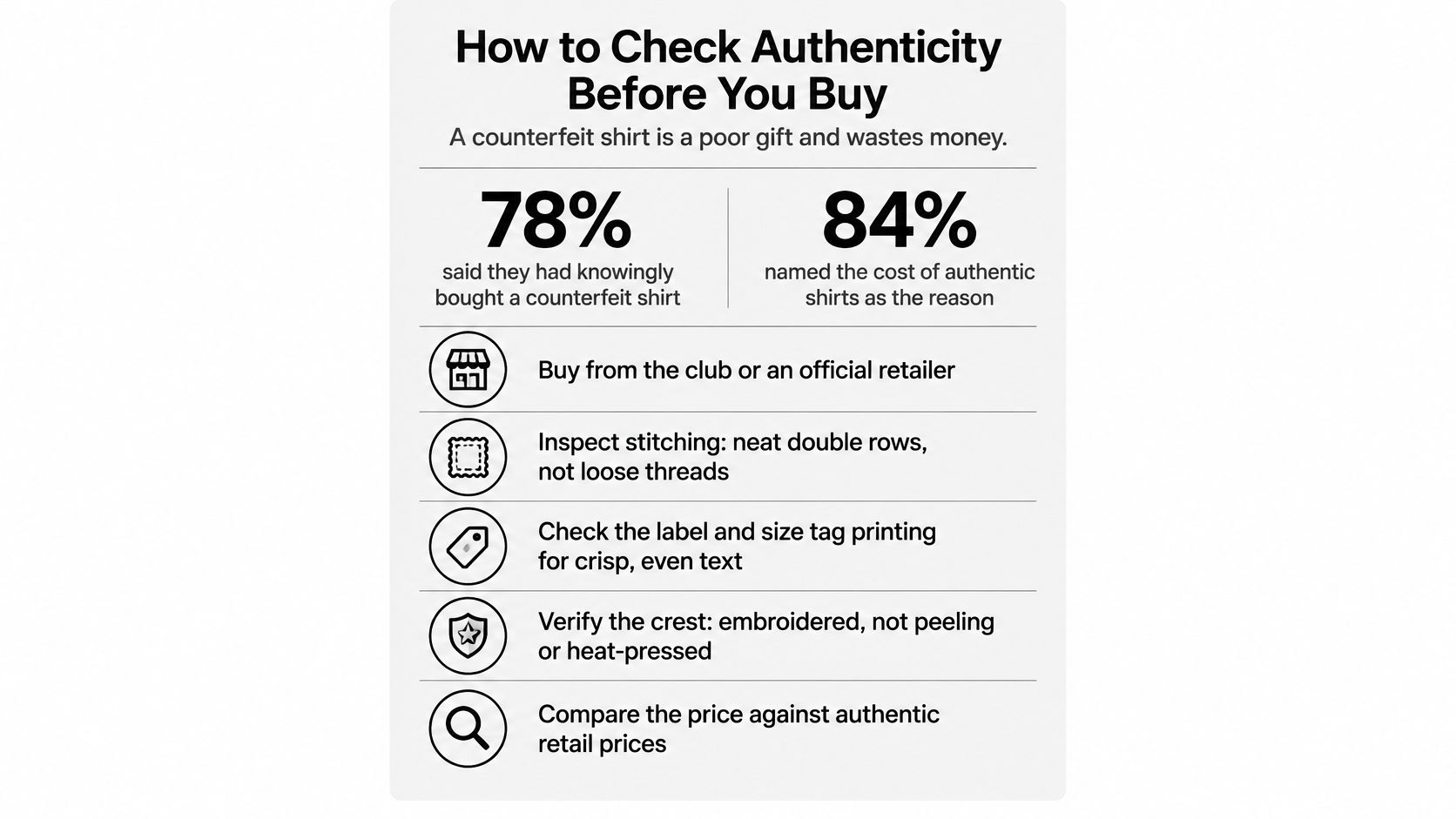
A counterfeit shirt is a poor gift and it wastes your money. The scale of the problem is measurable. In The Athletic's 2025 football-shirt survey, 78% of respondents said they had knowingly bought a counterfeit shirt, and 84% named the cost of authentic shirts as the main reason, The Athletic reported.
These are the checks that catch a fake, in a shop or on a listing.
- Confirm the manufacturer and season. A shirt sold as this season's kit should match the current sponsor and crest.
- Compare the crest and badge placement against official club imagery, including the sleeve badges.
- Inspect the stitching at the collar and cuffs. Neat double rows, no loose threads, no glue lines.
- Read the neck and wash labels. Crisp, evenly printed text with the right country of manufacture.
- Check the seller's returns policy and keep the receipt. A seller who won't take it back is telling you something.
- For pre-owned shirts, check for odour, stains and a stretched neckline before you hand over money.
- For vintage pieces, compare the design against a verified example from the same season, not a photo someone uploaded last week.
Separate two things buyers blur together. A retail replica is the shirt sold to fans in shops. A player-issued shirt is the version made for the squad, rarely sold to the public and priced accordingly, so any claim of "player version" needs proof rather than a listing title. If you want the full breakdown of labels, codes and seller checks, this guide on how to check if your football shirt is authentic walks through it properly.
A pre-owned or vintage shirt lowers waste and carries real history, but it adds condition, sizing and authenticity risk in one go. Weigh that carefully. The cheapest shirt isn't the best value when the provenance is unclear or the return route doesn't exist.
Boots, Accessories and Experiences Beyond the Shirt
Boots are a surface decision before they're a style decision. Get that wrong and you've bought an injury risk in a nice box. A 2024 controlled study of five boot designs found that longer, asymmetric studs produced significantly higher traction coefficients in 75% of tested loading scenarios on natural grass and 50% on artificial grass, with traction varying by movement direction and load.
The mechanism is simple. Longer or irregular studs bite into the surface and increase braking and turning grip. Past a point that grip stops releasing, rotational torque climbs, and the foot locks when the knee wants to rotate. Match the outsole to the pitch he plays on.
| Playing surface | Boot type | Gift guidance |
|---|---|---|
| Dry natural grass | Firm ground (FG) | Safe default for regular pitch players |
| Synthetic pitch or 3G turf | Artificial ground (AG) | Avoid FG studs on artificial surfaces |
| Wet, soft natural turf | Soft ground (SG) screw-in | Give only if he plays regularly on soft turf |
| Indoor or five-a-side | Indoor or court shoe | Flat sole, no studs |
| Surface unknown | Multi-ground (MG) | Safest choice when you cannot ask |
Accessories and Experiences When Boots Are the Wrong Call
A training ball or boot bag suits the man who plays weekly and never replaces his kit. A stadium tour or match ticket suits the one who already owns the shirt and loves the matchday ritual more than the merchandise. A novelty item, socks, a mug, a keyring, is a stocking filler and nothing more, so don't build the gift around it.
If you're assembling several smaller pieces instead of one shirt, this breakdown of accessory bundles shows how the pieces combine without duplicating what he owns.
Ask one question before buying boots: which surface does he play on? If you can't ask, buy multi-ground or buy something else.
Wrapping, Shipping and Timing the Gift
Plan backwards from the date, not forwards from the idea. Five steps cover it.
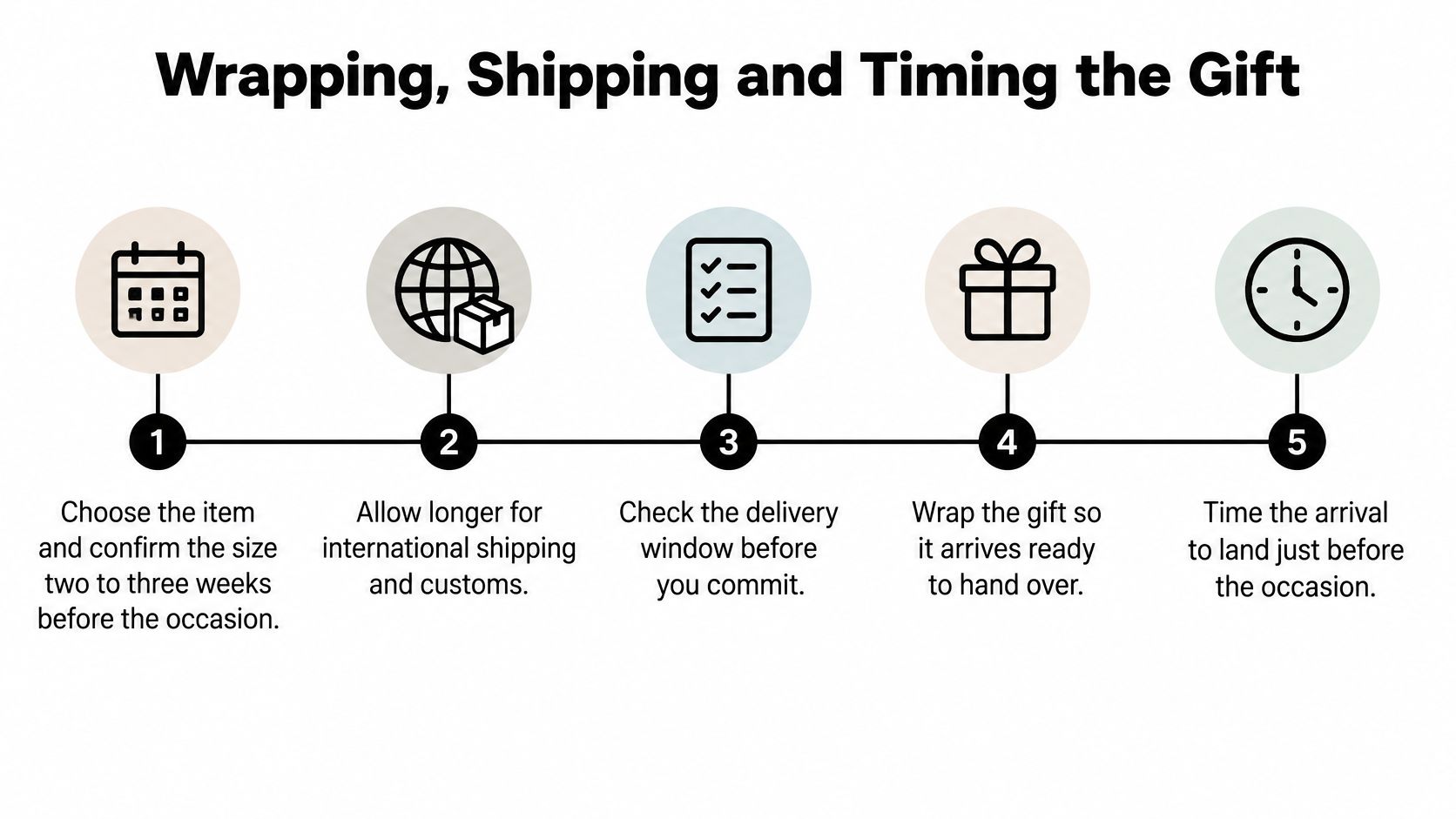
- Lock the item and the size two to three weeks before the occasion for domestic orders. Run longer for international shipping and customs clearance.
- Check the delivery estimate and order cut-off at checkout, on the day you buy, not the day you meant to.
- Choose the delivery address deliberately. Home, work, or a friend's place if he travels and parcels sit on a doorstep.
- Keep the order confirmation and request a gift receipt. Sizing is the single most common reason a football gift gets returned.
- Wrap the shirt flat in tissue with a card or a handwritten note, and keep the crest visible when the box opens.
Presentation does real work here. A shirt in a clear bag inside a gift tube gives a boxed reveal. A scarf folded around a bottle reads as deliberate rather than last-minute. A boot bag with a ball inside suits the player who's never organised.
Before you pay, read the returns window and the exchange route. A gift with no way back is a bet, not a purchase. If shipping is the variable you're least sure about, this guide to how long international express shipping takes sets realistic expectations.
Timing rule: if the date is fixed, order early enough that a sizing problem can still be fixed before it.
Choose the Gift and Order It in Time
The decision rule is one sentence. Know the club and the size and buy an authentic club shirt, in the style he'll wear; know neither and buy a surprise rather than a guess.
A surprise box removes the club question entirely. The Premium Football Shirt Mystery Box costs €44,95 and includes two authentic shirts from recent seasons in sizes XS-5XL, and the Premium Football Shirt with Name and Number Mystery Box costs €54,95 in the same size range, with a real player's name and number printed on the back. Each shirt is selected from a collection of football clubs, so the club itself stays a surprise. That's the trade-off, stated plainly: you don't pick the team, so the box suits a fan who'll enjoy the randomness, while a known club calls for a shirt you choose yourself.
Then move in order. Confirm his size from a shirt he already owns, pick the option that matches his fandom, check the delivery date against the occasion, and plan the reveal with a card. Check the current box contents and price on the product page before you order, since ranges and stock move.
If the date is fixed, order this week.
Mystershirt exists for the case this guide keeps circling back to: the buyer who wants to give a real, authentic football shirt without knowing the recipient's club by heart. Every shirt we send is 100% authentic with labels, chosen from clubs across the football world, in sizes from kids to 5XL, with the option to list the clubs, leagues or colours you'd rather avoid. If the date is close and the club is a mystery, visit Mystershirt and pick the box that fits him, then let the unboxing do the rest.


