

You're on your phone, comparing soccer jerseys for sale, and one listing is far cheaper than the club shop. The photos look clean. The size chart is a single column of letters. You still can't tell whether you're looking at a licensed shirt, last season's stock, or a copy.
Price alone doesn't settle it. A low number can mean an older season or a pre-owned shirt in honest condition. It can also mean a counterfeit. Tags and holograms don't settle it either, because copies now imitate those too.
Before you pay, lock the type of shirt, then check authenticity, size, fabric, condition, and what happens if the parcel is wrong. That's the order that keeps a gift, a matchday shirt, or a collector piece from turning into an argument with a seller.
Table of Contents
- Soccer Jersey Types and What Each One Is For
- How to Verify a Jersey Is Authentic
- Matching Size and Fit for Adults, Kids and Gifts
- Fabric and Construction Worth Checking
- Why Season, Condition and Provenance Set the Price
- Returns, Payments and Sustainability Claims
- Confirm These Checks Before You Buy
Soccer Jersey Types and What Each One Is For
| Type | What It Is | Typical Use | What to Check |
|---|---|---|---|
| Fan replica | Mass-produced version with a standard cut and printed crest | Everyday wear and matchday | Crest finish and size chart |
| Player version (authentic) | Match cut with heavier construction | Collectors and fans wanting the exact look | Fabric details, labels, and seller authenticity guarantee |
| Retro or vintage | Design from an earlier season | Collecting and nostalgia | Season year, condition, and provenance |
| Licensed reissue | Modern re-release of a classic kit | Gifts and casual wear | Licence label and care label |
| Kids' jersey | Sized by height for children | Youth play and gifts | Height-based size chart and room to grow |
| Name and number custom | Printed player name and number | Personalised gifts | Print quality and return policy for custom items |
| Counterfeit | Unlicensed copy of a real design | None; avoid | Price far below normal, blurred crest, no tags or labels |
Read the table left to right. Type tells you what you're buying. Typical use tells you whether that type fits the job. What to check is the first proof, not the whole proof.
A fan replica is the shirt many fans should buy for the stands. The cut is standard, the crest is usually printed, and it survives weekly wear. A player version, often sold as authentic, uses a tighter match cut and heavier construction. Collectors want that exact look. It's a poor default if you need room for a jacket underneath.
Retro and vintage shirts are earlier-season designs. A collector wants a documented season, not a vague "classic" photo. A licensed reissue is a modern remake of that classic, which is the cleaner gift when you don't want to gamble on a used shirt's history.
Kids' shirts are sized by height, not by an adult letter. Custom name-and-number shirts are gifts with a catch: many sellers won't take them back once the print is applied. The last row is the one to refuse. A counterfeit copies the look without a licence.
A cheaper previous-season or pre-owned shirt is a normal listing. A counterfeit is the only type with no honest use.
DataIntelo's football jerseys market estimate places consumer spending on football jerseys at $5.22 billion in 2025, with projected spending of $8.97 billion by 2034. That category already covers licensed replicas, authentic club and national-team shirts, name-and-number printing, customized jerseys, and teamwear for amateur, school, and academy sides. E-commerce accounted for 38.0% of football-jersey sales in 2025.
The aisle is wide because the jobs are different. Match support, collecting, gifting, and youth play don't want the same shirt. I would pick the row first. Verification, size, fabric, price, and seller protection only make sense after you know which shirt you meant to buy.
How to Verify a Jersey Is Authentic
A shirt at half the club-shop price sits in your cart. The crest colour matches, the seller says authentic, and the photo is sharp. Stop there. A low price is not a fraud signal, and it is not proof either. Previous-season stock, light wear, and surplus from clubs or manufacturers can all sell under retail and still be genuine. A fake can carry a full retail number if you never check type, season, condition, and the seller's terms.
UK government research on counterfeit goods found that 12% of people who bought sports products in the previous year had knowingly purchased counterfeits. Football kits were among the commonly counterfeited sportswear items, and e-commerce and social-media marketplaces were common purchasing channels.
Holograms, neck tags, and QR codes get copied. Listing photos get borrowed from real product pages. Treat those marks as one clue inside a buyer-side check, not as the whole test.
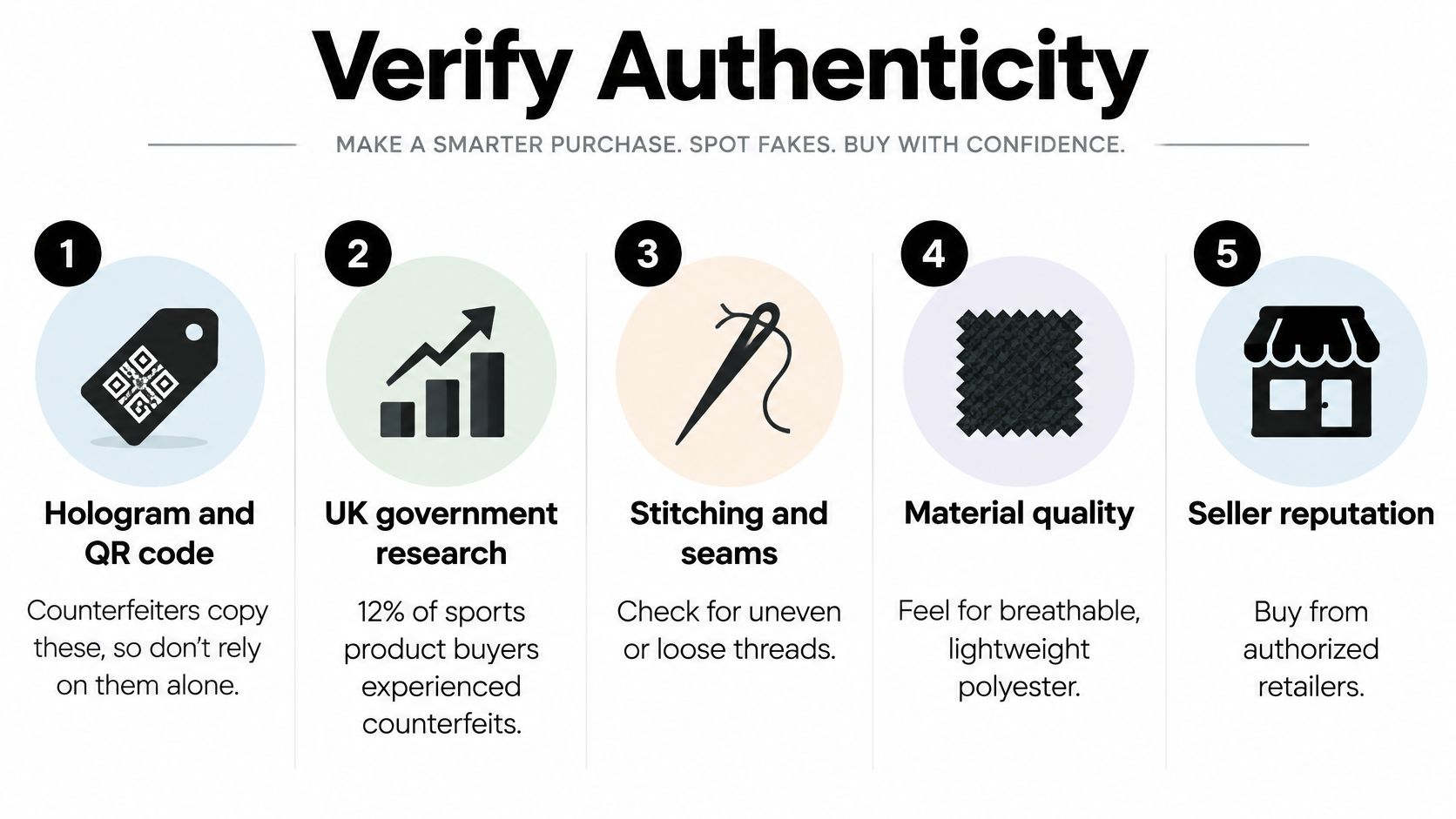
Five checks before you pay
- Match the graphics to an official shirt of that type and season. Compare the crest, sponsor, and number fonts with photos of a verified official shirt from the same season. Fakes often miss the badge shape or the back-print spacing even when the colour looks right. A fan shirt, a match shirt, and a training top are different products. The listing has to name which one you are buying.
- Inspect the build in daylight. Look at stitching density, badge edges, and printed numbers. Loose threads, a fuzzy crest, and numbers that already crack in the preview are cheaper production. Do not accept that as a factory variation.
- Read the label against the condition you are paying for. It should show the club or brand, the season, and the size. On a shirt sold as new, the original tags should still be attached. A missing label on a "new" shirt is a reason to stop. On a used shirt, the label should still agree with the season in the title.
- Get the seller's terms in writing. Read the authenticity promise and the return rights on the product page or in the order terms before you pay. Only a written guarantee can put money back, and only if it covers the exact shirt in the order.
- Ask where an older shirt came from. Provenance means a season year, photos of the tags, and a plain description of wear. "From a collector," with no detail, is not provenance.
If the crest, the back print, and the label don't tell the same story, don't talk yourself into the deal.
I would walk away when type, season, condition, and the written terms disagree, even if the price looks generous. Pay less for an older season or honest wear. Do not pay less for a shirt whose parts do not match.
Matching Size and Fit for Adults, Kids and Gifts
You order an XL because that is the letter on your jeans. The shirt arrives, the crest looks official, and it still pulls across the chest. Fit is its own check. Price does not settle it. A cheap shirt can match your measured width. A dear one can be a tight player cut.
Order the size that matches your measured chest, not the letter you wear in another brand. Confirm that width on the seller's garment chart before you pay.
Three measurements that beat a guess
- Measure a shirt you already like. Lay it flat and measure from armpit to armpit. That half-chest number is the figure that travels between brands.
- Put that width next to the seller's chart. Player cuts sit closer to the body, and the same letter changes by brand. An XL player cut can feel tighter than a fan-fit L. If the chart lists a garment measurement, trust that over a body-size cartoon.
- Add room if you layer. A training top or a light jacket under the shirt needs one size up. A shirt that is perfect on a bare torso will bind once you add sleeves underneath.
Kids and gifts
For children, buy by height from the seller's youth chart and leave room to grow. A body that is slightly long still looks like a football shirt. Sleeves that stop at the forearm are outgrown in a few months.
If you are buying a gift and you do not know the size, use height for a child or ask someone for a shirt the person already wears. Guessing an adult letter from age is how gifts get returned. A wrong size is a common reason a shirt comes back, and the return still costs you time even when the seller accepts it. Read the chart before you pay.
If the letter sizes still feel slippery, see whether football jerseys run big or small.
Namesets and custom shirts are often final sale. Check that line before you order a printed name. A perfect size you cannot return is still a risk if the print is wrong. I would not pay for a name until the half-chest on the chart matches a shirt that already fits.
Fabric and Construction Worth Checking
Ninety minutes in a heavy shirt is a different problem from a doubtful badge. The cloth either moves sweat or it traps it. A low price, by itself, does not prove a fake and does not prove the fabric will perform.
| Fabric | Drying Rate (mL/h) | Best For | Care Note |
|---|---|---|---|
| 100% polyester | 2.73 | Match, training, and warm weather | Wash cool, air dry |
| 91% polyester and 9% spandex | 2.62 | Fitted training and stretch | Avoid high heat to protect elastane |
| 100% cotton | 0.67 | Casual wear and lifestyle | Slow drying; not ideal for sweaty use |
| Open-knit polyester eyelet | Strongest cooling in the knit test | Hot and humid conditions | Check for mesh panels before buying |
| Dense interlock knit | No separate mL/h figure | Opacity and durability | Holds more heat than open knit |
The fibre name on the label is the start, not the decision. Knit structure decides whether that polyester breathes.
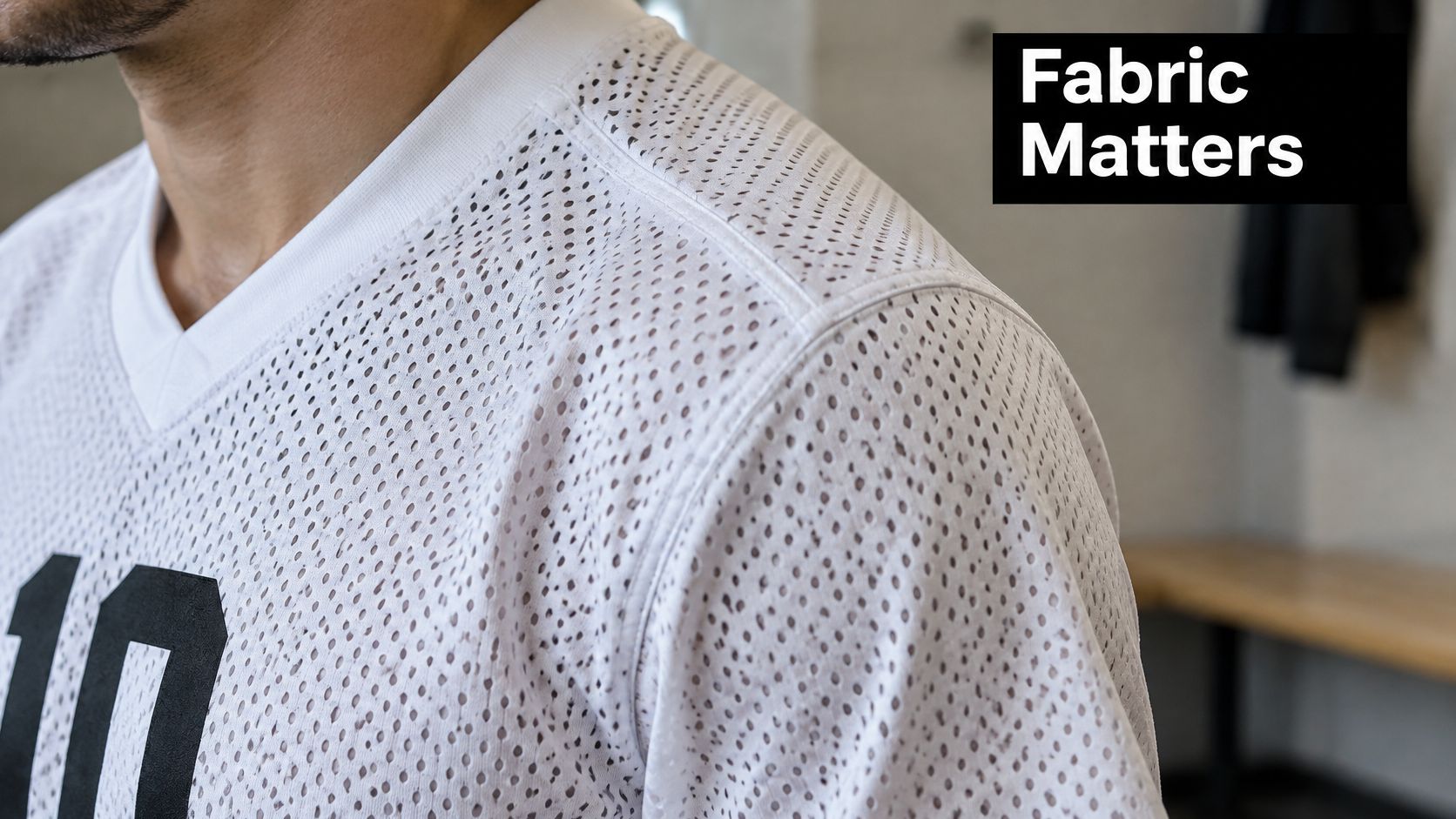
A 2025 study of commercial 100% polyester football-jersey fabrics found that porous open-knit polar-eyelet fabric had the strongest thermophysiological performance, with thermal resistance of 0.009 m²K/W and air permeability of 2,149.2 mm/s. Larger pores and connected air channels move heat and vapour out. On a hot matchday, mesh panels do more than a slogan about "performance fabric."
Drying speed splits the same way. A 2025 activewear study recorded an average drying rate of 2.73 mL/h for 100% polyester, 2.62 mL/h for a 91% polyester and 9% spandex fabric, and 0.67 mL/h for 100% cotton. Polyester does not soak liquid into the fibre the way cotton does, so sweat can spread and leave when air can reach it.
What to buy, and what slows it down
Choose lightweight polyester for matches, training, and warm weather. Choose the polyester-elastane blend when you want a closer training fit, and keep heat away from the elastane. Dense interlock gives you opacity and a tougher hand, and it also holds more heat. Cotton belongs in lifestyle shirts, not in a sweaty 90 minutes.
A tight fit, blocked mesh, or a heavy layered graphic slows drying no matter what the table says. Finishing, seams, and prints change airflow. Those lab figures are benchmarks, not a promise for every shirt on a rack.
High heat can damage elastane, transfers, and heat-applied badges. Wash cool and air dry. The fibre families are spelled out in this breakdown of what soccer jerseys are made of. For knitwear outside football, a Cashmere Boutique guide on how to spot quality cashmere covers sweaters, not match polyester, so it does not replace the jersey checks above.
I would still do two checks from photos or in a shop: look for visible mesh or eyelet panels, and read the care label before you pay. If the listing hides both, you are guessing at construction.
Panel placement is easier to judge once you see a shirt move:
Why Season, Condition and Provenance Set the Price
A low price is not automatic proof of a fake. Season, condition, and provenance set most of the gap between two genuine shirts.
| Condition | What It Means | Price Signal | Buyer Action |
|---|---|---|---|
| New with tags, current season | Unworn and labelled | Close to current retail | Verify labels and seller guarantee |
| New with tags, previous season | Unworn and labelled, older design | Below current retail | Check season year on the label |
| Pre-owned, minor wear | Used with small marks or wear | Below new retail | Ask for photos of the flaws |
| No label or unclear branding | Missing tags or labels | Often far below normal | Walk away unless authenticated |
| Vintage or retro | Earlier season design | Set by rarity and season proof | Ask for provenance and season proof |
How to read the listing
Check the season year first. A current shirt with tags should sit near current retail. A previous-season shirt with tags should cost less, and that discount is normal. A pre-owned shirt with small marks should cost less again, and the seller should show those marks instead of cropping them out.
Then check provenance. Photos of the neck label, the care label, and the back print should match the season the title claims. Honest listings name flaws. Vague listings say "great condition" and show one front photo.
A price gap between sellers should be read against those three factors, not against the club-shop price alone. Official retail is out of reach for plenty of fans, which is why older-season and pre-owned shirts exist as a real market. For a closer look at how those gaps show up in listings, see what drives soccer jersey prices.
A price is fair when the season, the condition, and the seller's terms all match what the listing claims.
A shirt with no label, or with branding that doesn't match the claimed season, sits outside that range. Walk away unless someone can authenticate it. Cheap and undocumented is not the same thing as cheap and last season.
Returns, Payments and Sustainability Claims
The shirt can be right and the purchase can still go wrong after you pay. Protection is a set of questions, not a logo on the checkout button.
Can you return it, and for how long? Get the return window in writing. A "satisfaction" line with no number of days is not a policy you can use.
Does a custom print void the return? Name-and-number shirts are often excluded. If the listing doesn't say, ask before you order the print. We back our own purchases with a 100-day money-back guarantee, and you should expect any seller to state the window with the same clarity.
Is it a refund or only an exchange? An exchange doesn't help if the size was wrong and the next size is gone. Ask which one applies to your order.
Can you dispute the payment? Pay by card, or by a service that lets you open a dispute if the item isn't as described. Save the listing screenshot and the order confirmation. Those two files are what a dispute team reads.
Who pays return shipping? That cost turns a "free return" into a real bill, especially on a cross-border parcel. A wrong size is cheaper to avoid than to post back, but you still want the number before you pay.
What an eco claim has to show
Recycled polyester is printed on a lot of modern shirts. Much of that fibre starts as plastic bottles, so the badge can describe a shift of plastic into textiles rather than a full account of impact. Don't treat the hangtag as evidence.
Ask for material composition, how the shirt is built to last, care instructions, expected lifespan, and whether repair or resale is realistic. Those answers are the evidence. Shipping and returns belong in the same conversation, because a shirt that flies back and forth has an impact the hangtag never mentions.
If the seller can't answer the return questions and the material questions in writing, don't pay yet.
Confirm These Checks Before You Buy
Pay only after the checks agree. Pick the jersey type. Verify authenticity. Measure and match the size. Check fabric and care. Compare the price with season and condition. Then confirm returns and payment terms.
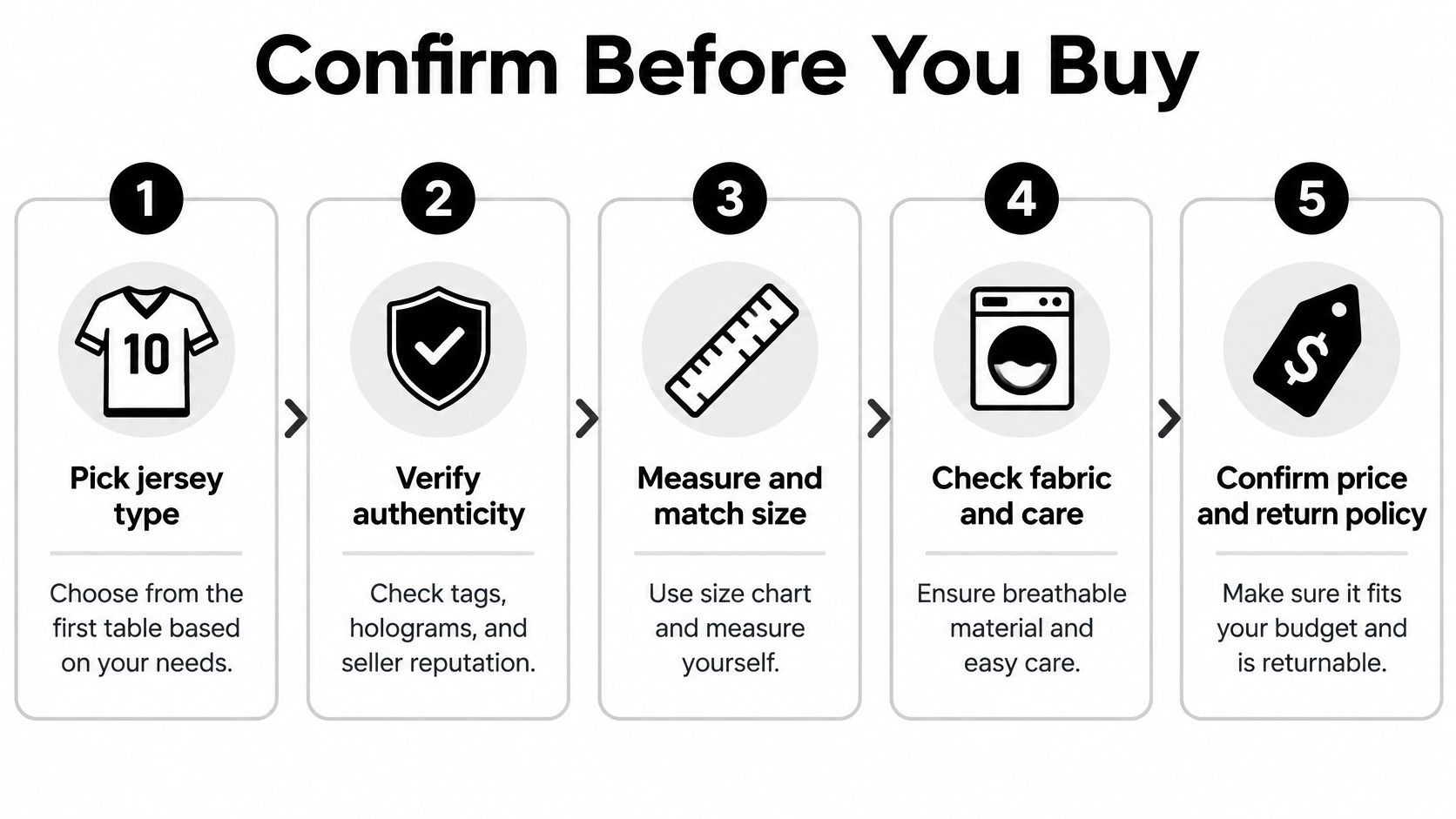
Copy this list
- The type matches the job. Matchday, collecting, retro, a gift, or youth play. If the club is still undecided, choose the type first and let that job narrow the club.
- The shirt matches an official photo. Crest, stitching, and label agree, and tags are attached on anything sold as new.
- The size matches a measured shirt and the seller's chart. Go one size up when you plan to layer.
- The fabric fits the use. Lightweight polyester, or polyester with elastane, for hot or sweaty wear, plus a care label you can read.
- The exit route is in writing. Return window, custom-item rules, a payment dispute path, and who pays return shipping.
We sell 100% authentic jerseys. The shirts in the boxes are authentic, from a recent season, and come with labels still attached. At checkout you can list clubs and leagues you want to avoid, and we take that list into account when we prepare the order.
Choose one type from the table, check the seller against this list, and confirm size and the return window before you pay.
If you want an authentic shirt without paying club-shop prices for every season, Mystershirt sends 100% authentic football shirts with labels still on, including mystery boxes where you set the size and the clubs to skip. That lines up with the checks above: a real shirt, a stated size, and a clear way to send one back. Visit Mystershirt and pick the box that matches the type of shirt you really want.


