“Buy a shirt with a certificate” is incomplete advice. A certificate can accompany a poorly documented autograph just as easily as a well-supported collectible. When you're browsing signed football shirts for sale, the useful question isn't whether paperwork exists, but whether it connects the signature, the garment and the seller's claims.
A lesser-known player's shirt with exact fixture documentation can be a more defensible purchase than a superstar autograph with a generic certificate. Buy the evidence you can check, not the story you're asked to believe.
Table of Contents
- What a Signed Shirt Should Cost
- Signed Replica, Player-Issued or Match-Worn Shirts
- Four Evidence Levels Behind Any Authenticity Claim
- How to Verify a Signed Shirt Step by Step
- Judging Seller Reputation and Returns
- Storing and Displaying a Signed Shirt Safely
- Choose One Listing and Decide
What a Signed Shirt Should Cost
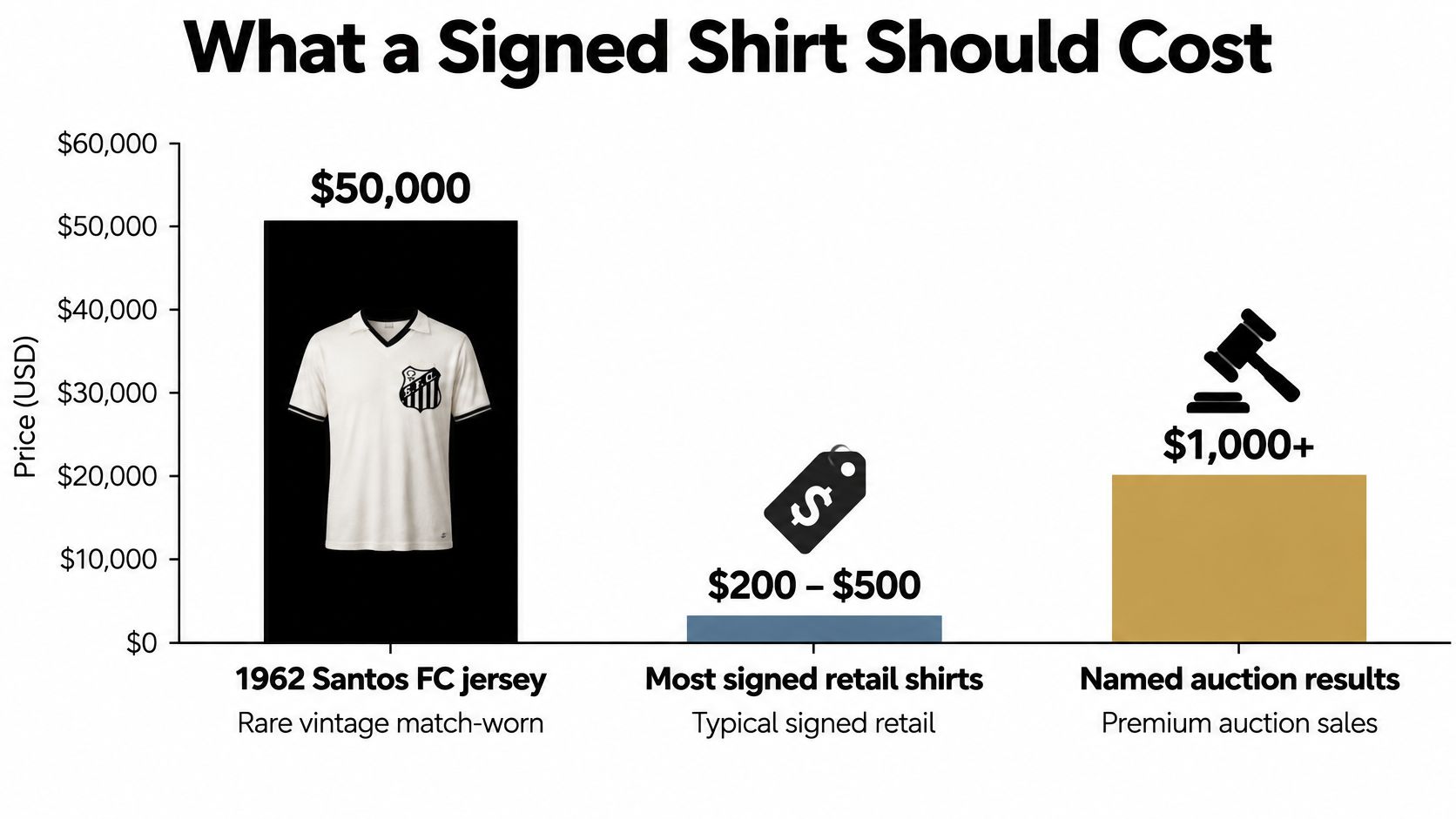
An ordinary signed retail shirt is a hundreds purchase until the garment and the paperwork justify more. Named auction results climb much higher because they mix different players, different shirts and different evidence. Those results are not interchangeable benchmarks.
One completed sale that is tied to a public record is the reportedly worn and signed 1962 Santos FC Pelé shirt, which realized $5,875 when Huggins & Scott offered it at its July 2012 auction. The sale summary does not spell out a separate authentication method, so that gap stays a gap.
Realized price for a signed football shirt
| Shirt | Signer or context | Authentication noted | Realized price |
|---|---|---|---|
| 1962 Santos FC jersey | Pelé, reportedly worn and signed, July 2012 auction | Not specified in the sale summary | $5,875 |
“Not specified” does not mean authentication was absent. It means you do not fill a missing line in the description with an assumption.
The chart below sketches how far market prices for signed football jerseys can diverge. Treat it as a broad picture of that spread, not as a set of documented sale results.
Separate the signature from the premium
Signer fame, historical significance, scarcity, documentation and shirt quality all change what a buyer will pay. A vintage garment with a defensible history is a different purchase from a newly signed retail release, even when the autograph is the same player's.
Fame without a fixture link, a match photo or a clear account of who signed the shirt is a weak reason to pay a premium. A lesser-known player's shirt with exact match paperwork can be easier to defend at resale than a star name sitting on a generic certificate. A presentation box and a certificate show that someone packaged the item. They do not, by themselves, set the price.
For the wider job of separating an asking price from a defensible valuation, DIYAuctions' guide to pricing sports memorabilia for maximum returns is a useful companion. If Messi is the target, use our guide to how much a signed Messi shirt is worth to narrow the comparison.
Budgeting rule: Find three completed sales with the same signer, shirt type and authentication standard before accepting an asking price.
I would match those three sales on evidence first, then on the name. Add delivery, buyer's fees and any inspection cost to the budget. A framed presentation can suit a gift, but an attractive mount should not hide the garment you are buying.
Signed Replica, Player-Issued or Match-Worn Shirts
Name the shirt before you price the ink. Signed retail replica, player-issued and match-worn are separate categories, and a listing that treats them as interchangeable is asking you to pay for a claim it has not shown.
A signed retail replica is a supporter's shirt with an autograph added. Retail labels and tags help identify the garment. What you are mostly buying is the signature, the condition, and a connection to a club or player.
A player-issued shirt is the player-level version, identified by construction details, tags or other identifiers. Those details do not show that a player wore it. They do not show that it reached the dressing room either.
Signed shirt types compared
| Shirt type | Evidence to expect | Typical buyer | Preservation needs | Resale implication |
|---|---|---|---|---|
| Signed retail replica | Retail label and tags, signature, certificate | Fans and gift buyers | Keep out of sunlight and avoid washing | Value rests mostly on signature and condition |
| Player-issued shirt | Player-issue tags or identifiers, signature where claimed | Collectors wanting a player's own version | Keep tags intact and avoid cleaning | Value depends on verifying player-issue status |
| Match-worn or match-issued shirt | Team or league identifiers, fixture link, photomatching where wear is claimed | Serious collectors and investors | Avoid cleaning or framing before inspection | Strongest when the fixture link is documented |
Issued isn't the same as worn
Match-issued means the shirt was prepared or allocated for a fixture. Match-worn adds a further claim: the player used that garment during play. A substitute's unused shirt can have a real fixture connection and still not be match-worn. That gap is where asking prices drift.
Barnebys' realized prices for signed football shirts list completed sale results. Read them as price history for signed shirts, not as a judgement of how a garment was used. Photomatching has to identify distinctive features on the actual shirt. A photo of the player in the same design is not a match.
A less famous player's shirt with an exact fixture record can be more defensible than a superstar autograph backed only by generic paperwork. More defensible does not automatically mean more valuable. It means fewer claims you cannot check.
One extreme shows how far a documented match shirt can sit from a signed retail product. BBC Bitesize records that Maradona's shirt from Argentina's 2–1 victory over England in the 1986 World Cup quarter-final sold for £7.14 million in May 2022. He wore it while scoring the Hand of God and Goal of the Century goals.
Put the shirt type at the top of your buying notes. If you cannot classify it, you are not ready to compare its price.
Four Evidence Levels Behind Any Authenticity Claim
A certificate of authenticity, usually shortened to COA, is a starting point. Its usefulness depends on who issued it, what they examined and how precisely they identified the item.
SCP Auctions' football memorabilia guidance treats authenticity, provenance, condition, rarity and historical significance as separate valuation factors. A document addressing one of those factors shouldn't be read as proof of all the others.
Evidence levels behind an authenticity claim
| Evidence level | What it proves | What it does not prove | Buyer strength |
|---|---|---|---|
| Generic COA | A certificate was issued | That the shirt or signature is genuine | Weak |
| Serialised authentication | The serial number exists and describes this item in the issuer's database | Season, match use or official status | Moderate |
| Independent signature examination | An examiner judges the autograph consistent with known examples | The shirt's season or match use | Moderate |
| Photo or video tied to the shirt | The signing happened with this garment, if the recording is genuine and identifiable | Club, season or match use | Strong for the signing |
Read the scope, not just the logo
A generic certificate may say little beyond the seller's belief. Serialised authentication adds a checkable record, but only if its description matches the garment in front of you.
Independent examination answers a handwriting question. It doesn't turn a retail shirt into a player-issued one, and it doesn't establish when the autograph was applied unless that is separately documented.
Photo or video evidence can be particularly useful when you can identify the shirt through signature placement, pen colour and visible garment details. A photograph of the player signing an indistinguishable pile of shirts is less conclusive.
An authentic autograph doesn't automatically authenticate the shirt's claimed season, match use or official status.
These evidence levels work best together rather than as an inflexible ranking. A carefully examined signature with a detailed item record may be more useful than a blurry signing photograph with no reliable connection to the listing.
For a fuller explanation of the document itself, consult our certificate of authenticity guide. Colorado Art Services' discussion of provenance checks for private collectors also provides a useful cross-collecting perspective on examining an object's supporting history.
Ask the seller which evidence they can supply, rather than whether a COA is included. An unverified certificate with no item-specific record or identifiable signing evidence remains an assertion you haven't tested.
How to Verify a Signed Shirt Step by Step
Confirm that the authentication record describes this exact shirt before paying. A valid number attached to the wrong garment is still a failed check.
The Sports Integrity certificate inspection checklist supports a provenance-first approach, including database checks, signature comparison and examination of signing photographs. Recognised specialists include PSA/DNA, Beckett Authentication Services and JSA, but the name on the paperwork doesn't remove the need to inspect the record.
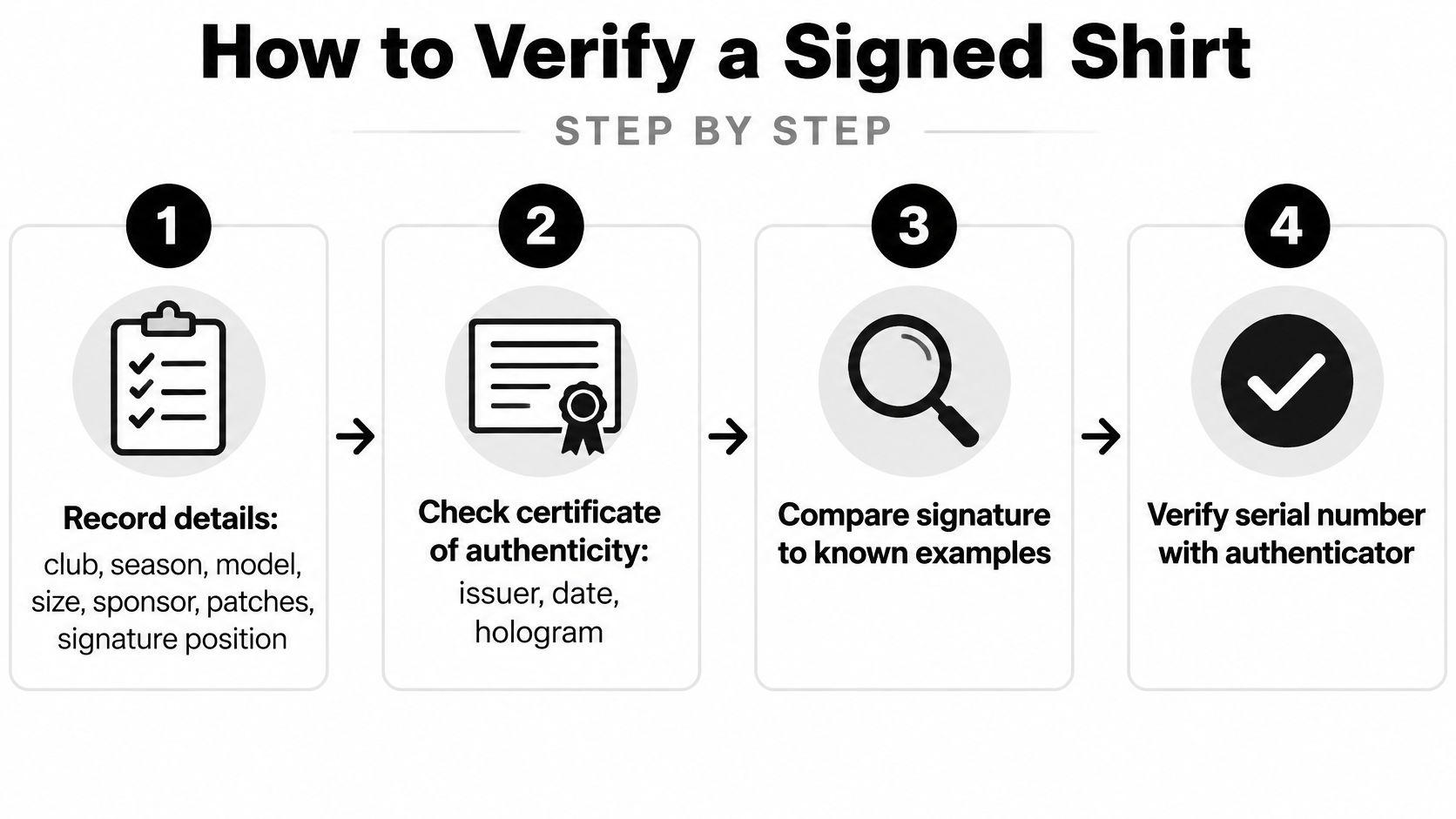
Use the visual checklist as a reminder, then complete the item-matching checks below.
Check the garment and the record
- Record the shirt's identity. Note the club, claimed season, model, size, sponsor, patches and signature position. Save full front-and-back photographs and close-ups of the label. This creates a reference against which you can detect a substituted garment or a description that has drifted beyond the evidence.
- Look up the certificate or hologram number. Go directly to the issuer's public database rather than trusting a seller's screenshot. Type the number carefully and save the result. This can expose an invented certificate, although a copied genuine number may still return a valid entry.
- Match the entry to the item. Compare the signer, garment description and any reference photographs. If the record identifies only an autograph without enough detail to distinguish the shirt, contact the authenticator before treating it as item-specific proof. A successful lookup proves little when the accompanying shirt doesn't match.
Examine the signature and signing evidence
- Compare several known examples. Look at stroke sequence where discernible, pen pressure, fluency, spacing, ink flow and unusual stops. Fabric texture and pen type affect appearance, so a difference isn't automatically a forgery. Use your comparison to identify concerns for a specialist, not to award yourself an authentication verdict.
- Inspect the signing photographs. Look for the same signature location, shirt details and distinctive marks. Check whether the image shows a witnessed signing of this garment rather than the player holding a similar shirt. Altered photographs and generic event images can create confidence without establishing a connection.
A genuine manufactured shirt can still carry an unauthorised signature. Conversely, a plausible autograph doesn't resolve an incorrect claim about the garment underneath it.
Build a file that survives resale
Keep the purchase invoice, seller identity, authentication record and shipping documents together. Save the listing description too, especially any claims about match use, signing date or previous ownership.
Request sharp photographs of the whole shirt, autograph, labels, hologram and certificate before shipment. On arrival, compare the item against those photographs before framing or altering anything.
An unfamiliar issuer with no searchable record, detailed description or physical business information warrants further investigation. Don't replace missing evidence with confidence in a polished website.
Your finished file should let another buyer follow the chain without relying on your memory: what was offered, who supplied it, which record identifies it and whether the delivered shirt matches. That's a stronger outcome than keeping a loose certificate in the bottom of a drawer.
Judging Seller Reputation and Returns
Judge the seller and the price together. A convincing storefront doesn't compensate for incomplete provenance, and a low price doesn't make an unverifiable shirt a bargain.
Catawiki's collecting guidance identifies signer fame, signature rarity, signing date, condition, authentication papers and signature count as valuation factors. Assess fabric, sponsor print, badges, signature clarity and certificate condition separately rather than giving the whole item a vague “excellent” grade.
Red flags and the check that catches them
| Red flag | Check that catches it |
|---|---|
| Generic COA from an unfamiliar issuer | Look up the serial number in the issuer's public database |
| No serial-number lookup offered | Ask for the number and confirm the record describes this exact shirt |
| No physical business details | Verify seller identity and a physical address before paying |
| Incomplete provenance | Request the purchase invoice and an authentication record linked to the item |
| Price far below comparable completed sales | Reject unless provenance and condition justify the gap |
| Vague returns terms | Require written refund terms if authentication fails |
Set your acceptance threshold
Consider whether additional signatures improve the item for your likely buyer. A coherent squad-signed shirt may appeal to a club collector, while scattered, less-desired autographs can weaken the appeal of a star-focused display.
Adjust completed-sale comparisons for authentication, size, condition and delivery costs. Reject a listing when the seller can't explain a substantial price gap or refuses evidence needed to support the advertised category.
We work directly with clubs, official suppliers and verified partners to source our shirts. That sourcing statement is useful context, but buyers should still assess the documentation supporting each signed item's particular claims.
Put the refund agreement in writing
Before payment, establish:
- Return window: When it starts and whether independent inspection can fit within it.
- Failed authentication: Whether the seller refunds the purchase price and original shipping.
- Return postage: Who pays, and which insured delivery method is acceptable.
- Disputes: Which examiner or evidence the seller will accept.
Don't assume a general satisfaction guarantee covers an authenticity dispute. Keep the seller's written response with the listing, and leave questionable stock uncleaned and unframed while you resolve it.
Storing and Displaying a Signed Shirt Safely
Once you've verified the purchase, protect both the garment and its records. Light, moisture, heat and unnecessary handling are avoidable risks, whether you bought a display piece or a family keepsake.
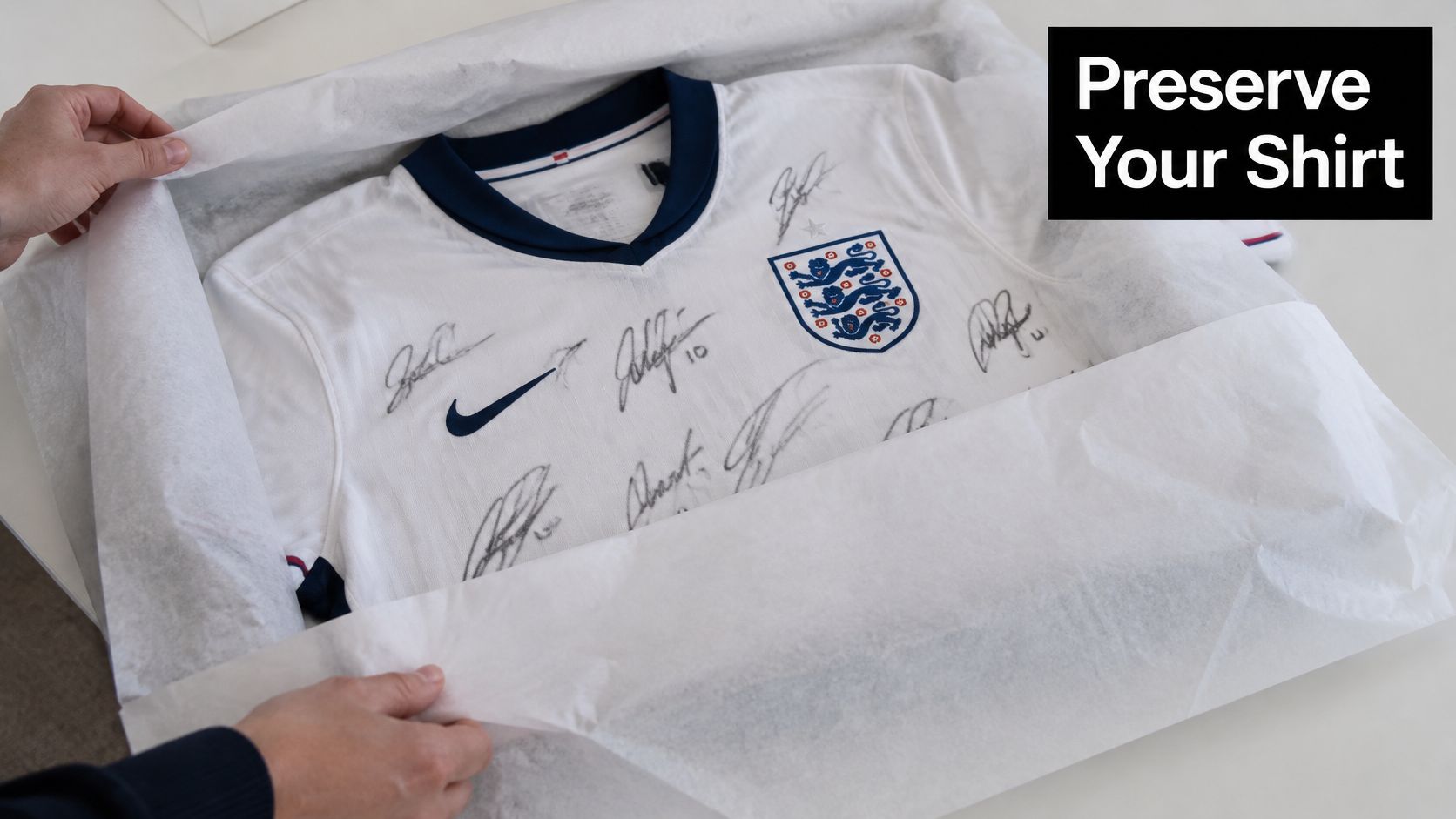
For storage, support the shirt rather than compressing it into a tight fold.
Protect the fabric and ink
Store the shirt flat in acid-free tissue where space permits. If folding is unavoidable, pad the folds and keep the signed area free from pressure. Choose an enclosure that accommodates the shirt without crushing it, and check material specifications when considering Boxes & Trays - Archival Storage from Storage & Removal Boxes Ltd.
Don't wash, iron or apply adhesive to the garment, and never attempt to clean the signature. Keep it away from damp cupboards, radiators, smoke and direct sunlight.
For framing, specify UV-filtered glazing and a reversible support that doesn't press against the signed area. UV filtering isn't permission to hang it in a sunny window.
This video provides an additional visual reference for handling and display.
Preserve the paperwork separately
Photograph the signature, labels and certificate before framing. Keep the original certificate in a labelled folder separate from the shirt, with the invoice and identifying photographs.
Our guide to football shirt preservation techniques offers further practical care guidance. For home display, choose an interior wall away from windows and heat sources, and periodically return the shirt to dark storage.
Display rule: Frame only what you've already verified, and keep digital copies of the records separately from the garment.
Choose One Listing and Decide
Open a listing you're considering and write a short buying note. Don't start with whether you like the frame or recognise the player. Start with what the seller is promising to deliver.
Name the category and evidence level in plain language. “Signed retail replica with a searchable authentication record” is useful. “Rare authentic collectible” is advertising unless the seller supports each part of the description.
Make the decision concrete
- Classify the garment: Retail replica, player-issued, match-issued or match-worn. Leave no ambiguity about whether wear is claimed.
- Identify the evidence: Record what can be independently checked, rather than copying the phrase “COA included”.
- Test the price: Use a small set of closely comparable completed sales, not unrelated asking prices for the same famous player.
- Complete the verification file: Save the lookup result, item-specific record and any identifiable signing photographs.
- Confirm the exit route: Keep written return and failed-authentication terms before you pay.
Say you're choosing between a superstar's signed retail shirt with limited paperwork and a less prominent player's fixture-linked garment. The first may make the better personal gift; the second may offer the clearer historical purchase. Neither choice requires pretending that emotional appeal and evidential strength are the same thing.
Apply the same standard to every seller
Our signed-item listings should face these checks too. Every shirt we sell is an official product from the club or the brand that made it, with the original labels and tags still on. That establishes a product standard, not an automatic answer to separate questions about an autograph or match history.
If a mystery purchase won't reveal the player or garment beforehand, decide whether that uncertainty suits your purpose. A surprise gift and a targeted historical acquisition aren't the same buying task.
Buy only when the evidence supports the advertised claim and the remaining uncertainty suits your budget. Choose one listing today, request its missing records, and postpone payment until you can make that decision without guessing.
Mystershirt offers signed shirts, shorts and sharing boxes to unbox in a group. Visit Mystershirt to explore the options, then check the signed item's description and supporting evidence against your buying notes before ordering.