The first tip most buyers get is to match the crest or scan the code and then pay. I would not start there. A copied badge is cheap to fake, and a correct code only proves that a code exists. Authentic throwback football jerseys are identified by a set of matching signals: season, fabric, construction, labels, and provenance. A correctly labelled retro reissue is a third category, not a fake and not a period original. Price it and describe it as what it is.
Table of Contents
- Telling Authentic, Replica and Match-Worn Shirts Apart
- Check Each Shirt Step by Step Before You Pay
- Fabric and Construction Expected for Each Era
- Why a Matching Product Code Does Not Prove a Shirt Is Genuine
- Measure Your Chest Before Choosing a Retro Size
- Caring for, Storing and Keeping Vintage Shirts Longer
- Mystery Boxes for Collectors and What They Cannot Promise
Telling Authentic, Replica and Match-Worn Shirts Apart
Place the shirt in one row before you argue about price. The claim on the listing has to match who made it, what the labels say, and whether a name and number were applied at the factory or later.
| Category | Made by | Labels and tags | Name and number | Authenticity claim |
|---|---|---|---|---|
| Authentic retail shirt | Club or brand under licence | Original labels and tags | Usually none | Genuine club-made garment |
| Player-spec shirt | Club or brand, player version | Original labels, often stitched badges | Often a player's name and number | Genuine, but not match-worn |
| Retro reissue | Brand, modern production | Modern labels with reissue marks | Often blank, sometimes a printed name | Reproduces an old design, not a period original |
| Replica or fan copy | Unlicensed or low-grade maker | Missing, altered or copied labels | Often a copied name and number | Not authentic |
| Match-worn shirt | Club, used in a match | Often unlabelled or match-specific | Player's name and number | Needs provenance evidence |
Authentic retail means the club or the licensed brand made the shirt and the original labels are still there. Player-spec is the version issued to players. It can be genuine and still never have been worn in a match. Retro reissues copy an old graphic with current cloth, current labels, and current finishing. Call them reissues. Replicas and fan copies come from unlicensed or low-grade makers, and the labels are missing, rewritten, or copied. Match-worn needs evidence outside the shirt, such as a match photo, a club record, or a documented chain from the dressing room.
Period originals matter because they sit at the start of licensed fanwear. In the 1973-74 season Admiral introduced what the National Football Museum identifies as the first replica shirt, and research reported by the BBC found that 92% of respondents had purchased at least one adult-sized replica shirt, while 63% had owned a child-sized replica. Shirts from the 1970s, 1980s, and 1990s record the years when match kit became everyday supporter identity and family memorabilia.
Club and manufacturer deals decide which badge, sponsor, and label a licensed shirt is allowed to carry. Football partnership insights from Vanta Sports are a useful reminder that a brand relationship changes the product fans can buy.
Practical rule: Name the category in one sentence, then list the photos that would prove it. If you can't name the category, you don't have a price yet.
Ask for the inside label, the full front and back, the sponsor close-up, and any paperwork. A retail shirt needs its tags. A match-worn shirt needs a link to a specific game. A reissue needs its modern label shown, not hidden.
Check Each Shirt Step by Step Before You Pay
Run the checks in order. Later steps are useless if the season is wrong.
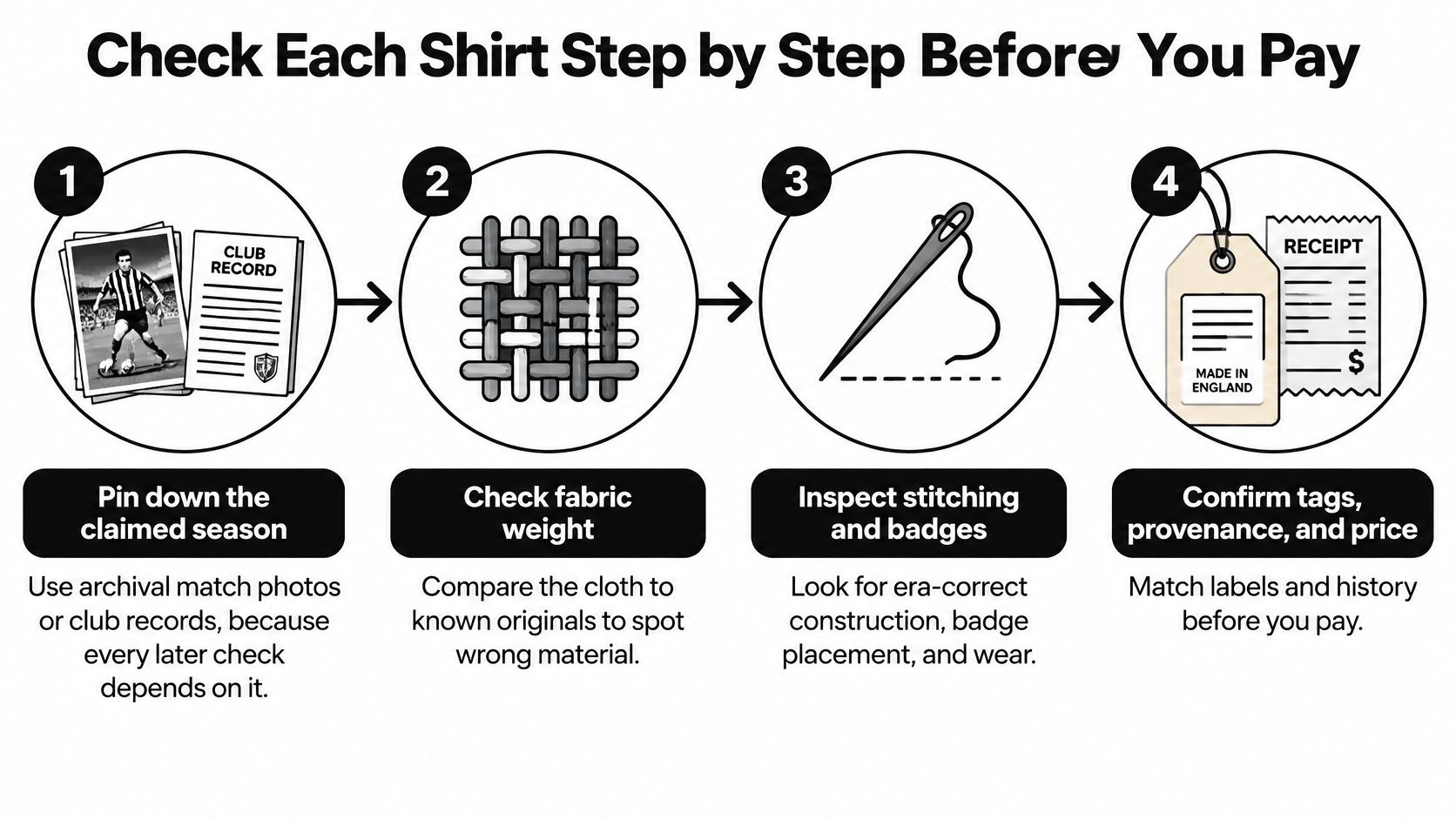
- Pin the claimed season. Use archival match photos or club records. Every later comparison hangs on that year.
- Check fabric weight and knit against a verified shirt from that same season, not against a shirt that merely looks old.
- Inspect the crest and sponsor. Even stitching, correct placement, and the application method of that year. A heat-press on a season that used sew-on cloth is a conflict.
- Read the seams and panel layout. Copies often fail on pattern. The pattern, not the badge, is the manufacturing logic.
- Check collar, cuffs, and trim for the rib, binding, and finish used then.
- Read the manufacturer mark, label format, and tag placement against that season's examples. Font, country line, and where the tag is sewn all count.
- Weigh the markers together. One correct crest confirms nothing.
- Request close photos of front, back, inside label, tag, and any repairs before you pay.
If three or more markers conflict with the claimed season, treat the shirt as unverified. Don't pay an original price for it.
A short walk-through of label, crest, and cloth checks helps if you want the routine in motion before you message a seller.
What to settle with the seller
Confirm whether the listing is retail authentic, player-spec, reissue, or match-worn. Those are different products. Read the returns policy before you transfer money, and keep the photos that were promised. A seller who won't show the inside of the collar is asking you to buy a story.
Say you're offered a "1994 home shirt" with a modern woven neck label, a thin open knit, and a crest that looks right. Steps 2, 5, and 6 already conflict. Stop. Either the year is wrong or the shirt isn't the original being priced.
Fabric and Construction Expected for Each Era
Judge the cloth against the claimed production era. Looks aren't enough. A heavy cotton shirt can be dyed to a famous stripe and still be the wrong garment, and a perfect graphic on the wrong knit is still the wrong garment.
| Era | Typical fabric | Construction clues | Red flag |
|---|---|---|---|
| 1970s to early 1980s | Heavy cotton, wool or cotton-polyester blend | Simple seams, sewn-on crests, plain collars | Ultra-thin stretch fabric or modern mesh |
| Mid to late 1980s | Cotton-polyester or thicker polyester | Sewn or printed sponsors, ribbed collars and cuffs | Modern moisture-management finishes |
| 1990s | Thicker polyester, some early mesh panels | Sewn crests and sponsors, label format of the season | Lightweight performance knit |
| 2000s onward (reissues) | Lightweight synthetics, open knit or polar-eyelet | Ventilation panels, modern labels | Sold as original with no reissue disclosure |
Earlier shirts commonly used heavy cotton, wool, cotton-polyester blends, or thicker polyester. Later performance shirts moved to lightweight synthetics. A shirt sold as an original 1970s or early-1980s piece that shows ultra-thin stretch, modern mesh, or contemporary finishing needs more proof, not a quicker checkout. Historical kit guidance makes the same cause-and-effect point: compare the garment with the era, because a counterfeiter can copy a badge and still miss the way the shirt was built.
Why a reissue can feel better and still not be original
Modern cloth is a different product. In a 2025 study of four 100% polyester football-jersey fabrics, the polar-eyelet construction produced the strongest measured comfort profile: thermal resistance of 0.009 m²K/W, water-vapour resistance of 0.44 m²Pa/W, water-vapour permeability of 237.7 g/m²/day, and air permeability of 2,149.2 mm/s. The open, porous knit sheds heat and moisture. A period original can feel less breathable because it predates that construction. A retro replica can use moisture-management textiles on purpose while reprinting old graphics.
That gap changes comfort, how long the shirt lasts, and how you should store it. Say so in the listing. "Original", "reissue", and "retro-inspired" are not synonyms. If you want the fibre names behind those knits, the breakdown of what soccer jerseys are made of is the reference to keep beside the era table.
Set the season from photos or club records, then compare fabric weight, panel layout, typography, manufacturer mark, and label format with verified examples from that season. Several independent markers raise confidence. One tidy crest does not.
Why a Matching Product Code Does Not Prove a Shirt Is Genuine
"If the code scans or matches online, is the jersey definitely genuine?" No. Footy Headlines reports that counterfeiters now reproduce correct product codes. A barcode or wash-tag code shows that a string of characters was printed. It doesn't show that this garment left the licensed factory.
A correct code can sit on a copied label. A genuine garment still has to agree in fabric, stitching, crest and sponsor application, cut, labels, and season-specific details. Pre-2000 shirts often have no product code at all, so a missing code on an early Admiral or Umbro piece isn't, by itself, proof of a fake. A present code on a modern reissue only supports the reissue.
What to ask for when photos are thin
Resale listings often arrive as one front shot and a price. Before you pay, ask for:
- The back, including hem and any nameset edges.
- The inside label and the care tag, sharp enough to read.
- Season-specific details, such as the sponsor type and collar binding.
- Repairs and replacements, including a new number, a new patch, or a replaced neck label.
Split three questions that listings mash together.
Authenticity asks whether this is a genuine licensed garment. Provenance asks whether it was worn or sold where the seller claims. Condition asks what has been repaired, re-numbered, or re-labelled. An altered nameset or a replacement label can cut the price without proving the base shirt is fake. A genuine retail shirt is not match-worn just because someone ironed a name on later.
A code match is a starting note. It isn't a verdict, and it never upgrades a shop shirt into a match shirt.
Before you pay, write three answers: Is the garment genuine for its label? Is the history documented? What has been changed since it left the factory? If any answer is "unknown", the price should match unknown, not museum stock.
Measure Your Chest Before Choosing a Retro Size
Vintage size labels lie more often than crests do. Cotton and early blends shrink, polyester can stretch at the ribs, and a "Large" from 1986 isn't a Large from last season. Measure the body you're dressing, then measure the shirt.
- Wrap a tape around the fullest part of your chest, level, snug, and not tight.
- Write the figure in centimetres and set it beside the chart.
- Lay the jersey flat, measure armpit to armpit, double it, and check that number against the seller's chart. Cuts differ by era and by brand.
| Size | Chest, laid flat (cm) | Chest circumference fit (cm) |
|---|---|---|
| S | 48 | 96 |
| M | 51 | 102 |
| L | 54 | 108 |
| XL | 57 | 114 |
| 2XL | 60 | 120 |
Use that chart as a reference, not a law. Retro bodies are often looser than modern slim-fit shirts, so choose for comfort rather than a painted-on look. Trust the tape on the garment over the printed size, especially on washed cotton and wool blends. Our authentic football jersey size chart is the place to cross-check a seller's numbers before you commit.
If your chest sits between two sizes, take the larger for a relaxed retro fit and the smaller for a closer look. Don't split the difference with guesswork on a shirt you can't return easily.
Kids and fast-changing sizes
Children's shirts are a different problem. A correct chest today can be short by next season, so buy the next size only when the shirt will be worn soon, and check whether the listing is a fashion size or a playing cut. Choosing soccer jersey sizes for kids walks through youth fit in a team setting, which is the same measurement habit you want on a retro kids' shirt. Measure the child, then measure the flat shirt, and ignore nostalgia on the tag.
Caring for, Storing and Keeping Vintage Shirts Longer
Old cotton, wool, and early synthetics shrink, fade, and lose elasticity faster than a new performance knit. Care is part of value, not a chore you add after the photo.
- Wash cold, inside out, on a gentle cycle with mild detergent, so prints and ribs take less abrasion.
- Skip bleach and fabric softener, which weaken fibres and can stain old sponsor inks.
- Dry flat, out of direct sun, so the body doesn't pull at the shoulders and the dye doesn't shift.
- Don't tumble dry. Heat is what finishes off a vintage rib.
- Iron low, with a cloth over printed or sewn crests. Direct heat cracks prints.
- Store flat or folded in acid-free tissue, in a dry, dark cupboard.
- Avoid thin hangers that stretch the shoulder seams overnight.
- Check for moth damage a few times a year, especially on wool and cotton blends.
When keeping a shirt is the better purchase
Buying an old shirt isn't automatically the greener choice. Business of Fashion cites Green Football's estimate that extending a shirt's life by nine months can reduce its combined carbon, water, and waste footprint by up to 30%, and places retro shirts at 16.4% of the official football-shirt market. Reuse can avoid a new garment. Shipping, extra packaging, harsh cleaning, long storage, counterfeit returns, and shirts that never get worn eat that benefit back.
The ownership pattern that holds up is simple. Buy one durable shirt, repair it, wash it carefully, then resell or donate it. That beats a run of impulse purchases that sit in a bag. Children's shirts make the strongest case for resale or hand-me-downs, because the size changes while the shirt is still sound. For storage methods beyond this list, the notes on preservation techniques cover tissue, folding, and light in more detail.
A shirt you repair and pass on does more than a shirt you buy to complete a photo and then forget.
Mystery Boxes for Collectors and What They Cannot Promise
A mystery box earns its place when you want discovery, a capped budget, and a mix of leagues you wouldn't have searched for one by one. It also works as a gift, because the recipient gets a real licensed shirt rather than a guess at their favourite season. You still decide which clubs, leagues, or colours you don't want. You don't get to point at one exact 1994 original and demand it from a sealed box.
That's the limit. A buyer who wants a specific period original should buy that shirt from a listing that names the season. A recent-season shirt in a box is retail authentic. It isn't match-worn, and it isn't a 1970s or 1990s original unless the category says so. We sell 100% authentic jerseys, we don't stock replicas, and every shirt is an official product from the club or the brand that made it, with the original labels and tags still on. Shirts in the boxes are from a recent season unless you choose a themed box built around one league, one era, or one country. Read that category before you order, and weigh labels, category, and the returns terms the way you would any other shirt.
Write down the era, the size, and the category you want. If the answer is one period original, go to a seller who can show that season. If the answer is variety inside a budget, a box matches the brief. If the answer is "surprise me, but keep it genuine", start with a Mystershirt mystery box, check the category against the era you wrote down, and keep the labels on the shirt when it arrives.