The most repeated advice about retro World Cup jerseys is to buy vintage because it holds value and it's the greener choice. Both halves collapse once the shirt is in your hands. Value lives in provenance, not in the word "vintage" typed into a listing title, and a genuine shirt isn't automatically the low-impact one.
The other popular line, the four-point authenticity checklist, proves almost nothing by itself. Labels get swapped between shirts. Badges get re-sewn. Sellers photograph in soft light, and soft light hides exactly the things that matter. Buyers who learn to read a shirt, not a listing, are the ones who end up with pieces worth keeping.
Do it in this order: decide what kind of shirt you're buying before you compare a single price, verify it with checks a phone camera can't fake, then judge the fabric for the wear it will get. That sequence saves more money than any bargain hunt.
Table of Contents
- Original, Reissue, Fashion Shirt or Counterfeit Compared
- Why Past World Cup Shirts Hold Their Value
- How to Verify an Original, Reissue or Counterfeit
- Fabric Fit and Care for Wearable Retro Shirts
- Is a Retro Jersey the Sustainable Choice?
- Choose the Right Retro Jersey for Your Purpose
Original, Reissue, Fashion Shirt or Counterfeit Compared
| Type | What it is | Typical price | Best for |
|---|---|---|---|
| Original vintage match shirt | Issued for a tournament or season and worn in play | £200–£300 or more (reported) | Collectors who value provenance |
| Official retro reissue | Licensed modern remake of an earlier design | Manufacturer retail, well below the vintage band | Wearers who want the look for less |
| Fashion jersey | Styled after a historic design, not a copy of it | Set by the brand, unrelated to match provenance | Everyday style |
| Counterfeit | Unlicensed imitation sold as genuine | Priced to undercut the real thing | No reliable use, avoid |
Four different products share one marketing word, and only one of them is a collectible. An original vintage match shirt was issued for a specific tournament or season and worn in play, and genuine originals now sit in the £200–£300 or more band because that's what proven provenance costs. An official retro reissue is a licensed modern remake: same crest, same colour blocks, new fabric, contemporary cut. A fashion jersey borrows the mood of a historic shirt without copying it, so nobody should file it under replica anything. A counterfeit is an unlicensed imitation sold as genuine.
Take the 1990 West Germany style as a worked example. Buy it as an original and you're buying a piece of a tournament summer, with era-correct trim and 1990s fabric weight. Buy it as a reissue and you're buying the photograph of that shirt rendered in modern polyester, which drapes nothing like the original and never will.
The price test: the vintage band applies to genuine originals. A "original" listed near reissue money is a warning sign, not a bargain. When provenance can't be established, the reissue at a known retail price is the safer purchase every time.
Name your purpose before you compare a single price. Historical collecting points you at row one. Affordable nostalgia points at row two. Everyday wear can sit comfortably in row two or three. The mismatch that burns people most often is paying original money for a reissue, or buying a reissue and expecting it to appreciate like a 1990 shirt.
Why Past World Cup Shirts Hold Their Value
A World Cup shirt is dated by the tournament, not by the season it resembles. The first FIFA World Cup was played in 1930. That depth is why a shirt from earlier tournaments reads as a cultural artifact rather than sportswear with a badge on it. The oldest shirts carry history in the cut, fabric, crest and tournament identity. That is value no modern remake can copy.
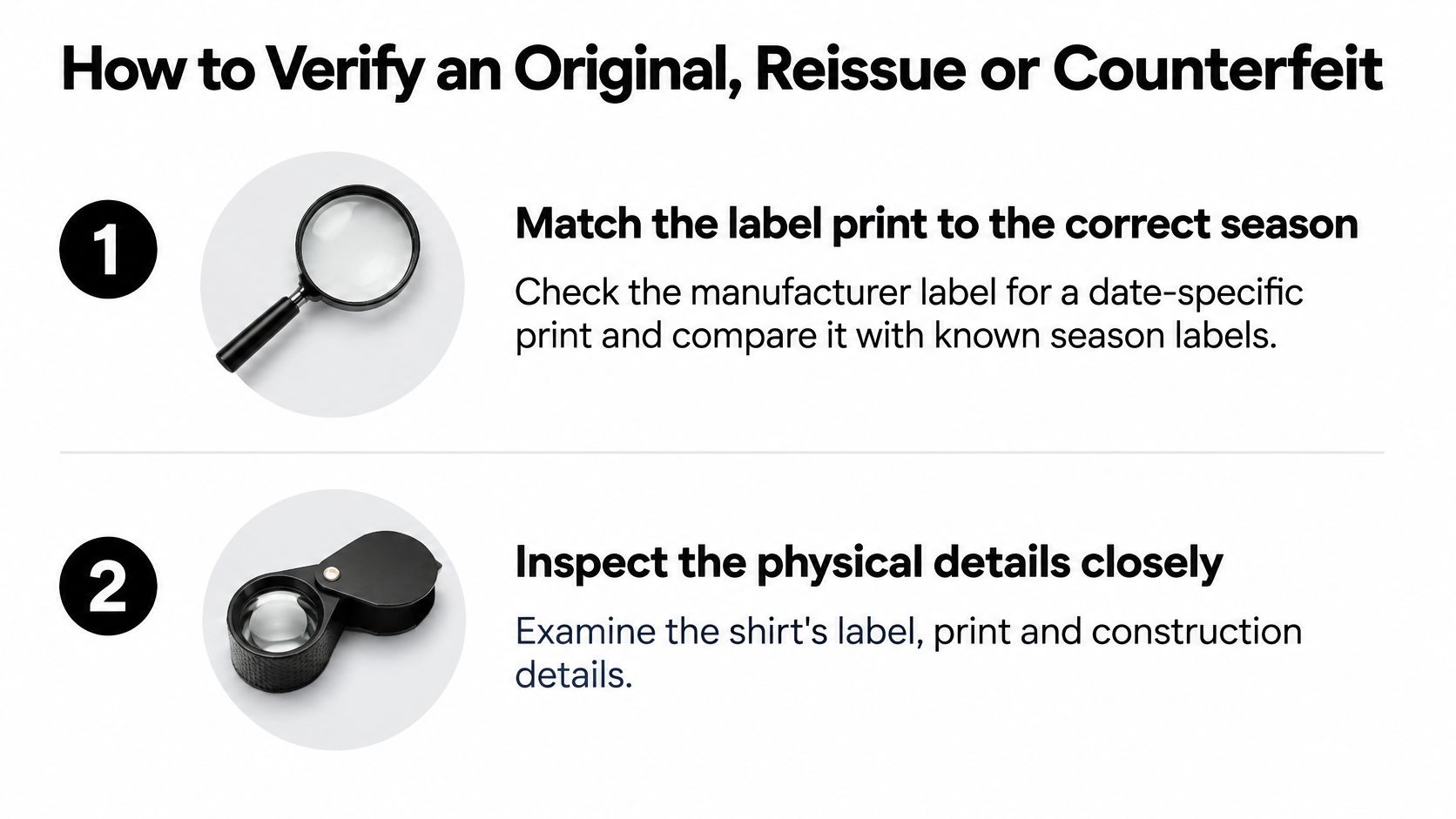
Before any provenance means anything, the shirt has to be the shirt it claims to be. The two-step check below is the fastest way to separate an original from a licensed remake or a fake.
The Design Museum's archive of football kit design singles out West Germany's 1990 home shirt, made by adidas, as a landmark of football-kit history. The reason is simple: West Germany won that tournament, beating Argentina 1–0 in the final. A design tied to a world championship milestone carries a value a handsome shirt from a forgettable campaign never will. Buy the story, not just the colourway.
Read one jersey and you're reading five layers at once: the World Cup edition, the national team, the manufacturer, the tournament result, and the design language of its period. Decide which layer matters to you, because each one is priced separately and only one of them is reproducible. Anyone can remake a colourway. Nobody can remake a final.
A collector walking you through the physical differences is worth ten written checklists, so watch how the details are examined rather than what the seller claims. Close attention to labels, stitching, fabric weight and badge construction beats a confident product description every time.
Retro styling also sells at scale when a federation embraces its own archive. Nike's 2018 Nigeria "Naija" shirt referenced the country's 1994 World Cup kit. The reception showed how strongly old tournament identities still sell. That's the modern pattern: reinterpret a previous tournament's visual identity through new materials and graphics rather than reissuing it stitch for stitch.
The secondary market has grown to match. Front Office Sports' report on the vintage shirt market says vintage retailer Classic Football Shirts was selling more than 750,000 pre-owned shirts annually in 2024, with roughly 15% of sales coming from the United States. Buyers are chasing the same 1970s, 1980s and 1990s shirts, and a finite number remain in wearable condition.
If your motive is resale rather than wearing, run the numbers the way you'd run any asset purchase, using what actually drives football shirt resale value as your starting frame. The shirts that hold money are the ones with a tournament story attached, not the ones with the loudest graphic.
How to Verify an Original, Reissue or Counterfeit
Verification is a sequence, not a vibe. Run the same checks every time and most fakes fall out at step one or two.
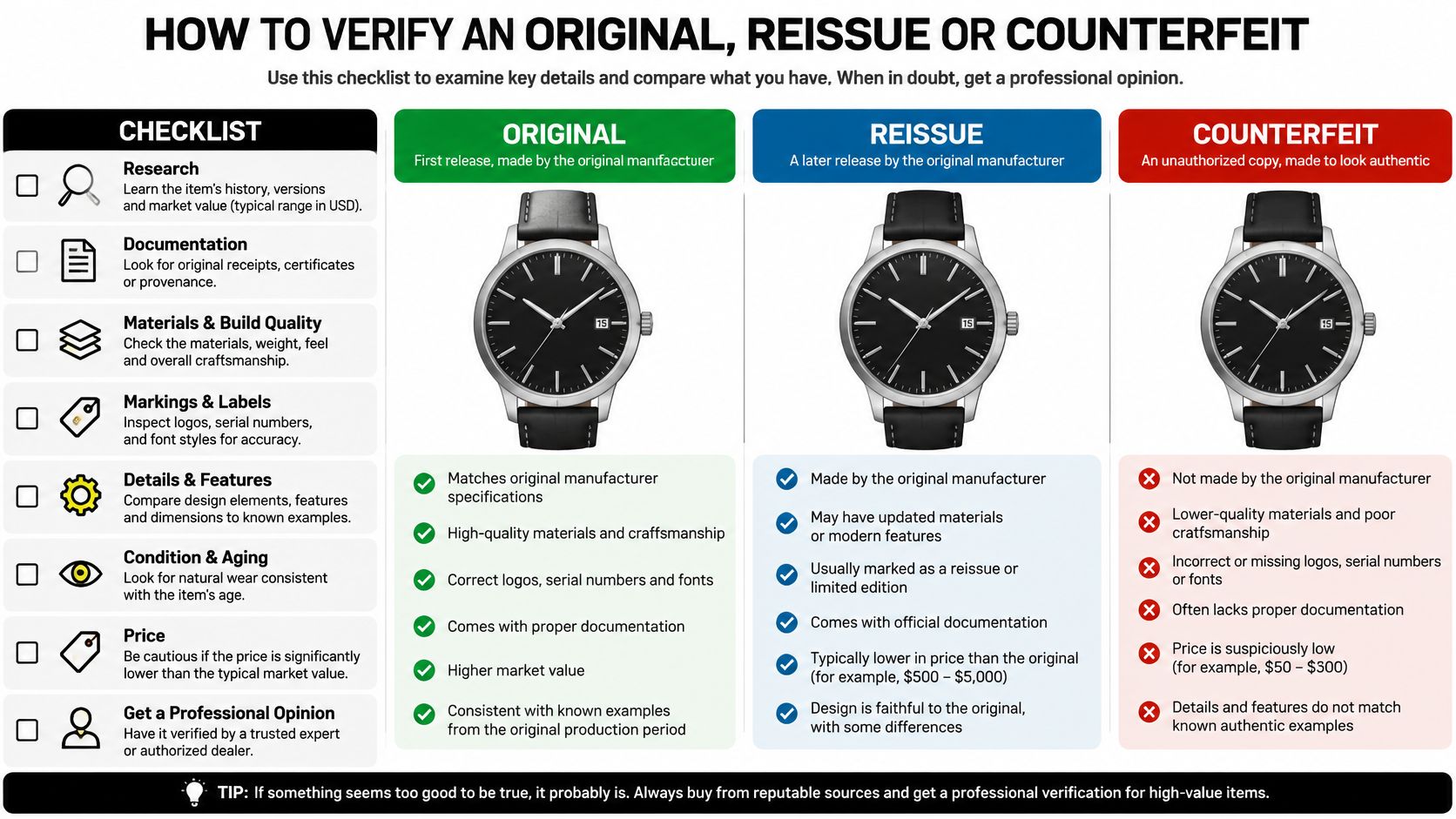
- Manufacturer label. Match the print, font and layout to the label that specific season used, not to a photo of a similar shirt. Fakes copy the crest and ignore the label, because the label is the boring part nobody photographs.
- Fabric and stitching. Original shirts show the construction of their era: seam type, thread, hem finish, the way panels meet. Reissues use modern overlocking and modern fabric weight, and counterfeits split the difference badly.
- Sponsor typography. Letter spacing, the thickness of a stroke, the exact shade of a logo. Counterfeiters slip most often on these details, because a wrong letterform is obvious side by side and invisible alone.
- Badge construction. Stitched versus printed crest, embroidery density, how the badge sits on the chest and whether the surrounding fabric puckers. A badge re-sewn onto a different shirt leaves needle marks and an uneven outline.
- Country of manufacture. Check it against the era. A shirt that should read one country and reads another is a reissue at best.
- Sizing conventions. Vintage sizing rarely matches today's cut, so compare the listed chest and length measurements against a shirt you already own and like, then ask for a flat lay before you pay. Trusting the size tag is how people end up with a "large" from 1986 that fits like a small.
- Match issue or retail. Confirm whether the shirt was issued for play or sold as a fan product. Player issue changes the price, the fabric and the paperwork.
"Authentic" and "original" are not the same word. Reported prices for original vintage shirts have climbed from roughly £75 a decade ago to £200–£300 or more, while reissues let you wear the same design for far less, as Footy Headlines' reporting on the remake trend sets out. An official reissue is a legitimate product with a legitimate place in a wardrobe. It just isn't a collectible from the tournament year, and it shouldn't be sold to you as one.
A photo cannot prove fabric weight, thread type, or whether a badge was moved. Ask for close-ups of the label, the care tag, the crest and the underarm seams. A seller who won't send them has answered your question.
Work through the same checks in more depth, including the tells that survive a bad photograph, in this guide to spotting an authentic football shirt. The practical rule for anyone who can't verify a shirt to their own satisfaction: buy a licensed reissue at a known price instead. Certainty at retail beats doubt at a discount.
Fabric Fit and Care for Wearable Retro Shirts
Buy for the fabric you will wear. A tournament design can look right while feeling stiff, trapping sweat or pulling at tired seams. Yarn type, knit structure and porosity affect moisture transport: plain single-jersey panels are more porous than rib or interlock, while micro-polyester offers more capillary channels than the compared textured-polyester and polyester-spandex fabrics, according to textile research on football sportswear fabrics.
That helps explain why a period original and a modern performance remake can feel different despite matching graphics. The styling may stay familiar while the yarn, knit density and finishing change. Textile testing assesses vertical wicking, drying, air permeability and water-vapour transmission. A listing photograph cannot establish those properties.
Use these four checks to assess a shirt intended for regular wear.
| Check | What to look for | Warning sign |
|---|---|---|
| Fabric composition | Lightweight micro-polyester for moisture management | Heavy, coated or unidentified fabric |
| Knit structure | Breathable single-jersey panels | Dense, compacted knit |
| Porosity | Intact, open fabric structure | Surface closed by coating or compaction |
| Moisture transfer | Fabric that wicks and dries quickly in use | Moisture lingering and slow drying |
Treat a shiny, compacted surface as a reason to ask questions, rather than proof of poor performance. Confirm the composition and ask whether the material feels stiff. Judge fit through movement too: a shirt that pulls across the shoulders or side seams is a poor choice for playing, whatever the size label says.
How polyester ages in a wardrobe
Grade textile condition separately from the badge and print. Heat, moisture, abrasion and repeated washing affect polyester sportswear; research on sportswear ageing examines changes in thickness, porosity, stretch, stiffness, wetting, drying, abrasion resistance and pilling. Reduced porosity can compromise breathability, while greater stiffness changes how a shirt hangs. Those changes matter when deciding whether to wear it regularly.
Inspect these areas before you commit:
- Collar and cuffs. Look for stretched ribbing, stiffness and poor recovery. A collar that stays distorted deserves a lower condition grade.
- Underarm abrasion. Check for thinning and discolouration where the arm rubs. Visible wear here matters more for playing than for display.
- Sponsor print. Fine cracks and lifting edges are different problems. Lifting means parts of the print are already separating.
- Seam stress. Lay the side seams flat and inspect for pulled threads or shine along the stitch line.
- Pilling and yellowing. Chest fuzz and collar discolouration affect wearable condition even when the crest looks clean.
A tidy badge cannot compensate for tired fabric.
Price the shirt accordingly. If the material is stiff, thin or stretched, do not pay a wearable-condition premium just because its graphics remain attractive. Photographs can show damage, but they cannot prove softness, stretch recovery or drying performance.
Washing and storing for another decade
Keep shirts away from prolonged sunlight, high heat and damp. Dark, dry storage reduces exposure to those stresses. Before washing, read the care label and inspect the print and seams. Where the label permits washing, turn the shirt inside out, use cool water and minimise mechanical stress.
Practical rule: if a shirt is too fragile for its labelled washing method, stop before experimenting. Advice on dry cleaning for workwear and suits applies to different garments and does not establish a safe treatment for a printed vintage jersey. Follow the shirt's own care instructions.
For a wearable shirt in sound condition, use this guide on how to wash a football jersey. Skip fabric softener, which can coat fibres and interfere with moisture management.
Keep a simple record of each shirt's era, composition, knit type, print condition, elasticity and existing wear. Update it when the condition changes. That makes the distinction between a display piece and a match-wearable shirt concrete, for you and any future buyer.
Is a Retro Jersey the Sustainable Choice?
Second-hand is not automatically the greener buy. Peer-reviewed work on football shirt consumption describes jerseys as garments that go obsolete fast, move into secondary markets, or end up in landfill and incineration, and notes that counterfeit demand is partly driven by the high price of legitimate shirts, in research on football shirt consumption.
That evidence sets the central question. Authenticity and lifecycle impact have to be judged separately. A fake shirt is still a shirt with fibres, transport, packaging and a disposal route. A genuine shirt can still be wasteful if it is bought, worn twice and replaced. Anyone claiming that every authentic jersey is environmentally superior is skipping the harder part of the calculation.
Judge the routes separately, on durability, washing, shipping, packaging and end-of-life:
- Keep wearing a shirt you already own. No new production, no shipping, no packaging. This wins on almost every measure, and it's the least discussed option.
- Buy an official reissue. New production and new shipping, but a known supply chain and a shirt that will last.
- Buy original vintage. No new manufacture, though it may arrive from another continent in a parcel, and its remaining lifespan is shorter than you'd like.
- Buy a counterfeit. Unpredictable materials, no durability information, and no reliable basis for claiming a lower impact.
Authenticity and sustainability are separate attributes. A genuine shirt can involve resource-intensive production; a well-worn second-hand shirt can carry a very low incremental impact. Buy the shirt that already exists, wear it hard, wash it less often than you think you need to, and repair the collar before you replace the shirt. If the choice is between a distant counterfeit and a durable shirt already in your drawer, the drawer wins.
Choose the Right Retro Jersey for Your Purpose
Five decisions, in order, and you're done.
- Pick one purpose. Historical collecting, affordable nostalgia or everyday wear. That single choice tells you which row of the comparison table you're shopping in, and it stops you from judging a reissue by collector standards.
- Set a budget against the right band. Genuine originals sit at the reported vintage price. Reissues sit below it. A "original" priced like a reissue is a red flag, not a find.
- Verify before you fall in love. Run the numbered checks, ask for label and crest close-ups, and walk away from any seller who won't send them.
- Confirm the fabric suits the wear. A shirt destined for five-a-side needs open, breathable single-jersey panels. A shirt destined for a frame needs the print intact and nothing else.
- Buy from a seller with a returns policy. Distance selling means you can inspect the label, the weight and the fit in your own hands and send it back if the description was generous.
A fixed design no longer fits your purpose, don't overpay to force it. Buy the shirt that already exists in the condition you can live with, at the price the market supports, from someone who lets you return it.
If you want the surprise route rather than hunting a specific shirt, our Retro Mystery Box picks the shirt for you, and requests for a particular team or era get ignored by design. Every shirt we send is an official product from the club or the brand that made it, with the original labels and tags still attached, and every jersey we sell is 100% authentic. This week, do one thing: run the numbered checks on a shirt you already own. You'll learn more from that than from any listing you're currently watching.
Hunting a retro World Cup shirt without the guesswork is exactly what Mystershirt is built for: our Retro Mystery Box pairs you with an authentic shirt from a past era, chosen by hand and shipped with its original labels still attached. If you'd rather chase a specific club or tournament year, use the verification checks above and buy that shirt directly, or start with a box and let the surprise do the work. Head to Mystershirt to see the Retro and Premium boxes, pick your size, and get a genuine shirt in your hands this week.