You've found the shirt, checked the club, and hidden the order confirmation from the recipient. Then the practical question arrives: what kind of shirt box for gift will make the jersey feel special without crushing the badge, exposing the surprise, or creating unnecessary waste?
The answer isn't a generic apparel carton. A good box is a measured fit system, a presentation piece, and, if the gift travels, a small piece of shipping engineering. Choose it around the recipient, the shirt, and the route it must survive.
Table of Contents
- Why the Box Matters for a Shirt Gift
- Measuring the Shirt and Choosing the Right Box Size
- Comparing Material Choices Through a Sustainability Lens
- Personalizing the Shirt Gift Without Spoiling the Surprise
- Folding, Layering, and Sealing for the Reveal
- Shipping the Shirt Box Without Damage
- Pre-Shipment Checklist and Last-Minute Checks
Why the Box Matters for a Shirt Gift
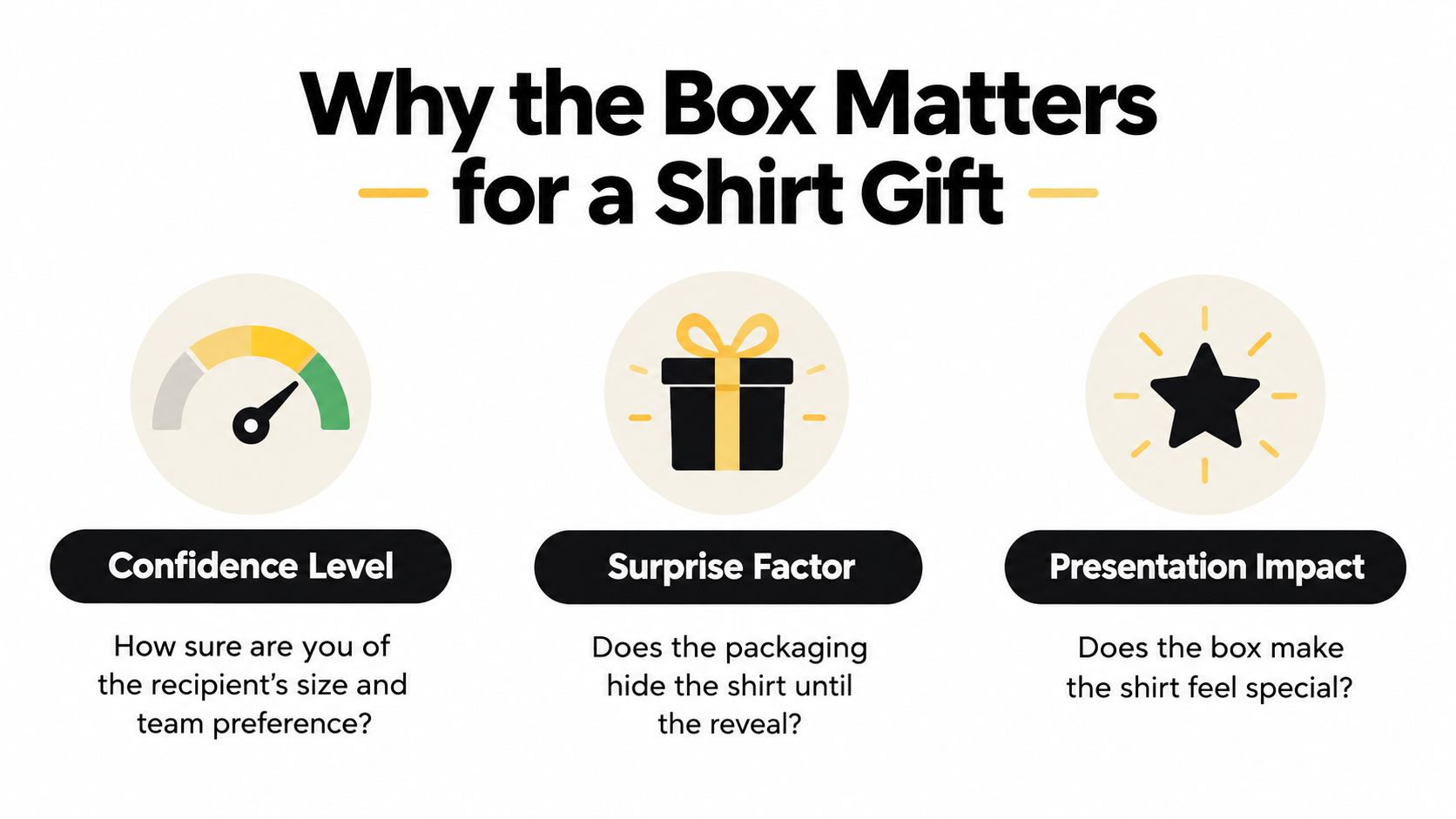
Before you buy packaging, answer three questions. How certain are you about the recipient's size? Is the box for a quick birthday reveal or long-term shirt storage? Will it cross a room, a city, or an international delivery network?
Start with fit confidence. If you know the recipient's usual football-shirt size and the garment is a standard short-sleeve cut, a close-fitting presentation box can look polished. If the size is uncertain, choose a little more internal room and preserve the option to inspect or exchange the shirt without destroying the packaging. A tight box may look neat, but it can compress sponsor prints, embroidered badges, and folded sleeves.
Next, decide what the opening should feel like. Tissue inside a folding carton works for a simple birthday reveal. A rigid reusable box suits a collector who'll store the jersey afterward. If you're planning a broader gift presentation, a specialist guide such as this gift box candle guide Canada can also provide useful ideas for layering, inserts, and reveal sequencing without copying candle-specific packaging.
Finally, consider distance. A box carried by hand needs presentation strength. A box placed inside a mailer needs corner resistance, closure security, and moisture protection. Don't treat the decorative carton and the shipping package as the same object.
Boxes are not a niche format. The cited gift-packaging analysis valued the broader market at USD 29.13 billion in 2025, with boxes accounting for 28.35% of global gift-packaging revenue, the largest product segment in that analysis (Fortune Business Insights gift-packaging market analysis). That makes sense for shirts: boxes protect folded fabric, create structure, and give the recipient a defined opening moment.
Practical rule: Decide the recipient's fit, the intended reveal, and the delivery route before choosing the carton.
Measuring the Shirt and Choosing the Right Box Size
Measure the actual folded shirt. Don't buy a box because its product title says “large apparel gift box.”
Lay the shirt flat, then fold it exactly as it will sit inside the carton. Record the folded length, width, height, and mass. Press the garment gently, release it, and observe how much it rises again. That compression recovery matters because a shirt that looks flat for a moment can become too tall once tissue is added.
Add controlled clearance for tissue and removal. The shirt shouldn't slide around, but the recipient should be able to lift it without dragging a badge against the wall. A slightly generous, reusable box is usually better than a precise carton that forces the recipient to pull at the garment.
| Shirt type | Folded size (cm) | Box internal (cm) | Clearance |
|---|---|---|---|
| Kids' short-sleeve shirt | Measure the folded garment | Add controlled room on all sides | Enough for tissue and easy removal |
| Adult short-sleeve shirt | Measure the folded garment | Add room for relaxed folding | Avoid badge compression |
| Long-sleeve or retro shirt | Measure sleeves and folded height carefully | Size up if sleeves create a tall stack | Allow recovery after folding |
| Shirt with shorts or accessories | Measure the complete bundle | Choose the next practical internal size | Prevent movement between pieces |
Board choice matters as much as dimensions. A 16 to 18 point SBS paperboard range is a common reference for retail folding cartons, but thickness alone won't tell you whether the carton will perform. Check bending stiffness, internal bond, moisture response, compression, and drop performance before approving a production run (folding-carton material guidance from Box Your Brand).
Use a tuck closure for a clean, efficient carton when the tabs lock securely. Choose a magnetic closure only after checking repeated opening, because weak tabs, over-tight folds, and poorly positioned magnets can tear corners or crush raised decoration.
A shirt box also needs to accommodate the possibility of an exchange. Online apparel returns reach 24.4% on average, and 53% of sellers identify size and fit as the leading reason, so an exchange-friendly box is more useful than a tightly fitted one (apparel returns benchmark from Size.ly). For practical football-shirt packaging ideas, see this guide to a soccer gift box.
Comparing Material Choices Through a Sustainability Lens
A premium-looking box isn't automatically a responsible box. Magnets, foam, plastic windows, heavy coatings, and oversized empty space can make disposal harder and shipping less efficient.
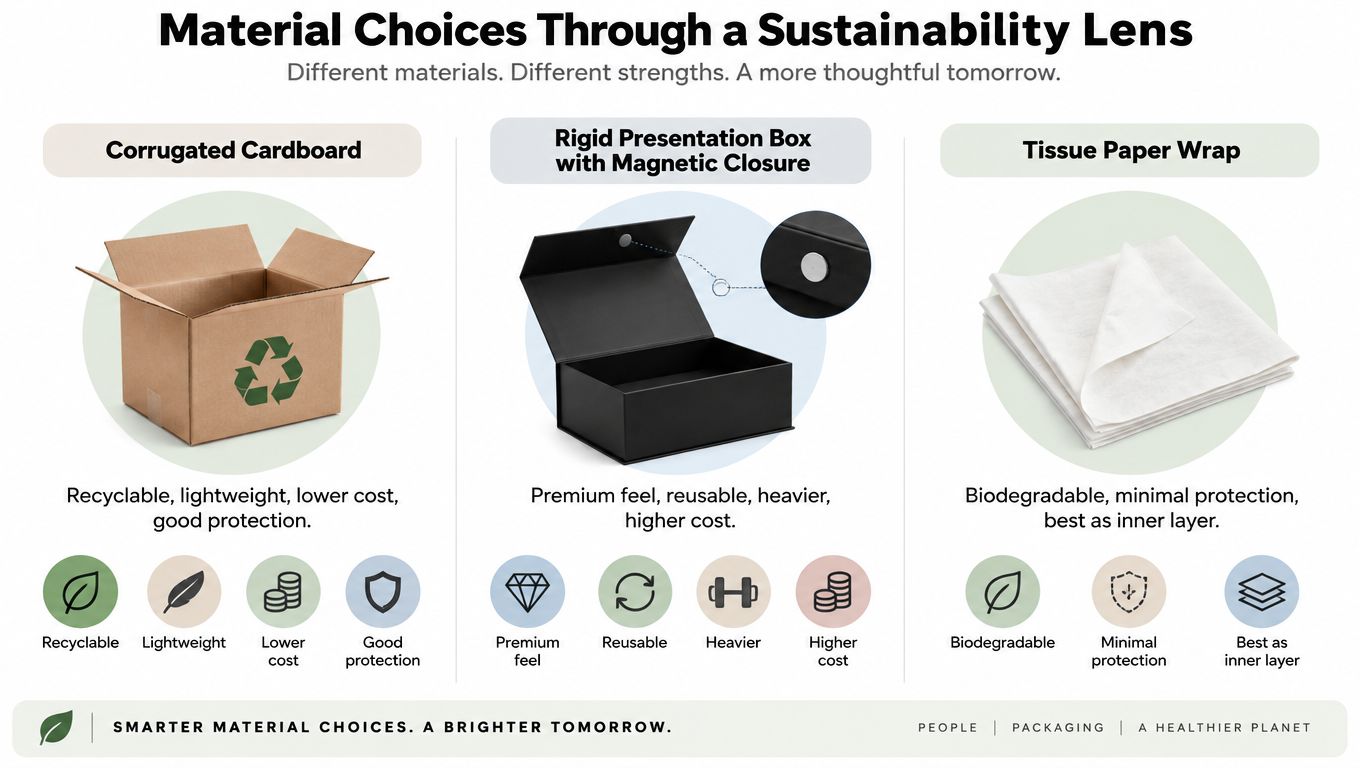
Corrugated cardboard is the strongest all-round choice for a shirt that must travel. It's lightweight, protective, and commonly recyclable, although the buyer should still check local recycling instructions and remove tape or mixed-material elements where required. Use it as the outer shipping layer or as a straightforward presentation carton when the reveal doesn't need rigid luxury packaging.
Rigid presentation boxes deliver the most substantial opening experience and can become useful shirt storage. Their weakness is weight and material complexity, particularly when they combine board, fabric wrap, magnets, foam, or decorative coatings. Choose one when the recipient is likely to reuse it, not for a single reveal followed by disposal.
Tissue paper belongs inside the box, not between the gift and the outside world. It adds softness and helps separate printed surfaces, but it offers little impact protection. Use acid-free tissue where possible, and avoid pairing loose tissue with printed numbers or surfaces that could transfer ink.
Match the material to the job
| Material | Protection | Shipping efficiency | Reuse and disposal |
|---|---|---|---|
| Corrugated cardboard | Strong for its weight | Efficient when correctly sized | Usually practical to recycle |
| Rigid presentation box | Excellent presentation and storage | Heavier and bulkier | Best when kept and reused |
| Tissue paper | Prevents surface contact and creasing | Very efficient as an inner layer | Often easier to dispose of than mixed components |
| Plastic mailer | Moisture resistance, limited structure | Light but weak as presentation | Disposal depends on material and local facilities |
| Fabric packaging | Soft, reusable presentation | Can add bulk without structure | Useful when the recipient will reuse it |
The cited market analysis estimated that paper and paperboard represented 64% of the global gift-packaging-boxes market in 2025, up from 51% in 2019, while 84% of consumers reported willingness to pay a premium for sustainably packaged products (Dataintelo gift-packaging-boxes market analysis). Those figures support a practical conclusion, not a decorative one: favor fiber-based packaging, reduce empty space, and explain what the recipient can recycle or reuse.
Separate the presentation box from the outer mailer. The inner carton can be kept as a jersey-storage box, while the shipping layer can be selected for protection and moisture resistance. A reusable rigid box often beats a disposable luxury box because the recipient gets value after the reveal.
Personalizing the Shirt Gift Without Spoiling the Surprise
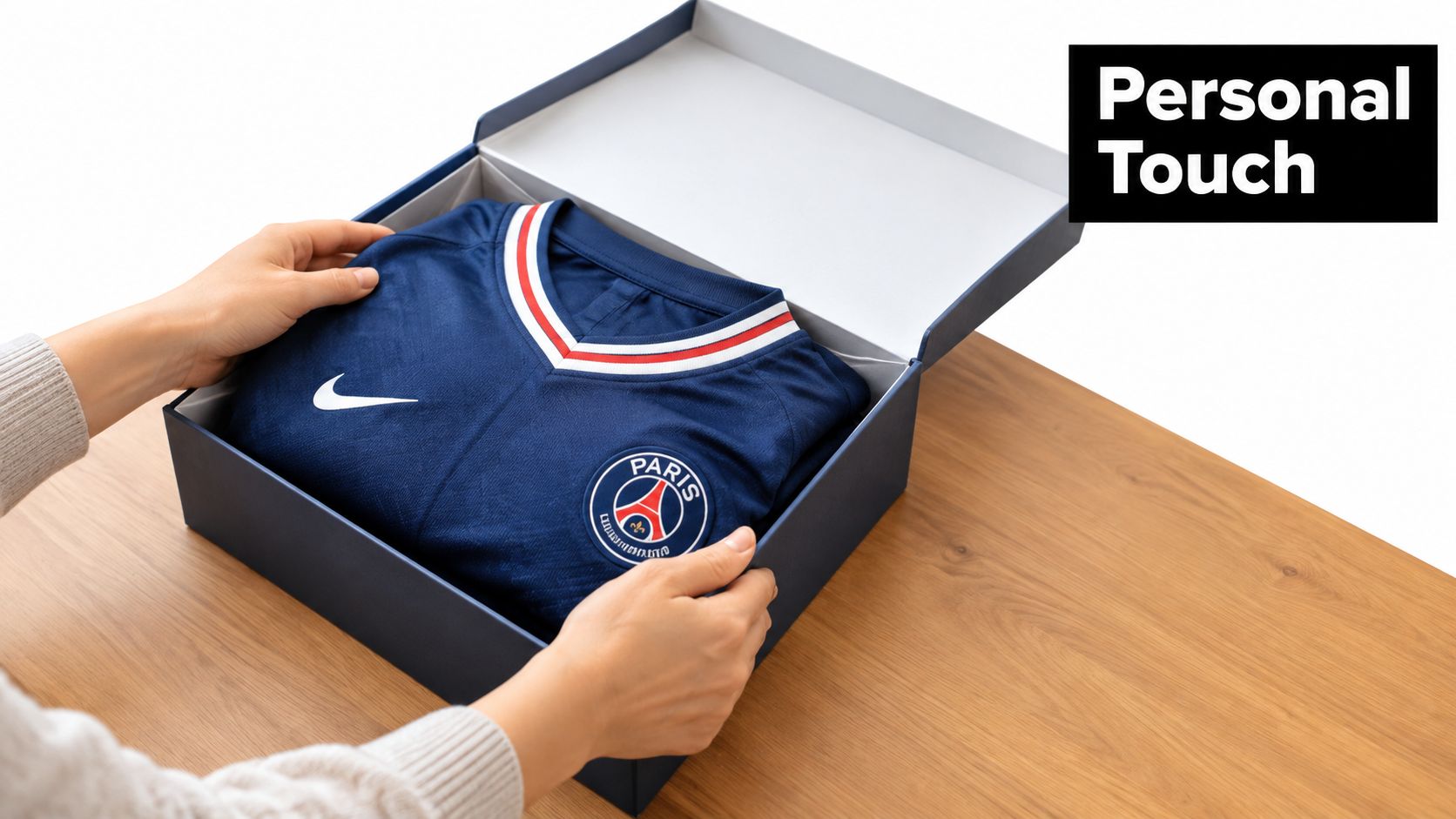
A good surprise starts with the right constraints. Ask a sibling or friend which clubs, colors, leagues, and shirt styles the recipient avoids. A discreet size check beats guessing from age or height. Use a football shirt from the recipient's wardrobe as your reference, since casual T-shirt sizing can mislead.
For a known jersey, settle the style before ordering. Decide between a current design, retro shirt, long sleeves, or a relaxed fit. A name and number can make the gift feel personal, but customization raises the cost and can restrict exchanges. Add it only when the number has clear meaning. An empty space in the box does not need decoration.
A surprise product with size selection and club, league, or color exclusions gives you control without revealing the exact shirt. Keep original labels and authenticity tags attached. Put the gift receipt or exchange note where the recipient can find it after opening, not beneath permanent wrapping.
Discreet size checks that work
- Check an existing label: Inspect a football shirt from the recipient's wardrobe instead of relying on a casual T-shirt.
- Ask the right person: A sibling, partner, teammate, or parent can confirm the usual size without spoiling the gift.
- Use the box as a buffer: If uncertainty remains, choose a presentation box that allows inspection and careful repacking.
- Protect the return path: Leave tags and labels intact, and avoid sealing the shirt permanently inside the carton.
A 100-day money-back guarantee combined with labels on every jersey reduces the risk when a surprise size does not work (Mystershirt). For practical ideas on giving a surprise football-shirt gift, keep the reveal intact while making size and exchange details easy to handle.
Personalization should improve recognition or usefulness. A focused exclusion list, a meaningful name or number, and a clear exchange option usually matter more than an elaborate insert. The box should support the surprise, not create another decision for the recipient.
Folding, Layering, and Sealing for the Reveal
Fold the shirt around its most valuable visual feature. For a football jersey, that might be the club badge, sponsor, player name, or number. Place the chosen feature on top so the recipient sees it as soon as the tissue opens.
Start with a clean, flat surface. Smooth the shirt without stretching it, fold the sleeves inward, and create a rectangular shape that matches the carton. Keep embroidered badges and raised sponsor details away from hard folds. If the jersey has a delicate print, avoid pressing a sharp carton edge directly across it.
Place a sheet of acid-free tissue between folds, then add a second layer over the top if the box will be opened more than once before gifting. Tissue should separate surfaces, not create a bulky mound that makes the lid strain.
Choose the closure after the folded height is confirmed. A tuck carton gives a crisp finish when the tabs engage cleanly. A magnetic closure feels substantial, but keep the magnet and lid pressure away from raised badges. If the box lacks a finger cut-out, add a simple ribbon pull tab rather than forcing a fingernail under the lid.
Packing sequence: smooth the jersey, protect the print, fold for the chosen top feature, add tissue, check the lid pressure, then seal.
Troubleshoot before the final wrap. If the folded shirt is too tall, refold the sleeves rather than forcing the lid. If a magnet presses on a badge, rotate the jersey or use a different closure. If tissue sticks to printed numbers, add a clean separating layer and avoid adhesive near the garment. Never use tape directly on the shirt or its authenticity tags.
Shipping the Shirt Box Without Damage
Shipping is a separate engineering problem from presentation. A beautiful rigid carton can still arrive with crushed corners if it travels inside a mailer with too much empty space or too little cushioning.
Use two validation stages. First, perform an integrity check on the complete packed box. Then run an ISTA 3-Series general-simulation protocol that matches the intended air or ground route. ISTA 3-Series testing reproduces handling impacts, vibration, and compression across varied vehicles and exposure sequences, making it the relevant general-simulation benchmark for parcel-shipped gift boxes (ISTA test procedures).
Build the test sample with production-equivalent board, closure, tissue, labels, folded shirt, and outer mailer. Testing an empty carton gives false confidence. So does using unrealistic fill or treating a decorative rigid box as the complete shipping package.
Use a clear acceptance rule
The shipped package should pass all four checks:
- Product condition: The shirt remains clean, crease-controlled, and free from badge or print damage.
- Opening security: The box doesn't open accidentally during handling.
- Presentation condition: Corners aren't crushed enough to compromise the reveal.
- Label readability: The shipping label remains attached and legible.
Run successful tests on separate, identical samples. Three successful tests provide a practical baseline, while five or more are preferable where feasible. Repeat the validation after changing the board grade, dieline, closure, folded thickness, outer mailer, or carrier route.
The outer shipping layer should resist moisture as well as impact. Don't assume a general transport procedure covers every environmental condition. For route-specific planning, consult this international shipping guide for football shirts, then match the outer package to the actual delivery path.
Pre-Shipment Checklist and Last-Minute Checks
Before sealing the mailer, run this checklist:
- Measure the packed shirt: Confirm internal length, width, height, mass, and clearance.
- Check the carton: Verify board stiffness, closure engagement, and lid pressure.
- Confirm the gift details: Recheck size, club and color exclusions, personalization, labels, and receipt information.
- Inspect the jersey: Make sure badges, sponsor prints, tags, and folds look clean.
- Test the package: Confirm the integrity, compression, drop, and closure checks have passed.
- Prepare the outer mailer: Remove excessive empty space, add moisture protection, and keep the label readable.
- Audit the materials: Identify which components are recyclable, reusable, or difficult to separate.
The strongest shirt box is the one the recipient keeps. A reusable rigid carton with sensible dimensions often creates more lasting value than a single-use decorative box that looks impressive only until the first opening.
Choose the shirt size and exclusions first, then let the packaging protect the surprise rather than create new uncertainty. Visit Mystershirt to explore authentic mystery football-shirt gifts with labeled jerseys and a 100-day money-back guarantee.