

65% of U.S. children ages 6–17 participated in a team sport at least once in 2024, according to Aspen Institute Project Play's State of Play report, as reported by FC National. That's a broad audience, not a group of uniformly committed competitors. The best soccer gifts for kids work for the child's actual interest, including the possibility that they'll change teams, stop competing or prefer backyard play.
A useful buying question isn't what looks most impressive when unwrapped. It's what the child will still enjoy when their interests change.
Table of Contents
- Why Soccer Gifts Land Well Across Different Ages
- Best Soccer Gifts for Kids by Age Group
- Comparing Gift Types on Enjoyment and Safety
- Safety Checks Before You Buy Goals and Equipment
- Choosing Gifts That Reflect a Child's Team and Identity
- Confirm Authenticity, Sizing and Place Your Order
Why Soccer Gifts Land Well Across Different Ages
Total U.S. soccer participation reached 20.5 million people in 2024, while 5.3 million children aged six to 17 were interested in playing but hadn't participated during the preceding twelve months, according to reporting based on Sports & Fitness Industry Association data in the Youth Sports Business Report. A soccer gift can therefore suit an established player, a devoted viewer or a child who hasn't joined a team.
Say you're buying a birthday present for a child who already trains with a club. Another decorative soccer item might be less useful than a dependable practice ball. But even equipment needs a quick check with a parent: the child may already own what they need.
A holiday gift for a fan has a different job. That child might know every player in their favorite lineup without wanting extra training sessions. A shirt can express that connection without turning the present into homework.
Match the gift to the situation
- For a current player, identify a genuine gap in their kit rather than buying a more expensive version of something they already own.
- For a fan, prioritize the team, player or football culture they care about. Performance specifications are secondary.
- For a newcomer, make starting easy. A manageable ball and someone willing to play with them beat complicated training equipment.
An encouragement gift before a first season should lower the pressure, not announce expectations about ability. Avoid position-specific equipment before the child has explored the game.
Buying principle: Follow the child's stage of interest, not just the badge they recognize.
Age helps narrow the choice, but it doesn't tell you whether a child wants to train, collect or join in casually.
Best Soccer Gifts for Kids by Age Group
| Age band | Best gift type | Why it fits | Watch for |
|---|---|---|---|
| Under 6 | Soft ball and a shirt sized to grow into | Builds comfort with the ball through light play | Avoid heading practice and heavy equipment |
| 6 to 9 | Coach-approved ball, cones and a shirt | Supports enjoyment and basic dribbling | No heading practice; any mini goal needs secure anchoring |
| 10 to 13 | Correct-size training ball, rebounder or target net | Develops passing, first touch and shooting accuracy | Heading restrictions and supervised equipment setup |
| 14 and older | Club-approved boots, training gear, retro shirt or signed shirt | Suits more established playing or collecting preferences | Confirm surface suitability, fit and collector interest |
For the youngest children, keep the activity simple: roll the ball, stop it with a foot and dribble toward a marker. A soft, light ball is more inviting than a hard match ball. Our toddler soccer shirt guide offers a useful starting point when clothing matters more than training equipment.
School-age beginners don't need a drill station filling the garden. Cones can mark a dribbling route, a passing gate or a pretend pitch, then pack away easily. Confirm the ball specification with the child's coach rather than guessing from age alone.
Keep training age-appropriate
U.S. Soccer guidance prohibits heading for players under 10 and limits players aged 11–13 to roughly 15–20 headers per week, as described in the National Academies discussion of youth soccer head-injury prevention. Don't interpret the older group's allowance as a target to reach, and confirm the child's team rules before introducing heading drills.
Choose gifts that develop dribbling, passing, first touch and shooting, rather than repetitive heading. A rebounder should support those activities, with a suitable setup area and adult oversight.
For older children, boots require the player's input. A signed shirt is a collecting gift, not necessarily something they'll want to wear to practice.
Small organizational gifts can also help a child use what they already own. InchBug's guide to personalized tags for soccer bags is useful when similar-looking bags get mixed up at training.
Finish with a practical fit check: the child should control the ball comfortably, and a shirt should allow movement without swamping their hands or hanging loosely off their shoulders.
Comparing Gift Types on Enjoyment and Safety
Longevity of enjoyment means usefulness across changing interests, not just durability. A technically excellent product can sit unused if it requires a training routine the child doesn't want.
Soccer attracts 21% of six-year-olds, more than any other sport, but participation declines with age, according to Aspen Institute Project Play's participation report. That's a reason to buy flexible gifts, not to assume a young enthusiast will lose interest.
The visual comparison offers a quick way to consider practical gifts alongside equipment.
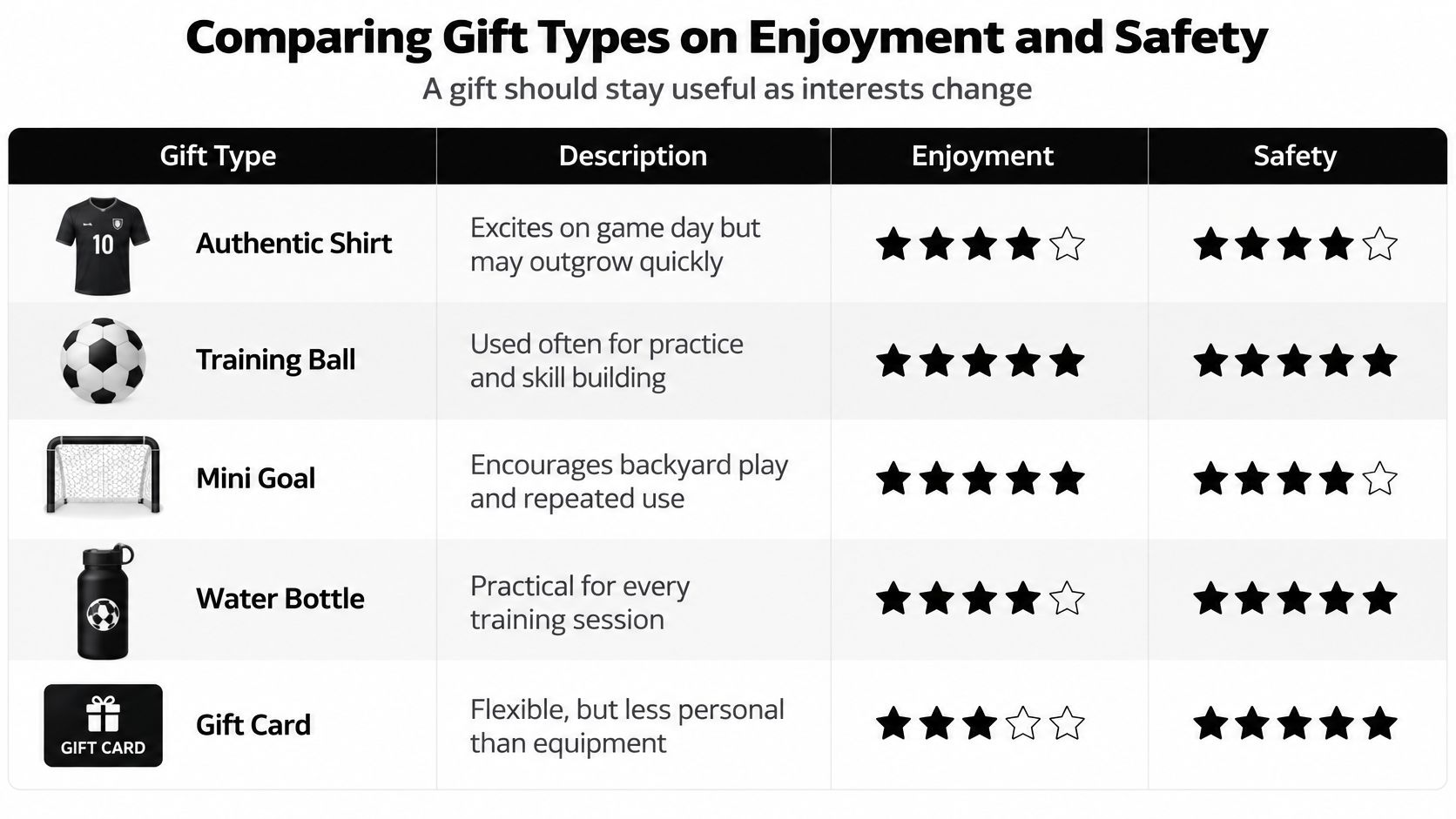
Compare the trade-offs
These are buying judgments, not measured product-lifespan or injury ratings.
| Gift type | Enjoyment span | Safety risk | Skill benefit | Best when |
|---|---|---|---|---|
| Authentic shirt | Long potential, worn then collected | No equipment-specific risk in ordinary wear | None directly | The child enjoys shirts beyond a single favorite team |
| Training ball | Medium to long | Low with appropriate use and space | Touch, passing, shooting | The child practices regularly |
| Mini goal or net | Medium | High if an unsecured structure tips | Shooting accuracy | A supervised shared space has suitable anchoring |
| Boots | Shorter, limited by growth and wear | Low with correct fit and surface compatibility | Supports technique, doesn't teach it | The child has a club and a proper fitting |
| Mystery or subscription box | Medium, driven by discovery | No equipment-specific risk for shirt-only contents | None directly | The fan enjoys discovery over choosing |
A shirt can outlast its wearing phase as a keepsake, but only if the child values collecting. A training ball offers more direct playing value, though it still needs somewhere suitable to use it.
Boots are a poor speculative purchase. The wrong sole for the playing surface or an uncomfortable fit can make an expensive present useless. A mystery box has a different limitation: surprise is enjoyable only when the child welcomes an unfamiliar team.
For another soccer-focused viewing option, there's also this video.
Choose the gift the child can use in several ways before paying extra for a narrow performance feature.
A bottle or flexible gift card may feel less dramatic, but either can be preferable to equipment that creates storage, fitting or supervision problems.
Safety Checks Before You Buy Goals and Equipment
A goal's stability is a purchasing requirement. When a child climbs the net or hangs from the crossbar, the goal can tip toward them. Unanchored soccer goals have caused serious injuries to children, so check how the product is secured before choosing it.
Use this checklist to compare the manufacturer's setup requirements with the space available.
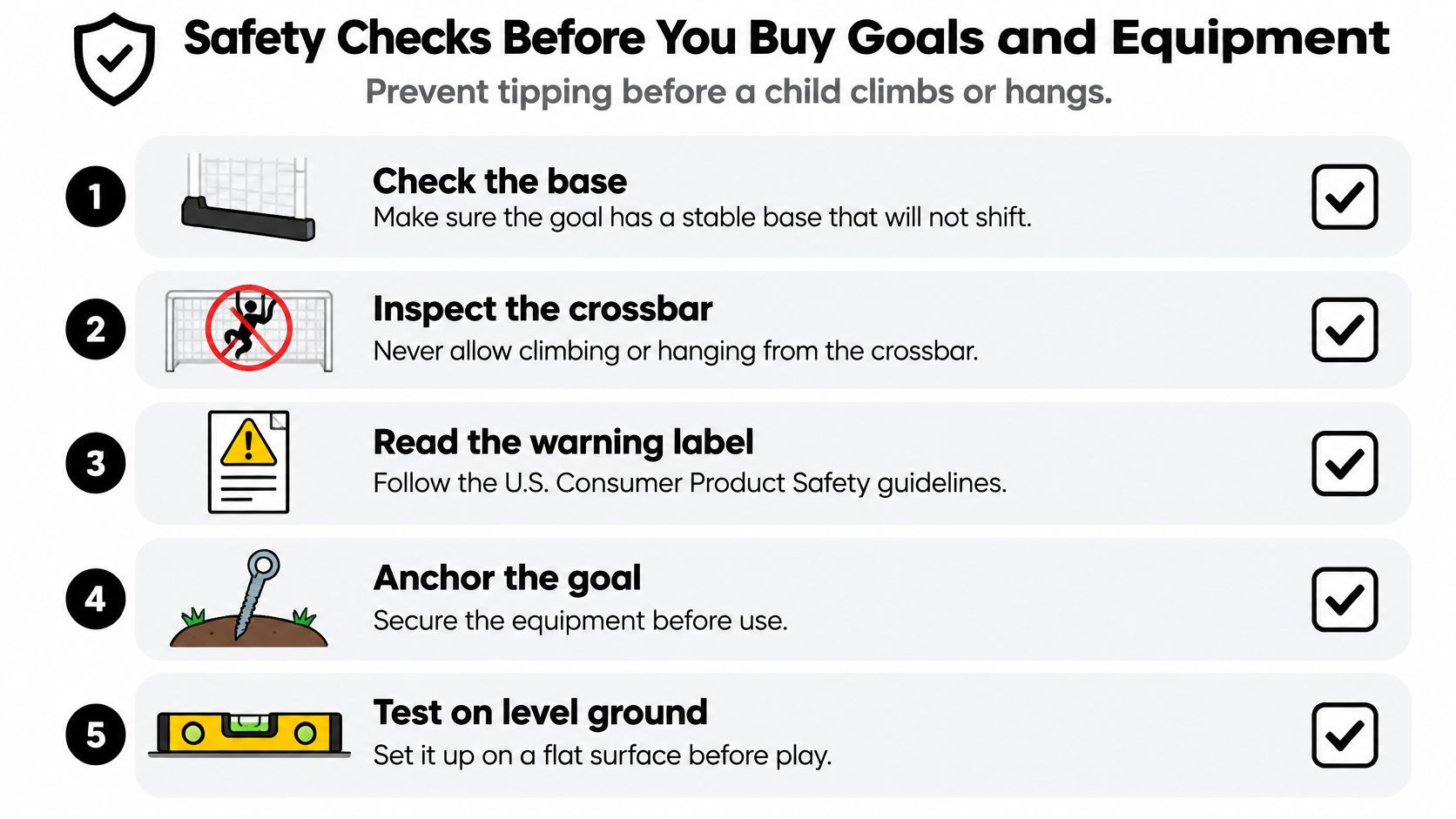
Conditions to meet before play
- Confirm the required anchors or counterweights. Check the manufacturer's instructions and whether the necessary equipment is included. Don't substitute improvised weights or assume the frame is stable because it feels heavy.
- Read the setup instructions before buying. Check the ground requirements, hardware and storage method, not just the goal's dimensions and color. A goal designed for grass may not suit a paved yard.
- Inspect connectors and joints before every use. Look for missing fasteners, loose connections, damaged frame sections and unsecured net attachments. Keep damaged equipment out of play.
- Secure the goal when it's unattended. Follow the storage instructions, including securing or tipping it forward where specified. A goal still needs protection when no one is playing.
- Set a clear rule against climbing or hanging from the crossbar. Supervise play and give younger siblings and visiting children the same instruction.
These checks apply to goals used in gardens, schools and shared play spaces. An adult should agree to handle installation and storage before you give bulky equipment.
A goal can be a good gift if the safe setup is part of the purchase decision. If the available space doesn't allow appropriate anchoring, choose a ball, cones or a target net that can be securely mounted instead.
Choosing Gifts That Reflect a Child's Team and Identity
16.6 million girls and women play organized soccer globally, a 19% increase since 2019, according to FIFA figures cited in academic research on women's football. Girls' soccer gifts shouldn't default to a generic boys' design or a famous men's club.
That doesn't mean a girl necessarily wants a women's-team shirt. It means the buyer should discover which players and teams matter to her rather than deciding from gender. The same care applies to children whose strongest connection is a national side, a family's hometown club or a less widely marketed league.
Ask discreetly, without giving away the present
A parent, sibling or close friend can usually answer a few focused questions:
- Team connection: Which club or national side does the child actively follow?
- Women's football: Is there a women's team or player they'd be excited to represent?
- Hard exclusions: Is there a rival club, competition or color they wouldn't want?
- Personal meaning: Does a particular shirt connect with family, language or cultural identity?
Don't confuse the child's playing team with their favorite professional club. Our guide to custom youth soccer uniforms is relevant when the need is coordinated teamwear rather than an individual supporter gift.
If preferences remain unclear, keep the possible selection broad. Avoid assumptions about position, ability or preferred colors based on gender. An unfamiliar club can be an enjoyable discovery, but a disliked rival may be a different matter.
Use exclusions honestly
During ordering, our text box lets customers name clubs, competitions or colors to avoid. Use it to communicate genuine exclusions clearly, rather than filling it with a long wish list.
Requests for specific shirts or teams to include will be ignored. If the child will only enjoy a particular team, a surprise selection isn't the right format. Use the note to exclude, not to request, so discovery remains part of the gift without disregarding the child's identity.
Confirm Authenticity, Sizing and Place Your Order
Novelty merchandise can resemble a club shirt without being official teamwear. That's fine when it's clearly sold as a soccer-themed top, but it isn't the same purchase as an authentic football shirt.
Check the seller's description before examining decorative details. The listing should identify what the item is, explain its condition and state whether it's authentic. Attractive product photographs alone don't establish provenance.
Check the garment and its sourcing
Compare the crest, manufacturer branding and sponsor placement with the shirt's stated season and version. Sponsor arrangements and designs can change, so don't reject a shirt because it differs from the team's current kit. Look for consistent manufacturer labels and size tags, while remembering that copied labels aren't proof by themselves.
Use the following checks together:
- Listing accuracy: The description should distinguish official teamwear from novelty clothing and explain whether the shirt is new or previously owned.
- Garment details: Compare the neckline, panel layout, crest treatment and printed elements with the relevant version.
- Seller accountability: Look for a clear authenticity statement and an accessible returns policy.
- Sourcing: A seller should explain where its stock comes from. We purchase shirts in large quantities from clubs, brands and manufacturers.
Our guide to kids' authentic jerseys provides further context for separating a genuine football shirt from a lookalike. No single visible detail should carry the whole decision.
Checking the listing with the child's parent can preserve the surprise while preventing an unsuitable purchase.
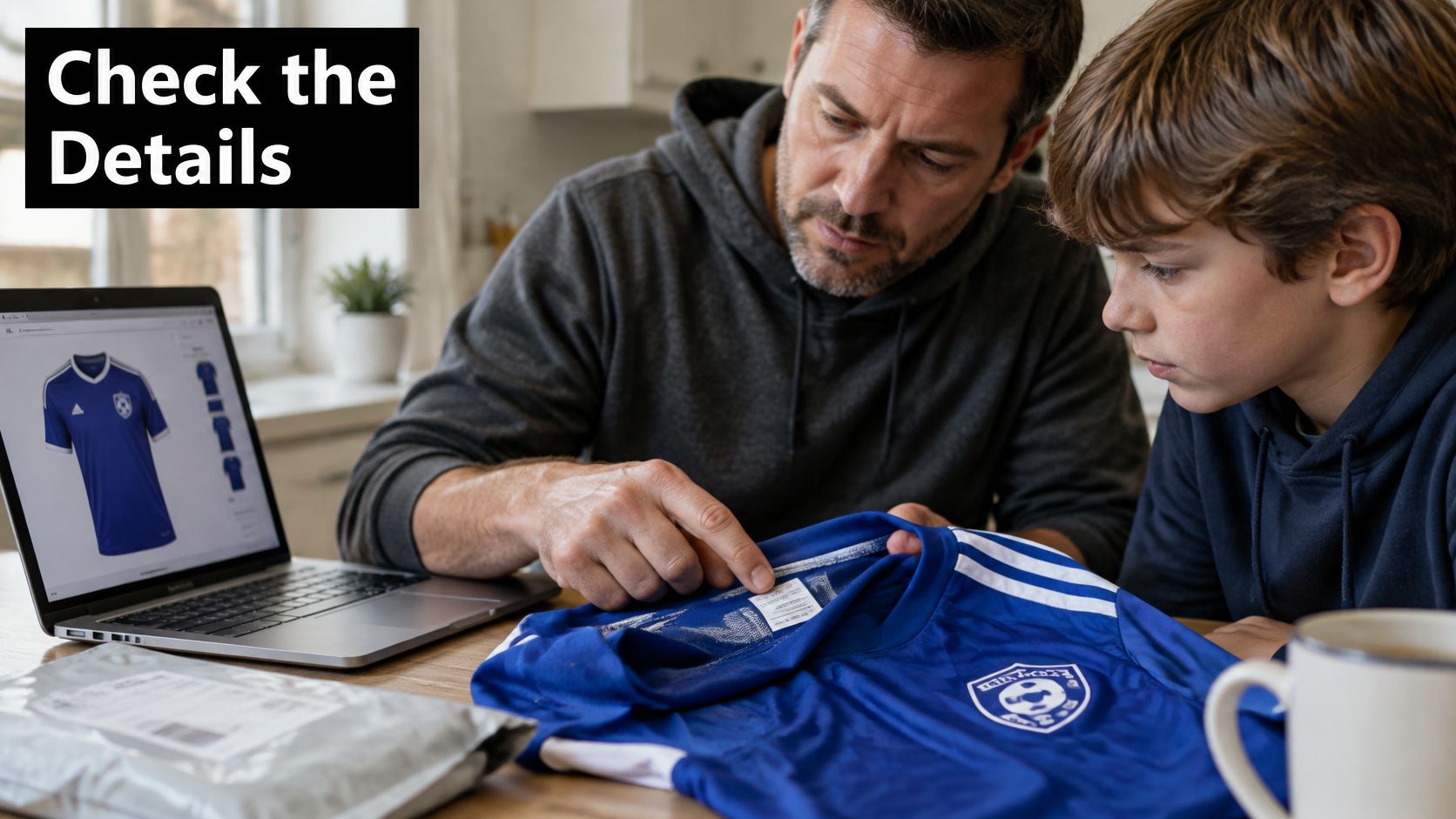
Measure instead of guessing from age
Use the child's current height and chest measurement, then compare them with the relevant size chart. Measure the chest around its fullest part with a flexible tape, keeping the tape level and comfortable rather than tight.
A well-fitting shirt already in the wardrobe offers another useful reference. Compare its laid-flat chest width and length only with garment measurements taken the same way. Don't compare a flat width directly with a full body circumference.
Sizing up can be sensible for a growing child, but excessive length and dropped shoulders aren't useful growing room. Youth and adult cuts may differ even when their labels appear close. ClothME's practical advice to reduce returns on children's clothing is a useful companion when shopping without a fitting room.
Fit check: Buy room to move, not a shirt the child has to grow through before enjoying it.
Complete the order deliberately
- Choose the age-appropriate category. Use the child's current play habits to decide between clothing, a ball, training equipment or a collecting gift.
- Resolve practical constraints. Confirm equipment storage, supervision and installation before committing to a physical training gift.
- Match measurements to the available sizes. Save the measurements so a parent can review the choice without seeing the intended design.
- Enter exclusions accurately. Check spelling and make the avoidance note unambiguous.
- Read authenticity and returns statements. Find out how an unsuitable size would be handled and whether tags or packaging must remain intact.
- Confirm delivery for the occasion. Use the checkout information rather than assuming an arrival date, especially when ordering close to a birthday.
For children whose measurements fit the range, our Kids Football Shirt Mystery Box covers sizes 128–158, costs €69,95 and contains a 100% authentic football shirt from a club anywhere in the world. It's labelled 1+1 Free, so consider whether the additional shirt adds useful wearing or collecting value. We carefully select shirts from a collection of football clubs, keeping the actual selection a surprise.
Before wrapping, check the returns conditions and keep the order information accessible. The best purchase isn't necessarily the most technical or expensive one. It's the gift that fits the child's life now and still offers something enjoyable when that life changes.
Mystershirt offers authentic football shirts in children's sizing, with a surprise selection and the option to name clubs, competitions or colors to avoid. If discovery suits your young fan, visit Mystershirt, compare the available sizes with their measurements and choose a gift they can wear now and keep as part of their football story.


