You're standing at checkout with three tabs open. One is the club's official store, another offers the same-looking shirt for a fraction of the price, and a third promises a mystery bundle from famous leagues. The photos look convincing. The descriptions are vague. You want a genuine football jersey, but you don't want to pay more than necessary or discover a fake after the parcel arrives.
The right answer depends on who you are buying for and what you expect from the shirt. A collector needs provenance and player-level construction. A parent needs sensible pricing and an easy return. A gift shopper needs reliable delivery and low sizing risk. A budget buyer may be better served by an official replica, a verified secondhand shirt, or a structured mystery box. This guide shows where to buy authentic football jerseys, which channels deserve your money, and which checks should happen before you pay.
Table of Contents
- The Real Decision Every Jersey Buyer Faces
- What Makes a Jersey Authentic in 2026
- Trusted Channels to Buy Authentic Football Jerseys
- Price Tiers and When Each One Is Worth It
- How to Verify a Jersey Before You Pay
- Sizing, Shipping, and Returns Made Simple
- Mystery Boxes and Bundle Options for Value Buyers
- Picking the Right Channel for Your Situation
The Real Decision Every Jersey Buyer Faces
A collector sees the official club store and thinks about provenance. The shirt needs to be the right season, the right player edition, and in condition that justifies the price. A low-priced marketplace listing might look tempting, but if the seller can't show the inner labels, product code, and purchase trail, the apparent saving isn't a bargain. It's an authentication problem waiting to happen.
A parent has a different calculation. Children grow quickly, shirts get washed often, and a match-level garment may be unnecessary for a young player who wants to wear the club colours every weekend. The sensible choice is usually a licensed replica from a retailer with clear measurements and straightforward returns, not a suspiciously cheap listing described as “player version.”
Then there's the gift shopper, usually buying against a birthday or matchday deadline. This buyer should value delivery certainty, gift receipts, and a known returns process above a small discount. A genuine shirt that arrives late or fits badly still makes a poor gift.
The budget buyer has the most interesting choice. A licensed replica is legitimate and usually more practical for everyday wear. A verified pre-owned authentic shirt can offer better construction at a lower cost, but condition and seller expertise matter. A mystery bundle can work for someone who enjoys discovery and doesn't need a specific club or player.
Collector rule: If you need one exact shirt, buy through a channel that can prove exactly what it is. If you want the experience of discovering several shirts, you can accept less control.
These four situations lead to different recommendations:
- Collector: prioritize official stores, kit manufacturers, and specialist resale platforms with documented provenance.
- Parent: choose a licensed replica with published measurements and a dependable return policy.
- Gift shopper: use an established sports retailer or official store with delivery tracking and gift-friendly returns.
- Budget buyer: compare a licensed replica, verified secondhand authentic shirt, and reputable bundle before considering any informal seller.
What Makes a Jersey Authentic in 2026
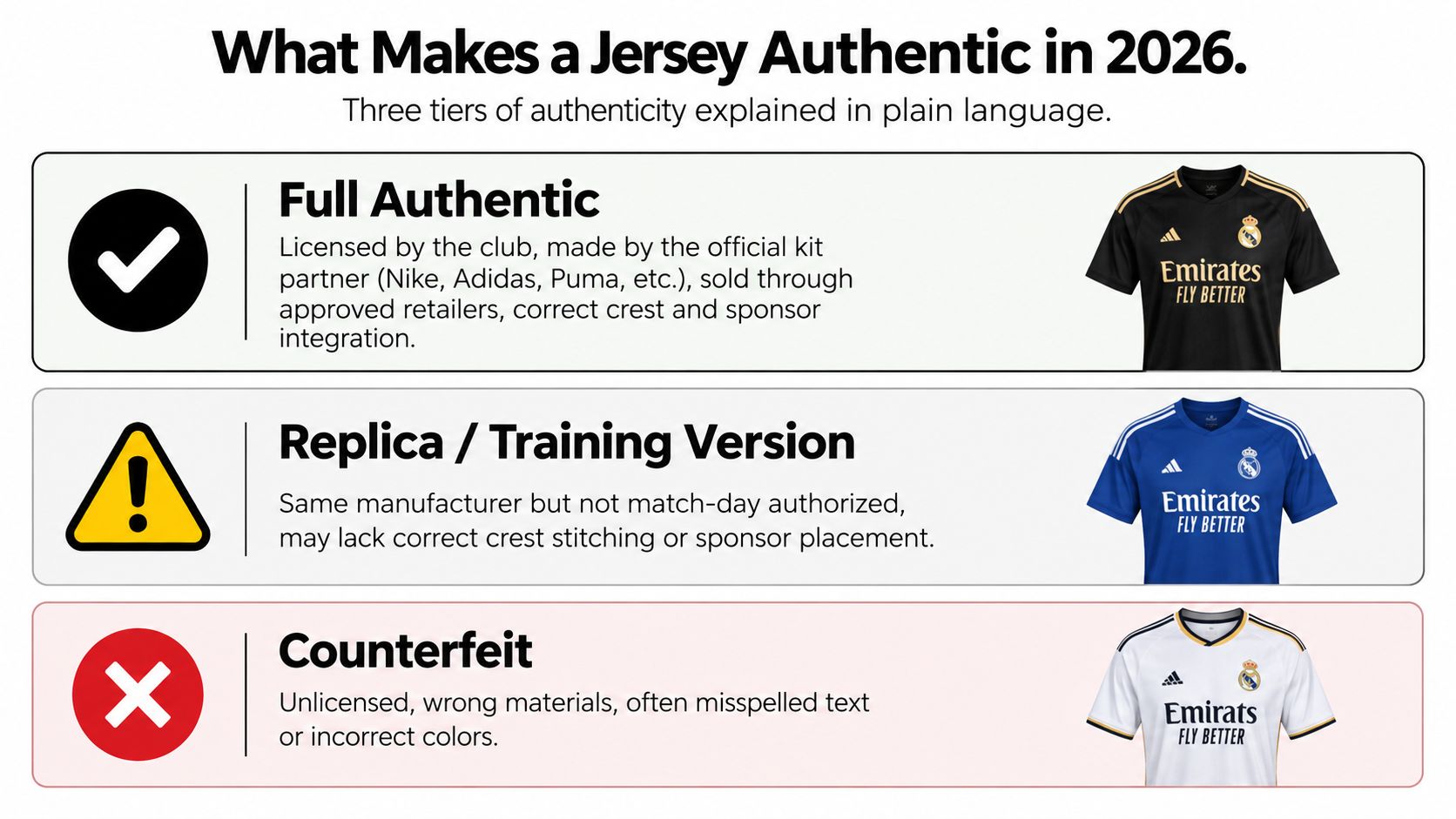
The word authentic gets used too loosely. Before comparing sellers, separate the three product tiers.
An authentic jersey is a licensed shirt made by or for the club's official kit partner and sold through an approved channel. It follows the club's authorized design, including the crest, sponsor treatment, colours, and relevant on-field specifications. The cut is often more performance-oriented, and the finishing tends to be more precise.
A replica jersey is also officially licensed. It's designed for supporters rather than match use, so it may have a roomier fit, different fabric construction, or a simpler badge and sponsor application. Replica doesn't mean fake. It means licensed fan version, and for many buyers it's the smarter purchase.
A fake, or counterfeit, is unlicensed. It imitates the club's marks, colours, and manufacturer branding without authorization. Counterfeits frequently appear through informal social sellers, unbranded shops, and marketplace listings that use language such as “AAA quality,” “1:1,” or “same as original.” Those phrases describe an imitation, not a legitimate product category.
The distinction matters because licensed football merchandise is a substantial commercial industry. One 2025 estimate values the global licensed sports merchandise market at USD 38 billion and projects it to reach about USD 53 billion by 2031, while another estimates USD 39.50 billion in 2025 and USD 56.21 billion by 2034. Football represented 37.95% of the licensed sports merchandise market in 2025, according to the same market reporting, which helps explain why clubs, federations, and kit manufacturers treat licensing and authentication seriously. See the global licensed sports merchandise market estimates for that market context.
Counterfeits damage more than a buyer's wardrobe. Industry reporting estimates that licensed sports apparel and merchandise loses about USD 3.2 billion annually to counterfeit goods. That helps explain why official tags, product codes, manufacturer labels, and approved retail channels are useful checks rather than decorative details.
Trusted Channels to Buy Authentic Football Jerseys
Trust isn't evenly distributed across the jersey market. Buy as close to the rights holder or manufacturer as your budget and use case allow.
Official stores offer the cleanest trail
The club's online megastore, an official league shop, or the kit manufacturer's own website should be your first stop for a current shirt. These channels provide the clearest product description, recognized branding, and standard consumer support. They're particularly suitable for gifts, current-season kits, and collectors who need a specific player or customization option.
The drawbacks are predictable. You'll generally pay full retail, popular sizes can disappear quickly, and older seasons may be unavailable. Still, if authenticity matters more than finding the lowest price, this is the least complicated route.
Established sports retailers balance choice and convenience
Licensed sports apparel chains and long-running specialist retailers are useful when you want alternatives to the club shop. They may carry several manufacturers, older stock, customization services, and promotional offers. Check that the listing identifies the exact season and version, rather than assuming every shirt carrying a club crest is the same.
This channel suits gift shoppers and parents because returns, delivery tracking, and size exchanges are usually easier than on informal marketplaces.
Specialist resale platforms reward careful collectors
Resale specialists can be excellent for deadstock, discontinued shirts, and player-issue pieces. They can also be expensive, especially when a particular season or player has collector demand. Ask for close-up images of the inner label, crest, sponsor application, and product code. A seller who understands the difference between authentic, replica, and counterfeit should be able to answer precise questions.
Large marketplaces require the most discipline
Marketplaces offer the widest price spread and the greatest number of questionable listings. That doesn't make every marketplace seller dishonest, but it does mean the platform's search result isn't proof of authenticity. Treat the individual seller as the business you're evaluating.
| Buying channel | Authenticity confidence | Price range | Best for | Main risk |
|---|---|---|---|---|
| Official club, league, or manufacturer store | Highest | Full retail, varies by release | Current kits, gifts, exact player editions | Stock sells out and prices are less flexible |
| Established sports retailer | High when listing is clearly licensed | Varies by season and promotion | Parents, gifts, easy returns | Confusing authentic and replica versions |
| Specialist resale platform | Varies from high to excellent | Often premium for rare pieces | Collectors and discontinued shirts | Misidentified condition or version |
| Large marketplace | Seller-dependent | Widest spread | Research and bargain hunting | Counterfeit listings, weak returns, vague descriptions |
Practical rule: A cheap listing is only useful when the seller can identify the shirt precisely and support that description with real photographs.
Price Tiers and When Each One Is Worth It
Price is a useful warning signal, but it isn't a complete authentication test. A low price can indicate a legitimate replica, an end-of-season clearance item, a worn secondhand shirt, or a counterfeit. You need to know which product tier you're comparing.
Market reporting places authentic on-field versions around USD 250 to USD 350, while replica jerseys commonly sit around USD 80 to USD 150. Those are broad historical market markers, not a promise that every club or season will fall inside the bands. They do show why a listing that claims to be a brand-new match-level shirt for a tiny fraction of the normal price deserves scrutiny. The licensed sports merchandise market analysis also estimates that authentic jerseys represented 35.6% of the football jerseys market and were valued at roughly USD 6.0 billion in 2025.
Match-level authentic
Choose this tier when you care about player-style construction, technical details, or long-term collection value. It makes sense for a collector chasing a specific release, not for a child who may outgrow the shirt quickly. Confirm whether the listing says authentic, player version, match issue, or match worn. Those terms shouldn't be treated as interchangeable.
Licensed replica
This is the sensible choice for most supporters. You get official club branding and legitimate manufacture without paying for every on-field specification. It works for regular matchday wear, casual clothing, and children who need a shirt that can handle ordinary use.
Verified secondhand
Pre-owned shirts can deliver strong value, particularly when the seller provides detailed condition photos and a clear description of previous wear. Inspect sponsor prints, name and number applications, cuffs, collar, and underarm seams. A lower price is only attractive if the condition matches it.
Counterfeit pricing
A listing that calls a shirt “authentic” while using vague quality language, generic photos, and an implausibly low price should be treated as a counterfeit risk. You may receive poor materials, incorrect branding, inconsistent sizing, and little practical help if the order goes wrong. The cheapest shirt is often the most expensive mistake because you lose both the purchase price and the time spent resolving it.
| Tier | Typical price | Build quality | Best for | Resale value |
|---|---|---|---|---|
| Authentic on-field version | USD 250 to USD 350, market marker | Match-level construction and finishing | Serious collectors and specific player editions | Potentially stronger, depending on rarity and condition |
| Licensed replica | USD 80 to USD 150, market marker | Fan-focused construction and fit | Matchday wear, gifts, and families | Usually more modest |
| Verified secondhand | Varies by season and condition | Depends on original tier and wear | Budget-conscious collectors | Depends heavily on provenance and condition |
| Counterfeit | Often presented as unusually cheap | Unlicensed and inconsistent | Not recommended | No reliable resale value |
How to Verify a Jersey Before You Pay
You don't need specialist equipment to reject most risky listings. You need clear images, a few minutes, and the willingness to walk away when the seller avoids basic questions.
Start with the listing, not the stitching
Read the title and description closely. “AAA,” “1:1 quality,” “player version same as original,” and “stock picture” are warning signs, especially when the seller doesn't identify a product code or official version. A trustworthy listing should state whether the shirt is authentic or replica, identify the season where relevant, show the actual item, and explain returns.
Next, compare the photographs. Crest placement, sponsor alignment, collar shape, sleeve details, and name-and-number geometry should look consistent from image to image. If the listing uses only catalogue photographs, request pictures of the exact shirt before paying.
Inspect the garment
Look at the internal labels, care instructions, manufacturer tag, and SKU or style code. Check spelling, spacing, material information, and whether the code corresponds to the described model. Examine the crest and sponsor application under angled light. Genuine shirts generally show clean, consistent stitching or neatly applied heat-pressed and sublimated graphics, while peeling edges, irregular seams, loose threads, and visibly uneven lettering deserve caution.
Some expert guidance uses stitch density as one construction clue, with about 8 to 10 stitches per inch cited for genuine garments compared with lower counts on counterfeits. Treat that as one observation, not a standalone verdict. A replica may be legitimate even though it isn't built to the same specification as an authentic on-field shirt.
Confirm the purchase trail
Ask for the original order confirmation or invoice when buying an expensive resale item. Verify the seller's return terms before sending payment, and use a payment method with buyer protection rather than a direct bank transfer to an unknown person. You can also compare the listing against this football shirt authenticity checking guide before making a decision.
A quick search of the seller's username in collector communities can reveal repeated complaints or authentication discussions. Request a real-time photograph of the size tag and stitching if the listing feels incomplete. If the seller refuses, move on.
Sizing, Shipping, and Returns Made Simple
A genuine shirt can still be the wrong purchase if the fit doesn't suit the wearer. Authentic cuts are commonly closer to a slim performance fit, while replica or stadium versions are usually more forgiving, but the label alone isn't enough. Nike, adidas, and Puma each use their own garment measurements, and the same letter size can feel different across brands or product lines.
Measure a shirt that already fits well and compare its chest, body length, and sleeve measurements with the seller's chart. Don't rely on “I always wear a medium.” Also check whether the product is described as slim, stadium, classic, women's, or youth fit. Children's shirts are cut differently from adult garments, and a youth size shouldn't be selected by converting an adult letter size.
Protect yourself from the most common return problem
Sizing errors create unnecessary exchanges, particularly when a buyer selects an authentic cut but expects a relaxed replica fit. If you're between published measurements, order from a retailer that supports simple exchanges, or ask customer service for garment measurements before checkout.
Use these safeguards:
- Compare measurements: Use chest and body length, not only S, M, L, or XL.
- Read the return policy: Confirm the deadline, condition requirements, and whether customization makes the item non-returnable.
- Check return costs: A prepaid label can matter more than a small initial discount.
- Keep packaging: Don't remove tags or wash the shirt until you're sure the fit is right.
Overseas listings add another layer of uncertainty. Delivery can take longer, tracking may change between carriers, and customs or currency conversion can erase an apparent saving. Before paying, calculate the full landed cost and confirm who handles import charges. The international football shirt shipping guide is useful when a seller ships across borders.
Avoid direct bank transfers to unknown sellers. A card, PayPal, or another payment method with a dispute process gives you more practical protection if the item never arrives or differs materially from the listing.
Mystery Boxes and Bundle Options for Value Buyers
A mystery box is not the right answer for someone who needs a specific club, season, or player. It can be a reasonable value format for a fan who wants genuine shirts, enjoys surprise, and cares more about variety than exact selection.
The model is simple. You choose a box or bundle, select the size, and receive one or more football shirts selected by the retailer. Depending on the seller, the assortment may include current, retro, club, or national-team pieces. The lower per-shirt cost comes from giving up control over the exact design and player selection.
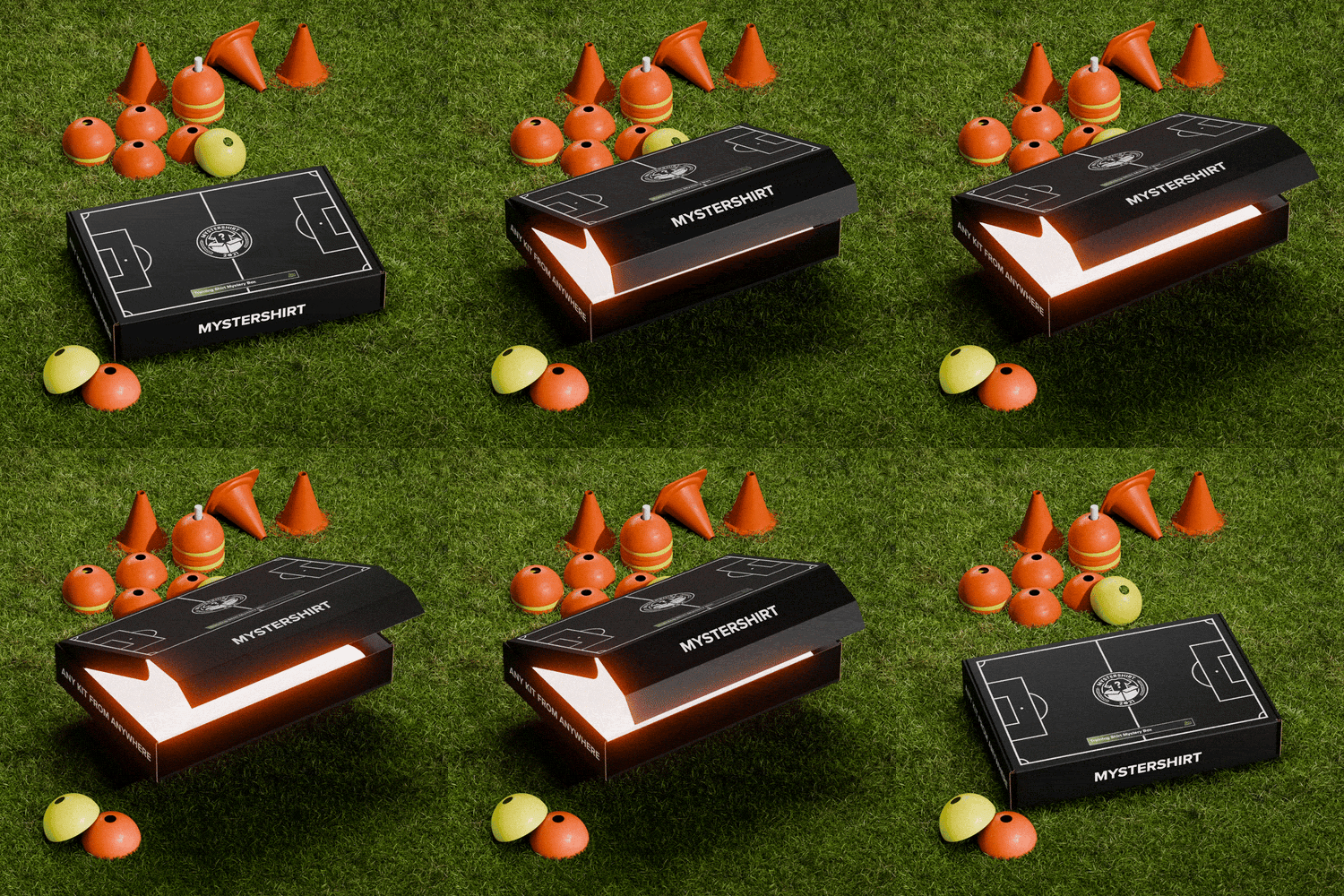
Mystershirt offers mystery football shirt boxes with authentic shirts, size choices, and preference filters for clubs, leagues, or colours a buyer doesn't want to receive. That makes the experience less blind than an entirely random parcel, although it still doesn't guarantee a particular shirt.
Before ordering, check four details:
- Authenticity wording: Look for a clear statement that the shirts are licensed and genuine.
- Box contents: Confirm whether the selection can include replicas, authentic versions, retro releases, or player editions.
- Size exchanges: Ask what happens if the shirt fits badly or the chosen size is unavailable.
- Value calculation: Include shipping and any taxes before deciding whether the bundle beats buying a known shirt.
The trade-off is straightforward. You may receive a design you wouldn't have chosen, and a return may be more complicated than with a standard product listing. In return, you can build variety without researching every individual shirt. The football jersey mystery box guide explains the format in more detail.
Choose this route if you enjoy unboxing, want multiple shirts, and can accept less control. Don't choose it for a time-sensitive gift when the recipient supports one specific club.
Picking the Right Channel for Your Situation
Use the buyer, not the discount, as your starting point.
The collector
Buy from the official club store, the kit manufacturer's retail site, or a specialist resale seller with strong provenance. You need exact information about season, version, condition, and customization. Ask for close-up images before paying for a rare or expensive piece.
The parent
Choose a licensed replica through an established sports retailer. The child gets an official shirt, the fit is usually more wearable, and a clear return process matters more than match-level detailing. Avoid chasing a “player version” when the shirt will be worn regularly and outgrown quickly.
The gift shopper
Use an official store or a major sports retailer with delivery tracking, gift receipts, and a practical exchange policy. If you don't know the recipient's measurements, avoid permanent name-and-number customization. A gift card or a flexible shirt option is safer than guessing.
The budget buyer
Compare a licensed replica with a verified pre-owned shirt. A mystery box from an established seller can suit a buyer who wants several authentic shirts and doesn't need to choose every design. Don't confuse a low price with proof of value. Verify the seller and the product tier first.
Quick answers before checkout
Can I trust an overseas seller? Only when the seller clearly identifies the product, publishes return terms, and offers a protected payment method. Add delivery, customs, tax, and currency conversion to the advertised price.
Does a low price prove a jersey is fake? No. It may be a legitimate replica, clearance item, or used shirt. But a very low price combined with vague wording and stock images is a serious warning.
What is the safest payment method? Use a credit card, PayPal, or another service with a documented dispute process. Don't transfer money directly to an unknown seller.
Should I buy authentic or replica? Choose authentic for player-level construction and collecting. Choose replica for everyday wear, gifts, and growing children. Both can be legitimate when sold through an authorized or clearly trustworthy channel.
The safest decision is usually the least glamorous one. Identify the exact tier, verify the seller, compare the measurements, calculate the landed cost, and walk away when the listing won't answer basic questions.
Mystershirt offers authentic football shirt mystery boxes with size selection and preferences for clubs, leagues, or colours to avoid, making it a practical option for fans who want variety without choosing every shirt individually. Visit Mystershirt to browse the available boxes and decide whether a curated surprise fits your collection, gift, or budget.