Express delivery in Europe typically takes 1 to 4 days, while global shipping ranges from 1 to 30 days, and the checkout estimate for your own address is the figure that applies to your order. That wide gap isn't evasiveness. It reflects how many separate companies and authorities handle one parcel before it reaches your door.
Worldwide shipping sits inside a much larger system. More than 80% of goods traded worldwide by volume are transported by sea, according to the World Bank overview of shipping and ports. Your football shirt may travel by air or road, but it still depends on the same basic chain: dispatch, international transit, import clearance, and last mile delivery.
Read every delivery estimate and fee through those four handoffs. If a parcel is late, one handoff caused it. If a charge appears at the door, one handoff explains that too. Once you know which stage you're looking at, the numbers at checkout stop looking arbitrary.
Table of Contents
- Delivery Windows by Region at a Glance
- The Four Factors That Set Your Shipping Fee
- Why the Same Order Can Arrive in Days or Weeks
- Duties, VAT and Who Pays Them at the Door
- How to Track a Parcel That Has Stalled
- Returns, Guarantees and Mystery Box Exceptions
- Pre-Order Checklist for International Orders
Delivery Windows by Region at a Glance
European express delivery typically takes 1 to 4 days, and worldwide shipping to all destinations ranges from 1 to 30 days.
That second figure is the full published range, not a promise for your country. A nearby destination on a direct route sits at the short end. A remote address, a route needing transshipment, or a border requiring customs clearance sits at the long end.
Mystershirt Delivery Windows by Region
| Destination or option | Delivery window | What lengthens it | Where to confirm |
|---|---|---|---|
| Europe, express delivery | 1 to 4 days | Customs checks if leaving the EU area | Checkout estimate |
| Worldwide, all destinations | 1 to 30 days | Remote locations, transshipment, customs holds | Checkout estimate |
| Sharing Box orders | 1 to 30 days | Number of parcels in the order | Checkout summary |
| United Kingdom, United States, Canada, Australia | 1 to 30 days | Import clearance and border checks | Checkout estimate |
How to Read This Table
Start with your region and take that window as your outer boundary. Then enter your full address at checkout and compare the estimate shown there. The table tells you what's possible across all destinations. The checkout figure narrows it to your street, your country, and the speed you've selected.
Sharing Box orders need one extra check. A group order can travel as more than one parcel, so different parcels in the same order may not arrive together. The checkout summary, not the general table, shows how your specific order is structured.
Practical rule: The checkout estimate overrides the general range every time. If that estimate looks unreasonable for your country, contact the store before you pay, not after dispatch.
Keep this order of trust in mind. The 1 to 30 day range sets expectations. The checkout estimate sets your plan. If you're buying for a birthday or match day, count backwards from that date using the checkout figure, then add a buffer for border checks. A window that ends on the day you need the shirt leaves no room for a customs hold, a missed delivery attempt, or a weekend with no local delivery service.
The Four Factors That Set Your Shipping Fee
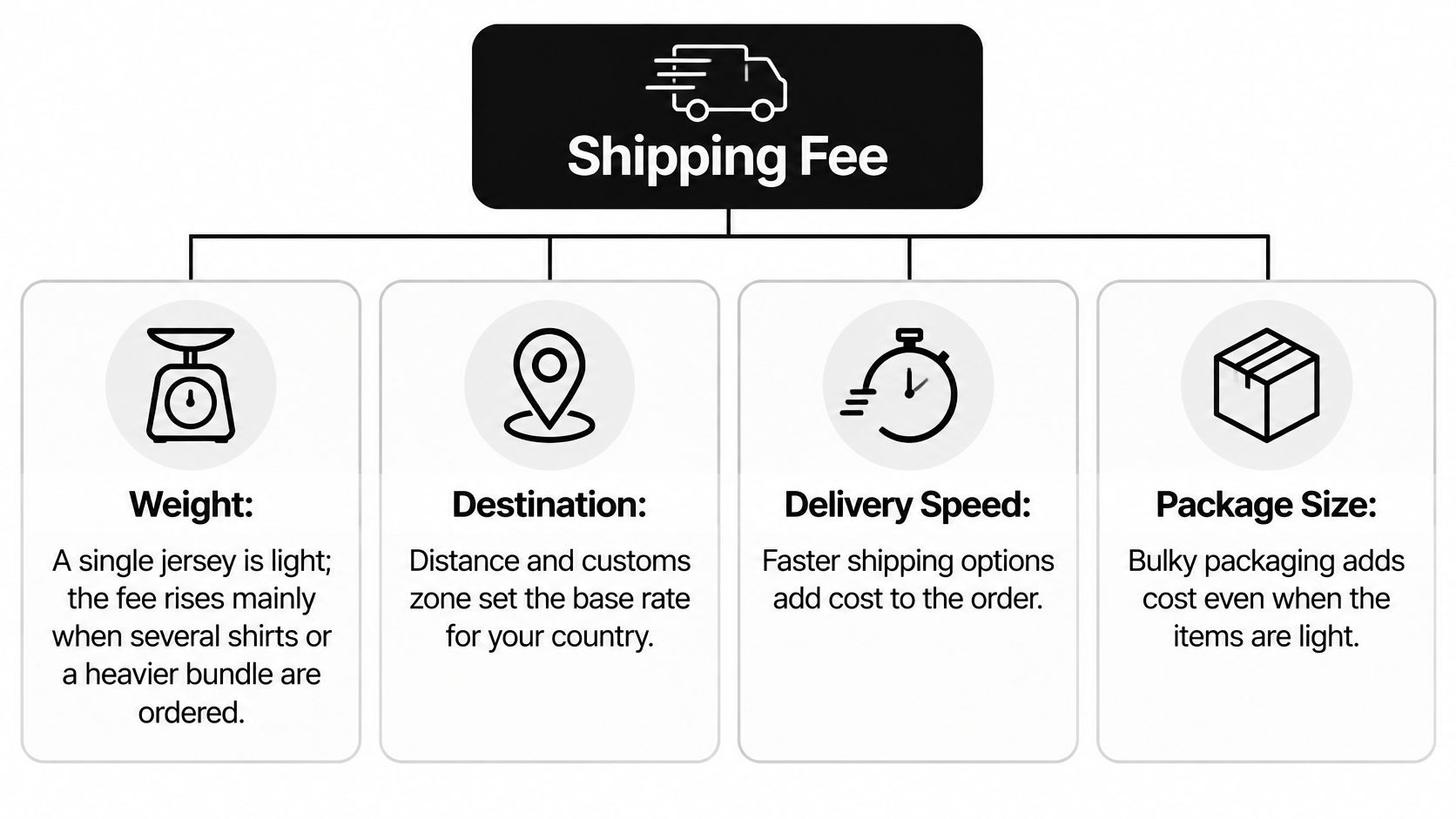
Every extra dollar on the postage line is attached to a handoff: getting collected, crossing between networks, clearing the border, or reaching the final address. Four inputs move that price at checkout: weight, destination zone, service speed, and order structure. Change one input and the total changes with it.
Weight and Package Size
A single jersey is light, so one shirt rarely pushes the fee up on weight alone. The fee rises mainly when several shirts, a bundle, or a Sharing Box add parcel weight. Size can matter as much as scale reading. A carton filled with protective packaging can be billed for the space it occupies, which is why oversized-goods guides such as packing large Buddha statues for shipping put dimensions beside protection.
If checkout jumps after you add a third shirt, check parcel count and volume before blaming the shirt count.
Destination and Speed
- Destination zone: Countries farther from the warehouse and from major shipping lanes cost more and take longer.
- Service speed: Express delivery costs more than standard worldwide shipping and shortens the window.
- Order structure: Items shipped together use one label. Items split into separate parcels use several, and each label adds cost.
One jersey to a neighbouring country is the cheap case: minimal weight, close zone, standard service fast enough. Three jerseys to a distant country for a fixed gift date flips the priorities. Destination and speed dominate, and a split into two parcels adds a second label on top. Same shop, same product type, very different fee.
Before you pay, run a two-click test. Change the destination, then change the speed, and watch which line moves your total most. The checkout figure is calculated for your address and selected speed, so it shows the trade while you can still choose. If express costs more but protects the date you need, that cost is visible before commitment.
Why the Same Order Can Arrive in Days or Weeks
Worldwide shipping works like a relay race with four handoffs: dispatch, international transit, import clearance, and last mile delivery. A parcel can sprint through the first two legs and still stall at the third.
The first handoff happens inside the warehouse, where handling time passes before a carrier collects anything.
The World Bank Logistics Performance Indicators 2.0 use 21 country-level indicators, including maritime connectivity, which reflects the number and quality of a country's shipping links, and container import dwell time, which measures how long containers remain in seaports after arrival. Weak connectivity increases transshipment dependence. Long dwell time adds delay before inland transport even begins.
That explains the spread between identical orders. A well-connected destination gets direct routes and frequent departures. A poorly connected one waits for a hub connection, then waits again at a port or inland checkpoint. The parcel hasn't been lost. It's queued.
This short video shows how a parcel moves through carrier handoffs in practice.
Say a jersey leaves the warehouse on Monday. It can clear an international hub within days, then sit a week at an import checkpoint waiting for inspection or documents. Nothing in the first two legs predicts that wait, because a different authority controls the third leg.
Your destination matters more than the speed you select. Paying for faster transit doesn't shorten a customs queue. That's why the checkout estimate for your address is the honest figure to plan around. It includes the warehouse handling before the first leg, which no separate published window states. In relay terms, you're not buying one runner's speed. You're buying the whole team's time, including the handoffs nobody applauds.
Duties, VAT and Who Pays Them at the Door
A parcel can move through dispatch and international transit on schedule, then reach import clearance and pick up charges you did not see at checkout. Duties and VAT are assessed at that border handoff. Last-mile delivery is only where the bill is collected if it was not settled earlier.
Two terms decide who pays. Delivered Duty Paid (DDP) means the seller settles duties and taxes before delivery, so checkout shows one landed price. Delivered Duty Unpaid (DDU) pushes payment to delivery: customs assesses the charge, the carrier collects or advances it, and a brokerage fee may be added for the paperwork.
DDP Versus DDU: Who Pays Duties and VAT
| Term | Who pays duty and VAT | What you see at checkout | Main risk |
|---|---|---|---|
| Delivered Duty Paid (DDP) | Seller arranges payment at import | One total including import charges | Higher upfront total, fewer doorstep surprises |
| Delivered Duty Unpaid (DDU) | Buyer pays before release | Lower checkout total, charges due later | Bill on arrival; parcel can be refused or returned if unpaid |
| If terms are unclear | Treat as unresolved until checkout names DDP or DDU | Destination-specific terms should be stated | Assuming DDP when the order is actually DDU |
Your Checklist Before Paying
- Confirm the term: Find whether DDP or DDU applies to your destination before you pay.
- Know your order value: Customs may ask for the declared value and product description, so keep your confirmation handy.
- Separate tax from carrier fees: VAT and duty go to the state; brokerage or disbursement fees go to the carrier for collecting them.
- Understand refusal: A parcel you refuse or leave unpaid can be returned to the sender.
For background on how import VAT is calculated and who acts as importer of record, the DreamBid guide to import VAT explains the mechanics in plain terms. You can also read more about import tax on clothing and how it applies to shirt orders before you commit.
Many international sellers choose DDP because it gives shoppers a single price with import charges included. If you see a DDU charge, ask which handoff created it: assessment at import clearance, collection by the carrier, or an added paperwork fee.
The applicable term for each specific country should not be guessed from a general guide. Confirm it at checkout and on the terms page for your destination. Predictability matters more than the lowest postage price, because a cheap fee followed by an unexpected doorstep bill is the most expensive outcome of all.
How to Track a Parcel That Has Stalled
A tracking page that hasn't moved in days usually means your parcel is waiting at a handoff, not that it's lost. Each pause sits at one of four points in the journey: dispatch, international transit, import clearance, or last-mile delivery. Work through these steps in order.
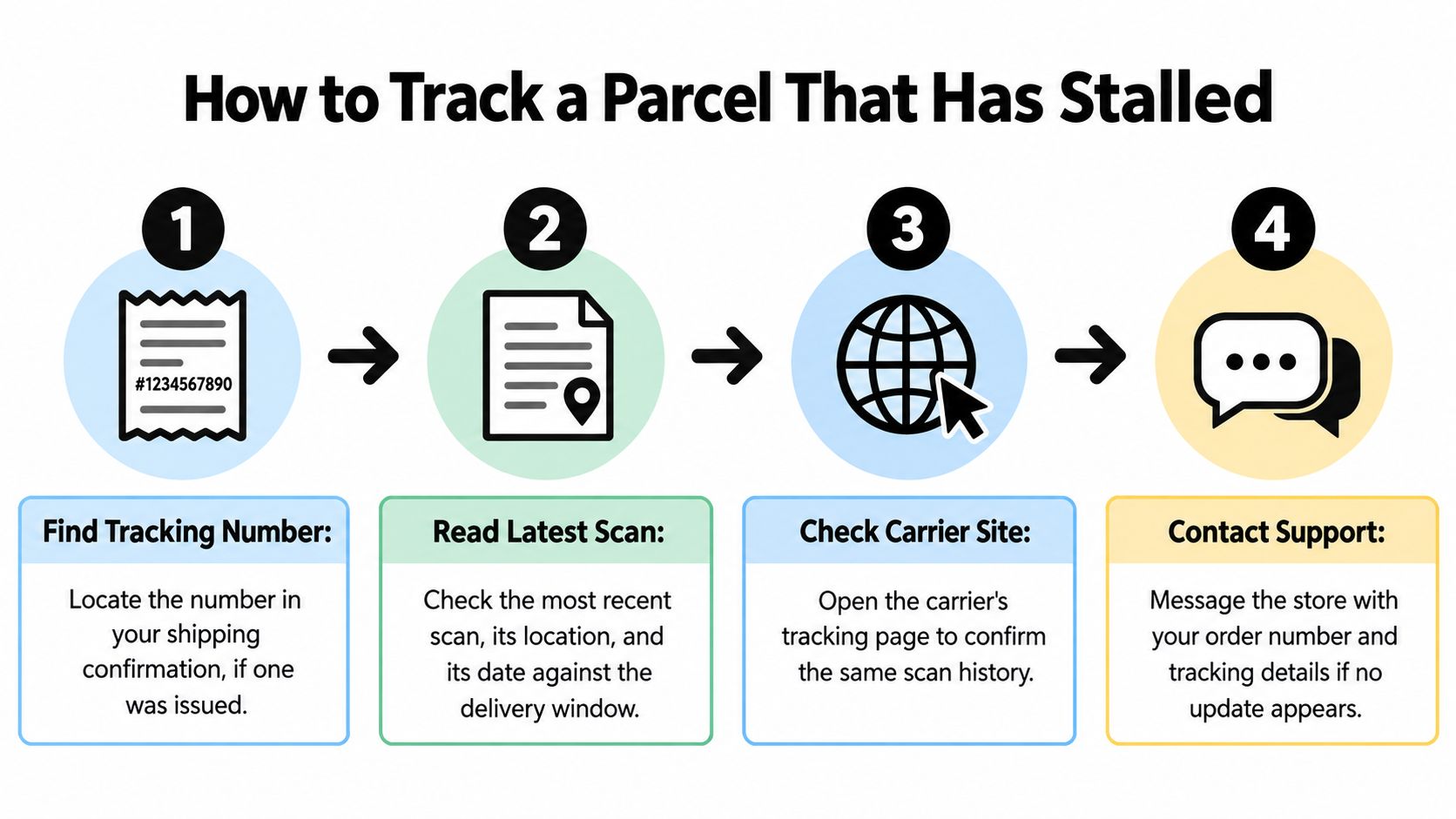
- Find the tracking number: Look in your shipping confirmation, if one was issued for your order. Without it, neither the carrier nor the store can locate your parcel.
- Read the latest scan: Note its location and date, then compare both with the delivery window for your region. A scan inside the window is slow, not stalled.
- Check for a port or customs location: A long wait there is a normal cause of delay. This is dwell time, and it ends when the checkpoint releases the parcel.
- Look for a customs request: Check your email and post for a request for an invoice, duty payment, or further information. A missing document is one common reason a parcel is held at import clearance.
- Contact the store: Send your order number, tracking number, and destination, and ask whether the parcel is still in transit or has been returned. Reading about delivery confirmation and what each status means first helps you describe the problem precisely.
- Handle a failed attempt: If delivery was attempted, arrange collection from the local depot or book a new date with the carrier. Australian readers can troubleshoot missing Australia Post tracking updates with carrier-specific steps.
- Escalate after the window: Only raise a formal case once the window has passed with no movement at all.
A gap in your scan record usually reflects a weak link in the chain, not a vanished parcel. The World Bank Logistics Performance Index scores six components, including tracking and tracing, customs clearance efficiency, and timeliness, on a 1 to 5 scale. Silence on the map typically means the parcel is sitting somewhere it isn't being scanned.
Returns, Guarantees and Mystery Box Exceptions
Every jersey is 100% authentic and delivered with labels, and orders are backed by a 100-day money-back guarantee. That guarantee is the starting point for most return questions.
It's also voluntary. It sits alongside the consumer rights you hold under the law of your destination country, and those statutory rights can apply even outside the guarantee window. Keep the two separate in your mind: the guarantee is what the store promises, while your legal rights are what your country guarantees regardless of any shop policy.
Return Coverage by Situation
| Situation | Covered by | Refund or exchange |
|---|---|---|
| Changed mind, unworn with labels | 100-day money-back guarantee | Refund under guarantee terms |
| Damaged in transit | Store guarantee and destination consumer rights | Refund or replacement |
| Wrong size in a Sharing Box or gift order | Guarantee terms for exchanges | Exchange where terms allow |
| Parcel refused or returned by customs | Destination import rules | Duties refundable only if destination rules allow |
Return postage and the exact refund method aren't confirmed here, so check the current policy before sending anything back. The full details are in the returns and refunds policy for shirt orders, and reading it before you order costs you two minutes.
Sending one lightweight shirt back across a border can cost a large share of what the shirt is worth. Check the return route before you buy, not after you open the box.
The DHL 2025 returns research found that 33% of global shoppers avoid buying from other countries because of return costs, and 67% prefer returning through a parcel locker or shop, rising to 79% in Europe. That preference is rational. A local drop-off or an exchange often makes more sense than international return postage.
Mystery boxes add a twist ordinary orders don't have. A surprise item can be the wrong size, a duplicate of a shirt you own, or a club you'd have excluded. None of that makes the jersey faulty. So before you order a surprise gift for someone abroad, check the guarantee terms, confirm the recipient's size, and list clubs to avoid. Those three steps prevent most return conversations entirely.
Pre-Order Checklist for International Orders
Run through these six checks before you pay for any international order. Each one takes under a minute.
- Delivery: Enter your country and the speed you need, then compare the checkout estimate with the regional window. If it looks unreasonable, ask before paying.
- Total: Read the full total including import charges, not only the postage line, and confirm whether your price is DDP or DDU.
- Size and exclusions: Note your size and any clubs, leagues, or colours to avoid, since these decide whether an exchange is even needed later.
- Gift timing: Count the delivery window back from the date you need the parcel and add several days for a possible customs hold.
- Records: Save your order confirmation and tracking number. You'll need both for any tracking request, customs query, or return.
- Guarantee: Read the 100-day guarantee terms before ordering a Sharing Box or surprise gift for someone abroad.
The most confident order is simple: a checkout total you've already seen in full, delivered inside a window you counted back from your own date.
Ready to put this into practice? Browse the mystery boxes at Mystershirt, enter your country at checkout to see your exact delivery estimate and total, and order with the 100-day money-back guarantee behind you. Pick your size, list the clubs to avoid, and let the four handoffs do the rest.