European express orders from Mystershirt typically arrive in 1–4 days, while global shipping can take 1–30 days, depending on the destination. That range is useful, but it only makes sense once you understand what happens between checkout and your front door.
You've ordered a retro Brazil shirt, perhaps for yourself or as a gift, and now you're refreshing the tracking page every hour. The order confirmation says “international shipping,” but that phrase hides a complicated journey. Your jersey may be waiting for export processing, moving between carrier hubs, sitting with customs, or already travelling toward your local delivery depot.
Table of Contents
- The Eager Fan and the Invisible Journey
- Why Shipping Times Vary So Much
- Reading Your Tracking Updates Like a Pro
- European Express vs Global Standard Shipping
- Customs and Documentation That Affect Your Delivery
- How to Get Your Order Faster and Avoid Delays
The Eager Fan and the Invisible Journey
The order confirmation arrives, the payment goes through, and the excitement starts. Then the waiting begins. A football shirt doesn't move directly from a warehouse to your home like a pass from one player to another. It travels through a relay involving warehouse staff, export facilities, airlines or postal networks, customs officers, and a final-mile carrier.
For an international jersey order, the journey usually contains several separate stages:
- Order processing: The seller confirms the order, prepares the shirt, creates the shipping label, and hands the parcel to a carrier.
- Origin handling: The carrier sorts the package and moves it through an export hub.
- International transport: The parcel travels by air, road, sea, or a combination of methods.
- Destination processing: The local carrier receives it and presents the shipment for import clearance.
- Customs release: Authorities review the shipment details and decide whether it can enter the country.
- Final-mile delivery: A domestic carrier takes the parcel to your address.

The important point is that shipping time means more than time spent in the air. A parcel advertised with a broad window, such as 1–30 days, may spend part of that period waiting for collection, transfer, documentation, border review, or local delivery. The quoted range is an end-to-end estimate, not a promise that the shirt will spend the entire period travelling.
A simple mental model for your parcel
Think of the shipment as a football tournament with several rounds. Your order must pass through each stage before it can reach the final. If the parcel moves smoothly through every checkpoint, delivery feels fast. If one stage asks for more information or misses a scheduled connection, the whole journey takes longer.
A useful international shipping guide for football shirt buyers can help you understand the difference between the advertised delivery window and the actual events behind it.
Practical rule: A quiet tracking page doesn't automatically mean your jersey is lost. It may mean the parcel is between carrier systems or waiting for the next scan.
That perspective changes how you read a delivery estimate. You're not waiting for one vehicle to cross one distance. You're waiting for a chain of organisations to complete their part of the route.
Why Shipping Times Vary So Much
Two parcels can travel a similar geographic distance and arrive at very different times. The main reasons are transport mode, carrier handoffs, transshipment, customs conditions, and congestion.
Air express reduces the long-distance movement between hubs. DHL describes some standard air-freight products with typical airport-to-airport transit times of 1–2 days, while some globally available services list 5–7 days for that transport segment. These figures generally cover movement between airports, not the complete journey to a customer's door. You still need to allow for collection, export handling, import clearance, and local delivery. DHL's standard air-freight information explains why airport transit shouldn't be confused with door-to-door delivery.
Economy networks work differently. They may consolidate parcels, route them through more hubs, and use several postal or commercial carriers. Sea freight adds vessel schedules, port calls, possible intermediate transfers, and inland transport. That's why the same shirt can move quickly through an integrated European air-and-road network but take much longer on a global route with several handoffs.
The hidden effect of transshipment
The World Bank's logistics research found that more than 60% of international import lead time is spent on ships, with the remaining time divided among export ports, import ports, and transshipment facilities. The same research reports that roughly half of containers worldwide require at least one transshipment.
A transshipment means the cargo moves through an intermediate port before reaching its destination. For a football shirt travelling through a broader freight network, each transfer can introduce another loading schedule, handling step, or period of waiting. Routes with fewer direct connections usually carry more timing uncertainty.
Port conditions add another variable. UNCTAD reported that average port waiting time in 2024 rose from 5.2 to 6.4 hours in developed economies and from 10.2 to 10.9 hours in developing economies. These figures aren't parcel-delivery guarantees, but they show how congestion can affect schedules before customs or last-mile delivery begins. UNCTAD's maritime transport material provides useful context for readers comparing international routes.
For destination-specific context, a guide to courier transit time to Australia can also help shoppers see why distance alone doesn't determine the result. Route design and carrier connections matter just as much.
Reading Your Tracking Updates Like a Pro
Tracking updates become less alarming when you know what each status represents. A scan usually tells you which organisation handled the parcel most recently, not exactly where the shirt is at every moment.
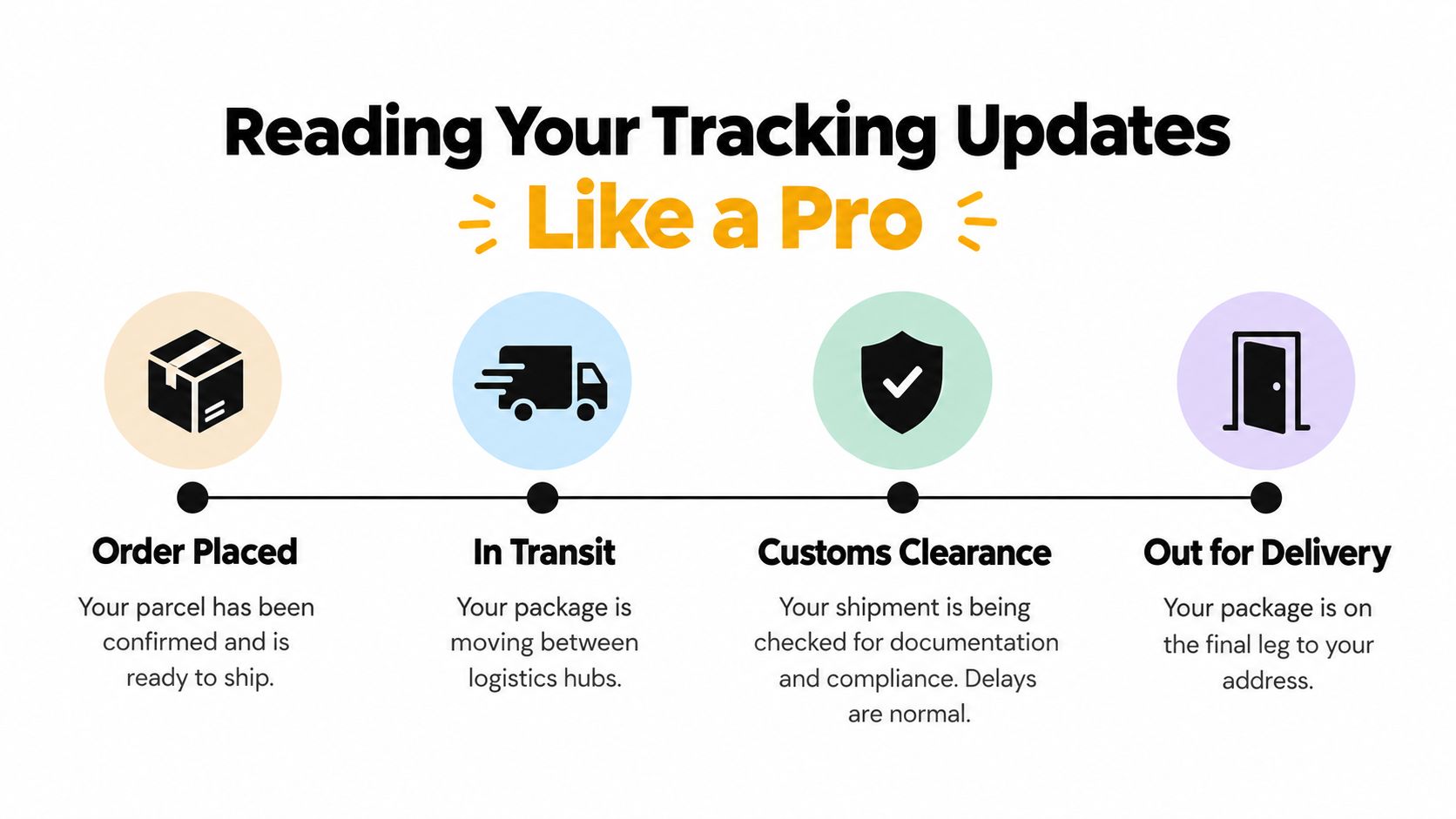
What the common statuses mean
“Order confirmed” means the purchase has been accepted and is moving into preparation. It doesn't necessarily mean a carrier has collected the parcel.
“Label created” means the shipping information exists in the carrier system. The physical package may still be waiting for pickup or its first scan.
“In transit” is a broad status. It can describe movement between warehouses, airports, sorting centres, or regional depots. A parcel may continue moving even when the tracking page doesn't show a new location immediately.
“Arrived at destination country” usually means the international transport stage has ended or is close to completion. The parcel still needs local processing and, in many cases, customs release.
“Customs clearance started” means the shipment has reached the destination-border stage. It isn't a delivery promise, and it doesn't automatically indicate a problem. Customs may be checking the electronic declaration, confirming the description, assessing taxes, or deciding whether more information is needed.
“Out for delivery” is the clearest sign that the final-mile carrier has assigned the parcel to a delivery route. At that point, the remaining uncertainty is mostly local address access, delivery volume, and the driver's route.
A useful compliance resource such as YipSMS Inc.’s delivery notification guidance can also help businesses and shoppers understand how delivery messages should communicate status changes without creating false certainty.
The customs stage deserves patience. The World Customs Organization's Time Release Study framework measures customs performance from cargo arrival until physical release. In practice, clearance can take seconds or several days, depending on the destination, documentation, inspection requirements, and shipment details.
When a pause deserves attention
A short gap between scans is often normal, especially when one carrier has handed the parcel to another. Contact the seller or carrier when the tracking message specifically requests documents, payment, or recipient action, or when the parcel remains beyond the quoted delivery window without a meaningful update.
If customs requests information, respond promptly and use the exact details from your order. Delays become more likely when the recipient ignores a duty request, misses a carrier message, or submits inconsistent information.
European Express vs Global Standard Shipping
Choosing a shipping method means balancing speed, price, tracking quality, and uncertainty. European express delivery of roughly 1–4 days is technically plausible when a parcel stays within an integrated air-and-road network and clears documentation without intervention. Worldwide delivery of 1–30 days reflects a much broader set of routes, handoffs, border processes, weekends, and remote-area conditions.
The two options serve different situations. Express makes more sense when the shirt is needed for a match weekend, birthday, or planned event. Standard shipping may suit a collector who wants to control the total cost and has flexibility around the arrival date.
| Shipping Type | Typical Delivery | Best For | Risk Level |
|---|---|---|---|
| European express | 1–4 days | Time-sensitive orders within an integrated regional network | Lower when documents and address details are correct |
| Global standard | 1–30 days | Flexible shoppers ordering across longer or less direct routes | Higher variation because of handoffs, customs, and remote delivery |
| Economy postal or multimodal service | One to four weeks or more in some cases | Budget-focused orders where speed is secondary | More exposure to consolidation, transfers, and limited scan frequency |
The broader difference isn't only distance. European routes may involve fewer transshipments, closer destination markets, and more coordinated road and air links. A global parcel may pass through an intermediate hub, wait for a scheduled connection, and then enter a destination-country customs process that operates at a different pace.
Compare the full landed experience
Don't compare only the delivery fee. Check whether tracking is included, whether duties and taxes are prepaid, and whether the carrier will contact you if customs needs clarification. A slower service can be cheaper at checkout, but an unexpected import or handling charge can change the total cost.
Survey data reported by Fulfilmentcrowd's cross-border research found that 38% of shoppers said high shipping fees could deter a purchase from a foreign brand, while 34% cited long delivery times and 30% cited customs fees. The same source reports that a preferred maximum delivery time was commonly three to five days, while 35% were willing to wait six or more days. These findings support a practical choice: select the fastest option when timing matters, but choose value when the total price and delivery responsibility are clear.
For a wider explanation of carrier networks and shipping decisions, this creator's guide to international shipping offers useful background. You can also compare the stages involved in international express shipping before deciding whether the premium suits your order.
Customs and Documentation That Affect Your Delivery
Customs isn't just a gate that opens after a fixed waiting period. It's a decision point where officials and carriers check whether the parcel's information is complete, consistent, and suitable for import processing.
For a football-shirt order, the commercial information should identify the item clearly, such as “authentic football jersey.” The declaration should also include the correct value, country of origin, and appropriate HS classification. The aim isn't to use complicated wording. The aim is to make sure the description matches the actual product and the supporting details agree with one another.
Why small errors create long pauses
Suppose a declaration uses a vague description, shows an inconsistent value, or leaves the classification unclear. Customs or the carrier may ask for clarification, perform a closer inspection, assess duties, or route the parcel into manual processing. The shirt has already reached your country, but it still can't enter the domestic delivery network until the issue is resolved.
That explains why faster transport doesn't always produce faster delivery. Express service can shorten the line-haul segment, but it can't remove a destination-country inspection or an unpaid import charge. Once the parcel reaches customs, the next step depends on the quality of the paperwork and the local process.
The World Customs Organization's time-release framework treats customs release as a measurable part of the overall import journey. For shoppers, that means “customs clearance started” should be read as progress toward release, not as evidence that the parcel is already on a delivery van.
What shoppers should check
Before completing an international order, review the delivery address, postcode, phone number, and email address. Keep the order confirmation available because the carrier may ask you to confirm the product description or value.
Customs performance varies significantly by country. Recent logistics data reports median clearance times ranging from under an hour in Canada to about 6 hours in the United States, 27 hours in Japan, 68.9 hours in Portugal, 151.1 hours in Brazil, 156.7 hours in Spain, and 231.5 hours in Russia. These figures come from Ship24's cross-border logistics report, and they illustrate why a single global delivery promise can conceal major country-level differences.
If a carrier asks for documents or payment, act through its official communication channel. If no action is requested, keep monitoring the tracking page rather than assuming that every quiet period means the parcel is stuck.
How to Get Your Order Faster and Avoid Delays
The most effective way to shorten an international delivery is to remove avoidable waiting. You can't control every airport schedule, inspection, or local carrier backlog, but you can make the order easier for the network to process.
Choose for the deadline, not the wish. If the jersey is needed for a match, birthday, or group event, select an express option when the destination and available service support that choice. If the date is flexible, standard shipping can be a reasonable way to manage the total purchase cost.
Check every address field before payment. A missing apartment number, incorrect postcode, or unreachable phone number can delay the final handoff after the parcel has already cleared customs. Use the address format expected in the destination country.
Keep your order information consistent. The recipient name, product details, and declared information should align. If a carrier asks you to confirm a description or value, answer quickly and accurately rather than guessing.
Watch the tracking without refreshing constantly. Tracking pages don't always update at every handoff. A parcel may move between systems before the next scan appears, especially when an international carrier transfers it to a domestic partner.
Allow room for weekends and local delivery limits. A parcel that arrives in the destination country may still need customs release and a scheduled route to a remote address. Nearby countries often have more direct connections, while long-distance routes can involve more transfers and border uncertainty.
The useful question isn't “Why hasn't it moved today?” It's “Which stage has the carrier completed, and does anyone need information from me?”
Contact support when the stated delivery window has passed, the tracking shows a specific exception, or customs requests information you can't provide. Wait when the parcel remains within the published range and the latest status shows ordinary movement through a hub or clearance process. Mystershirt provides the delivery estimate and available shipping method at checkout, so save those details before placing the order and use them as your reference point.
Mystershirt offers Mystery Soccer Jersey Boxes with authentic football shirts in options such as Premium, Retro, Kids, and sharing formats, with worldwide delivery estimates shown at checkout. Visit Mystershirt to choose a box, confirm the route and timing for your destination, and order with a clearer understanding of the journey ahead.