

Sixty-five percent of U.S. youth aged 6–17 tried a team sport at least once in 2024, the highest rate recorded by the Sports & Fitness Industry Association since at least 2012, as Youth Sports Business Report notes. More children on pitches means more parents buying shirts, shorts, and socks, and treating that purchase as a club-colour pick is how families waste money.
CNN's account of football-kit history places the category's start in the 1950s, when clubs sold complete kits to children as practical uniforms, often without a shirt-front sponsor and sometimes without a prominent badge. Colour television in the 1980s, plus the fitness boom, made sports clothing acceptable for older fans. By the early 1990s, Manchester United's megastore at Old Trafford was selling replica shirts as leisurewear.
A kids' football kit is still both sportswear and identity. The useful buy is the one that fits the body you measured, breathes in training, won't irritate skin, and still looks sensible after you divide the price by a season of wears.
Table of Contents
- Kids Football Kit Sizes by Age and Height
- Fabric Choices That Survive Training and Washing
- How to Spot an Authentic Kids' Football Shirt
- Safety Checks Every Kids' Kit Must Pass
- The Real Cost of a Kids' Football Kit
- Gifting and Team Orders Without the Guesswork
- Choose the Right Kit for Your Young Player
Kids Football Kit Sizes by Age and Height
European kids' sizes name standing height in centimetres. A size 128 is cut for a child about 128 cm tall. "Age 8" on a sticker is only a rough guess. Most kids' ranges stop at 158. After that, teens move into adult XS or S.
Height labels work like bike frames marked by rider height: the number has to match the body, not the school year. A shirt that is one band small binds at the shoulders in the first month of training and gets retired early, which is wasted money per wear.
| Size (height in cm) | Approximate age | Fit note |
|---|---|---|
| 110-116 | 5-6 | First proper kit size, expect one season of wear |
| 122-128 | 7-8 | Common starter size for club training |
| 134-140 | 9-10 | Allows a thin base layer underneath |
| 146-152 | 11-12 | Check chest first, growth spurts start here |
| 158 | 13-14 | Last kids' size before adult XS |
| Adult XS-S | 14 and up | For teens who have outgrown size 158 |
Age bands are only a starting map. Brand cuts differ, and replica fits run slimmer than classic or fan cuts. A child who is 140 cm with a broad chest can be a 146 in one brand and a 152 in another. Compare those bands on a youth jersey size chart, then check them against the brand's own chart before you trust an age sticker on a product page.
Measure, then add a little room
- Chest. Use a soft tape over a thin shirt, around the fullest part of the chest, under the arms, tape level and snug but not tight. Write the number in centimetres.
- Height. Measure without shoes, heels against a wall, book flat on the head. This is the number that maps to the size label.
- Take the larger match. Compare both numbers with that brand's own chart. If height says 140 and chest says 146, buy 146. Slim replica cuts punish a size-down.
- Growth room. Add 2–4 cm, about half a size to one size, for a child in a growth spurt. That is room for a season, not a shirt to last two years.
Edge cases that trip orders
A goalkeeper shirt with padded elbows, or a padded base layer underneath, needs more room than a plain outfield shirt worn on its own. If the child trains in a long-sleeve base layer from October, size the match shirt so the shoulders still move with that layer on.
A shirt that fits in August and binds in November is the wrong size, even if the label matched the summer measurement.
Practical rule: When the chest measurement and the age label disagree, buy for the measurement, and always open the specific brand's chart before you pay.
Fabric Choices That Survive Training and Washing
The fibre name on the label is only half the story. A sports-textile study in the Journal of Mechanical Engineering identifies polyester as the dominant kit fibre because it is dimensionally stable, smooth, durable, and relatively inexpensive. The same study notes that polyester's low moisture absorption can feel uncomfortable in hot or humid conditions. Comfort depends less on the word polyester than on knit structure, porosity, vertical wicking, drying rate, and water-vapour resistance.
Mesh or microfibre polyester can move perspiration off the skin through tiny channels in the knit. A tighter jersey structure generally lets less air and vapour through. A wet, clingy shirt raises how hot a younger player feels and pulls attention away from the ball in a long session. The buy you want is a lightweight polyester or polyester-mesh shirt with documented moisture-wicking and quick-dry behaviour, not a hangtag that only says "100% polyester." Our guide to what soccer jerseys are made of walks through those fibre and knit differences in more detail.
What to check in your hands
Technical fabric fails if the garment rubs. Before you keep a shirt, run this construction check.
- Seams. Flat or covered internal seams. Pinch one and stretch it gently. Sparse stitches that open under light pull will fail by mid-season.
- Neck. A soft opening that doesn't scratch. Stiff binding at the collar is a common reason kids tug at a new shirt all session.
- Badge and prints. Embroidered or properly bonded crests. A thick, glassy print over the chest is what peels in the wash and what rubs during a slide.
- Reviews. Scan recent buyer notes for fading, peeling numbers, or shrinkage after a normal wash. One complaint is noise. A pattern is a reason to switch shirts.
A four-step wash that keeps wicking alive
- Wash cold, inside out, so prints face inward and grit from the pitch doesn't grind the face of the fabric.
- Skip fabric softener. It coats fibres and kills the wicking you paid for.
- Air dry, away from radiators. Don't tumble dry a printed kids' shirt.
- Don't iron prints or badges. If a crease needs heat, iron the reverse on a low setting with a cloth between iron and fabric.
How to Spot an Authentic Kids' Football Shirt
A fake kids' shirt is closer to an unmarked bottle of dye than to a club souvenir. Counterfeit football shirts sit outside normal quality, labour, and manufacturing controls, so you often cannot tell what went into the fabric or the colour. Unknown dyes and chemicals in those kits can irritate a child's skin. Washing a suspect shirt with the rest of the family's clothes spreads that uncertainty into every load.
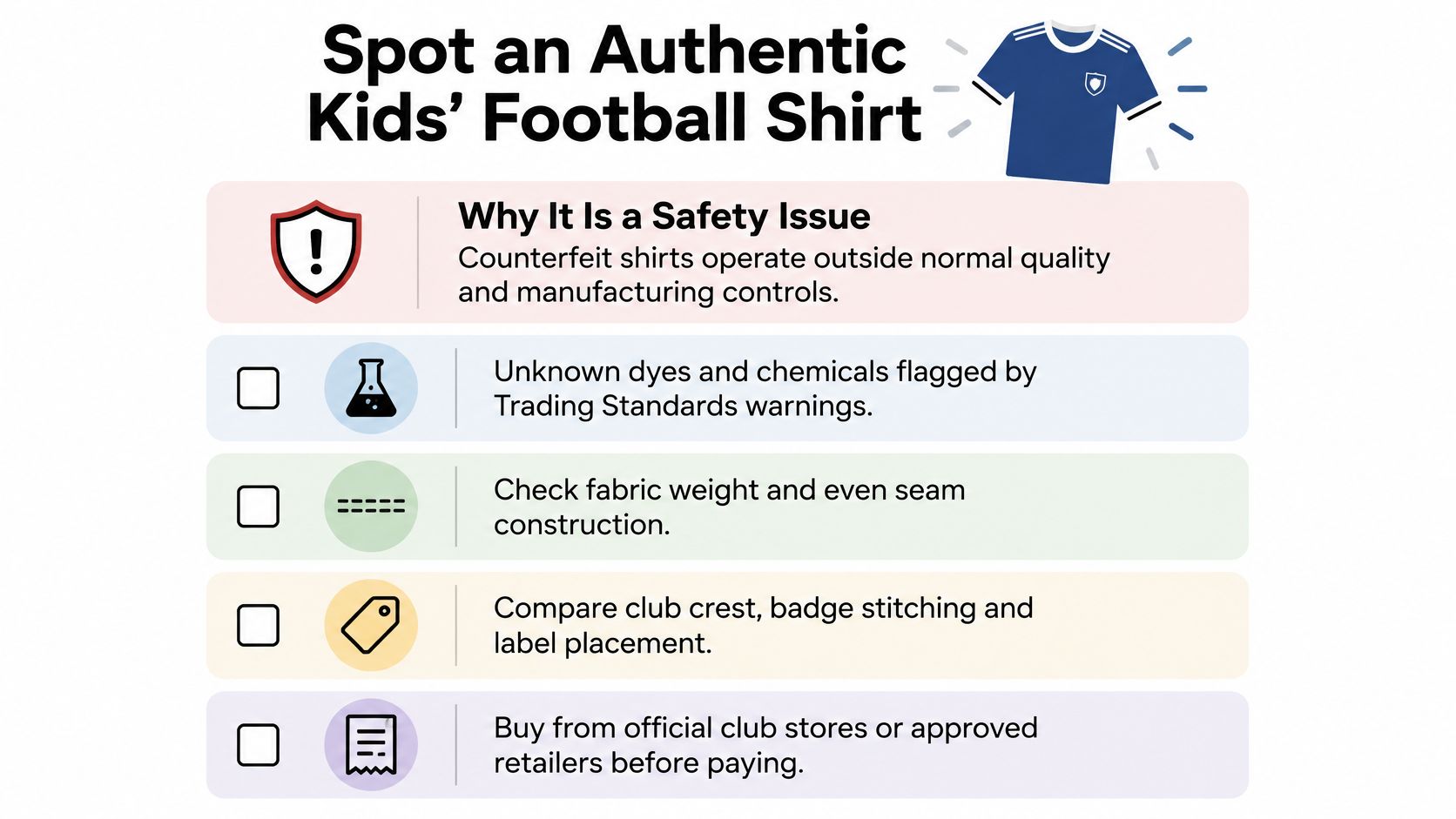
Provenance is the check that matters, the same way you would check any product that stays against skin for a full training session. A crest printed cleanly on the chest is only decoration until someone outside the seller has confirmed the garment. A clear HYDAWAY guide to third party verification shows why an outside check beats trusting the printing on the front. For a shirt, you run that check yourself before it ever reaches the drawer.
Six checks before the shirt goes in the drawer
- Seller. Buy from an established shop with real reviews and a returns policy you can use. A marketplace profile created last week, with three reviews, is not that shop.
- Price. Compare with normal retail for that season. A current-season kids' shirt at about a third of the usual price is a warning, not a bargain. Cheap copies shift the cost onto skin and onto a return you may never get.
- Labels. Look for a care label, product codes, and any hologram or authenticity tag the brand uses. Missing codes, or a label sewn in crooked, belong in the reject pile.
- Stitching and badges. Even seams, a crest that sits straight, sponsor lettering that does not bubble. Crooked crests are a classic counterfeit tell. Treat them as a failed identity check, not a small cosmetic flaw.
- Photos. For marketplace listings, ask for photos of the actual shirt, including the inside label. Catalogue images only mean you are buying a picture.
- First wash. Wash a new shirt on its own until you trust the fabric. If dye runs heavily, stop wearing it on skin and use the returns window.
Gift buyers have the hardest version of this job. They cannot try the neckline, and a low price is often the whole brief. Insist on a traceable seller and intact original tags, or do not send the shirt.
Safety Checks Every Kids' Kit Must Pass
Replica and fan kits are not competition-certified playing equipment. They still have a useful quality bar. FIFA's equipment regulations state that playing-kit clothing must not pose a risk of injury or illness through its shape, construction, or materials. IFAB Law 4 requires a shirt with sleeves and prohibits dangerous equipment. The same FIFA regulations say a shirt collar must close securely in a match and may not extend more than 5 cm downward from the front opening.
You can run the screen in about two minutes at the kitchen table.
| Check | Requirement | Why it matters |
|---|---|---|
| Sleeves | Shirt must have sleeves under IFAB Law 4 | Arms stay protected during falls and challenges |
| Collar | Must close securely and not extend more than 5 cm down from the front opening | Prevents snagging and keeps the neck construction safe |
| Seams and badges | Smooth inside, no rigid or abrasive decorations | Stops rubbing and skin irritation during play |
| Shin guards | Compulsory for matches and covered by socks | Protects the most exposed bone in a young player's leg |
| Overall fit | Room for a base layer without excess looseness | Loose fabric snags and interferes with running |
What to do with each row
Hold the shirt up and confirm both sleeves are real sleeves, not cap sleeves a referee could query. Fasten or overlap the collar and check the opening doesn't drop into a deep V. Run a hand inside the side seams and behind the badge. Anything that scratches your palm will scratch a child by half-time.
For matches, pair the kit with shin guards that match the leg, not the age on the packet, and pull the socks over them so the guards stay put. A winter base layer is fine if the shirt still lets the shoulders lift without the collar dragging.
The failure mode parents underestimate is buying two sizes up "so it lasts." An oversized shirt catches on a hand, flaps in a sprint, and becomes the thing the child fiddles with instead of watching the ball. Buy for this season with modest growth room, then re-check chest and height before the next registration. Measure the torso as well as the chest. Age labels on the packet are the least reliable number on the garment.
The Real Cost of a Kids' Football Kit
Sticker price is the wrong unit. SFIA's 2025 Team Sports Parents Insights Report found that U.S. households spent an average of $1,016 per child on their primary youth sport in 2024, a 46% increase since 2019. In that same parent survey, 94% rated durability and quality as an important influence on equipment purchases, and 94% rated affordability the same way. 90% said better value or lower prices would make purchasing easier. The shirt is one line in a bill that is already rising.
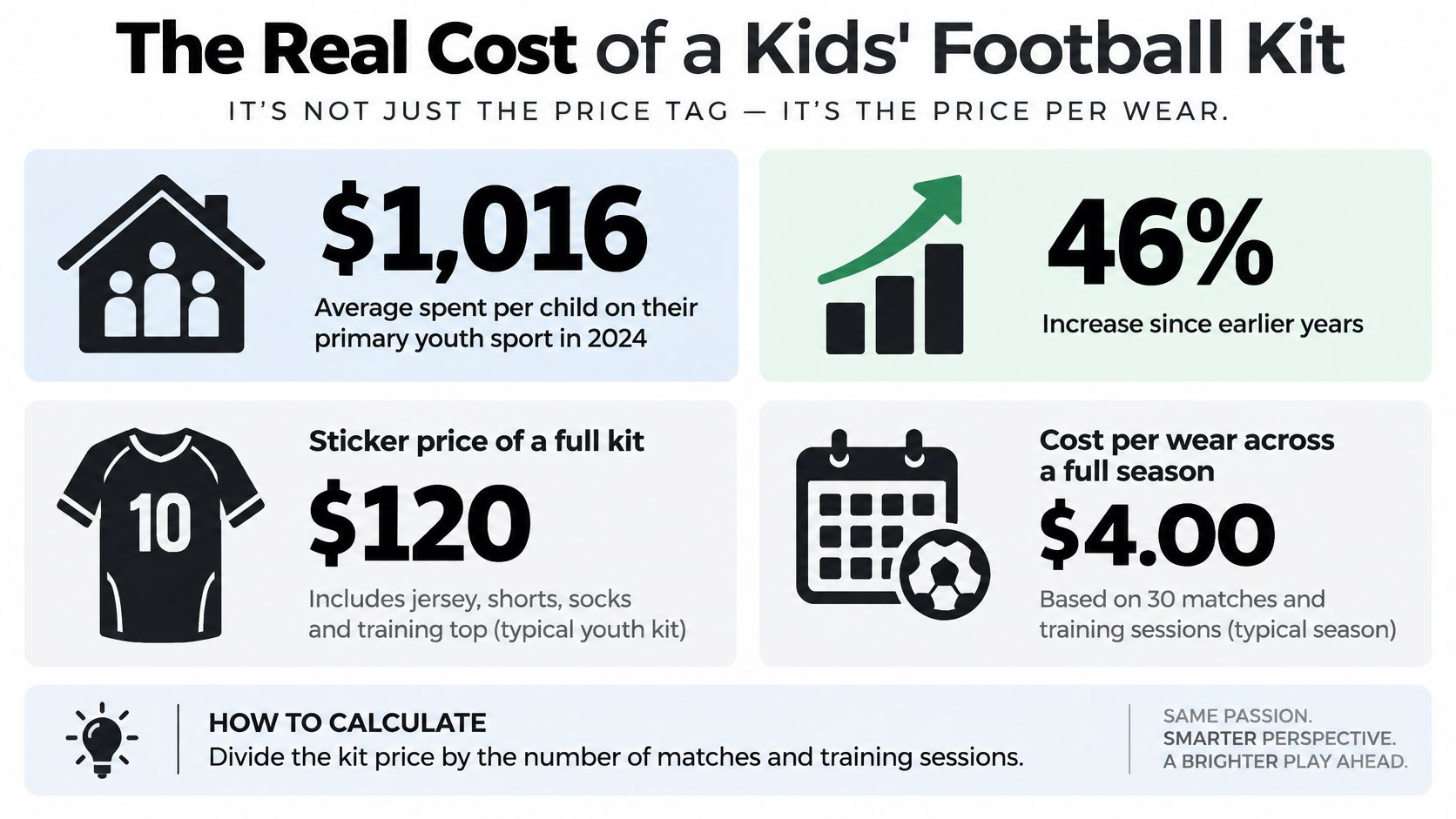
Those figures are U.S. household spending, not a global kit price. The decision still travels. Divide what you pay by the number of training sessions and matches you expect, then add the cost of replacing a shirt that peels, fades, or gets outgrown in six weeks.
Five questions that set cost per wear
Use frequency comes first. A shirt on a child who trains three times a week can justify a better knit than a birthday shirt worn once a month in the garden. The occasional shirt can be a simpler replica. The training shirt should be the one that survives the wash routine.
Growth stage is next. Stay with the current measured size and only modest extra room. Jumping two sizes to "save a future purchase" usually means a shirt that never gets worn properly, then a second purchase anyway.
Construction beats the lowest ticket. A cheap print that cracks after ten washes costs more per wear than a mid-price shirt that lasts the season. Count replacement, not just checkout.
What is already in the kit bag changes the basket. If shorts, socks, and guards fit, a shirt-only buy is the economical order. A full bundle only wins when those pieces are worn out or missing.
Second life is the last cut. A shirt that still has its badge and hasn't shrunk can go to a younger sibling or a local resale group. A peeled, dyed-out shirt cannot.
The cheapest shirt is rarely the most affordable once washing, growth, and a mid-season replacement are on the same bill.
Gifting and Team Orders Without the Guesswork
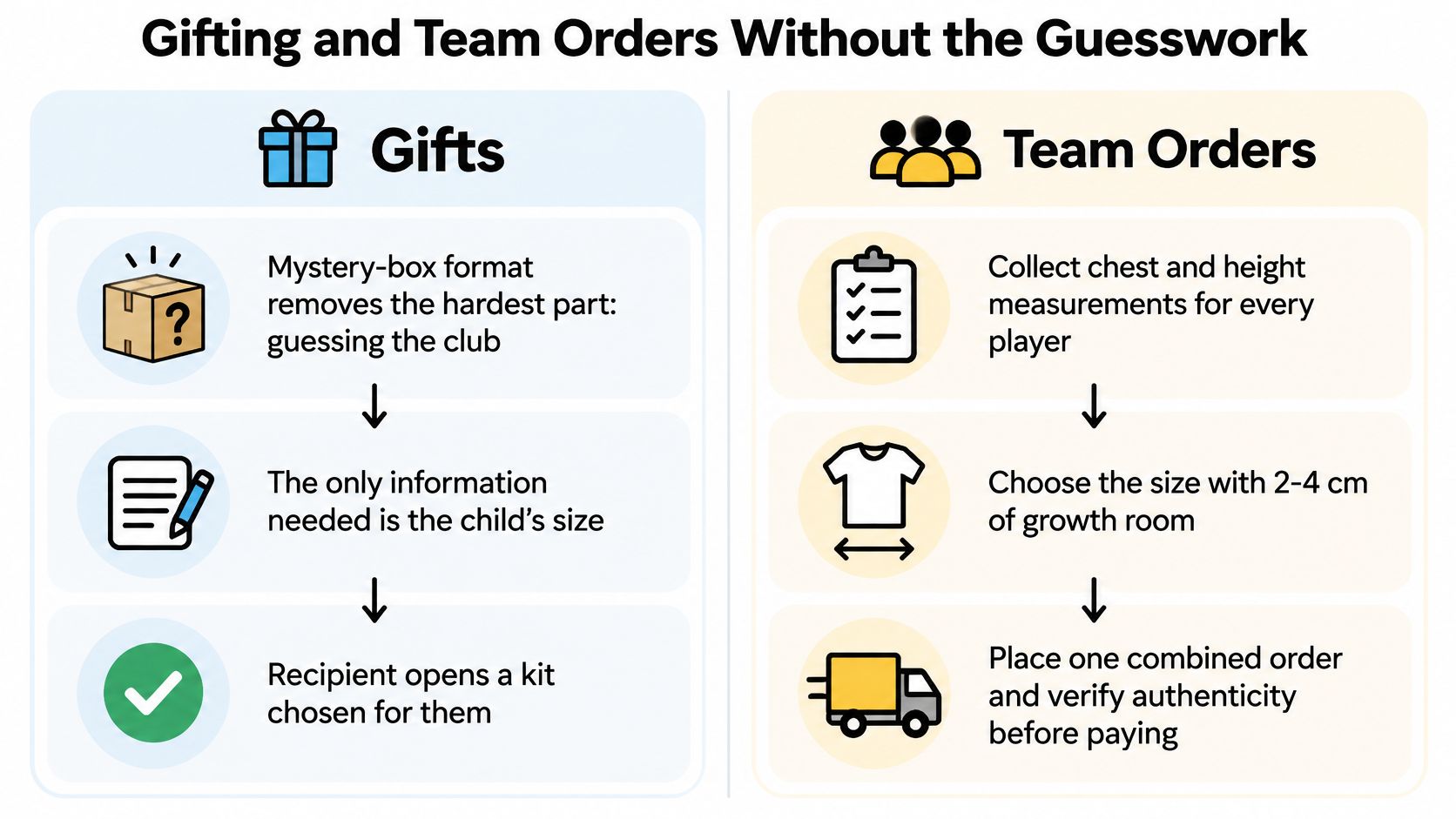
Two different jobs get mixed up in group chats. A gift needs one child's size and a list of clubs to avoid. A team order needs a roster of measurements and one delivery. Treat them as separate checklists.
A gift when you don't know the club
Guessing a child's club is the part that goes wrong, not the wrapping. A mystery-box format drops that guess. Each shirt is selected from a wide club collection, so the unboxing is a surprise, and a card in the box can explain who the club is. You still decide what must not arrive. We built the range as a more sustainable and more affordable way to get football shirts, and the customer still decides which shirts they do not receive.
Send the size range, plus clubs or colours to rule out. Don't send a demand for one exact team. Requests for specific shirts or teams to include in a box will be ignored, while avoid-lists are the control that works. If the child is between measured bands, use the larger of chest and height, the same way you would for your own child. Our notes on custom youth soccer uniforms help when a group wants matching kit instead of a surprise shirt.
A sharing box for a team or a friend group
- Fix a per-player budget before anyone opens a product page, so the thread doesn't drift into adult authentic prices.
- Collect measured sizes, chest and height, not ages. Mixed squads break here because kids' sizes end around 158 and several teenagers already need adult XS or S.
- Have every family list clubs and colours to avoid. That is how you stop a rival shirt landing in the wrong bag. Specific-team wishes are not the lever. The avoid-list is.
- Place one grouped order and track a single delivery. One parcel is easier to chase than twelve.
- Hand the boxes out at training. A shared unboxing is the moment the shirts become a team thing rather than a courier notification.
Tell parents, plainly, that the club inside is a surprise from the collection. The honesty up front prevents the "but I asked for City" argument on the touchline.
Choose the Right Kit for Your Young Player
Measure chest and height, pick the size with a little growth room, check fabric and seams, confirm the shirt is traceable before you pay, and judge the price by wears, not by the banner. That path doesn't change. The next click does, depending on who you are buying for.
One favourite-club shirt. Order the current measured size from a seller with a real returns policy. On arrival, read the care label and product codes, then wash inside out from the first cycle. If the collar gapes or a seam scratches, send it back before the child wears it to training.
A growing fan or a birthday. A kids' mystery box is the lower-risk route when you know the size and not the club. The Kids Football Shirt Mystery Box costs €69,95 in sizes 128–158, includes a 100% authentic football shirt from any club around the world, and is labelled 1+1 Free. Put the size and the avoid-list in the order, and read the returns window before you pay. Labels should still be on the shirt.
A team or a friend group. Gather measurements and avoid-lists, lock a per-player budget, place one order, and give the boxes out at training. Once the shirts exist, a simple rondo or a small sided game session ideas plan gives the new kit a job in the first session, which is when children decide a shirt is "theirs."
Before any of those routes, confirm three things in writing. The returns window, the size range the listing covers, and how authenticity is shown, whether that is original labels or a seller you can trace. Those three decide whether the order is safe. The discount line does not.
A short look at how a season of shirts gets used on the pitch makes the "cost per wear" idea concrete.
Mystershirt sends authentic football shirts in mystery boxes, including kids' sizes, so you can kit a young player without paying full replica prices for every surprise. You choose the size and the clubs or colours to avoid, and each shirt arrives as an official product with its story on a card. Visit Mystershirt to pick a kids' box or a sharing box for the group.


