

The boots are in the cupboard, worn twice. The expensive ball with the shiny finish went flat in August. The shirt, though, the one you nearly didn't buy because it seemed too simple, gets worn to school on non-uniform day and to bed on match nights. Most soccer gifts fail in the corner of a bedroom, and they fail for boring reasons: the wrong size, the wrong surface, the wrong club, or a product that only matters if the boy turns out to be a different player than he is.
Judge every soccer gift by one question only: will he still be using it after a season? That test kills plenty of impressive-looking presents and rewards a few unglamorous ones. The rest of this guide applies that test to balls, shirts, shin guards, cleats and the smaller stuff, with the sizes and standards you need before you pay.
Table of Contents
- Quick-Pick Soccer Gifts by Age and Interest
- Matching Ball Size to Age and Weight
- Choosing the Right Shirt for His Club and Fit
- Shin Guards and Cleats Worth Buying
- When a Surprise Shirt Beats a Chosen One
- Comparing Gifts by Budget and How Long They Last
- Gifts for Beginners, Teammates and Siblings
- Confirm the Gift Before You Buy
Quick-Pick Soccer Gifts by Age and Interest
Four rows answer most of the question before you read anything else.
| Age band | Typical interest | Gift to consider | Check before buying |
|---|---|---|---|
| Under 7 | Plays for fun, copies favourite players | Light size 3 ball and a simple pump | Ball is light enough to control with his feet |
| 7 to 10 | Joins a team, watches matches | Fan shirt in the right size, or a training ball | Shirt sized for growth; ball size matches age, size 3 under about 9 and size 4 from 9 to 11 |
| 11 to 13 | Trains with a club, has a favourite player | Named shirt, shin guards, turf-style boots | Gear fits and the model suits the pitch type |
| 14 and older | Plays regularly, collects shirts | Adult-size authentic shirt, training gear or signed item | Adult fit confirmed; shirt is genuinely authentic |
Use the age band as a starting point, not a rule. A 9-year-old who trains four evenings a week needs gear that behaves like an older player's, and a 13-year-old who has never joined a club gets more from a ball and a shirt than from boots.
Interest matters just as much, because it tells you which category to shop in. A boy who collects shirts wants something to wear and show off. A boy who plays wants something he can use until it wears out.
Three questions settle the choice in under a minute:
- How often does he play? Twice a week at a club, or kickabouts in the garden.
- Does he follow one club or one player? A fixed favourite makes a shirt an easy win.
- Will he outgrow it within a season? If yes, buy smaller and cheaper, and put the money into something that lasts.
If several boys are celebrating together and you want the party to be the gift, what bubble soccer involves is worth reading before you book anything. Find the age band, then the interest, and let those two pick the category. Everything below is about getting the details inside that category right.
Matching Ball Size to Age and Weight
The ball is the soccer gift bought wrong most often, because shoppers pick by look and price rather than by measured size and weight.
| Ball size | Circumference | Weight | Typical age |
|---|---|---|---|
| Size 3 | 60 to 62 cm | 280 to 310 g | Under about 9 |
| Size 4 | 63.5 to 66 cm | 350 to 390 g | U9 to U11 transition |
| Size 5 | 68 to 70 cm | 410 to 450 g | About 13 and older |
The age label on the box isn't the specification. Circumference and mass are, and they have to be checked together, as the football size guide published by Playo sets out: a youth ball's reduced mass lowers the force needed to control, pass and strike it, which is exactly why a smaller player develops faster with one. Hand a 7-year-old an adult-weight size 5 and his first touch turns into a battle with the ball.
Three checks before you pay
- Look up his league's ball rule. Some programmes use a lighter size 4 or size 5 during the transition rather than jumping straight to the adult weight. A gift that breaks the rule sits in the bag on match day.
- Match the ball to his level, not the calendar. A tall 8-year-old in his first season still benefits from a size 3 he can manipulate. A small 11-year-old training three times a week is ready for size 4.
- Reject the heavy practice ball. A durable training ball with the right circumference but excess weight undermines first-touch practice and tires him out before the session ends.
If he sits between sizes, buy the lighter option for the garden and confirm the league ball separately for matches. Two correct balls beat one wrong one.
Practical rule: weight before graphics. A plain ball at the right mass gets used every day; a premium ball at the wrong mass gets used once.
Choosing the Right Shirt for His Club and Fit
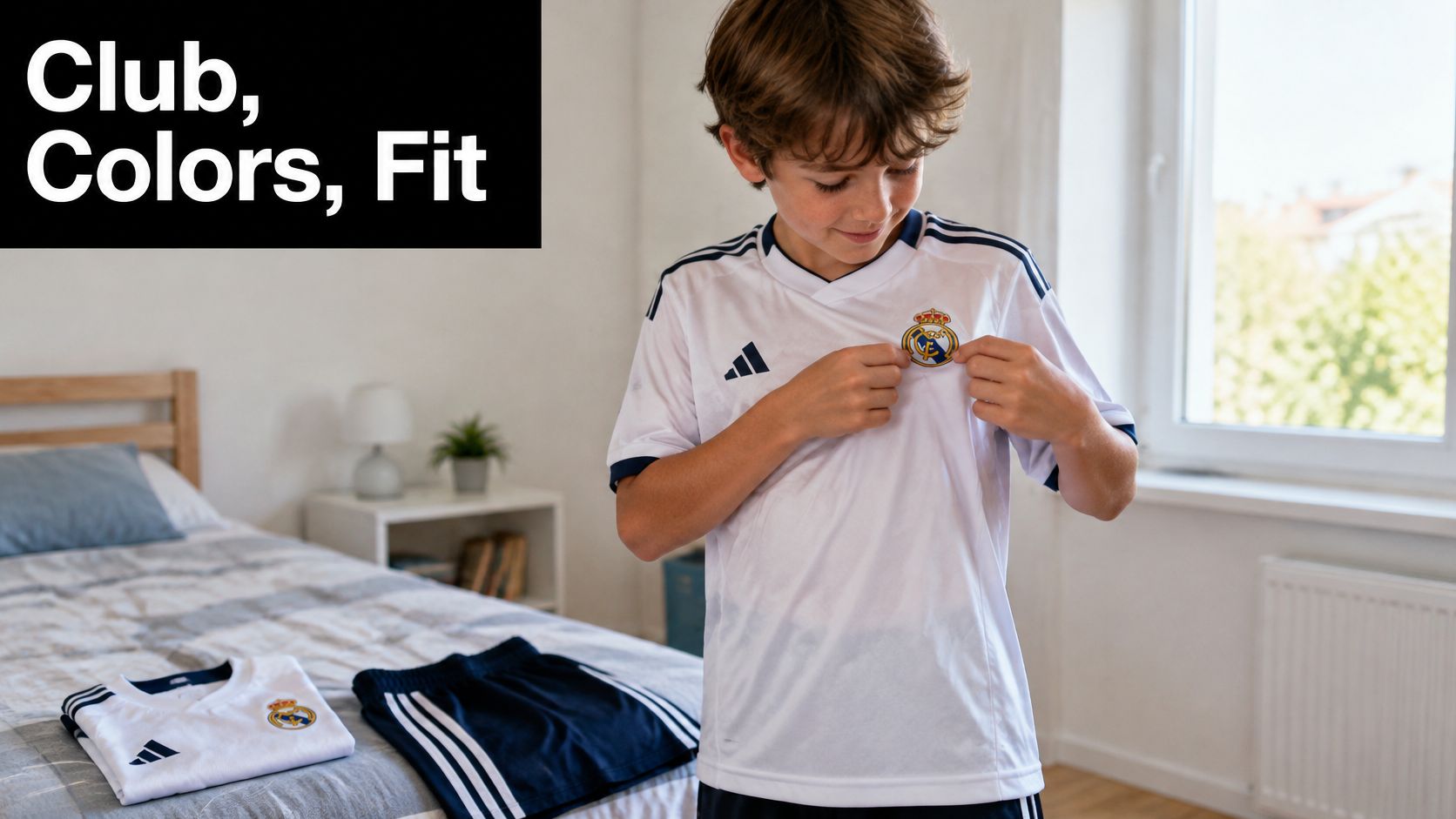
A shirt is the gift with the longest useful life in this whole guide, provided you get three things right: club, size and authenticity. Get them wrong and it hangs unworn with the tags on.
The category itself was built for children. Academic research published by the University of Warwick Press records that Umbro began selling child-sized kits directly to individual customers in 1959 rather than only to youth clubs, and that an official Leeds United replica shirt went on public sale at Elland Road on December 22, 1973, in children's sizes only. The same research found that 63% of surveyed supporters had owned a child-sized replica shirt, which tells you how deep that habit runs.
Three shirt choices that decide whether he wears it
The current club kit suits the boy who watches one team every weekend and knows the squad. A retro design from a classic season suits the boy who likes patterns nobody else at school has. A named shirt with a player's number suits the boy who copies one player's celebration in the garden.
If he picks players by fantasy football returns rather than by loyalty, Arsenal FPL player statistics show how form and minutes shift through a season, which is a useful check before you commit a name to a shirt he'll wear for two years.
Sizing is where most shirt gifts go wrong. Too large and it reads as a costume, so allow a little room to grow and no more. Measure his height and chest against the brand's chart, and use our youth jersey size chart when the label is unclear.
How to spot a copy sold as authentic
Check the crest first: a clear, properly stitched badge with straight edges. Then the inner label, which should carry size and batch detail. Be sceptical of any price far below the official range, especially on a shirt described as new-season. And remember the simplest test of all: ask what he watches on a Saturday, then buy that club rather than the one that looks popular online.
Shin Guards and Cleats Worth Buying
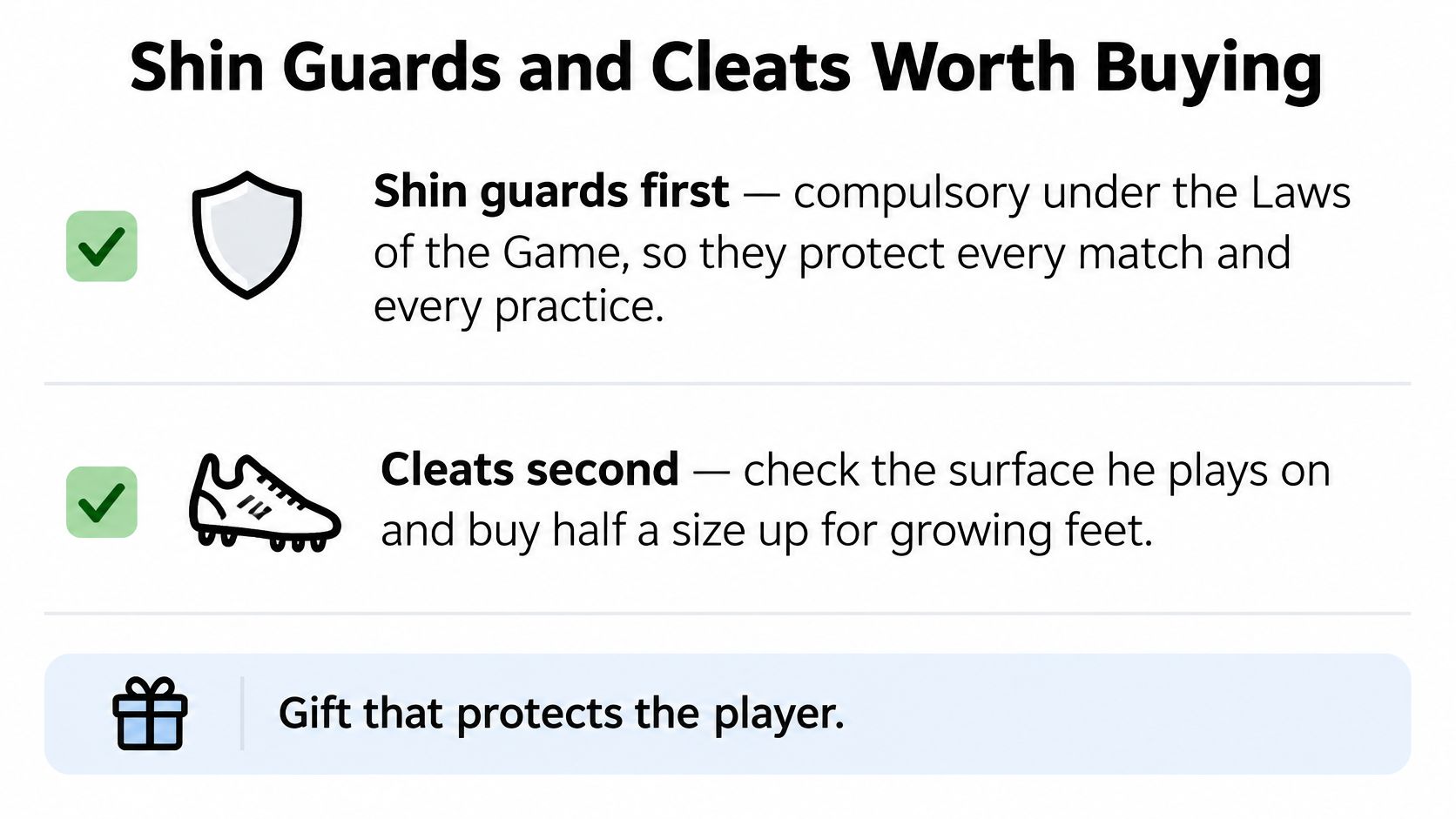
Protective gear outranks any decorative accessory, because shin guards are compulsory under the Laws of the Game. A boy without them doesn't play, so the gift has an immediate job.
Fit decides whether they stay on. The guard should run roughly from below the knee toward the ankle, cover the shin, and leave ankle and knee free to move. Two failures repeat constantly: guards that are too large slide down mid-run, and guards that are too small leave the tibia exposed, at which point the child takes them off and the protection is zero.
Fitting shin guards so he keeps them on
The American Academy of Pediatrics position paper on soccer injuries in youth makes the same point about coverage and certification, and it's blunt about what a label can and cannot promise. Look for a recognised safety mark, such as NOCSAE certification where it applies, or the relevant national or European standard. Those standards reduce lacerations, contusions and punctures. They do not guarantee protection against every fracture, and no honest sales pitch should claim otherwise.
Cleats come second, and the surface decides the model before size or colour. The AAP review links bladed studs with greater lateral-foot pressure than rounded studs in some studies, and systematic-review evidence identifies turf-style footwear as the more protective option for repetitive impacts on artificial surfaces.
- Confirm the pitch type he plays and trains on most.
- Measure his lower-leg length for guard sizing, and his foot in the socks he wears.
- Check the certification label inside the guard.
- Test before match day. Ten minutes of running in the garden shows whether anything shifts.
That last step saves a mid-match complaint and a pair of guards abandoned in a bag. If you want a second opinion on what belongs in a kit bag, this short round-up is a fair summary of the essentials.
When a Surprise Shirt Beats a Chosen One
Everyone assumes the chosen shirt is the safe gift. It isn't always. A chosen shirt he already owns, or one from a club he's gone off since last season, lands worse than a surprise he didn't expect.
The shirt market explains why the surprise option has room to work. A market forecast puts global football-jersey consumer spending at $5.22 billion in 2025, rising to $8.97 billion by 2034 at a projected 6.2% compound annual growth rate, with replica fan jerseys at roughly 60.0% of that spending, as Versus reports on the football shirt market. A shirt is a cheap way to buy into a global culture, and an unfamiliar badge is part of the appeal.

A surprise suits the open-minded boy, and it suits the gift-giver who doesn't know which team he follows. It's a poor fit for the boy who has one club tattooed on his personality. That's where the surprise gift box approach works best, and it's how our own boxes work: each shirt is drawn from a collection of clubs, so every order is a surprise, and specific team requests are ignored by design. You still choose what you'd rather not receive, which keeps the surprise affordable and avoids duplicates.
A quick test before you decide: ask whether he has a fixed favourite club or player. Fixed answer, buy direct. Shrug or a list of five teams, let the surprise do the work.
Comparing Gifts by Budget and How Long They Last
Price tells you almost nothing about value here. Duration of use does, and the parents surveyed for the 2025 Team Sports Parents Insights Report from the Sports & Fitness Industry Association seem to agree: 94% weighed product quality and durability alongside affordability, 86% said the child's own preferences shape the purchase, and 90% wanted better value. Separate 2025 consumer tracking in the same report found 59% of parents with sports-playing children spent nothing on sports equipment in the first quarter, up from 50% in January. Budgets are tight, and a gift that dies in one season is the most expensive kind.
| Gift | Useful after one season | Outgrow risk | Best for |
|---|---|---|---|
| Fan shirt in the right size | Yes, worn casually | Medium, check size | Boys who follow a club or player |
| Training ball in the right size | Yes | Low when size matches age | Boys who practise at home |
| Shin guards | Yes, if fitted correctly | Medium, as legs grow | Every player in matches |
| Cleats | Often, if the surface matches | High, feet grow quickly | Players with a fixed playing surface |
| Signed or novelty item | Yes, as display | Low | Collectors and occasion gifts |
Read the outgrow column. Cleats carry high risk and earn their place only when the size is confirmed and his feet are growing slowly; a training ball or a fan shirt is the lower-regret purchase almost every time. Kit prices climb quickly once you're buying branded boots and full strips, which is where a breakdown of soccer kit prices helps you see what you're paying for.
A shirt he wears to school for two years delivers more use per pound than boots he outgrows in one season. Cost per wear is the only price comparison that matters.
The rule that comes out of this: a correctly sized, durable item he chooses and wears repeatedly beats a technically advanced item he never touches. The most performance-oriented product in the shop is not automatically the best gift.
Gifts for Beginners, Teammates and Siblings
Participation is the part gift guides skip. Outdoor soccer in the United States reached nearly 16 million players in 2025, including about 5.5 million children aged 6 to 12, yet U.S. Soccer has reported that roughly 70% of children quit by age 14, with the sharpest drop-offs in underserved communities, as reporting on the youth soccer participation gap sets out. A gift can nudge a boy toward staying, or it can signal that the sport costs more than his family can justify.
That's why I separate two jobs a gift can do. Signalling belonging is a shirt, a scarf, a team-related item. Equipping play is a ball, shin guards, training cones. Neither is better, but they solve different problems, and conflating them pushes families toward spending they can't sustain.
For a beginner, a light training ball plus one simple team item does more than expensive boots. He can practise in the garden with either, and nothing needs breaking in.
For a teammate, a shared box or a team ball works well as a group gift, and it spreads the cost across several families. A matching item for a team celebration does the same job socially without asking anyone to spend big.
For a sibling, a good-condition hand-me-down shirt is a real gift, not a concession. It costs nothing, it carries a story, and it removes the awkwardness of one child receiving new kit while the other watches.
Durable, reusable and shared gifts matter most where club fees and travel costs already stretch a household. A well-chosen present should lift a boy's participation, never imply that gear determines his commitment or his talent.
Confirm the Gift Before You Buy
The whole decision collapses to one action: pick his age band from the first table, confirm the size and the surface, and then commit to a category. Most bad soccer gifts for boys come from skipping that order and shopping by what looks impressive instead.
If you've landed on a shirt for a younger boy, we sell a Kids Football Shirt Mystery Box for children in sizes 128 to 158, containing a 100% authentic football shirt in the right size. For an older boy, the Premium Football Shirt Mystery Box carries sizes XS to 5XL and holds one authentic shirt from a recent season, from a club anywhere in the world. Where his favourite player is the whole point, the Premium Football Shirt with Name and Number Mystery Box, at €54,95 in sizes XS to 5XL, prints a real player's name and number on the back.
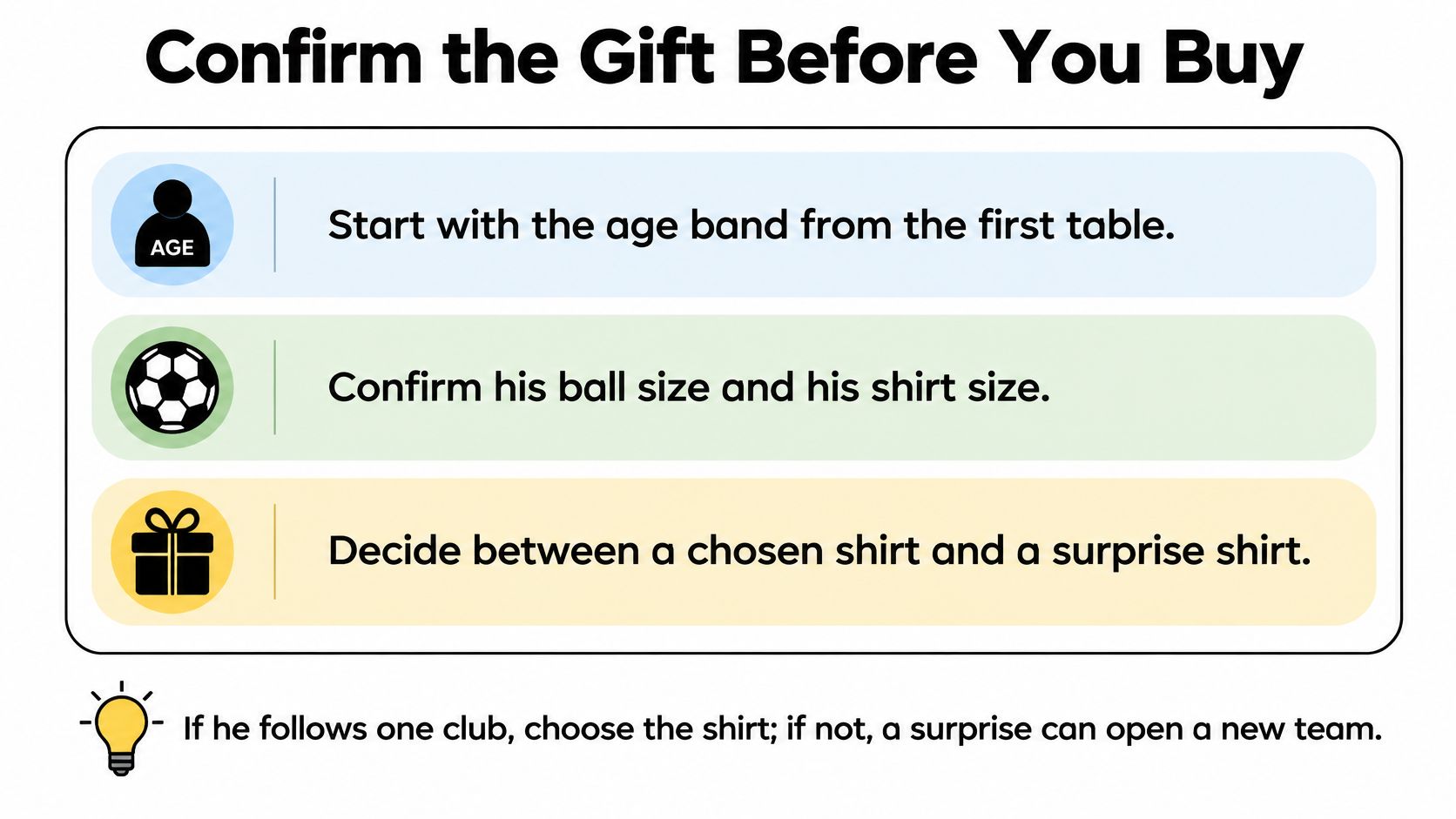
Two checks before you order. Confirm the size against his current measurements rather than the age on the label. Then decide whether he's the boy who needs the club to be right, in which case buy it directly, or the boy who enjoys the unknown.
Decision rule: if he follows one club, choose the shirt. If he doesn't, a surprise can hand him a new team.
Pick the age band, confirm the size, then choose the category and buy. That's the sequence, and it's the reason the shirt you nearly didn't buy ends up being the one he wears twice a week.
Mystershirt exists for the boy who'd rather unwrap a real football shirt than another gadget, and for the gift-giver who doesn't want to guess a club wrong. Every box holds a 100% authentic shirt in your chosen size, drawn from clubs around the world, with labels intact and a card explaining who the club is and why the shirt matters. Pick the Kids box for sizes 128 to 158, the Premium box for XS to 5XL, and visit Mystershirt when you're ready to order.


