
International express shipping typically takes 1–5 business days on premium air services, but most cross-border parcels arrive in a wider 2–7 day window. What you can control, and what customs controls, is the true story behind the delivery estimate.
You've ordered something from another country, received a tracking number, and now the status seems frozen. The parcel may have crossed a border, reached an airport, or be waiting for a customs scan, while the delivery date on the checkout page starts to feel less convincing.
The short answer to how long international express shipping takes depends on the route, service tier, origin cutoff, customs process, and final-mile network. Express means the carrier prioritizes the shipment through an air-based network. It doesn't mean every international parcel arrives on the same day, or that customs and local delivery are fully predictable.
Table of Contents
- What International Express Shipping Means
- How the Major Express Carriers Compare
- The Five Stages That Make Up Your Delivery Time
- Realistic Timelines by Route and Region
- Why Express Parcels Still Miss Their Window
- Reading Tracking Updates and ETAs Correctly
- Practical Ways to Speed Up Your Delivery
What International Express Shipping Means
You place an order overseas, receive an express tracking number, and see a delivery promise that sounds simple. In practice, that promise covers several connected handoffs, not just the aircraft's journey. The parcel must leave the sender, clear export controls, cross the border, pass import checks, and reach the final-mile courier.
International express shipping is a premium cross-border service built to coordinate those steps from the sender's address to the recipient's door. Carrier guidance commonly places express delivery within 1–5 business days, but the route, service tier, destination, and customs process shape the actual result. Fast FedEx air options can take 1, 2, or 3 business days, while economy express can take 2–5 business days, according to International shipping guidance. Published examples also place DHL Express Worldwide at 1–4 business days and UPS Worldwide Expedited at 2–5 business days, depending on the lane.
The aircraft may spend only part of that window in transit. Pickup, export paperwork, airport handling, customs review, and local delivery can consume the rest. Express therefore pays for priority movement, more structured tracking, and a coordinated door-to-door service, rather than only a faster flight.
What the service includes
A typical shipment moves through these checkpoints:
- Pickup: The carrier collects the parcel and records its first network scan.
- Export handling: Staff process the documents and security requirements.
- Line-haul: The parcel travels by air toward the destination country.
- Customs clearance: Import authorities review the goods, documents, and applicable requirements.
- Last mile: A local courier takes the parcel to the recipient.
Practical rule: “Express” describes a service level, not one universal arrival date.
A carrier may commit to a delivery time for a particular service and route, with exclusions for weather, customs action, incomplete addresses, and other events outside its control. Those exclusions can affect whether a refund or credit applies. Before ordering, check the destination estimate and shipping conditions in the international shipping guide, rather than treating “express” as a fixed promise.
How the Major Express Carriers Compare
A parcel sent from a major city to another major hub may receive frequent departures and direct handling. The same carrier can produce a different experience for a rural postcode, where a regional partner completes the final delivery. FedEx, UPS, and DHL serve many of the same international trade lanes, so their advertised windows often overlap. The practical comparison is the route behind the label, not the brand name alone.
FedEx International Priority, UPS Worldwide Express services, and DHL Express Worldwide generally target premium delivery within one to five business days, with faster results on major lanes. FedEx's international guidance lists one to three business days for its fastest air options and two to five business days for economy express. Carrier performance still depends on the lane, handoff, and selected product, as described in the international transit guidance.
| Carrier | Service | Door-to-door window | Day-definite guarantee | Included customs clearance |
|---|---|---|---|---|
| FedEx | International Priority | Often 1–3 business days on major lanes | Depends on service and lane | Commonly arranged within the express service |
| UPS | Worldwide Express or Expedited | Often 2–5 business days, depending on service | Depends on service and lane | Commonly arranged within the express service |
| DHL | Express Worldwide | Often 1–4 business days | Depends on destination and selected service | Commonly arranged within the express service |
| Regional carriers | DPD or Aramex services | Varies by region and handoff | Varies by product | Depends on the destination network |
The details buyers often miss
Customs brokerage affects speed because the carrier or appointed broker must interpret the commercial invoice, product description, classification, and import requirements. Tracking detail also varies. Some networks scan parcels at many facilities, while others show few updates during air movement. Delivery timing can include morning or Saturday options in selected markets, but the route and product determine whether those services are available.
The network's hub structure matters too. FedEx uses major gateways such as Memphis and Paris, UPS operates large facilities including Louisville and Cologne, and DHL runs significant international gateways such as Leipzig and Hong Kong. These hubs do not guarantee an arrival time. They help explain why major-city routes often have more frequent service than remote destinations.
Price needs the same route-level check. If a low-cost express label sends a parcel to a rural address through a less predictable local handoff, the delay can outweigh the saving compared with a tracked premium service on the same route. For commercial orders or packaging-heavy shipments, use this guide to compare courier rates for bulk packaging while checking the delivery window, tracking coverage, customs process, and final-mile partner.
The Five Stages That Make Up Your Delivery Time
The parcel's flight is only one part of the journey. Industry guidance separates airport-to-airport movement, often benchmarked around 24–72 hours, from fully door-to-door express service, which can take 2–4 business days on major routes. Air freight transit guidance also notes that customs can add anything from a few hours to as much as 2 weeks in exceptional cases.
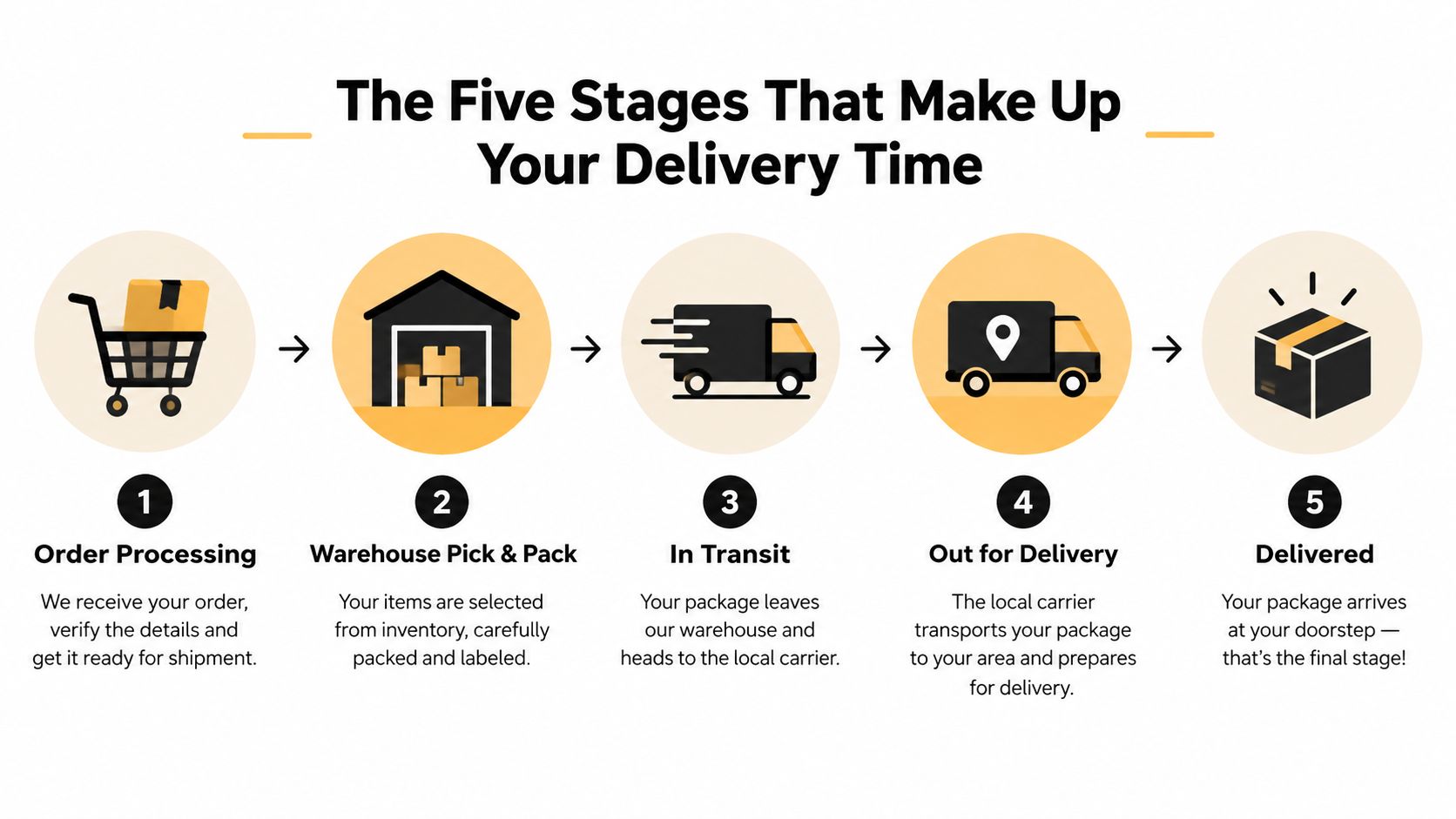
The journey in order
-
Pickup and origin handling
The courier collects the parcel, weighs or verifies it, and moves it into the export network. A shipment can appear inactive here if it misses the local collection cutoff or waits for the next scheduled dispatch. -
Export documentation and screening
The carrier checks the commercial invoice, description, classification details, and security information. Missing or inconsistent information can stop the parcel before it reaches the aircraft. -
Air line-haul
This is the part you might imagine when you hear “express.” The parcel travels toward the destination gateway, but it may also wait for a scheduled sort, connection, or hub transfer. -
Import customs and clearance
Customs officers and the carrier's brokerage team review the shipment. Routine clearance may be quick, while an inspection, unclear description, duty question, or restricted item can extend the wait. A clear explanation of the customs clearance process is useful when a tracking scan changes from transit to review. -
Last-mile delivery
After release, the parcel moves from the import hub to the delivery depot and then to the recipient. Rural addresses, limited delivery schedules, and an unavailable recipient can add another handoff.
The practical lesson is simple. The aircraft rarely controls the entire delivery time. The surrounding handoffs, especially customs and the destination network, usually create the widest variation.
Realistic Timelines by Route and Region
A parcel leaving a major European city may move through frequent direct connections. One entering a remote destination may need a feeder service after the international flight. The express brand can be identical, but the route controls the practical range.
Use these route examples as planning ranges, not promises. Route-based international shipping estimates places Europe-to-Europe shipments at 1–3 days, Europe-to-North America at 2–5 days, Asia-to-North America at 3–8 days, and routes involving South America, Africa, or Central Asia at 5–12 days.
| Origin | Destination | Typical business days | Notes |
|---|---|---|---|
| Europe | Europe | 1–3 | Major hubs are usually faster than peripheral destinations |
| Europe | North America | 2–5 | Customs and the final-mile network can change the result |
| Asia | North America | 3–8 | Inland origins and extra hub transfers may extend transit |
| Major international hubs | Major international hubs | 1–5 | Premium services generally perform best on direct lanes |
| South America, Africa, or Central Asia | International destinations | 5–12 | Secondary gateways and local handoffs often add variability |
Why the same service produces different results
Airport access changes the route before the parcel ever reaches the aircraft. Major gateways offer more departures, direct connections, and brokerage capacity. A remote postcode may require an additional road or air transfer after customs release, so the final handoff can take longer than the flight.
Origin cutoff times create another timing trap. A service described as “one day” generally starts from the carrier's accepted shipment date, not from the moment the order is submitted. If the parcel misses the origin city's collection cutoff, the carrier may process it on the next business day. Cutoffs can also differ between cities because collection schedules and export departures are not identical.
That distinction matters when comparing global shipping options. An order placed late in the week may wait for the next export cycle, even when the selected service is express. The displayed service window describes the planned transport, while the actual calendar also depends on acceptance time, route frequency, customs release, and the destination network.
Why Express Parcels Still Miss Their Window
Premium shipping reduces transit time, but it doesn't remove uncertainty. The IPC 2025 shopper survey found that more than half of cross-border orders arrived within 2–7 days, while the most common reported windows were 4–5 days at 19% and 10–14 days at 20%. Only 7% took 15 or more days, compared with 29% in 2020, according to IPC's cross-border e-commerce shopper survey.
Those figures describe cross-border delivery outcomes rather than one carrier's narrow express promise, so they shouldn't be treated as a direct express-service pass rate. They do show why a single brochure estimate doesn't describe the full distribution of real deliveries. Some parcels arrive quickly, while others spend extra time at customs or in local delivery networks.
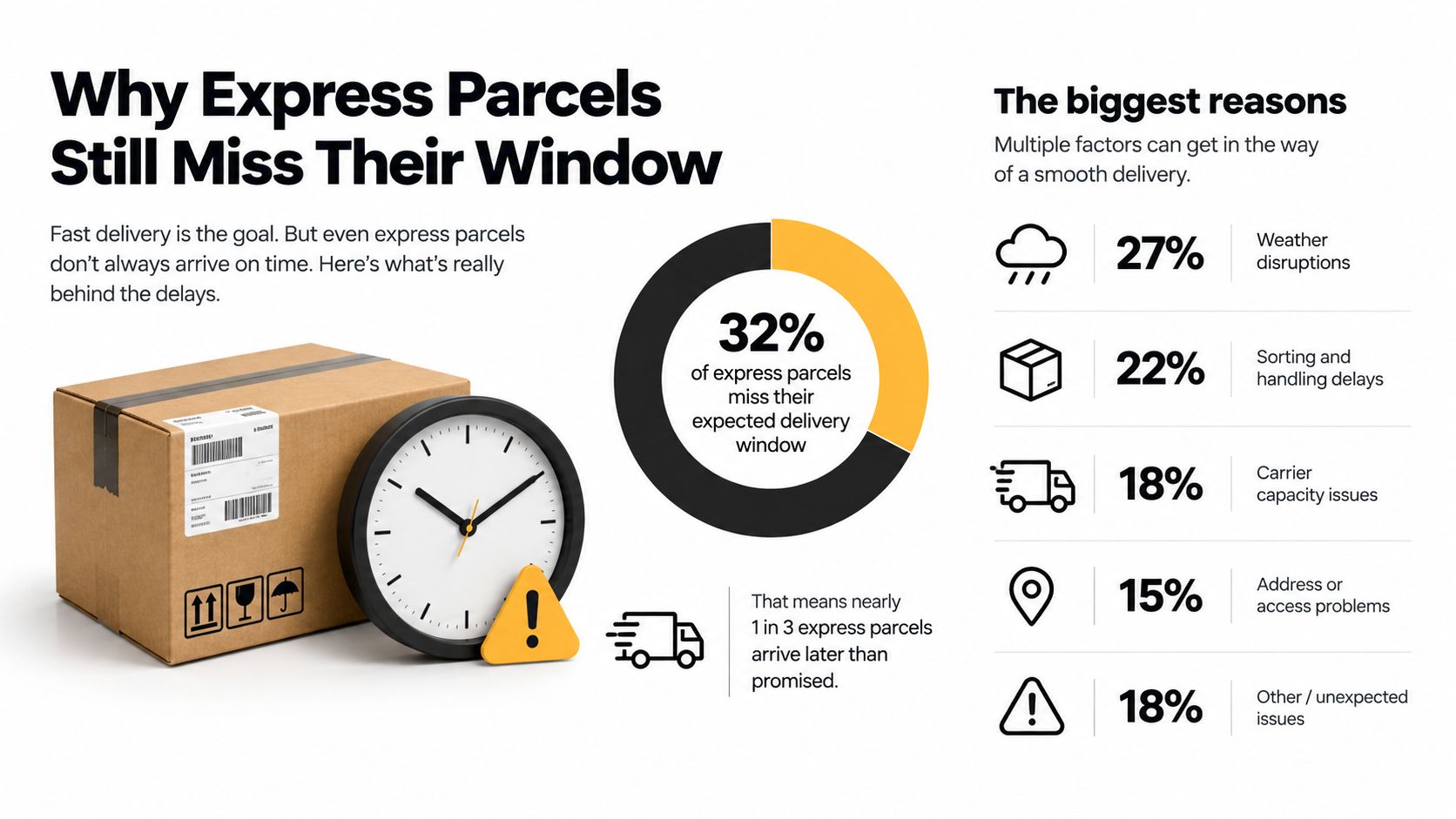
What causes the delay
Some causes sit within the carrier's operating process:
- Missed connections: A late pickup or delayed sort can push the parcel onto the next departure.
- Airport congestion: A hub may need to process large volumes before the shipment moves onward.
- Capacity changes: The carrier may reroute or reassign shipments when planned transport changes.
- Address problems: An incomplete apartment, postcode, or phone number can prevent final delivery.
Other causes sit outside the carrier's direct control:
- Customs inspections: Authorities may select a parcel for additional review.
- Duty or classification questions: A vague product description can create a clearance hold.
- Weather and security events: Conditions at an airport or along the route can affect the wider network.
A delivery guarantee also isn't the same as automatic compensation. Claims may require a formal request, and exclusions can apply to customs delays, incorrect addresses, weather, or other external events. If your tracking page shows an unusual scan, this explanation of delivery exception meaning can help you distinguish a routine update from a genuine intervention.
Reading Tracking Updates and ETAs Correctly
Tracking pages often look precise because they display dates and named facilities. The data is useful, but each scan represents a stage in the network, not a promise that the parcel is moving continuously.
“Shipment information received” usually means the label exists, but the carrier may not have the parcel yet. “Picked up” confirms physical acceptance. “Departed origin facility” means export movement has started, while “arrived at destination country” means the parcel has reached the country or a gateway associated with it, not necessarily the local delivery depot.

Read the estimate as a moving calculation
An estimated delivery date can change as the carrier receives new scans. A quoted service date may represent the carrier's stated commitment for that product and route, while an estimate recalculates around actual events. Those two dates can differ without meaning that the parcel is lost.
Customs-related scans deserve closer attention. “Customs clearance delayed” or “held at customs” indicates that import processing needs more time. “Address incomplete” points to a recipient-side correction, while “awaiting pickup” after a delivery attempt can mean the parcel is waiting at a facility rather than continuing toward the door.
A clearance delay may move the projected arrival by 24–72 hours, even when the parcel itself is safe and correctly routed. That range reflects the operational effect of a hold, not a universal rule for every shipment.
A quiet tracking page isn't automatically bad news. Long-haul movement often produces fewer scans than pickup, customs, and delivery stages.
If the parcel has shown no meaningful movement for more than 48 hours, contact the sender first. The sender can often open a carrier investigation or correct shipping information more effectively than the recipient acting alone. Keep the tracking number, order ID, full delivery address, and recipient phone number available. Guidance on customs handoff tips can also clarify why a parcel may appear to pause between international transit and the local carrier.
Practical Ways to Speed Up Your Delivery
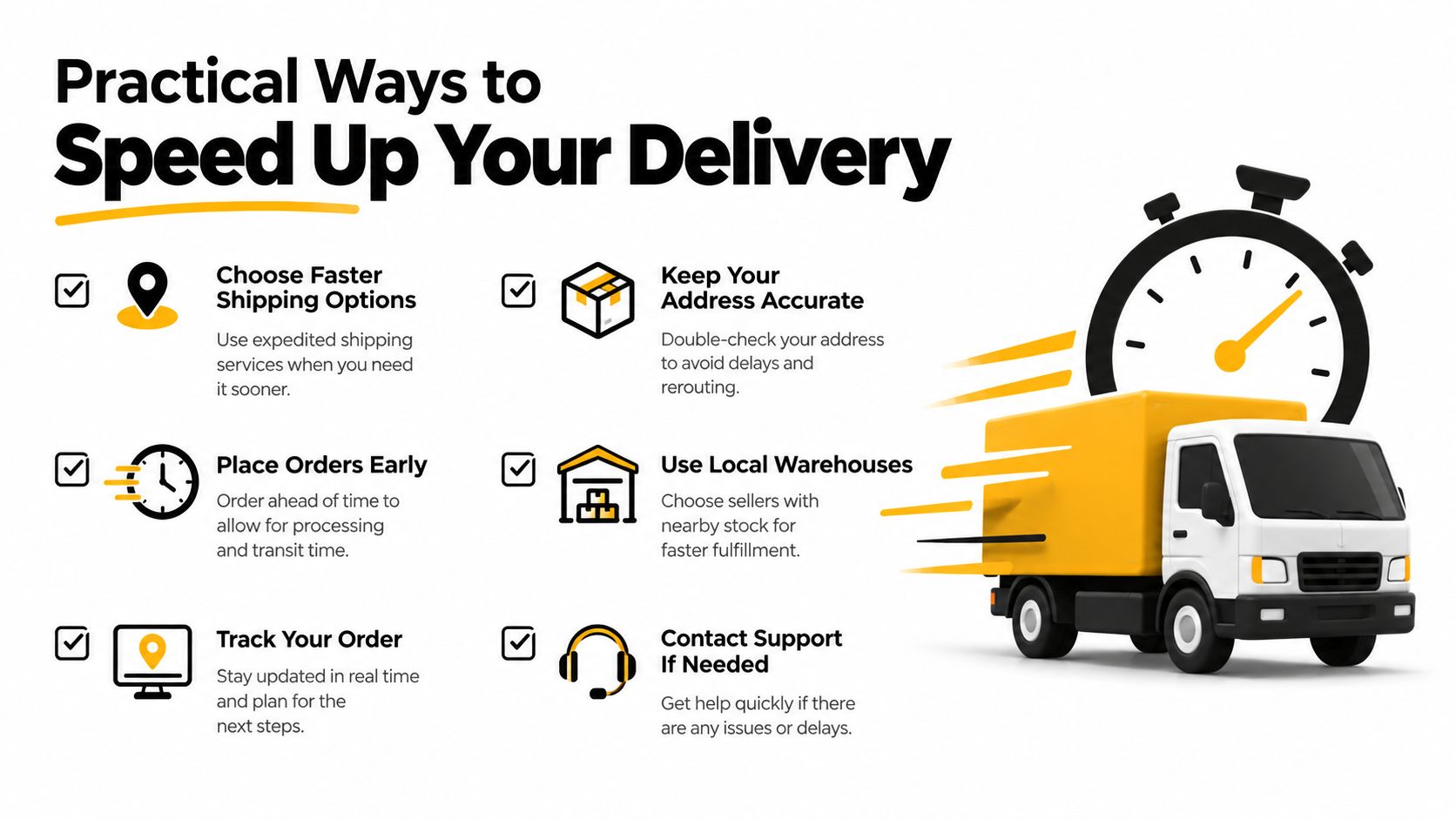
The fastest way to avoid a delay is to remove preventable questions before the parcel reaches the border. The sender controls the dispatch process, but the buyer controls much of the information the carrier and customs authorities need.
For Mystershirt orders, the checkout and shipping information provide the relevant destination estimate. Mystershirt's stated operating details say that orders placed before 14:00 CET on a business day ship the same day, and the platform uses DHL Express and FedEx International Priority for express shipping. Its published expectations put express delivery in Europe at 1–4 days and worldwide shipping at 1–30 days. Those are destination estimates, not a promise that every parcel follows the shortest route.
Prioritize these actions
- Enter the address exactly as the destination country expects it. Use the correct postcode format, apartment or unit information, and any required regional details. Address conventions differ, so don't translate or shorten local fields casually.
- Add a reachable local phone number. Couriers may need the recipient to confirm access, clarify an address, or arrange a delivery attempt.
- Complete customs information carefully. Product descriptions should identify what the item is in plain language. Inconsistencies between the order, invoice, and parcel can lead to questions.
- Choose duties and tax handling when available. A prepaid arrangement such as DDP can reduce the need for the recipient to respond during import processing, although availability depends on the destination and shipment.
- Avoid restricted or unusual contents. Goods requiring manual inspection can take longer than ordinary merchandise, even when the courier service is premium.
Timing also affects the practical result. Ordering earlier in the business week can reduce the chance of a weekend gap at the warehouse or destination depot. For a lightweight shipment traveling to Asia, DHL Express may be a suitable option when it is available at checkout, while Saturday delivery only helps if someone can receive the parcel.
Mystershirt offers authentic Mystery Soccer Jersey Boxes in several formats and sizes, with express delivery options shown for the destination during checkout. Visit Mystershirt to choose a box, enter your preferences, and review the available international delivery estimate before ordering.