

You've found the shirt your child wants, but the size menu isn't helping. Their everyday clothes say Youth Medium, the jersey uses height labels, and the player version looks narrower than the fan shirt. Buying bigger feels sensible until the sleeves swallow their arms.
Kids soccer jerseys are a fit purchase before they're a logo purchase. Start with the child's measurements, check how the particular shirt is cut, and decide whether it's for playing, supporting, or giving as a gift. That approach avoids paying for a shirt that looks right in the box but never feels right on.
Table of Contents
- Kids Soccer Jersey Sizes by Age, Height and Chest
- How to Measure Your Child and Choose the Right Size
- Replica, Authentic and Player Versions Compared
- Choosing Style, Club and Name Printing for Kids
- Safety and Fit for Playing Matches
- Washing and Making a Jersey Last
- Gift Jerseys and Final Order Checklist
Kids Soccer Jersey Sizes by Age, Height and Chest
| Age | Typical label |
|---|---|
| 4-5 years | Youth XS |
| 6-7 years | Youth S |
| 8-9 years | Youth M |
| 10-11 years | Youth L |
| 12-13 years | Youth XL |
Treat these as illustrative shopping bands, not a size conversion chart. Each brand sets its own cut, and the label beside an age group can change between North American, UK, and European ranges. Use age to find the relevant part of a shop's menu, then use the actual brand chart to select the shirt.
Height guides length; chest guides width. A height-labelled jersey isn't guaranteed to provide the right chest room, and a Youth Large label doesn't tell you whether the hem will cover a tall child's waist. Both dimensions matter, particularly when the shirt has a fitted torso or narrow sleeves.
Read the chart's measurement instructions
Before comparing anything, establish whether the chart lists body measurements or garment measurements. A body-chest figure describes the child the shirt is intended to fit. A garment-chest figure describes the shirt itself, which needs room beyond the child's body for comfortable movement.
A flat armpit-to-armpit measurement is another format again. Don't compare that width directly with a tape measurement taken all the way around your child's chest. Check the retailer's diagram rather than guessing what the column means.
Practical rule: A familiar size label is a starting point, not evidence that a particular jersey will fit.
Children also don't grow in matching proportions. A tall, narrow child may need extra length without extra width, while a shorter child may need a roomier torso without a longer hem. Switching cuts can solve that problem more effectively than moving up through sizes.
Find the brand-chart band that matches your child's height, then check its chest guidance before ordering. If those measurements point to different sizes, keep both figures in front of you rather than averaging them into an age label.
How to Measure Your Child and Choose the Right Size
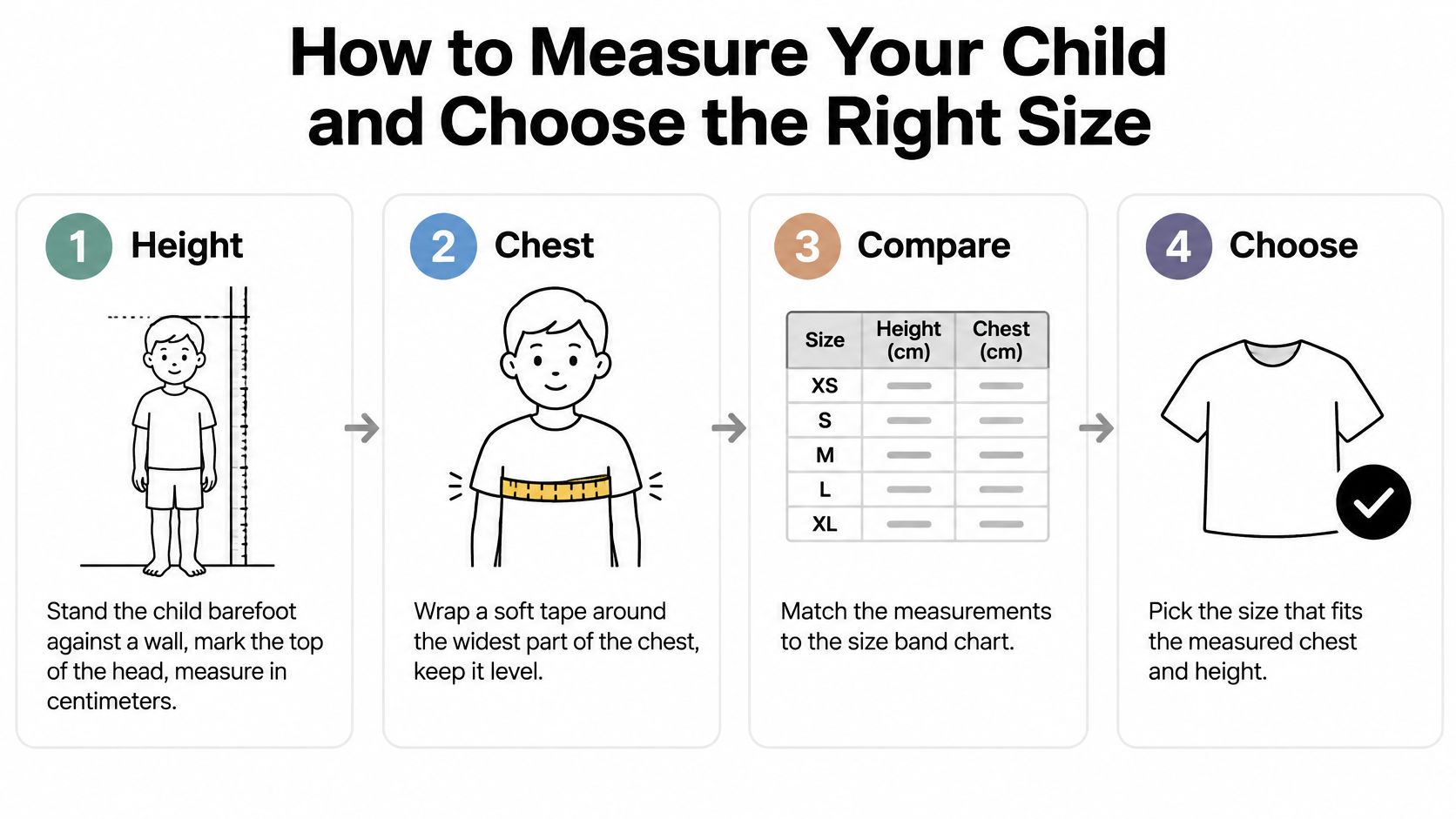
- Measure height barefoot. Stand your child against a wall on a hard floor, looking straight ahead. Rest a book level on their head, mark the wall, and measure from the floor in centimetres. Shoes and raised heels can distort the result.
- Measure the chest with a soft tape. Pass it around the fullest part, under the armpits, with arms relaxed. Keep it level and comfortably touching the body, with about a finger's room rather than pulling it tight. Measure over a thin top, not a hoodie.
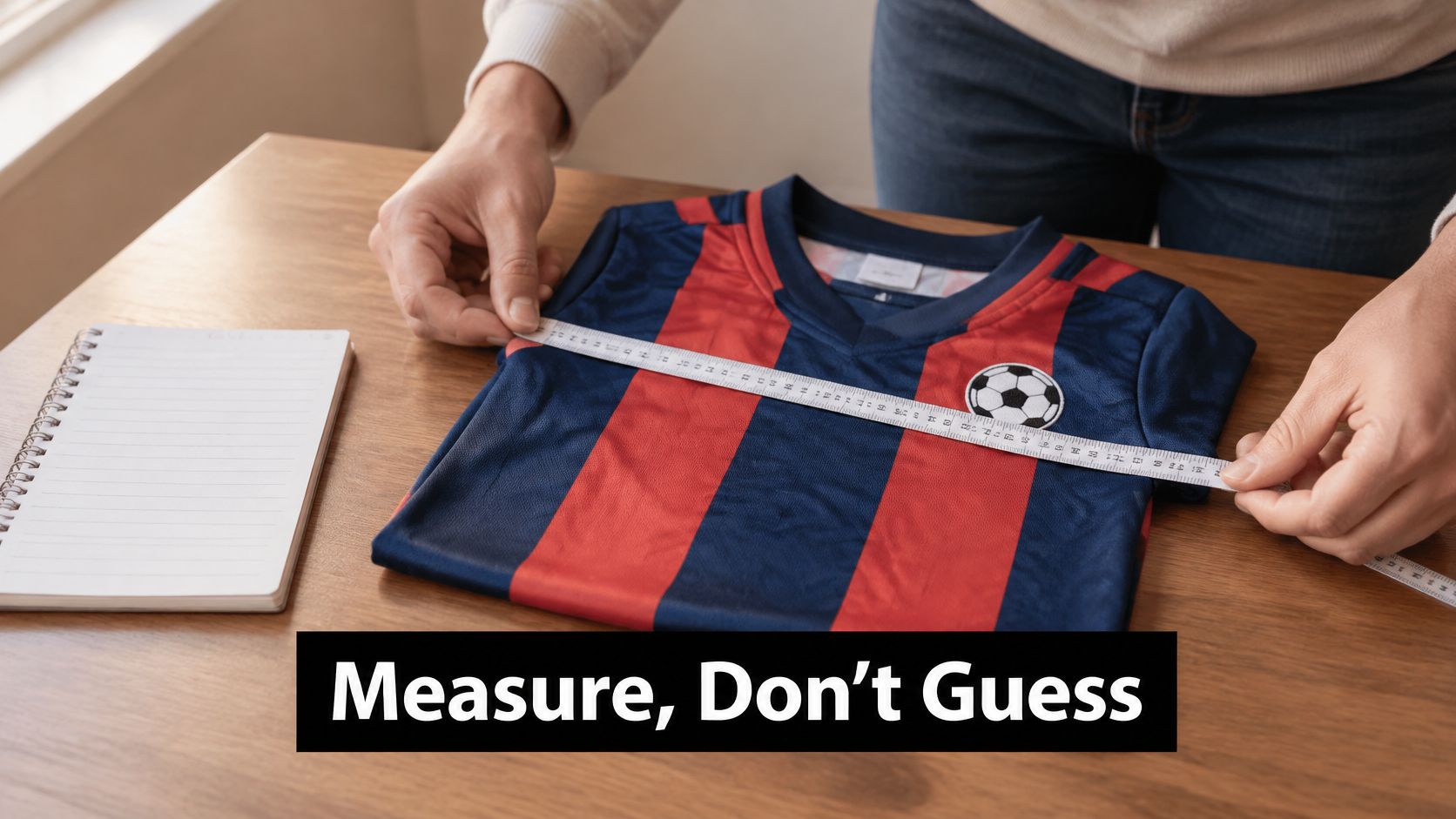
- Check a shirt that already fits. Lay it flat without stretching it and measure from the shoulder beside the neckline to the hem. Compare that with the seller's garment-length diagram, since different measuring points produce misleading comparisons.
- Match the figures to the specific product chart. Don't substitute the chart from another brand or an adult version. Fit and sizing remain important reasons parents value physical shopping, according to Mordor Intelligence's kids sportswear market overview.
- Record the candidate size and intended layers. Write down the measurements, product version, and whether the child will wear a base layer. Don't add a generous allowance to the body measurement if the chart already includes wearing room.
Use this visual reminder while taking the measurements.
What to order when height and chest disagree
| Situation | Order | Reason |
|---|---|---|
| Height and chest both fall in the same band | That band | Both principal measurements support the choice |
| Height in a larger band, chest in a smaller one | Start with the chest band, then verify garment length | Correct width won't compensate for a hem that's too short |
| Height in a smaller band, chest in a larger one | A chest-compatible size with a suitable length, or a roomier cut | Choosing the smaller height band can leave the chest restricted |
| Child will grow over a season | The next band only if it passes the movement check | Growth room is useful only when the shirt is wearable now |
Don't resolve a broad-chest conflict by ordering a tight shirt. If the chest-compatible size is too long, choose another cut rather than accepting either problem.
Buy the current fit unless the next band still places the sleeves and hem correctly and allows unrestricted arm movement. Once you're keeping the shirt, identify it for changing rooms; Quote My Wall's Nursery name labels are a resource to consider, checking that the chosen label suits the garment and its care instructions.
Replica, Authentic and Player Versions Compared
| Version | Construction | Badges and printing | Best for |
|---|---|---|---|
| Replica or fan | Usually a more forgiving supporter cut; check fabric and seams | Standard crests and sponsor graphics | Everyday wear and supporting |
| Authentic or official | Describes genuine club or brand merchandise, not a single construction | Original labels and tags; stitched or heat-applied details | Buyers seeking a verifiable official product |
| Player or performance | Typically lighter and closer-fitting, with performance-focused construction | Often lightweight applied badges and graphics | Children who prefer a fitted playing shirt |
Club identity is easy to spot; construction needs closer inspection.
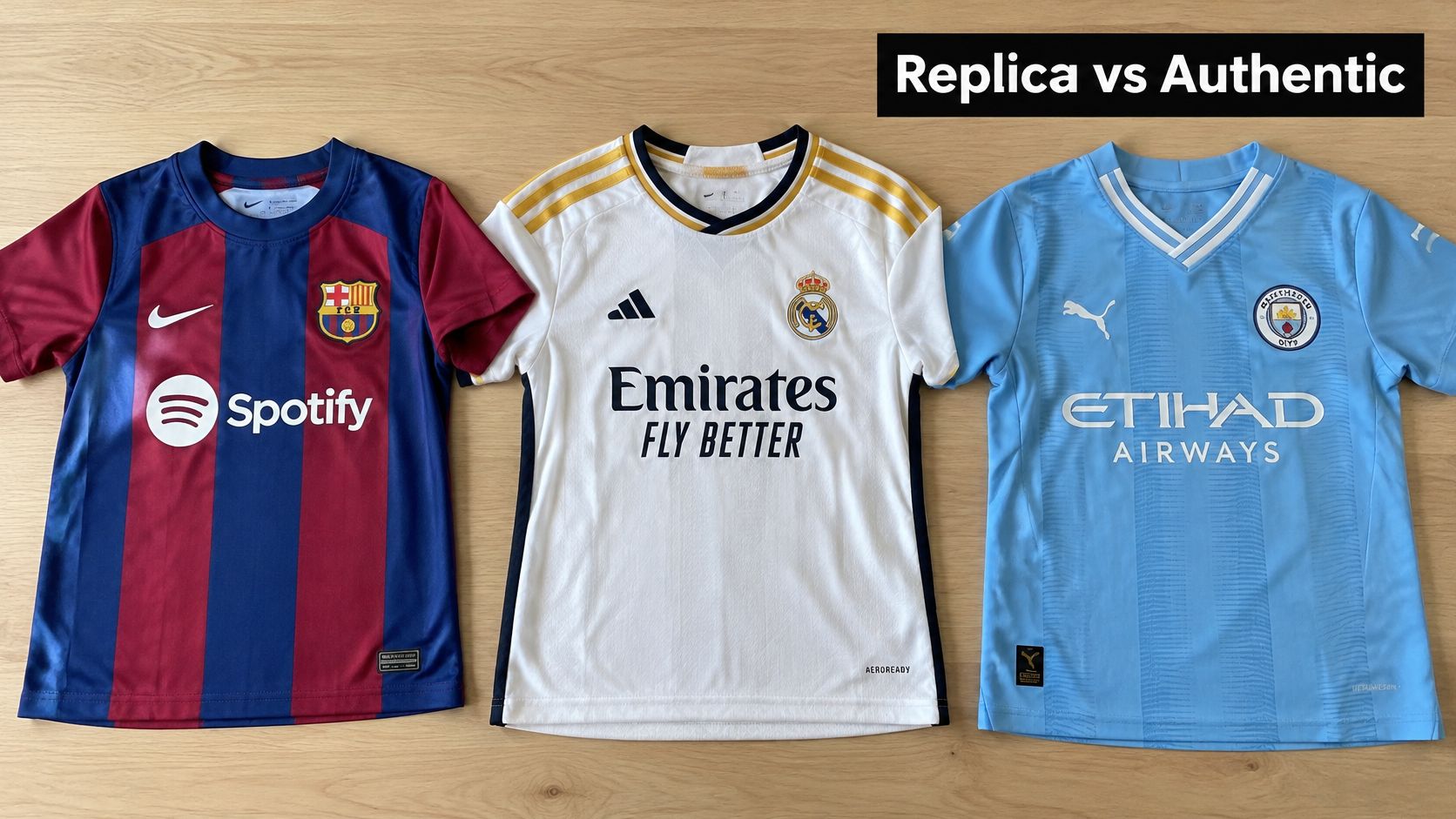
Replica doesn't mean counterfeit. An officially licensed fan shirt can be genuine, while some retailers use authentic as the product name for their player-specification range. Read the description rather than assuming these terms are mutually exclusive; our guide to football replica kits provides useful context.
For training, lighter fabric and effective ventilation can help with comfort, but a closer cut isn't automatically better. A child who dislikes fabric clinging around the torso may prefer a fan version, even when they play regularly. Polyester content alone doesn't establish quality.
Check the garment and its provenance
- Inspect applied details. Badge edges and sponsor graphics should lie flat, without lifting corners or bubbles.
- Look inside. Check for even stitching, comfortable seam finishes, and a secure neckline.
- Check identification. Original tags and labels should agree with the product description, though tags alone don't prove authenticity.
- Consider the supply chain. At Mystershirt, we work directly with clubs, official suppliers, and verified partners to source our shirts.
The FIFA Equipment Regulations state that clothing must not create a risk of injury or illness. For parents, that makes secure finishing and comfortable construction more useful checks than decorative complexity.
The video below offers another way to examine football-shirt details.
Choose the version by how the child will use it, then inspect the actual garment before removing its tags.
Choosing Style, Club and Name Printing for Kids
A child's preferred badge can settle the club choice, but the shirt still needs to suit its purpose. For team kit, get the approved design from the coach before ordering. Correct club colours alone do not confirm the right season, sponsor layout, or goalkeeper design. For supporter wear, start with the shirt the child wants.
Home, away, and third kits offer different colour choices while keeping the same club. Retro designs provide another option, but an older design may have a different cut from a current shirt. Check the specific product listing, particularly for remaining stock with limited exchange options. If height and chest measurements point to different sizes, use the size guidance for that exact style rather than choosing by the badge or age label alone.
Settle these details before printing
- Confirm the club. Ask the child directly if there is any doubt, especially when siblings support different teams.
- Confirm the season and kit. Compare the product picture with the intended design. A colour description alone may not distinguish home, away, third, or goalkeeper shirts.
- Decide on personalization. Check spelling, whether the child wants their own name or a player's, and the seller's terms for printed items.
- Get team approval. Confirm the number assignment and goalkeeper colour with the coach instead of copying a professional player's shirt.
Name printing can make a jersey feel personal, but it can make a wrong-size order harder to resolve. Settle the fit before authorizing customization whenever the ordering process allows it. A child who will play in the shirt may need a different design choice from one who will wear it as supporter gear.
A blank back stays flexible for hand-me-downs, changing favourite players, or a child who prefers the shirt without lettering. Personalization makes sense when the child wants it and the club, design, size, and print details are settled. It is an option, not an automatic upgrade.
Safety and Fit for Playing Matches
- Have the child raise both arms. Watch whether the neckline pulls backward, the underarms tighten, or the hem leaves the waist exposed.
- Ask them to rotate their shoulders. Reaching forward and across the body should feel easy, without seams digging into the armpits.
- Let them jog and change direction. The shirt shouldn't twist persistently, catch around the hips, or need constant adjustment.
- Check sleeves and skin contact. Sleeve openings should allow movement without engulfing the elbows. Ask about scratchy seams rather than judging comfort from appearance.
Match compliance is primarily about safe equipment, not shirt prestige. IFAB Law 4 requires a shirt with sleeves, prohibits dangerous equipment or clothing, and requires appropriately sized shinguards made from suitable material and covered by socks.
A jersey doesn't replace protective equipment. Select shinguards for the child and their coverage needs, not because their packaging uses the same size word as the shirt. A matching label is no guarantee of an appropriate fit.
Test the complete match outfit
Repeat the movement check with the base layer the child will wear. A jersey that feels comfortable alone may become restrictive across the shoulders when another layer sits underneath it. Equally, adding fabric beneath an excessively loose shirt doesn't necessarily make that shirt suitable.
For organized matches, undershirt sleeves must be a single colour matching the main sleeve colour, or reproduce the sleeve's pattern or colours as permitted by the equipment rules. Check the team's requirements before buying contrasting cold-weather layers.
A child should be able to concentrate on the ball, not on pulling their shirt back into position.
Remove loose accessories and avoid hard decorative additions. Don't attach a keepsake pin, rigid badge, or dangling ornament to a shirt intended for play. Decorative supporter accessories belong away from the playing field.
If the garment passes the movement and layering checks, it's a suitable fit candidate for matches. The coach or match official still determines whether the complete kit meets the competition's requirements, including colour distinctions.
Washing and Making a Jersey Last
Children may outgrow a jersey before wearing out its fabric. Usable life matters more than a vague eco claim, especially if the shirt can pass to a sibling, teammate, or resale buyer.
Start by checking what you can verify: material composition, care instructions, any advertised stain- or water-resistant treatment, and available product-safety documentation. A 2025 review of major children's-fashion brands by Defend Our Health identified substantial room to reduce exposure to chemicals of concern, including PFAS, phthalates, and PVC. That isn't evidence that every polyester jersey is dangerous, nor can washing establish whether a garment meets a chemical-safety claim.
Use a print-friendly care routine
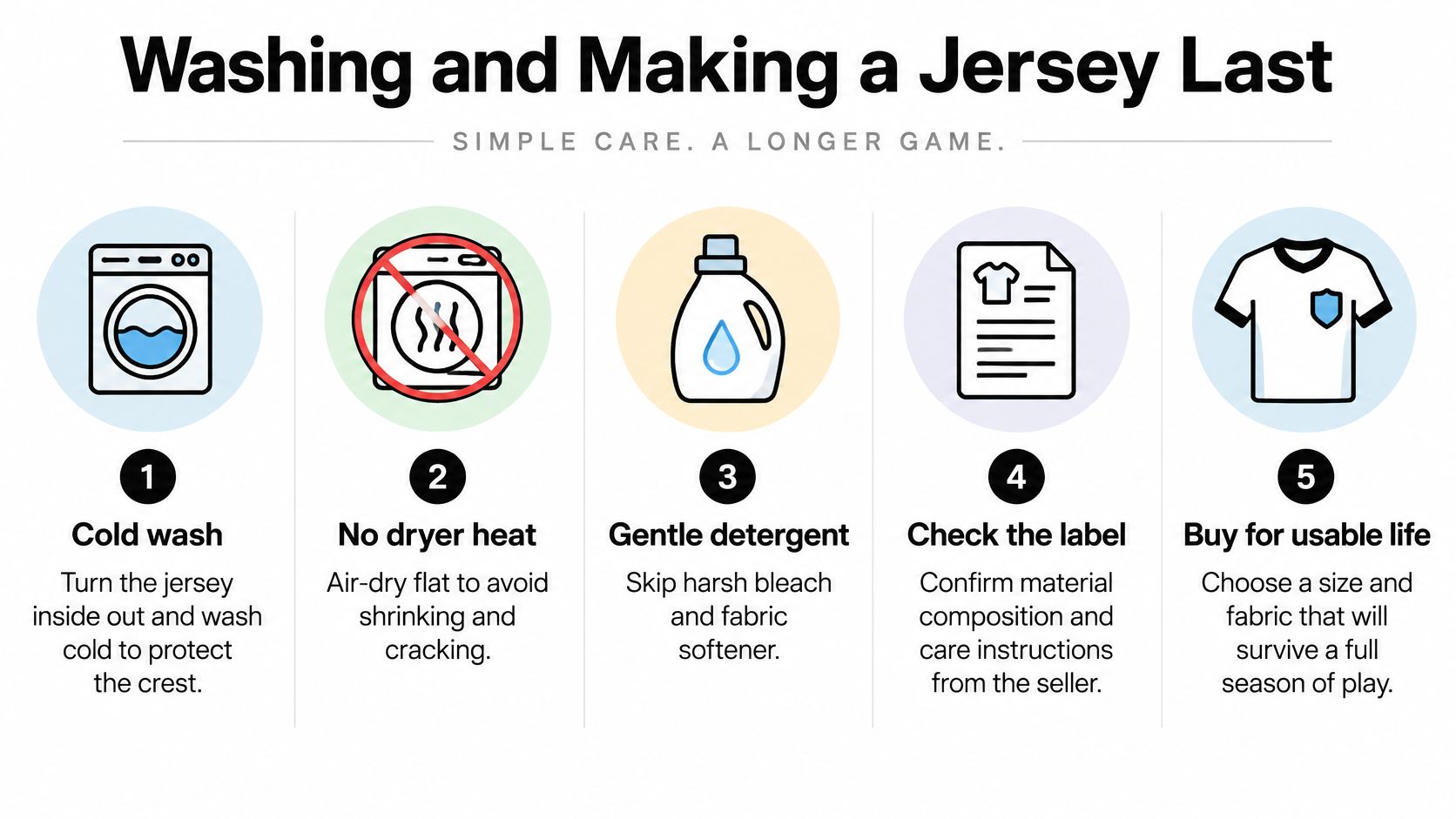
- Read the garment label first. Follow its temperature and washing restrictions, especially for shirts with mixed materials or delicate transfers.
- Turn the shirt inside out. Keep exposed zips, hook-and-loop fasteners, and abrasive garments out of the same wash.
- Use suitable detergent. Avoid bleach unless the care label permits it, and don't assume more detergent will remove persistent odour more effectively.
- Avoid high dryer heat. Air-dry according to the label, keeping applied graphics away from direct heat.
- Inspect before the next wear. Look for lifting badges, loose stitching, and developing snags. Don't pull a loose thread or press an iron directly onto a transfer.
Keep this care reminder near the laundry basket.
Our football jersey washing guide gives further care guidance for printed shirts. Whatever the routine, don't leave a damp jersey bundled inside a kit bag.
Keep it transferable: Repair a small seam failure while it's manageable, and store the clean shirt dry when the child outgrows it.
Whether an official shirt is worth buying depends partly on what happens after its first owner. A wearable garment with sound seams and intact graphics has more hand-me-down potential than a premium label attached to damaged fabric.
Gift Jerseys and Final Order Checklist
A successful jersey gift needs more than a guessed age and a famous badge. Ask a parent or caregiver for a discreet measurement check, then decide whether the surprise should be the club, the design, or the presentation. Keeping everything unknown increases the chance of buying something the child can't use.
Use these gift criteria:
- Measured fit. Request current chest and height measurements, or measurements from a comparable shirt that fits comfortably. A photograph of an old size label is less useful than dimensions taken now.
- Supporter preferences. Establish the club or colours the child likes and any teams they would actively dislike receiving. Don't mistake a favourite player for permanent loyalty to that player's current club.
- Intended use. Find out whether this is a match shirt, training top, school-holiday favourite, or collection piece. That determines how much a fitted performance cut matters.
Make the surprise manageable
For a mystery gift, leave the design unknown but settle size and exclusions. At Mystershirt, customers can list clubs and leagues they want to avoid in the text box at checkout, and we take those requests into account when preparing the order. A mystery purchase should still be an informed fit decision.
Our Kids Football Shirt Mystery Box costs €69,95, is available in sizes 128-158, and contains a 100% authentic football shirt from a club around the world in the selected size. Match that selection to the child's measurements rather than treating the size number as an age substitute.
A short card explaining the club and its home ground adds context, especially when the child discovers an unfamiliar team. Each of our boxes includes a card explaining who the club is, where they play, and why the shirt matters. For a different presentation, our soccer gifts for kids guide offers further ideas.
Use a comparable shirt to check dimensions without spoiling the design surprise.
Check before paying and after delivery
- Confirm the measurement match. Save the relevant chart and selected size with the order details.
- Confirm the version. Check that the described cut suits how the child will wear the shirt.
- Confirm preferences. Verify club, season, design, and exclusions before submitting the order.
- Check return eligibility. Read the conditions for wrong sizes, gifts, and personalized items. Don't assume a general returns promise covers every alteration.
- Inspect on arrival. Check badges, seams, labels, and the supplied size while keeping tags attached and packaging available.
Let the child try the shirt on before washing, printing, or wearing it outside. Keep the first fitting brief and clean so you don't inadvertently compromise return eligibility.
Order the size supported by the measurements. Choose extra growth room only when the shirt remains comfortable and usable immediately, not because an oversized gift seems more economical.
Mystershirt offers authentic football shirts with the surprise of a mystery box, while letting you select a size and list clubs or leagues to avoid. Take your child's measurements, settle those preferences, and visit Mystershirt to choose a gift they can enjoy wearing.


