In 2024, 34% of football fans who buy replica shirts purchased retro kits, according to YouGov. For those buyers, the number on the back presents a deceptively simple question: does it identify a position, a particular player, or a shirt that player wore?
Table of Contents
- Why Retro Shirt Numbers Still Matter
- What Numbers 1 to 11 Meant on the Pitch
- From Positional Labels to Squad Numbers
- How to Check a Retro Number Against Its Era
- Iconic Numbers That Outgrew Their Positions
- When a Correct Number Is Still the Wrong Shirt
- Choose Your Next Retro Shirt by Number
Why Retro Shirt Numbers Still Matter
Say you find an older club shirt with a familiar attacking number. The colour looks right, the sponsor brings back memories, and you immediately associate it with a favourite footballer. It's tempting to treat that recognition as identification.
But recognition isn't provenance. The shirt might carry the number used by whoever filled that position, rather than a number permanently assigned to your favourite player. It might also be a supporter's shirt personalised much later.
Early numbers worked rather like seat labels in a formation. Whoever occupied the position inherited its identifying digit. Permanent squad numbers became more like nameplates, travelling with a player between appearances rather than changing with the starting lineup.
Collector's starting point: Ask what the number meant in that competition before asking whose number it was.
That distinction changes how you inspect a listing. A seller might describe a shirt through a famous player because that's the most recognisable association, while the garment itself offers no evidence connecting it to that individual. The association can be enjoyable without being documentary proof.
A useful reading of retro football shirt numbers therefore starts with tactics, then considers the competition's numbering system, and finally examines the garment. The position explains the original meaning; the squad list explains a later personal assignment; photographs and ownership records help establish the history of the actual shirt.
You don't need to memorise every club's numbering habits. You need enough context to spot when a seller has jumped from a plausible number to an unsupported player attribution. That lets you choose a shirt for its design and memories without accidentally paying for a stronger history than the evidence supports.
What Numbers 1 to 11 Meant on the Pitch
Traditional 1 to 11 roles on a retro shirt
| Number | Traditional role | Line | What a collector should read |
|---|---|---|---|
| 1 | Goalkeeper | Last line | The keeper's shirt in the positional system |
| 2 | Right full-back | Defence | Right-sided defender, not a personal squad digit |
| 3 | Left full-back | Defence | Left-sided defender |
| 4 | Right half | Half-back line | Later a defensive or midfield role, not automatically a right-half |
| 5 | Centre-half | Half-back line | Central half-back, later strongly associated with central defence |
| 6 | Left half | Half-back line | Left-sided half-back, later a midfield or defensive role |
| 7 | Outside right | Forward line | Right-sided attacker |
| 8 | Inside right | Forward line | Supporting forward beside the centre-forward |
| 9 | Centre-forward | Forward line | Main central striker |
| 10 | Inside left | Forward line | Supporting forward, not yet a fixed playmaker identity |
| 11 | Outside left | Forward line | Left-sided attacker |
This map belongs to the 2–3–5 formation behind the early numbering system: at Hillsborough on 25 August 1928, Sheffield Wednesday wore 1–11 against Arsenal's 12–22, and on 5 July 1939 the Football League management committee decided both teams should use 1–11 by position, as described in NewsDive's history of shirt numbering. Chelsea's match against Swansea Town also featured numbered shirts on that opening day, so the experiment wasn't confined to the Hillsborough fixture.
Read the formation before the player
The table runs from the goalkeeper through the defensive and half-back lines to the forwards. Within those lines, the traditional assignments run from the team's right towards its left. That's why an outside-right and an inside-right have neighbouring numbers despite performing different attacking jobs.
The Hillsborough experiment adds an important complication. Because the teams used separate ranges, a digit identified both a role and a team. Applying today's expectation that both goalkeepers should share the same number would misread the experiment.
The later Football League decision removed that complication. Both sides could use the same positional map, making the shirt a clearer guide to where its wearer belonged in the formation.
Positions moved, but familiar associations remained
Don't translate an old positional name directly into a modern job description. A half-back wasn't today's holding midfielder under another name, and the centre-half's responsibilities changed as coaches reorganised their teams.
For a later shirt, the table is therefore a starting translation, not a complete tactical diagram. Check a contemporary team sheet or match photograph before deciding where the wearer played. The goalkeeper and centre-forward associations are easier to recognise than the changing defensive and midfield assignments.
Watching footage helps because you can follow where the numbered player operates. For contemporary viewing comparisons, ROVE IPTV's guide to watch live sports in Canada provides a separate viewing resource; historical shirt identification still needs footage or photographs from the relevant fixture.
Start with the row in the table. Then investigate the club, formation and lineup rather than immediately searching for a famous wearer.
From Positional Labels to Squad Numbers
The decisive change wasn't that players suddenly wore unfamiliar digits. It was that the assignment stopped resetting with the team selection. A player could retain the same identifier whether starting, sitting on the bench or returning after an absence.
Arsenal's account of numbered shirts identifies the League Cup final against Sheffield Wednesday on 18 April 1993 as a prominent introduction of player-specific numbering in England, followed by standard Premier League adoption in 1993–94. Printed player names accompanied that Premier League change, making the back of the shirt a much more individual identifier.
When a retro number changed meaning
| Era | System | Typical range | What the number identified |
|---|---|---|---|
| Hillsborough experiment | Positional, different team ranges | Separate ranges for each side | Role and which team |
| Football League positional rule | Both teams numbered by position | Traditional starting lineup | Place in the formation that match |
| Compulsory numbering in UEFA European competition | Numbered shirts required | Starters commonly used the traditional range | Match identification |
| Premier League squad-number era | Permanent squad numbers plus names | Traditional digits and higher squad numbers | The same player across matches |
| UEFA European Championship | Fixed tournament squad list | Competition-defined squad allocation | A player's tournament registration |
The timeline makes the broader transition easier to visualise.
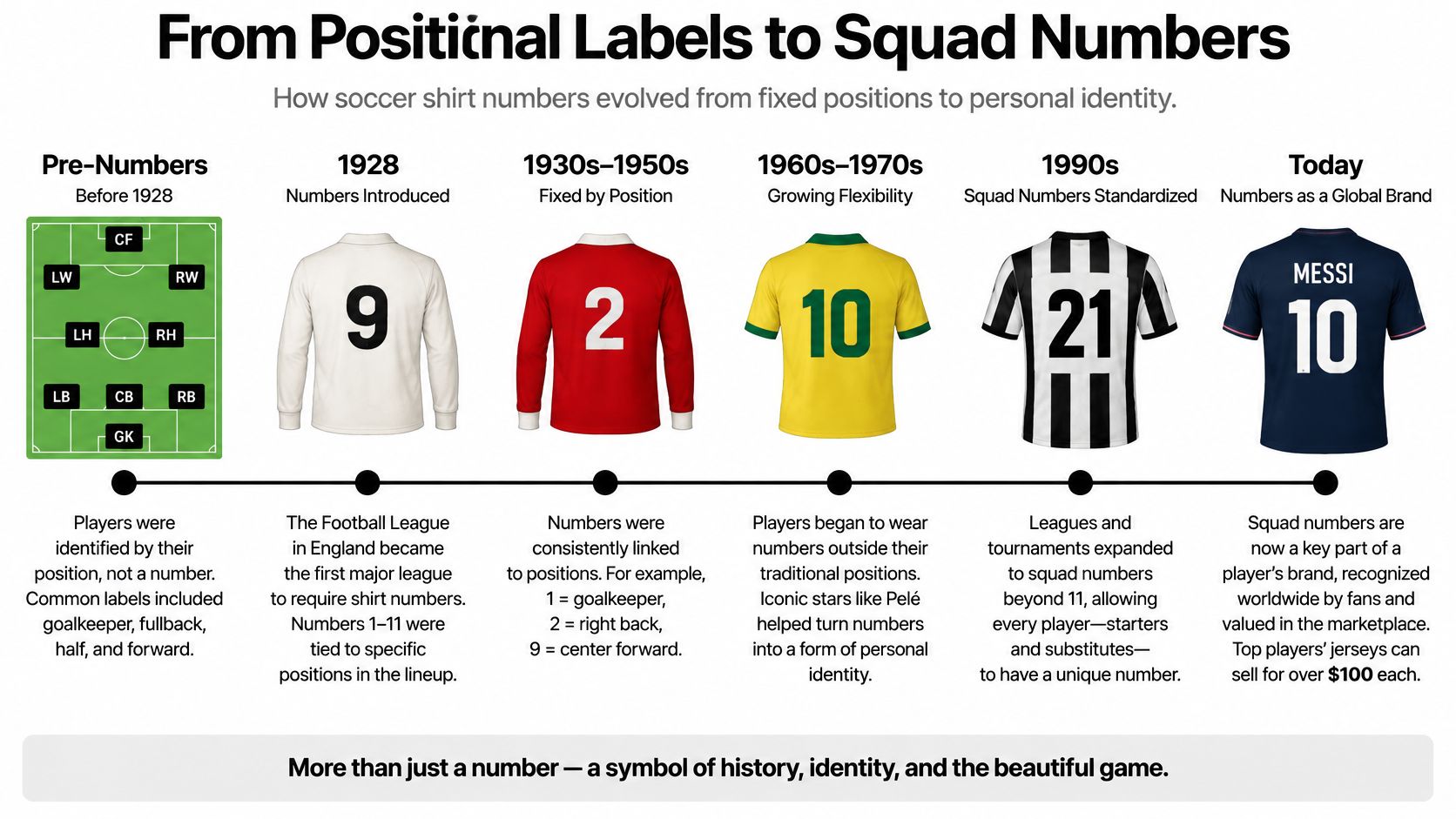
A personal identifier changes the collecting question
Under positional numbering, you investigate who occupied the role in the relevant match. Under squad numbering, you investigate who held the assignment during the relevant season or competition. Those are different searches, and confusing them can produce a convincing but incorrect nameset.
Permanent assignments also let supporters recognise a player through the back of a shirt without consulting that day's formation. Reserves and substitutes could retain higher numbers, while a familiar attacking digit could become part of an individual player's identity.
That made personalisation more meaningful, but not automatically more authentic. A correct player assignment tells you what a suitable replica might display. It doesn't establish that the club prepared or used the garment.
If you're considering adding a nameset, Striped Circle's comparison of DIY versus professional shirt printing is useful for the application decision. First settle the historical specification, including lettering, number style and competition version; only then decide who should apply it.
A neatly pressed modern nameset can be technically successful and historically unsuitable. Keep a photograph of your reference shirt alongside any printing instructions so the job follows a documented example rather than a general memory of the player.
How to Check a Retro Number Against Its Era
Start with the seller's exact claim, not the name you hope to connect to the shirt. Original-period replica, match-issued and match-worn describe different things, so write down which description you're testing.
The checklist below gives each part of that claim a separate test.
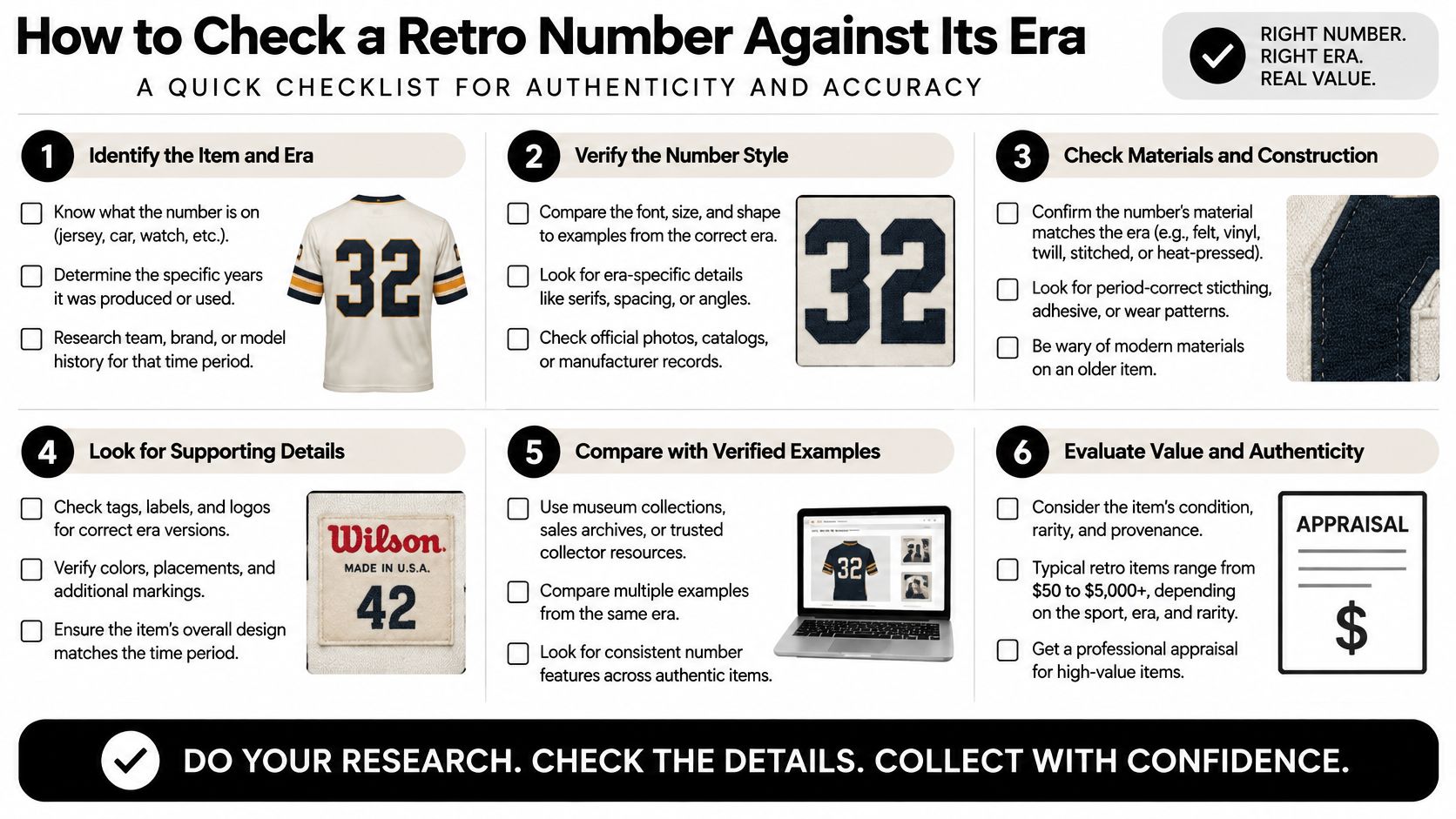
Five checks for a single shirt
- Identify the season and competition. Record the club, kit design, sponsor, manufacturer and claimed fixture. A failure example is a seller using a domestic league photograph to support a European match attribution without checking whether the shirt details agree.
- Establish the numbering convention. Find out whether players received shirts by starting position or retained personal squad assignments. A failure example is identifying a positional-era shirt solely through a player's best-known career number, without checking the lineup.
- Test the competition's permitted allocation. Celtic's numbering history notes compulsory numbered shirts in UEFA European competition from 1975, and describes European Championship allocations of 1–23 in qualifying and 1–26 at the finals, generally fixed during the final tournament. A failure example is a hypothetical finals shirt carrying a personalised digit outside that permitted allocation. Check the regulations applicable to the actual edition rather than treating a competition's current rules as timeless.
- Separate the garment from its printing. Inspect the shirt label, fabric, badges and sponsor independently of the name and number. A failure example is an authentic blank shirt with later lettering being sold as an untouched original player shirt.
- Match the confidence label to the evidence. Use period-correct design for compatible appearance, official reissue for an authorised later reproduction, and documented match-worn only when supporting records connect that garment to use. A failure example is a seller offering a photograph of the player in the same kit design as proof that the player wore this particular shirt.
Keep a record, not just a conclusion
Save the listing, reference photographs and any correspondence explaining the attribution. Note disagreements rather than smoothing them away: a replacement sponsor, altered nameset or unexplained badge can change how you should describe the item.
A contradiction is a reason to pause, not an invitation to invent a story that makes the shirt fit.
A commemorative product can be perfectly legitimate without being an original tournament artefact. The explicitly described Kilts4Less Argentina 1986 velvet cap illustrates why replica wording matters: a historical association isn't a claim of historical use.
For the wider relationship between design and context, Mystershirt's guide to historical football kits offers a useful companion. Your decision should remain specific: keep the attribution if the evidence supports it, reclassify the garment if it doesn't, or stop the purchase when a fixture claim cannot be reconciled.
Iconic Numbers That Outgrew Their Positions
A familiar number can trigger a player association before you've even identified the shirt. That's part of collecting's pleasure, but it also creates a shortcut that sellers' descriptions can reinforce.
The safer approach is to enjoy the association while asking what, exactly, the garment supports.
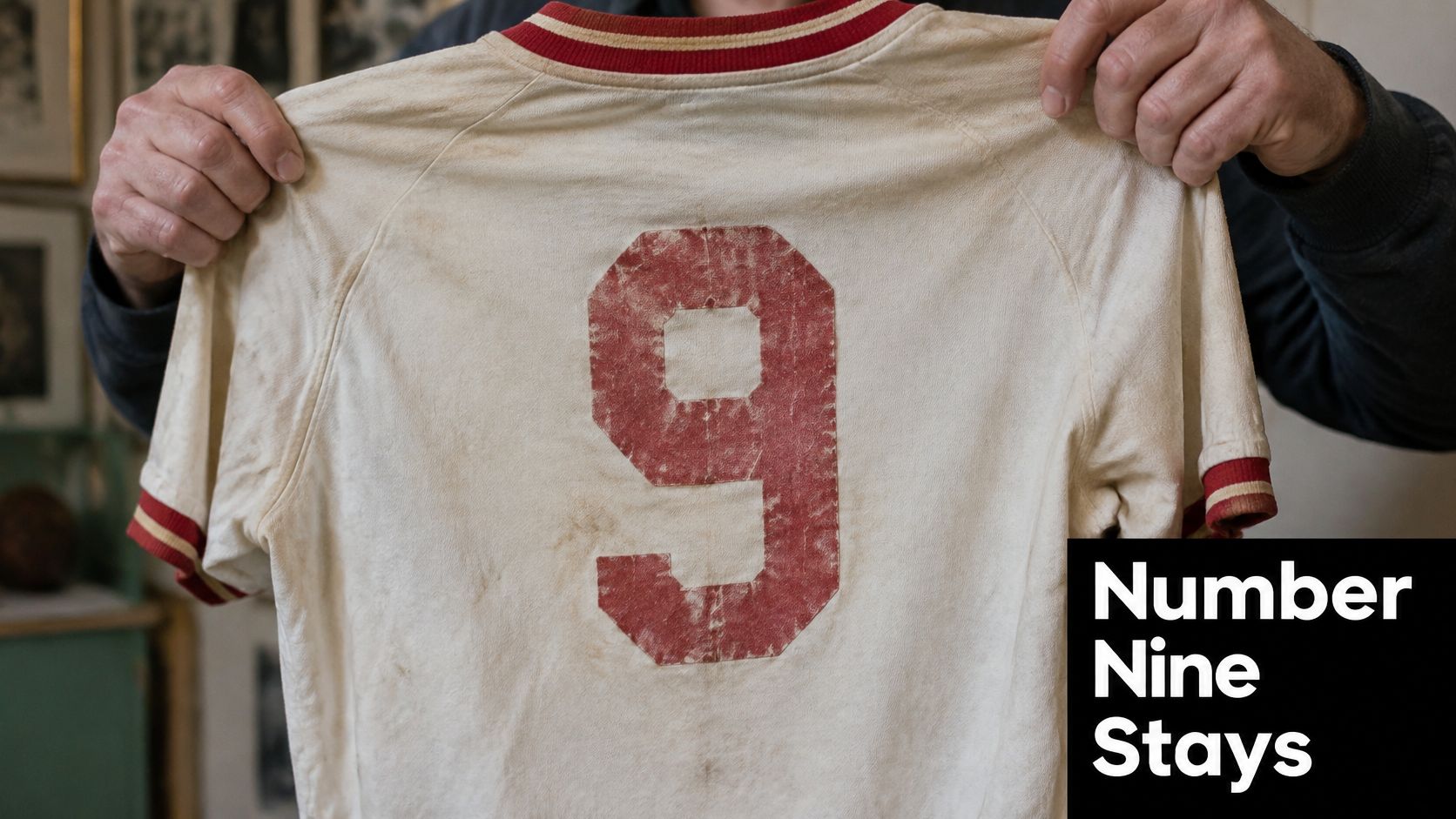
The striker and the creator
The centre-forward's shirt offers the clearest example. Say you find an older home shirt with the traditional striker's digit but no name. It can be a coherent tribute to the club's attacking role without belonging to the most famous striker associated with that design.
The collector's warning is simple: don't turn an appropriate positional choice into an exclusive player attribution. Several footballers might have filled that role during the shirt's use.
The creator's shirt invites a different assumption. Supporters often read the familiar playmaker number as a promise of imagination, technical skill and influence. Yet that modern expectation doesn't describe every historical wearer's tactical responsibility.
A shirt can evoke a creative favourite without reproducing a specific match. Decide whether you're buying a tribute or testing a historical claim, because those purchases need different levels of evidence.
The star and the personal signature
The winger's shirt shows how a positional association can become a club tradition. Names such as Best and Beckham may come to mind immediately, but a club's succession of famous wearers shouldn't be treated as an uninterrupted sequence of identical assignments.
For a player-themed collection, the season matters more than the legend attached to the digit. A player's memorable later identity doesn't automatically identify an earlier shirt.
The personal signature takes the idea further. Johan Cruyff is a useful subject for exploring how supporters connect a footballer's identity with a distinctive shirt choice; Mystershirt's Johan Cruyff jersey guide provides a player-focused companion.
The practical test remains the same even for an unmistakable personal association. Establish which club or national side, which competition and which garment version you're looking at before choosing the print.
The number supporters remember most vividly isn't necessarily the number visible in the match photograph they're trying to recreate.
Consider a hypothetical striker whose early shirt was allocated by position and whose later shirt carried a permanent squad assignment. Both garments could represent the same career accurately, even if their backs looked different. Trying to make them match would erase history rather than restore it.
A legend premium should therefore buy something clearly described: a desirable design, a documented assignment, a scarce original or supported player use. Don't let those separate qualities merge into a single vague promise.
When a Correct Number Is Still the Wrong Shirt
A nameset is printed lettering and numbering, not a history of ownership or use. It doesn't record who applied it, when it was added or whether the named footballer ever touched the garment. The 433FC guide to football shirt numbers provides context for distinguishing positional numbering, player identification and collecting claims.
For restoration, that distinction is especially important. You can make an authentic shirt look more complete while reducing its value as an untouched historical object. Photograph the blank back, labels and existing print before making changes, and retain the printing receipt.
Correct production is more than a familiar font
The UEFA equipment regulations permit whole numbers from 1 to 99, reserve 1 for a goalkeeper and require centred back numbers; they also specify digit heights of 25–35 cm for men's shirts and 20–35 cm for women's shirts, stroke widths of 2–5 cm, and legibility from at least 50 metres in daylight and under floodlights. Those regulations also prohibit manufacturer marks, sponsor advertising and decorative elements inside the digits.
These are equipment requirements, not instructions for reconstructing every historical shirt. A modern compliant print can still have the wrong shape, spacing, material or finish for an older garment.
Compare the complete back rather than an isolated digit. Look at the distance below the collar, the relationship between name and number, the outline thickness, and how the print sits over stripes or panels. A superficially similar block font may differ noticeably once you place it on the shirt.
- Design evidence: Match period photographs, including spacing and placement.
- Garment evidence: Examine labels, construction, badges and sponsor application.
- Use evidence: Seek records that connect the individual item to the claimed player or fixture.
Scale makes careful descriptions important
In 2024, Classic Football Shirts was selling more than 750,000 pre-owned shirts annually, according to Front Office Sports. That scale makes precise descriptions useful to ordinary buyers, not just specialist auction collectors.
Mystershirt's guide to checking whether a football shirt is authentic helps with the garment-level inspection. Keep that inspection separate from the player attribution: an official supporter shirt can be genuine merchandise without being player-issued.
Judge font accuracy, garment authenticity and proof of use independently. A strong result in one category doesn't fill a gap in another.
Choose Your Next Retro Shirt by Number
Choose the kind of connection you want before searching listings. If you want a formation relic, prioritise a shirt whose positional numbering suits its tactical context. If you want a player memory, look for a documented assignment from the particular stage of that player's career you remember.
For a gift, make the same distinction explicit. A shirt celebrating someone's favourite striker doesn't need match-worn provenance to be meaningful, but it should be accurately described. Spend on the quality and history you want rather than an ambiguous suggestion of player use.
Buy a shirt you can wear
Fit deserves its own check. The Jersox collector's glossary recommends measurements rather than relying on letter sizes across eras, noting that a vintage medium can fit like a modern slim small.
Lay a shirt you already enjoy wearing flat and compare:
- Pit-to-pit width: Measure straight across beneath the armholes without stretching the fabric.
- Back length: Use the same collar-to-hem reference point on both garments.
- Sleeve length: Compare from matching seams, allowing for raglan or dropped-shoulder construction.
Manufacturer, fabric, player-versus-supporter cut and laundering history can all affect the result. Don't assume a shirt will be roomy just because you associate its era with loose fits.
Leave room for discovery
At Mystershirt, our Retro box and Premium box, alongside signed shirts, shorts and sharing boxes, offer different ways to build a collection. Our warehouse holds more than 30,000 football shirts, and customers can specify clubs, leagues or colours they don't want to receive; we never put two shirts from the same club in one order.
Our approach offers a more sustainable and more affordable way to collect, with sizes from children's through 5XL. The surprise concerns the shirt you receive, not a promise of undocumented player history.
Choose your historical interest first, check the intended number where relevant, and compare fit before buying. That order keeps the enjoyment of collecting separate from assumptions a famous nameset can encourage.
Mystershirt offers authentic football shirts through mystery boxes, including a Retro option for collectors drawn to classic designs. Visit Mystershirt to choose your box and size, record your exclusions, and add a shirt you can appreciate for what it is rather than an unproven story about who wore it.