

The most common advice about a USA training jersey is to buy your usual size and choose the cheapest official shirt. Both shortcuts can leave you with a top that rides up during drills, feels awkward over a jacket, or costs more to return than it was worth. Choose by how you'll wear it, how it fits your body, and whether the seller gives you a usable return option.
A training shirt isn't just a discounted match shirt. It has a different job from a supporter replica or a close-fitting authentic top, and the right choice depends on whether you'll be running, watching, collecting, or buying for a growing child.
Table of Contents
- Training, Replica and Match Shirts by Use
- Checks That Show a USA Training Jersey Is Real
- Dating a USA Shirt by Supplier Era
- Sizing and Fit for Practice, Layering and Kids
- Polyester, Wicking and How to Wash the Shirt
- Buy with a Return Window You Can Actually Use
Training, Replica and Match Shirts by Use
Start with the use, then choose the grade. A training jersey is designed for warm-ups, drills, and travel days; a replica suits the stands and casual wear; an authentic or player-issue top prioritizes match performance. A pre-authentic shirt sits near match specification, but its label alone doesn't tell you whether it'll work well as an everyday shirt.
| Shirt grade | Typical use | Fit | 2025 listed price | Best for |
|---|---|---|---|---|
| Training jersey | Warm-ups, drills, travel days | Athletic, with room to rotate the shoulders; often slimmer than a fan replica | No separate price stated | Repeated practice and layering |
| Replica or supporter | Stands, street wear, casual match day | More fabric, everyday comfort | From about $40 | Daily wear and supporter use |
| Authentic or player-issue | Match performance | Reduced excess fabric | Around $90 | Competitive play |
| Pre-authentic | Near match-spec before a full release | Performance cut | Up to $165 | Collectors and serious sessions |
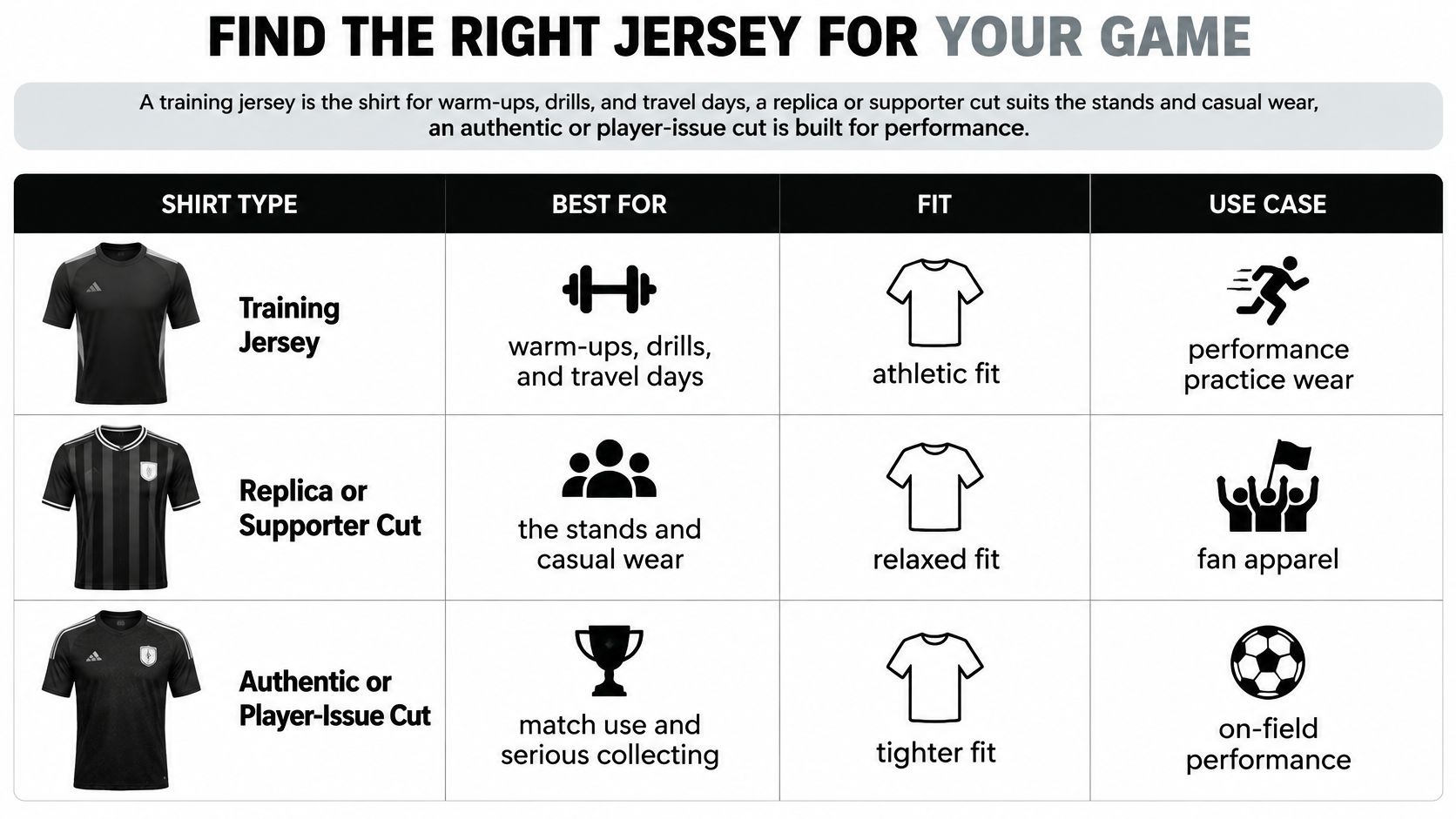
Those prices come from the 2025 U.S. Soccer and Nike collection, which included replica, authentic, and pre-authentic products. The lowest listed price isn't automatically the best value. A slim performance shirt may feel restrictive for a full day of casual wear, while a training or replica shirt may be more comfortable for supporters who want to wash and wear it often.
Match the shirt to the moment
For a weeknight pickup player, the training shirt is the straightforward pick. It's made for movement, and a suitable cut should allow the shoulders to turn without leaving loose fabric flapping at the sides. If you're doing short-sided play or pressing, that balance matters more than whether the shirt has the same construction as a match top.
For a watch party or a day in the stands, a replica usually makes more sense. Its roomier feel can accommodate a base layer or jacket, and it's generally easier to wear away from the pitch. Pick: replica.
A parent buying for a child who trains regularly should look for a clearly labeled training or kids' shirt and compare measurements with the size chart. Leave sensible room to grow, but don't buy a slim player-issue top that's already tight across the shoulders. Pick: training or kids' shirt.
A collector searching for a 2020 Futura piece or a USWNT shirt with a fourth star is buying the design and its era, not drill comfort. Prioritize condition, labels, and seller information over the fit you'd want for practice. Pick: authentic or replica, based on the specific collectible.
Value rule: Buy the cut you'll wear most, not the highest grade you can afford.
International buyers should make that choice before ordering. A mistaken fit can be expensive to ship back, so check chest, waist, and torso length rather than relying on a familiar size label. If the shirt is mainly for exercise, beginner-friendly guided circuit workouts for beginners can help you plan movement sessions that put your training gear to use.
Checks That Show a USA Training Jersey Is Real
Counterfeits are common enough that a familiar crest or a convincing product photo shouldn't settle the question. A 2025 survey of fans in multiple countries found that nearly 78% had knowingly bought a counterfeit football shirt, while about 84% cited affordability as the main reason. The same report estimated the counterfeit football-shirt market at roughly £180 million, or $233 million, with about 16.2 million shirts sold annually, according to The Athletic's report on counterfeit football shirts.
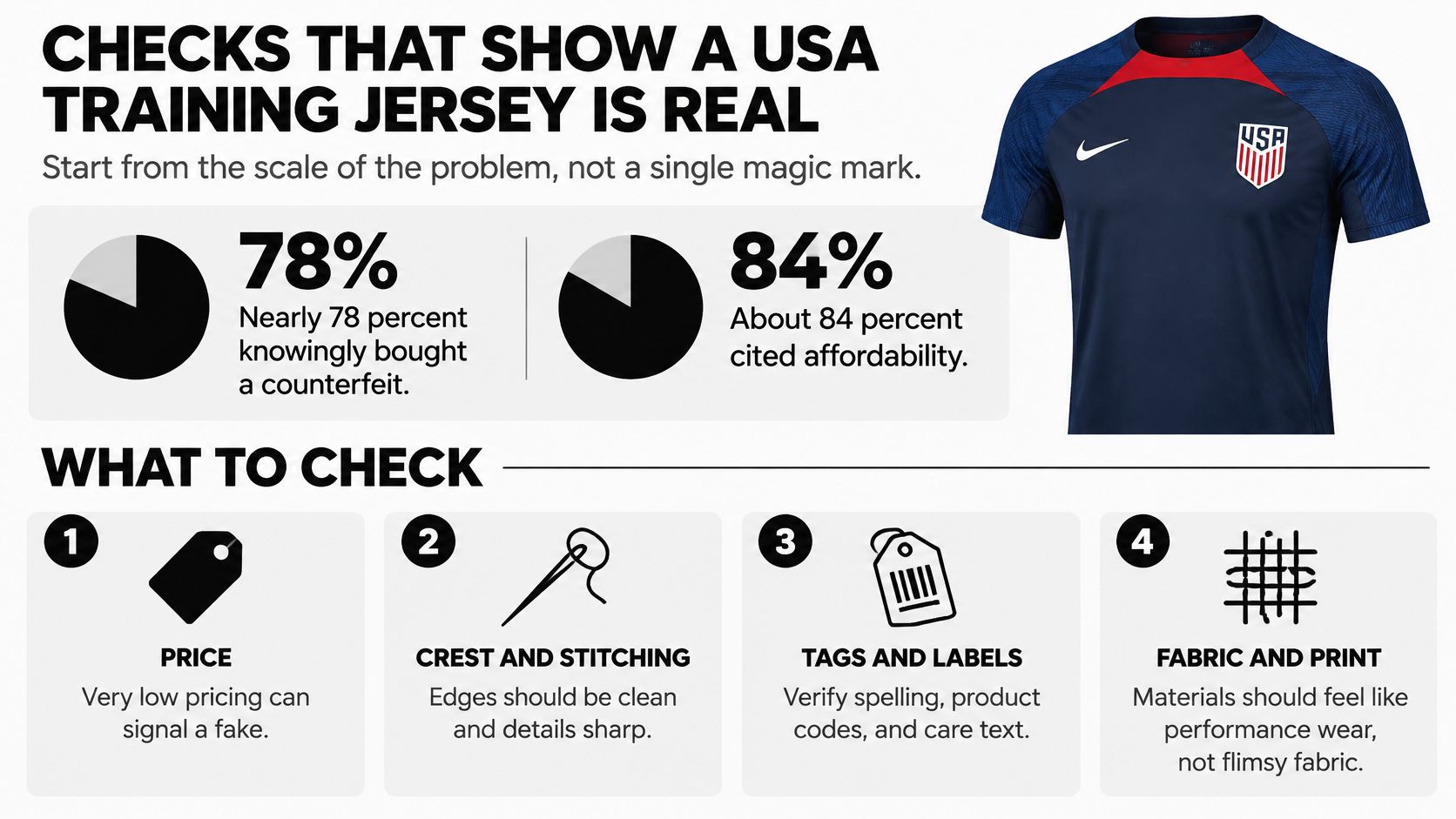
Check the shirt from the seller outward. No single detail guarantees authenticity, but several mismatches should make you pause.
| Check | Genuine sign | Red flag |
|---|---|---|
| Seller | Official store or a source tied to the club, brand, or a verified partner | No provenance and only a stock photo |
| Labels | Neck label, product code, size label, and wash tag | Missing, generic, or conflicting tags |
| Stitching | Even seams, firm at shoulders and side panels | Loose threads or puckered joins |
| Badge and print | Crest and graphics integrated into the fabric | Crooked, peeling, or heavily layered ink |
| Fabric | Lightweight polyester performance knit | Stiff blank cloth with no fiber claim |
| Price context | Official 2025 range about $40 to $165 | Extreme price treated as the only proof |
Inspect in a practical order
First, look at the seller. Official U.S. Soccer or Nike channels give you a clear starting point. If you're shopping elsewhere, check whether the seller can explain where the shirt came from and provide clear pictures of the actual item, not just a catalogue image.
Next, compare the labels. Look for the neck label, product code, size label, and wash tag. The details should make sense together. A product code that doesn't match the garment, missing care information, or conflicting sizes deserves more scrutiny. A careful guide to checking football shirt authenticity can help you examine those details systematically.
Then inspect the seams, badge, and graphic. Look for even stitching and secure joins at the shoulders and side panels. A crest that's already peeling, crooked printing, loose threads, or a thick layer of ink over the fabric may signal poor construction.
Finish by judging the fabric and the price in context. A training shirt should feel like a lightweight performance knit, not an unmarked, stiff blank. U.S. Soccer's listed 2025 products ranged from about $40 to $165, so a low price alone doesn't prove a shirt is fake, and a high price doesn't prove it's genuine.
Before paying, confirm the return window and what the seller will accept as proof if the shirt doesn't match its listing. A clear return option gives you practical protection that a close-up of a swoosh cannot.
Dating a USA Shirt by Supplier Era
Say a seller calls a USA shirt vintage and shows you a close-up of the crest. Before judging the shirt's age from its appearance, look at the supplier mark. It's a useful first clue, though it doesn't authenticate the garment on its own.
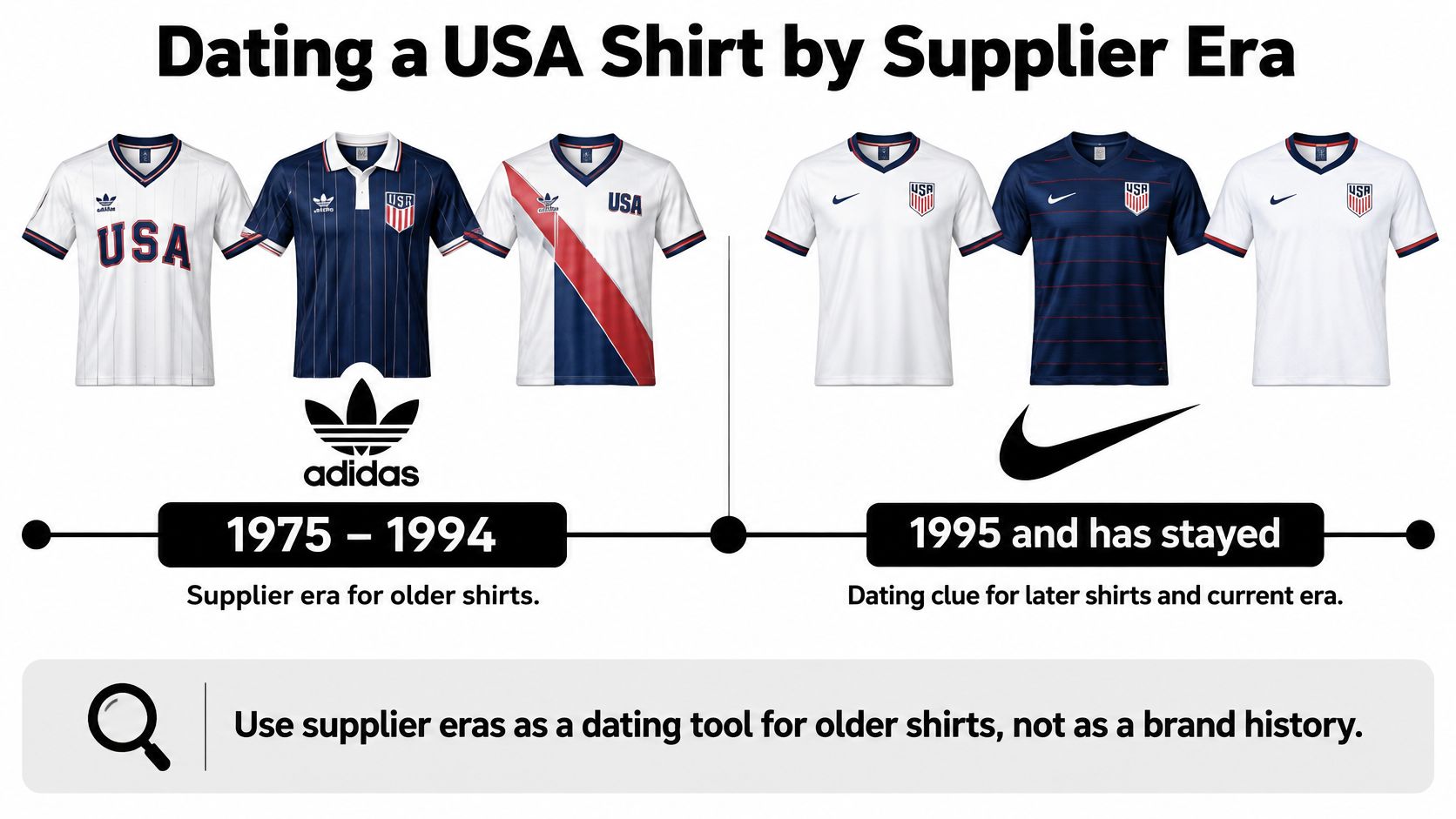
U.S. Soccer's account of its uniform history says Adidas supplied U.S. national-team uniforms from 1975 through 1994, and Nike became the supplier in 1995. That makes the handoff a useful dating check: a shirt with Adidas branding belongs to the earlier supplier era if it's genuine, while a Nike shirt points to the period beginning in 1995.
Read the design details
The supplier mark narrows the possibilities, but other details can help. In 2020, U.S. Soccer introduced a collection that included training apparel and fanwear alongside home and away uniforms. That collection used Nike's Futura logo rather than the standard Swoosh, making the logo a clue for shoppers looking at pieces from that launch.
A USWNT top with a fourth star also has a specific story behind it. The star represents the team's World Cup wins in 1991, 1999, 2015, and 2019. A training top can carry that mark without being the match shirt, so don't assume that a collectible-looking design tells you which garment type you're holding.
A supplier logo or star only helps you estimate an era. An old Adidas label doesn't prove a shirt is authentic, and a Futura logo alone doesn't confirm that a piece is from the 2020 collection. Check the neck label, product code, wash tag, and construction together before treating the date as settled. Then decide whether the shirt's condition and collector appeal justify the asking price.
Sizing and Fit for Practice, Layering and Kids
Don't order a USA training jersey by matching its size letter to your usual T-shirt. Measure your body, then compare the numbers with the seller's chart. A letter such as “medium” can mean a different chest, shoulder, or torso shape across product grades and men's and women's cuts.
| Measurement | How to take it | Compare with |
|---|---|---|
| Chest | Around the fullest point under the arms, relaxed | Chest figure on the seller chart |
| Waist | Around the natural waist, not the belly | Waist figure, mainly for women's cuts |
| Torso length | Shoulder seam to hem at the back | Back length, the usual failure for buyers abroad |
| Shoulder width | Edge to edge across the back | Shoulder figure, most important for training movement |
Test the fit with your arms
Once you have a candidate size, lift your arms overhead and rotate your shoulders as if you're reaching for a pass. The hem shouldn't climb up toward your ribs, and the shirt shouldn't pull sharply across your back. At the same time, avoid so much extra fabric that it catches or billows when you move.
Men's and women's cuts can differ in shoulder width, waist shape, and torso length. A men's medium isn't a reliable replacement for a women's medium just because both have the same letter on the tag. Compare the measurements rather than assuming that size labels translate between cuts.
Size up in these three cases:
- For casual layering: Go up one size if you want a looser fit over a hoodie, or if your measurements fall between sizes.
- For a child who's still growing: Leave room for a growth season, but check that the shoulders and torso still allow movement. Kids' shirts may be listed in numeric size ranges such as 128 to 158, rather than adult letters.
- For an all-day relaxed fit: A roomier cut may be more comfortable if you plan to wear the shirt around town as well as at the field.
For drills over a thin base layer, use the chart size, or consider a slimmer authentic cut if you prefer less fabric. Buyers outside the U.S. should pay particular attention to back length: a shirt that fits across the chest can still be uncomfortable if its torso is too short. If you're planning a different kind of active day, a practical guide to what to wear on marathon day is a useful reminder that clothing choices should match movement and layering needs. For a larger shirt option, this 3XL USA soccer jersey discussion can also help frame what to check beyond the label.
Simple rule: If the shirt needs to work for practice and daily wear, favor the roomier training or replica fit.
Polyester, Wicking and How to Wash the Shirt
Treat a USA training jersey as a performance layer, not a cotton tee with a crest. Official U.S. Soccer Nike Stadium jerseys use 100% polyester and Dri-FIT technology, which moves perspiration away from the skin to help it evaporate, according to the official U.S. Soccer Nike Stadium jersey listing.
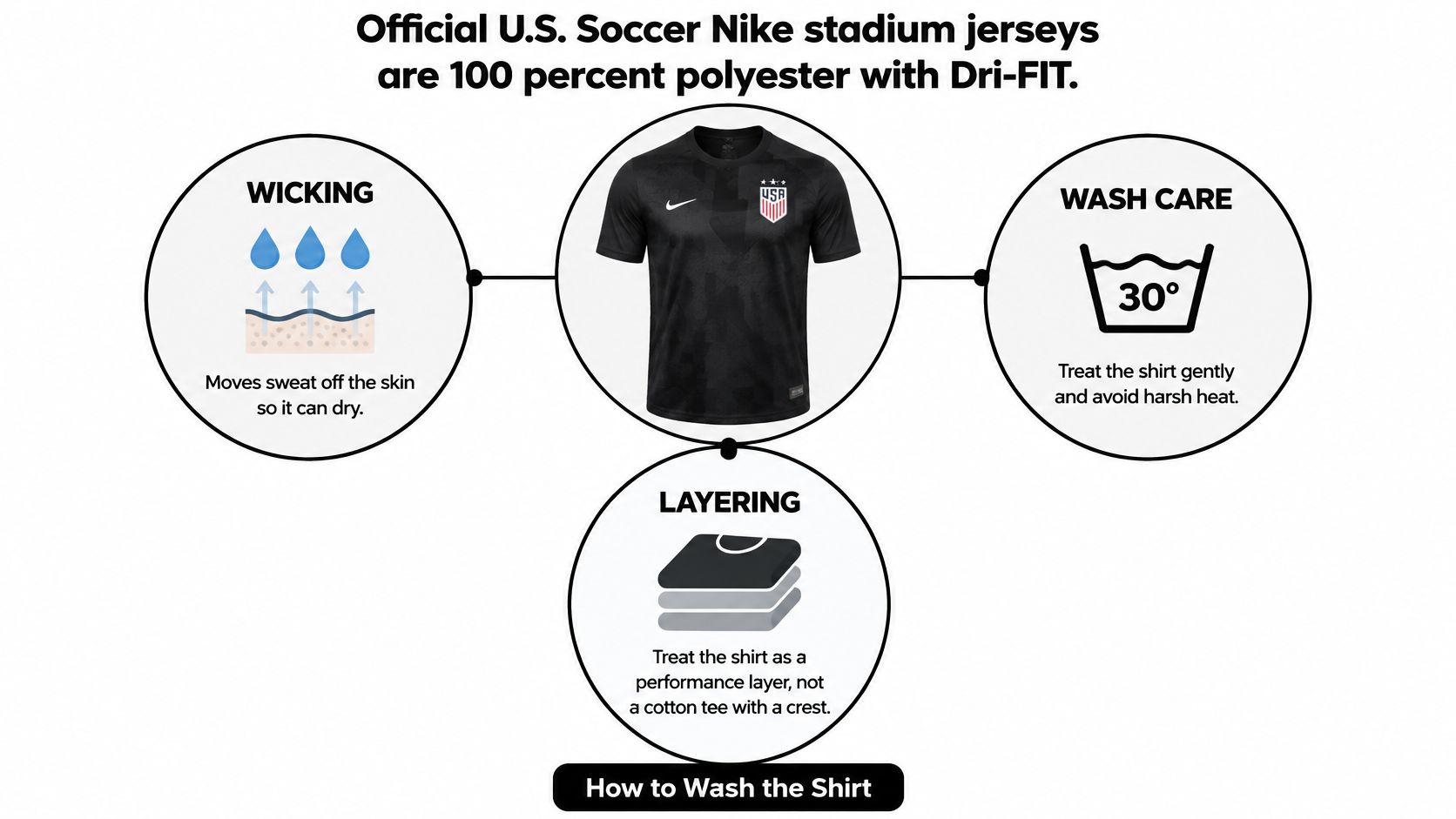
Think of polyester more like a tiled surface than a sponge. It absorbs less water than many fibers that readily take up moisture, while engineered yarns and the knit structure can move liquid toward the outer surface. That helps sweat evaporate and can reduce the wet, clingy feeling during repeated drills.
Look beyond the word breathable
When comparing shirts, check the fiber claim on the wash tag and look for a named moisture-management system, lightweight construction, and ventilation panels. “Breathable” by itself doesn't tell you how the garment handles perspiration. Fit matters too: a shirt needs enough room for shoulder rotation without leaving so much loose material that it catches during a sprint or change of direction.
Textile testing can help distinguish a measurable performance claim from a marketing phrase. ASTM's textile standards include references for sports-shirt fabric performance, textile moisture measurement, and textile conditioning and testing in its textile standards listing. For a buyer, the practical point is simple: a comparison is more useful when the fabric and testing conditions are clear.
Wash gently and inspect after use
Machine washing is permitted for the official jersey, but excessive heat and fabric softener can damage finishes and make moisture management less consistent over time. Turn the shirt inside out, wash it with similar colors, and avoid high heat in both the washer and dryer. If the badge or graphic is raised, air-drying is a sensible way to reduce wear.
After several washes, check whether the shoulder and side seams return to shape after stretching. Look at the graphic too: a print integrated into the fabric should hold up differently from a thick layer sitting on top. If the shirt bags out, stays wet, or develops cracks in its graphic quickly, its initial softness wasn't enough to make it a good training buy.
Buy with a Return Window You Can Actually Use
For a current USA training or stadium shirt in a size you already know, start with U.S. Soccer or Nike. Before paying, confirm the return conditions, especially if you're ordering from outside the United States. A seller's clear return terms are part of the purchase decision, not fine print to check after the shirt arrives.
Consider the limits of a surprise shirt
If you're open to receiving a shirt from another club, a mystery box offers a different kind of purchase. Mystershirt sells authentic jerseys from recent seasons with their original labels attached, sourced through clubs, official suppliers, and verified partners. Buying two Mystery Boxes for €84,90 includes a Training Shirt Mystery Box for free, but it doesn't guarantee a USA shirt or a particular team.
You can list clubs, leagues, or colors to avoid, but you can't request a specific club or exact shirt. Sizes range from children's options through 5XL in many adult boxes, so use your measurements before selecting a size. Read the Mystershirt returns and refunds policy before ordering so you know how the stated guarantee applies if the shirt isn't authentic or wearable.
When the parcel arrives, photograph the labels and tags before removing them. Compare the shirt's measurements with your notes, check the seams and fabric, and contact the seller promptly if anything doesn't match the listing. That arrival check is especially useful when you can't try the shirt on before buying.
If you're choosing a USA training jersey for practice, start with the cut and measurements, then weigh the seller's provenance and return terms. For an authentic shirt with the surprise of a mystery pick, Mystershirt offers boxes in a range of sizes and lets you list teams, leagues, or colors you'd rather avoid.


