
Your group chat is full of shirt sizes, someone wants to avoid a rival club, and a friend abroad has asked whether their share includes customs. You've found a shipping price, but you haven't yet worked out what everyone will pay to receive their shirt.
For a worldwide shipping group order, that's the calculation that matters. Each member needs a landed-cost estimate, a workable delivery address, and a named person who'll handle problems. Cheap postage isn't a saving if the recipient can't afford the import charge or the coordinator has to pay for another delivery attempt.
Table of Contents
- Pick a Group Setup That Fits Your Crew
- How to Run a Group Order from Collection to Checkout
- Splitting Deliveries Across Several Addresses
- Customs Paperwork and Who Pays Import Duties
- Refusals, Lost Parcels and Returns in a Group
- Landed Costs, Common Mistakes and the Final Check
Pick a Group Setup That Fits Your Crew
Start with how many people are ordering and how many countries you're sending to. Those decisions determine whether a shared checkout saves work or moves the sorting, forwarding, and customs problems onto one volunteer.
Group setups compared
| Setup | Best for | Main risk | Who tracks parcels |
|---|---|---|---|
| Sharing Box to one address | Friends unboxing together, choosing a five-box or ten-box setup | One person receives and redistributes everything | One coordinator |
| One checkout, one shared address | A small group in the same country | One failed delivery affects the whole group | Coordinator |
| Separate orders, individual addresses | A larger group spread across borders | More customs paperwork and more checkouts | Each buyer, with the coordinator keeping the list |
| Forwarding to one local recipient | A group buying from abroad with one collector | Extra handling and potentially another customs step | Recipient, plus any forwarder used |
I'd use a shared address for a small local group that can collect in person. For a larger international group, I'd favour individual orders so each buyer has their own destination details, customs record, and tracking.
Choose who does the redistribution
A shared unboxing works when everyone can meet. Otherwise, the collector becomes a small fulfilment operation, checking contents, matching shirts to members, buying packaging, and arranging onward postage.
Agree who takes that job before collecting money. If the collector lives abroad, include onward shipping and any further border crossing in the comparison, rather than treating delivery to the collector as the finish line.
For teammates, our guide to gifts for a football team can help separate individual preferences from the shared occasion. For an organised workplace group, Custom Mark's employee welcome kit merchandise planning is a useful companion when shirts form part of a wider kit.
Practical rule: Choose the setup, name the coordinator, and write down every destination country before anyone opens checkout.
How to Run a Group Order from Collection to Checkout
Use a shared Google Sheet or Excel workbook as the order record. Group chat is useful for reminders, but it's a poor place to retrieve an approved address or decide whether someone has paid.
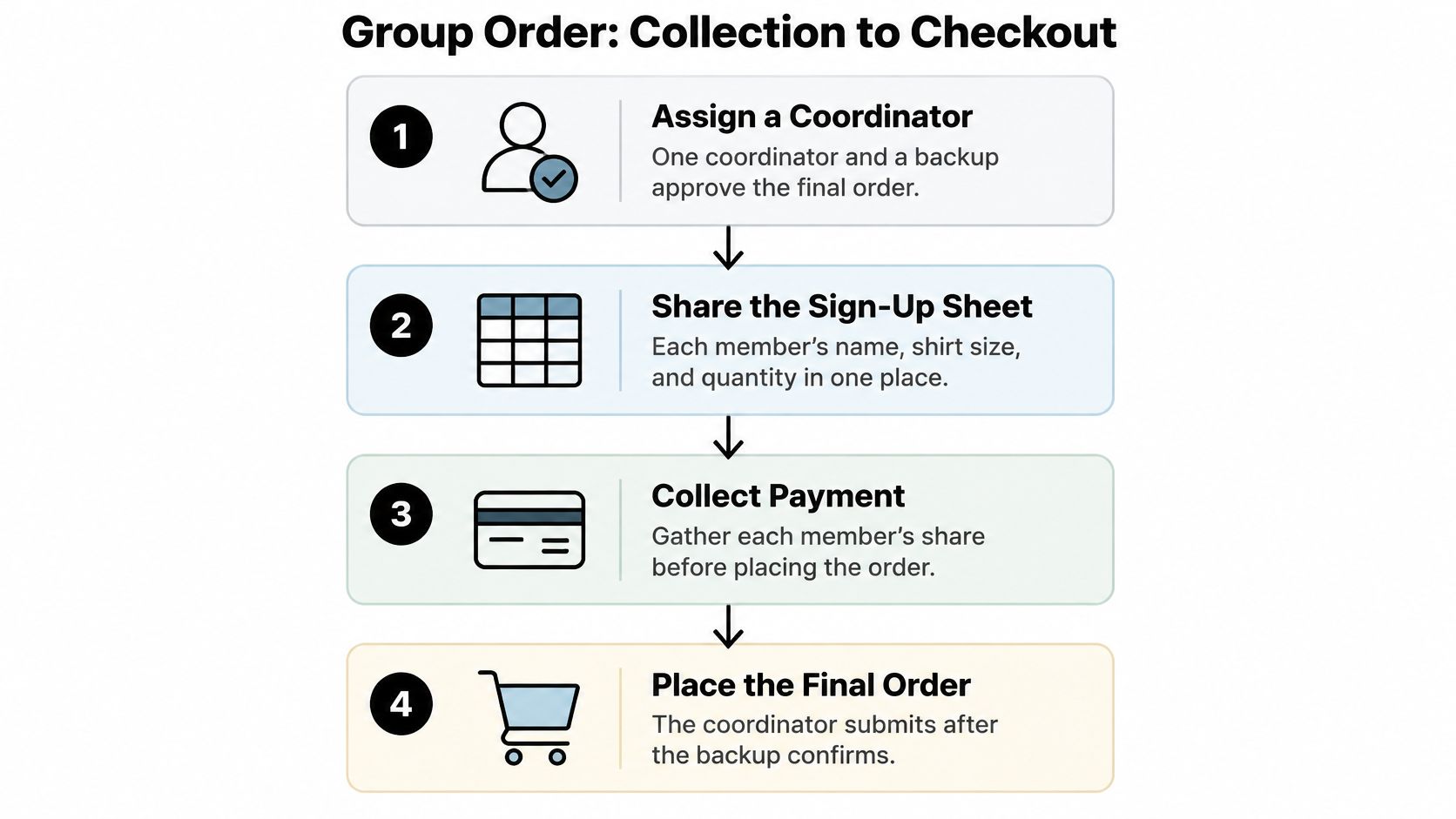
The collection and approval process should stay simple enough for a backup coordinator to take over.
Collect the information before the money
- Name a coordinator and a backup. Give the backup access to the sheet and responsibility for checking the final basket. The mistake to avoid is having several people making unrecorded changes.
- Record each member's name, quantity, requested shirt size, clubs or colours to avoid, and delivery country. Copy sizes exactly from the available selection rather than translating a member's usual clothing size yourself. Missing preferences are harder to resolve once the order has been submitted.
- Set a cutoff and a late-joiner rule. Work backwards from when the shirts are needed, leaving room for clearance and local distribution. Late additions should wait for another order if accommodating them would disrupt an approved basket.
Coordinating event clothing involves similar approval problems. Gradshop's guide to how to order caps and gowns offers a useful comparison for organising size selections and deadline-driven purchases.
Approve the basket and record the dispatch
- Validate addresses and collect payment. Have each recipient approve their postcode, building or flat number, name, and reachable phone number in the sheet. Don't ask the coordinator to finance uncertain commitments or guess missing address details.
- Submit the approved order before 4:00 PM for same-day shipping from us. Don't confuse dispatch with arrival, and don't rush an unchecked address just to meet the cutoff.
- Record the destination-specific checkout estimate. Our checkout shows how long shipping will take to the customer's destination, and customers choose the shipping method and how soon it arrives there. Copy the selected service and estimate into the sheet instead of giving everyone the same arrival promise.
- When the order ships, assign each tracking number to its parcel record and share it with the relevant recipient. Mark the parcel as dispatched, not delivered. The mistake here is posting an unlabelled batch of tracking numbers and expecting members to identify their own.
A complete order has one approved sheet, one cutoff, and an identifiable tracking record for every recipient. Save the order confirmation alongside it so the backup can resolve a question without searching through messages.
Splitting Deliveries Across Several Addresses
A correct street address can still be unusable if the courier can't match the recipient's name to the doorbell or workplace reception list. We deliver to the address the customer provides at ordering, where possible, and some deliveries require a signature.
For a flat, include the unit and the name displayed at the entrance. For a workplace, confirm that reception accepts personal parcels and knows the recipient. Don't assume a colleague can sign or that the courier can enter a locked building.
When a pickup point makes sense
Out-of-home delivery is a substantial part of online shopping: 25% of global online shoppers and 35% of European shoppers choose it, according to DHL's E-Commerce Trends Report. That makes lockers and parcel shops worth considering, but it doesn't establish that a particular service supports them for your order.
A pickup point can suit a shift worker who's rarely home or a student whose building has unreliable parcel access. The trade-off is that someone must collect within the permitted window, sometimes with identification or a collection code.
Before choosing one, confirm:
- Service compatibility: The selected carrier and destination support that particular locker or parcel shop.
- Recipient access: The named recipient can meet identification requirements and receive collection messages.
- Redirection rules: The carrier permits a change after dispatch, if that's part of your plan.
- Collection window: The recipient won't be away when the parcel becomes available.
Don't enter an ordinary locker street address unless the checkout or carrier explicitly supports that delivery method.
Track packages, not just people
For domestic redistribution after a shared delivery, compare collection with onward courier costs. Dirt Cheap Product, Inc.’s guide to regional shipping savings for small businesses is useful context for evaluating that local leg rather than automatically choosing a national service.
We package each shirt separately, including when a customer orders multiple boxes. That helps with sorting, but separate shirt packaging doesn't necessarily mean separate courier parcels or tracking numbers.
Use one sheet row per parcel, with a contents field listing the members whose shirts are inside. If someone receives several parcels, give each its own row. Otherwise, a partial delivery can look complete while another package is still moving.
Customs Paperwork and Who Pays Import Duties
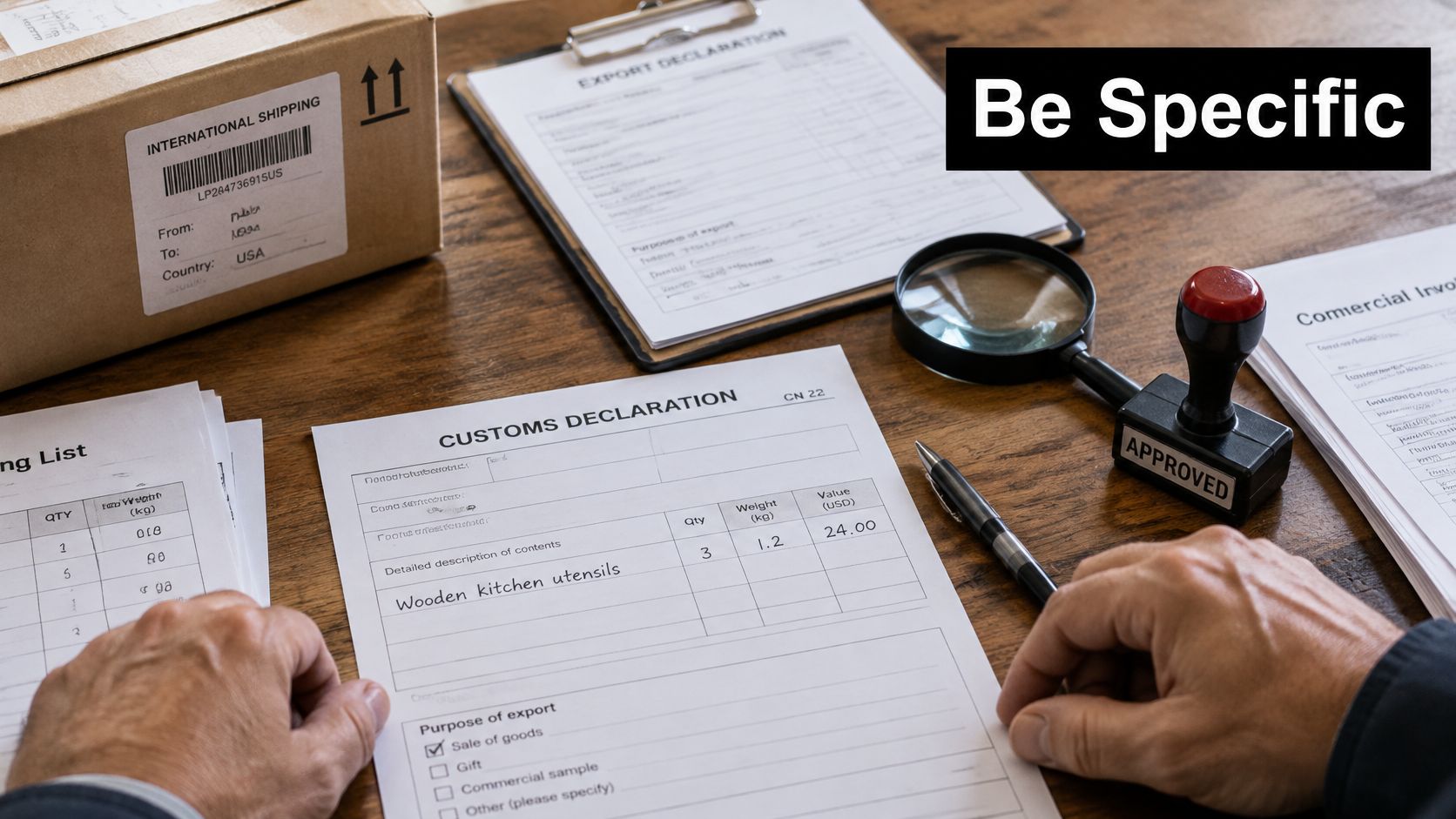
A vague description such as clothing can leave customs without enough information to assess a parcel. Ask the seller to use an accurate commercial description, such as football shirt, short-sleeved, club replica where that description is true, together with the correct transaction value and country of origin.
Don't confuse country of origin with the country where the parcel was dispatched. Don't reduce the declared value or describe a purchase as a gift to try to avoid charges.
The paperwork should describe the actual goods and transaction clearly.
Settle who pays before dispatch
For international parcels, distinguish prepaid duties and taxes from recipient-paid delivery. DHL's international shipping guidance is relevant when checking service options and customs arrangements; the selected checkout terms must establish what your particular shipment includes.
DDP versus DDU for group parcels
| Method | Who pays duty and tax | What the recipient sees | Main risk |
|---|---|---|---|
| DDP, duties paid in advance | Sender arranges payment, included in the checkout total | No additional import duty or tax at the door under the agreed arrangement | Higher upfront total can obscure comparisons with tax-exclusive offers |
| DDU, duties collected on delivery | Recipient pays assessed import charges | A payment request, potentially including a carrier handling fee | Refusal, return to sender, and another shipping bill |
| Domestic order, no border crossing | No import duty arises from that delivery | No border-related collection | Address errors, loss, damage, or carrier delays remain possible |
DDU is commonly used as shorthand for recipient-paid import charges. Read the seller's actual terms rather than relying on the acronym alone.
Prepare for clearance exceptions
Different destinations can require different documents and take different amounts of time to release a parcel. Leave a customs buffer before a birthday, match, or group event rather than promising arrival from dispatch speed alone.
Our customs clearance process guide can help recipients understand the stages. We're not responsible for delivery delays caused by carriers or customs, so an event deadline needs its own contingency.
A recipient-paid parcel isn't ready to send until the recipient knows they may have to pay to receive it.
Before dispatch, confirm the destination country, verify the duty method at checkout, retain the parcel's paperwork, and tell the recipient what charge to expect. Where the amount remains uncertain, label it as an estimate instead of presenting it as settled.
Refusals, Lost Parcels and Returns in a Group
Pull the affected parcel's tracking number from the sheet first. Don't start with the latest screenshot in group chat, which may show another member's shipment or an outdated status.
Then read the actual exception message. A request for customs documents, a missed collection, and a delivered scan require different responses. Sending every problem straight to reshipment creates avoidable costs and can leave the original parcel unresolved.
Match the response to the exception
- Customs hold: Identify the document requested and who must supply it. The seller may need to correct an invoice, while the recipient may need to provide information directly to the carrier or customs authority. Record the submission and keep the acknowledgement.
- Refused import charge: Contact the recipient to establish whether they understand the charge and can pay it. If they dispute the assessment, request the charge breakdown through the carrier's official channel before anyone assumes it's wrong.
- Delivered but missing: Confirm the entered address, reception desk, household members, and any permitted safe place. Use our delivery confirmation guide to organise the checks before escalating a non-receipt report.
- Uncollected pickup parcel: Check the collection deadline and whether authorised collection is possible. A locker notification isn't proof that the recipient has collected the package.
Save correspondence against the parcel record, with the next action and the person responsible. Share personal documents privately, not in the group chat.
Agree the next bill in writing
If tracking shows return to sender, establish what the seller or carrier requires before another attempt. Confirm receipt of the returned parcel where necessary, correct the underlying problem, and record who pays for reshipment.
For an authorised return, use the seller's approved method. A nearby parcel shop is only useful if it accepts the relevant return label; dropping the package into an unrelated network can make recovery harder.
Cost-control rule: No reshipment starts until the coordinator has recorded who pays for it.
Keep the member informed even when there's no new movement. A clear status and next action are more useful than repeated promises that the parcel should arrive soon.
Landed Costs, Common Mistakes and the Final Check
The lowest shipping line isn't necessarily the cheapest group option. Compare total landed cost per member, including the item, allocated shipping, expected import duty and tax, carrier handling charges, and any onward delivery.
Clear charges matter to buyers: 61% of cross-border shoppers consider clear delivery-charge information essential before purchase, while approximately half regard low customs duties as essential, according to the International Post Corporation's cross-border shopping survey. A low checkout total doesn't help a gift recipient who can't pay the later collection request.
Give each destination its own estimate
Create cost fields for each destination rather than dividing the entire bill equally without discussion. Members can agree to share costs equally, but that should be a deliberate arrangement, not an accidental subsidy.
Record a working estimate and a conservative charge allowance. Base the allowance on the relevant destination's rules and carrier fee information. If you can't establish a credible upper amount, mark it unresolved and obtain clarification before collecting payment.
For example, a member receiving locally may only need to cover their purchase and local delivery. A member receiving across a border may also need an import allowance, while someone collecting from a friend may face onward postage. Those aren't equivalent delivery arrangements.
Avoid these budgeting mistakes:
- Universal shipping estimates: A service quoted for one destination doesn't establish the price or timing for another.
- Unassigned charges: Record whether the member or group fund pays handling fees, onward postage, and an authorised reshipment.
- Unlabelled redistribution: Match each separately packaged shirt to its intended member before handing anything out.
- Automatic consolidation of collectibles: Compare separate shipping for higher-value items when individual ownership and claims need to remain clear. Don't split consignments to misrepresent their value or evade import rules.
Run the final payment check
Before anyone pays, complete the following checks:
- Match checkout to the sheet. Confirm the selected shipping method and destination estimate for every delivery arrangement.
- Approve each member's allowance. Have the member acknowledge the estimated landed cost and any unresolved import exposure.
- Verify the shared-box selection. Our Sharing Box costs €213.51 for five boxes or €393.31 for ten boxes. Confirm the chosen count and the final checkout total rather than assuming the displayed product price settles every delivery cost.
- Use the appropriate storefront. We have fulfilment centres in Belgium, the United Kingdom, and the United States, plus country-specific storefronts. Don't infer a parcel's dispatch location solely from the currency displayed.
- Read the return and size-exchange terms. Our guarantee covers everything in an order, but check the applicable procedure, conditions, and return-shipping responsibility before making promises to members.
If a member can't cover a surprise charge, don't substitute someone else's address and leave the liability unclear. Choose a confirmed prepaid arrangement, agree who can receive and fund the parcel, or postpone that member's purchase.
Mystershirt offers authentic mystery football shirts and group-friendly Sharing Boxes for a shared unboxing. Visit Mystershirt with your approved sizes, preferences, and destination list, then check each member's delivery option and total before placing the order.