You're scrolling past a faded football shirt with a bold sponsor, a generous collar, and colours that remind you of watching matches as a child. It looks perfect, perhaps for yourself, perhaps as a gift. Then you read the listing: retro, vintage, authentic. Do those words mean the same thing, and will the size on the label fit?
Table of Contents
- What Counts as a Retro Football Shirt
- How Replica Shirts Became Fan Culture
- Design Features That Define a Retro Look
- Retro Shirts and Modern Shirts Compared
- An Authenticity Framework for Buyers
- Sizing and Styling for Vintage Cuts
- Buying Routes and Why Mystery Boxes Work for Retro Fans
What Counts as a Retro Football Shirt
A retro football shirt is a shirt connected to an earlier football design or era. That description tells you something about its appearance, but it doesn't tell you when it was made, who authorised it, or whether it's an original garment. Those are separate questions.
Suppose you find several listings showing what appears to be the same old home kit. One seller offers a shirt manufactured during the season it represents. Another offers a recently produced, licensed recreation. A third sells a new shirt that borrows the colours and collar without claiming to reproduce the kit exactly.
They might all suit someone who loves the design. They aren't interchangeable purchases.
Name the category before choosing the shirt
- Original period shirt: A garment manufactured during the era it represents. If your aim is to own a physical piece of that period, this is the category to investigate.
- Officially licensed reissue: A later recreation produced with authorisation. It can offer the historical design without being an original period garment.
- Retro-inspired modern shirt: A contemporary product that borrows older visual ideas. It should be described as a modern interpretation rather than presented as a historical original.
A counterfeit is a different issue: it involves a false claim about a product's identity or authorisation. Don't confuse an openly described modern interpretation with a shirt being passed off as something it isn't.
Start with purpose: Decide whether you want an artefact, a faithful recreation, or simply a shirt you'll enjoy wearing.
That choice makes searching easier. An original collector might accept visible wear in exchange for documented history. Someone buying a birthday present might prefer a licensed recreation with clearer sizing and return arrangements.
You don't need to choose the most collectible option to participate in the hobby. The useful question is whether the shirt matches your expectations. Once you can name what you want, you can judge photographs, descriptions, measurements, and buying routes against that goal instead of relying on the word retro.
How Replica Shirts Became Fan Culture
The emotional appeal of a retro shirt makes more sense when you understand how supporters began wearing replicas. A shirt wasn't always an everyday way to announce your allegiance. The modern market grew as replica kit moved from specialist sports equipment into supporter clothing.
The National Football Museum identifies Admiral's 1973–74 replica shirt as a major turning point in that change. It helped establish the commercially licensed replica as an accessible version of what professional players wore, as described in the BBC's account of replica-shirt history.
The timeline below places that turning point within the wider development of supporter dress.
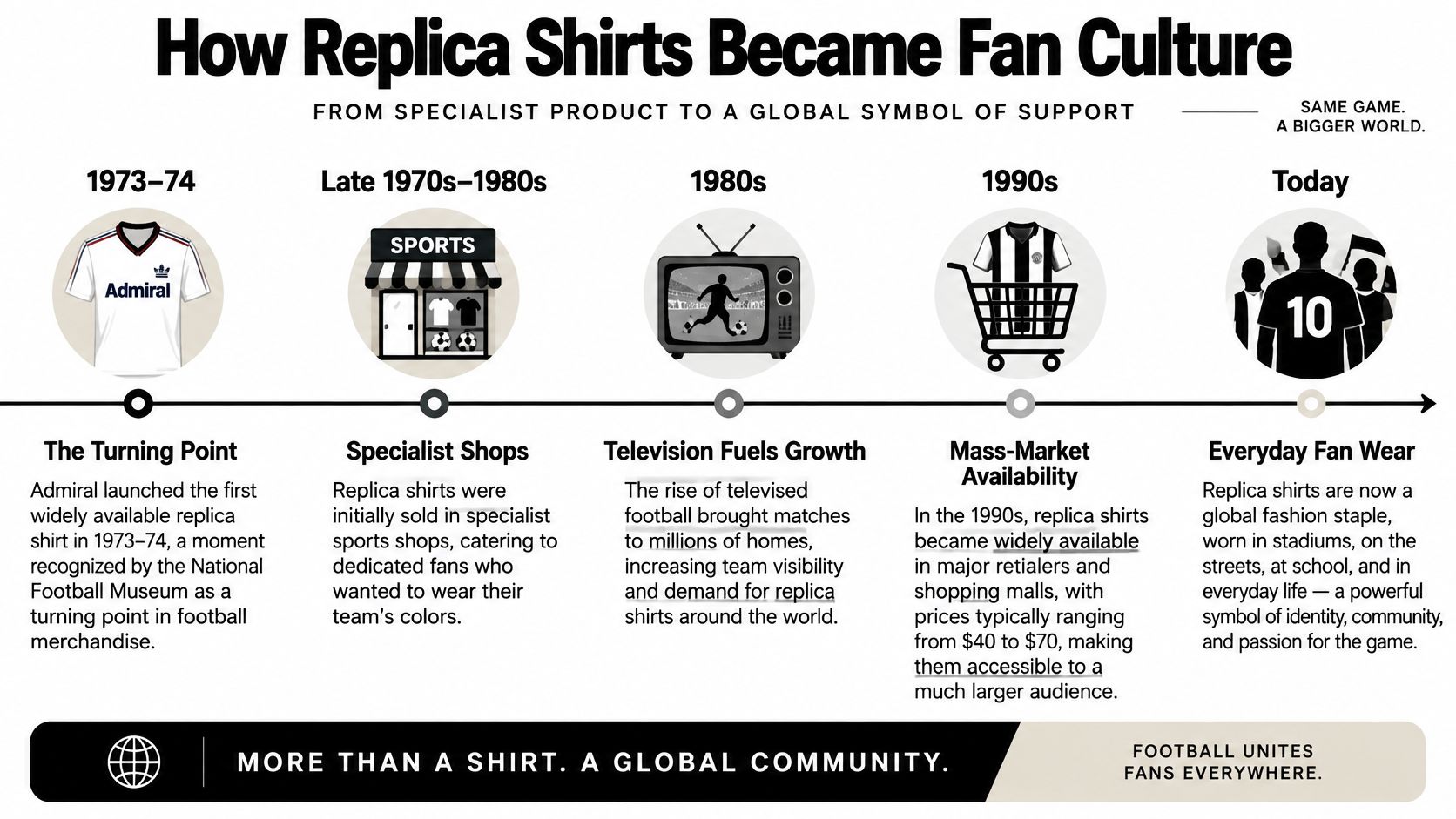
From buying equipment to wearing allegiance
The important change wasn't that more shirts became available. Supporters could wear a recognisable connection to their team away from the pitch. A replica became something you could associate with a match, a family member, or the first season you followed closely.
The research discussed in that BBC coverage found that 92% of respondents had bought an adult-sized replica, while 63% had owned a child-sized replica. It also recorded visible growth in shirt wearing between 1987–88 and 1990–91, followed by a sharper increase in 1992–93; by 1995, approximately 25%–30% of supporters were regularly seen wearing replicas.
Those figures describe the respondents and observations in that research, not every football supporter everywhere. Their value is in showing how established replica ownership and matchday wear had become within the culture being studied.
Why those shirts feel meaningful now
This history helps explain why designs from the 1980s and 1990s occupy such a prominent place in retro collecting. They belong to the period when mass-produced team shirts became closely connected with everyday fan identity.
For a collector, the attraction can therefore be more specific than liking an old pattern:
- Personal memory: The design recalls watching football with someone important.
- Club connection: The shirt represents a period the wearer wants to understand or celebrate.
- Design interest: The garment offers a tangible way to explore changes in football clothing.
You don't need to have lived through an era to appreciate its shirts. Learning their context can create a connection of its own. A thoughtful gift can acknowledge that interest without requiring the recipient to remember the original season.
Design Features That Define a Retro Look
Start with the fabric, not the sponsor. Earlier football kits commonly used heavy cotton or wool, while synthetics became increasingly important during the 1980s, allowing lighter garments with a shinier appearance. The Design Museum-related account of football-kit development in Domus connects these changes with demands for greater speed and comfort.
That transition matters because there isn't a single correct retro texture. A convincing recreation of an earlier cotton garment and one of a later synthetic shirt shouldn't necessarily feel alike. Fabric affects how a shirt hangs, catches light, and behaves when washed.
When you examine a listing, ask whether its textile character makes sense for the design being represented. A matching colour scheme alone isn't enough to establish historical accuracy.
Read the shirt as a complete design
Collars, crests, sponsor lettering, and trim are useful observation points. Look at the collar's shape, how the crest is attached, the proportions of the sponsor, and where contrasting panels meet. Treat these as details to compare with a documented example, not universal rules about what old shirts must look like.
Retro vs Modern Shirt Characteristics
| Characteristic | Retro Football Shirt | Modern Shirt |
|---|---|---|
| Fabric | Assess weight, texture, and sheen against the represented era | Assess the stated textile and intended use |
| Collar and trim | Compare shape and placement with the historical design | Judge the details against the current product specification |
| Crest | Check its construction and proportions against period evidence | Check the construction specified for that version |
| Sponsor | Examine lettering, scale, and position | Verify the design against the product being advertised |
| Overall appearance | Historical consistency matters more than isolated nostalgic details | A coherent contemporary design needn't imitate an older kit |
Use the table as an inspection method rather than a rigid old-versus-new checklist. An embroidered crest isn't automatic proof of age, and a shiny surface doesn't establish a particular season.
A shirt can look convincingly nostalgic while providing very little evidence about when it was made.
For a practical exercise, cover the listing title and study the photographs. Can you describe the fabric, collar, badge, and lettering without repeating the seller's claims? That habit helps you notice what's visible and identify which questions still need an answer.
Retro Shirts and Modern Shirts Compared
Choosing between retro and modern shirts is easier when you stop treating the choice as a contest. A collector looking for historical construction and a supporter looking for comfortable matchday clothing may reasonably choose different garments.
The distinction becomes especially useful with reissues. A shirt can reproduce an older design while using contemporary materials. Its appearance and its performance belong on separate lines of your buying checklist.
The comparison graphic offers a starting point, but its visual contrasts shouldn't be used as authentication rules.
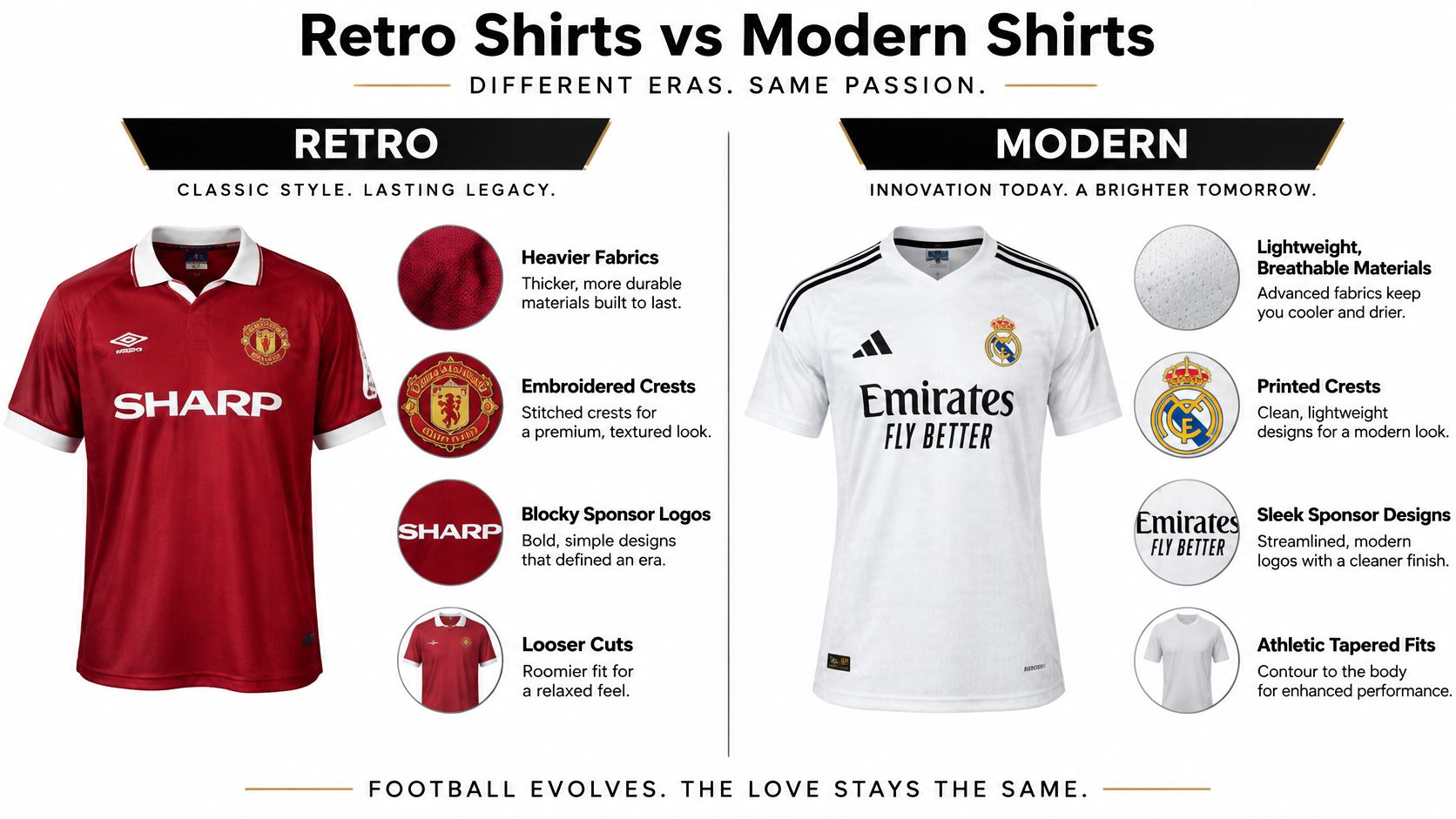
Comfort depends on construction
Polyester's limited absorbency doesn't automatically make it uncomfortable. Moisture transport, including wicking, matters: sweat needs to move through the fabric rather than remain trapped against the wearer.
Textile research published in Scientific Reports reports that polyester can take up sweat without retaining it through its wicking behaviour. In the tested fabrics, micro-polyester performed better for moisture management than textured polyester or polyester-spandex blends. The research also connects higher air permeability and lower thermal resistance with lower humidity and temperature within the clothing microclimate.
That's a reason to inspect construction, not a promise that every polyester shirt performs equally well. Ask about the knit, inner texture, and any claimed moisture-management finish rather than accepting polyester as a complete comfort specification.
Compare according to your intended use
- For regular wear: Prioritise how the actual garment feels, how freely you can move, and whether you're comfortable following its care instructions.
- For historical collecting: Decide how much original construction matters to you compared with condition and wearability.
- For contemporary convenience: Consider a reissue, but check what the seller means by historical accuracy.
- For environmental considerations: Ask whether you'll wear and care for the purchase. Don't assume that either the retro or modern label proves a lower environmental impact.
Fit and licensing deserve separate checks too. A modern-looking shirt isn't necessarily close-fitting, and an old-looking one isn't necessarily licensed. Those details must come from the specific garment and its documentation.
A useful shop-floor test is to ask yourself what you're paying for: period history, a recreated design, or everyday wear. There's no need to demand that one shirt do every job.
An Authenticity Framework for Buyers
Authenticity should describe a documented product category, not a feeling. Nostalgia, apparent rarity, and an ambitious asking price don't establish what a shirt is.
Academic research on affordable heritage products identifies counterfeit avoidance as a benefit and notes potential quality and ethical shortcomings associated with counterfeit shirts. For buyers, the practical response is to check the seller's specific claim rather than search for a single reassuring detail.
Build an evidence chain
Use the following hierarchy as a working method. It isn't a guarantee, and some evidence may be unavailable, but it helps prevent a neck label from carrying more weight than it should.
- Begin with archival photographs and club records. Establish what the claimed shirt looked like. Compare collar shape, panel layout, crest position, and sponsor proportions with clear references.
- Check manufacturer and sponsor details. Ask whether those elements agree with the claimed version. Investigate discrepancies rather than assuming every difference is either harmless or fraudulent.
- Examine construction and labels together. Request close-ups of stitching, fabric, neck labels, and care labels. Look for consistency across the garment.
- Review seller documentation. Ask what supports the description, including purchase records or provenance where available. Packaging can contribute context, but it shouldn't replace inspection of the shirt itself.
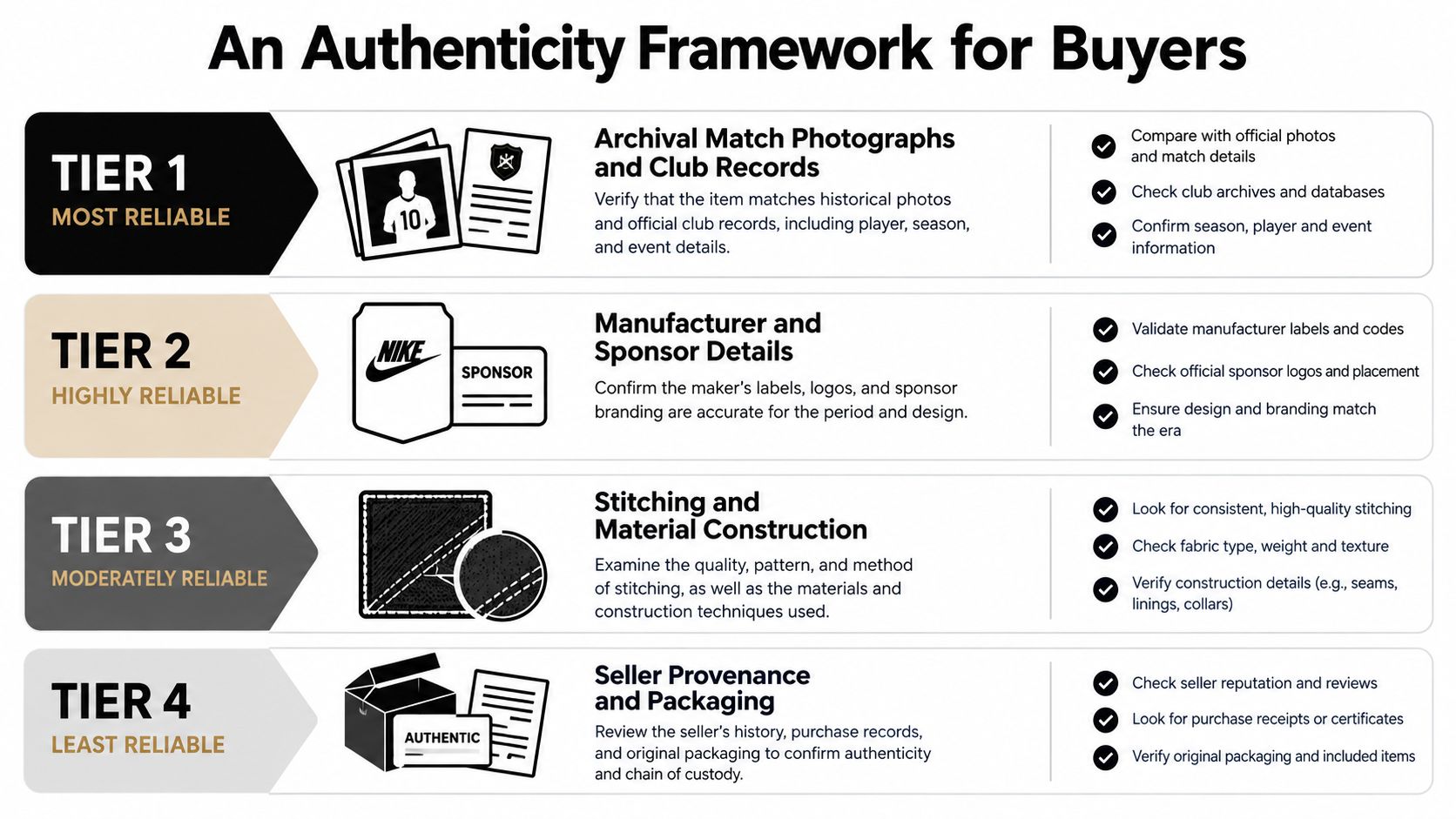
Allow an honest uncertain answer
A legitimate reissue can closely reproduce the visible design while using modern labels, materials, or sizing. That doesn't make it a counterfeit. The question is whether it's being accurately sold as a reissue rather than an original period garment.
You can use this football-shirt authenticity checklist to organise the details you want to inspect. Keep the assessment focused on the particular shirt, not a seller's general enthusiasm.
When evidence is missing: Treat the category as unverified rather than converting uncertainty into confidence.
Ask for missing photographs before paying. If the seller can't establish a claimed original's history, you can decline, seek knowledgeable help, or choose a purchase whose description you can verify more comfortably.
You don't have to deliver a definitive counterfeit verdict to protect yourself. Sometimes the soundest conclusion is just that the available evidence doesn't justify the purchase.
Sizing and Styling for Vintage Cuts
A shirt can be exactly what the seller claims and still make a disappointing gift if the recipient can't wear it. Measurements should lead the decision, with the label used as supporting information.
The image below shows the flat-laid approach to comparing garments.
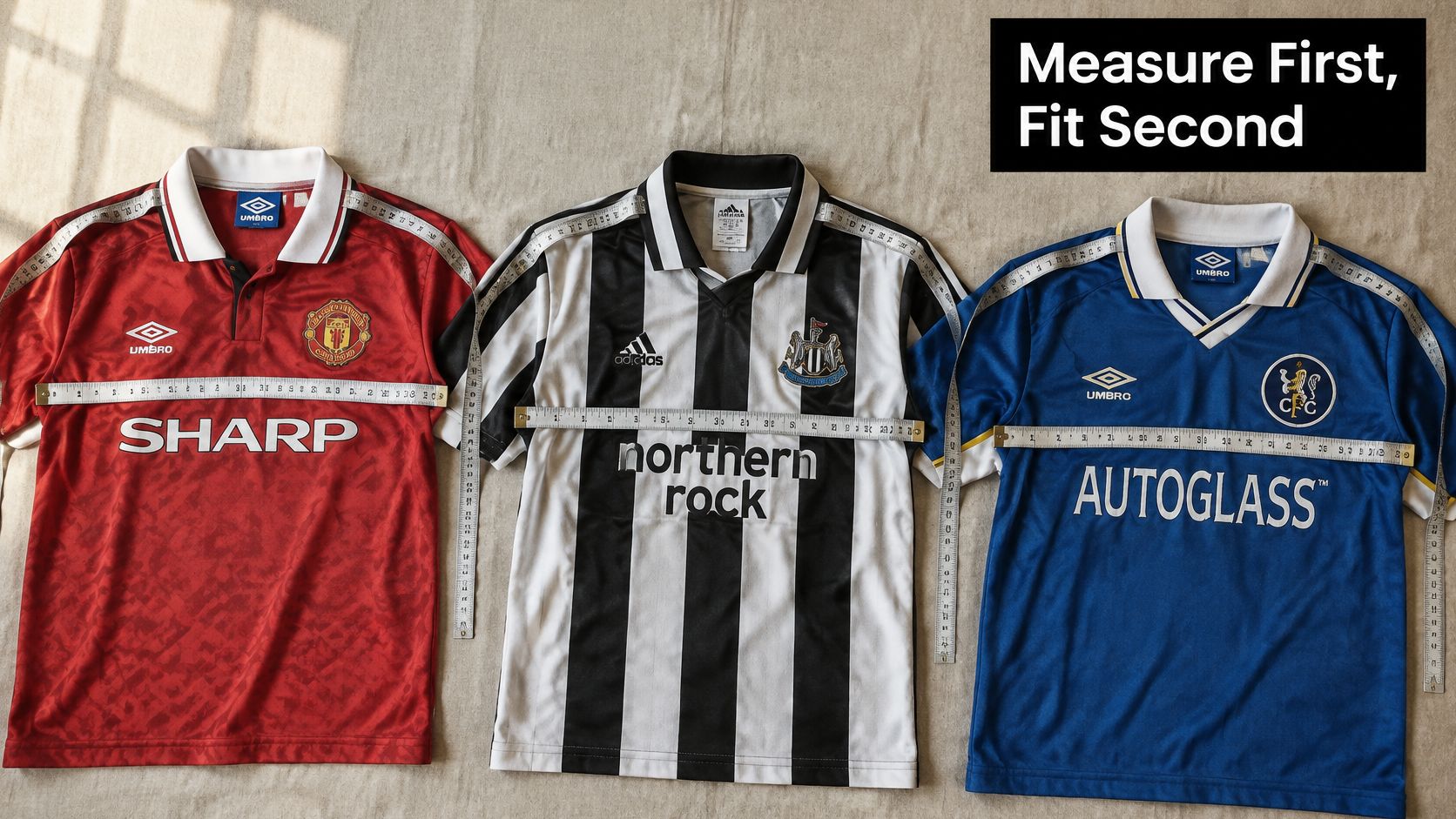
Choose a fit profile
Vintage football-shirt sizing guidance recommends comparing pit-to-pit width and garment length with a shirt you already own. Older garments can be boxier and longer, while player versions may be narrower and shorter; manufacturer, country, and era also affect sizing.
Use these profiles to describe the fit you want, not to predict it from appearance alone:
- Relaxed retro: Look for comfortable chest room and a length you enjoy wearing untucked.
- Slim player issue: Check chest width and body length carefully rather than automatically buying your usual label.
- Modern reissue: Consult that product's measurements instead of assuming it follows either historical or current sizing.
Lay a well-fitting shirt flat without stretching it. Measure across the chest from armpit to armpit, then measure its length, noting the starting point so the seller can use the same method. Compare like with like, especially whether a listing gives flat chest width or full chest circumference.
Make gifts easier to get right
For international purchases, use the seller's UK, EU, or US chart to interpret the label, then confirm garment dimensions. A football jersey size-chart guide can support that comparison. Robosize's women's size calculator guide is another resource for exploring sizing questions, but it shouldn't replace measurements of the vintage shirt.
For children or surprise gifts, compare with something the recipient currently wears comfortably. Ask about measurement variation and returns; there isn't a universal tolerance that suits every wearer.
Keep those comparison points in mind when watching the accompanying video.
For off-pitch styling, try jeans or chinos and let a bold shirt provide the main colour. An open overshirt can make the outfit feel understated without hiding the design.
Buying Routes and Why Mystery Boxes Work for Retro Fans
Your buying route should reflect how specific your wish list is. If you want a particular original shirt, search listings that let you inspect the exact garment. If you want a historical design without requiring period manufacture, investigate licensed reissues.
A mystery box suits a different aim: discovering something you haven't chosen in advance. That can make it appealing to a curious collector or a gift shopper who knows the recipient loves football but doesn't know which shirt to select.
Keep the surprise within useful boundaries
A mystery purchase is lower-risk only when the seller's terms address your concerns. Size selection, clear authenticity commitments, exclusions, and workable returns matter more than the excitement of the packaging. Don't assume that a retro box necessarily means an original period garment unless its description says so.
One option to investigate is this football jersey mystery-box guide. Compare the available Retro, Premium, Kids, and Sharing choices with the recipient's interests, then check the current product page for sizing, exclusions, and refund conditions.
This approach works best when you're flexible about the exact team and design. If the recipient wants a particular season, a mystery box leaves the most important part of the gift unresolved.
Check before paying
- Category: Establish whether you're buying an original, a reissue, or an openly described modern interpretation.
- Fit: Confirm dimensions where available and understand what happens if the shirt doesn't fit.
- Preferences: Record relevant exclusions and check which requests the seller can accommodate.
- Condition: Understand whether wear is expected and how it will be described.
- Returns: Read eligibility requirements, deadlines, and return-shipping responsibilities.
A good first purchase doesn't need to be rare. It needs to be accurately described, suitable for its wearer, and interesting enough that they'll want to learn its story.
Mystershirt offers Mystery Soccer Jersey Boxes, including a Retro option for fans who enjoy discovering football designs beyond their usual search. Visit Mystershirt to compare the box choices, check sizing and current terms, and choose a surprise that fits the person as thoughtfully as the shirt.