You choose a football shirt in your child's usual age bracket, but the shoulders pull and the hem hangs like a dress. Buying football T-shirts for kids gets easier when you start with measurements and what they'll do in the shirt, rather than the age on the dropdown.
Table of Contents
- Measure Then Pick the Size
- Fan Shirts Versus Training Shirts
- Cords Seams and Play Safety Checks
- How to Tell a Real Kids Shirt
- Match Day Training and Gift Examples
- Choose a Shirt Your Child Can Wear
Measure Then Pick the Size
A child can match the age printed on a shirt and still need another size. Use the larger of chest or height to choose a starting point, then allow only modest room for growth. A size that leaves space to move is useful; one that hangs loosely may get in the way.
Age labels are a browsing shortcut, not a fitting method. The Alibaba kids' football clothing guide notes that a child aged 8 might need a 6–7 or 9–10 shirt depending on body shape, and recommends checking chest and height against the manufacturer's chart.
Get useful measurements at home
Use a flexible measuring tape, a flat wall and a book. Measure over light clothing, and have your child stand naturally rather than stretching upward or holding their breath.
- Standing height: Ask your child to stand barefoot against the wall, looking straight ahead. Rest the book flat on their head, mark its lower edge, then measure from the floor in centimetres.
- Chest circumference: Pass the tape under the arms and around the fullest part of the chest. Keep it level across the back and comfortably against the body, without squeezing.
- Current shirt: Check the label on a T-shirt that fits well, then look at its shoulder position, chest room and length. Labels can fit differently across styles.
The sizing tips for young body forms provide context for children's proportions. For a shirt purchase, use the maker's size chart to make the final choice.
Check whether the chart gives body measurements or garment measurements. Compare a child's chest circumference with a body-size chart. A shirt measured flat gives a different figure, so don't treat its width as though it were a body circumference.
Read size labels without treating them as guarantees
The ranges below are practical reference points for common youth labels, not universal sizing rules. Makers' charts can differ, so check the relevant chart before ordering. Height is given in centimetres; chest is the circumference around the body.
Typical kids football shirt sizes by height and chest
| Size label | Typical height | Typical chest |
|---|---|---|
| 116 | 111–116 cm | 58–60 cm |
| 128 | 123–128 cm | 64–66 cm |
| 140 | 135–140 cm | 70–72 cm |
| 158 | 153–158 cm | 80–82 cm |
If your child's height and chest point to different rows, choose the size that accommodates the larger requirement. For instance, a child whose height fits one row but whose chest fits the next should start with the chest-based size, then check the garment's cut and length.
If the chart offers 164, or your child is moving beyond its largest youth option, compare it with adult XS. The labels are not interchangeable: shoulder width, sleeve shape and body length can change the fit.
Practical rule: Growth room should leave space to move, not enough spare fabric to wrap around the body.
For a casual fan shirt, a little extra length may be comfortable. For a shirt used in play, check that the hem doesn't swing around the legs or gather when your child bends. Buying much larger can leave them tugging the shirt back into place.
A fan replica and a shirt for active play also have different fit priorities. A relaxed fit may suit watching a match, while a shirt for movement should stay comfortable without excess fabric. Choose based on the shirt's use as well as the measurements.
The decision is straightforward: if both measurements fit the same row, start there; if they differ, follow the larger requirement; if your child sits between youth and adult ranges, compare both charts before ordering.
Fan Shirts Versus Training Shirts
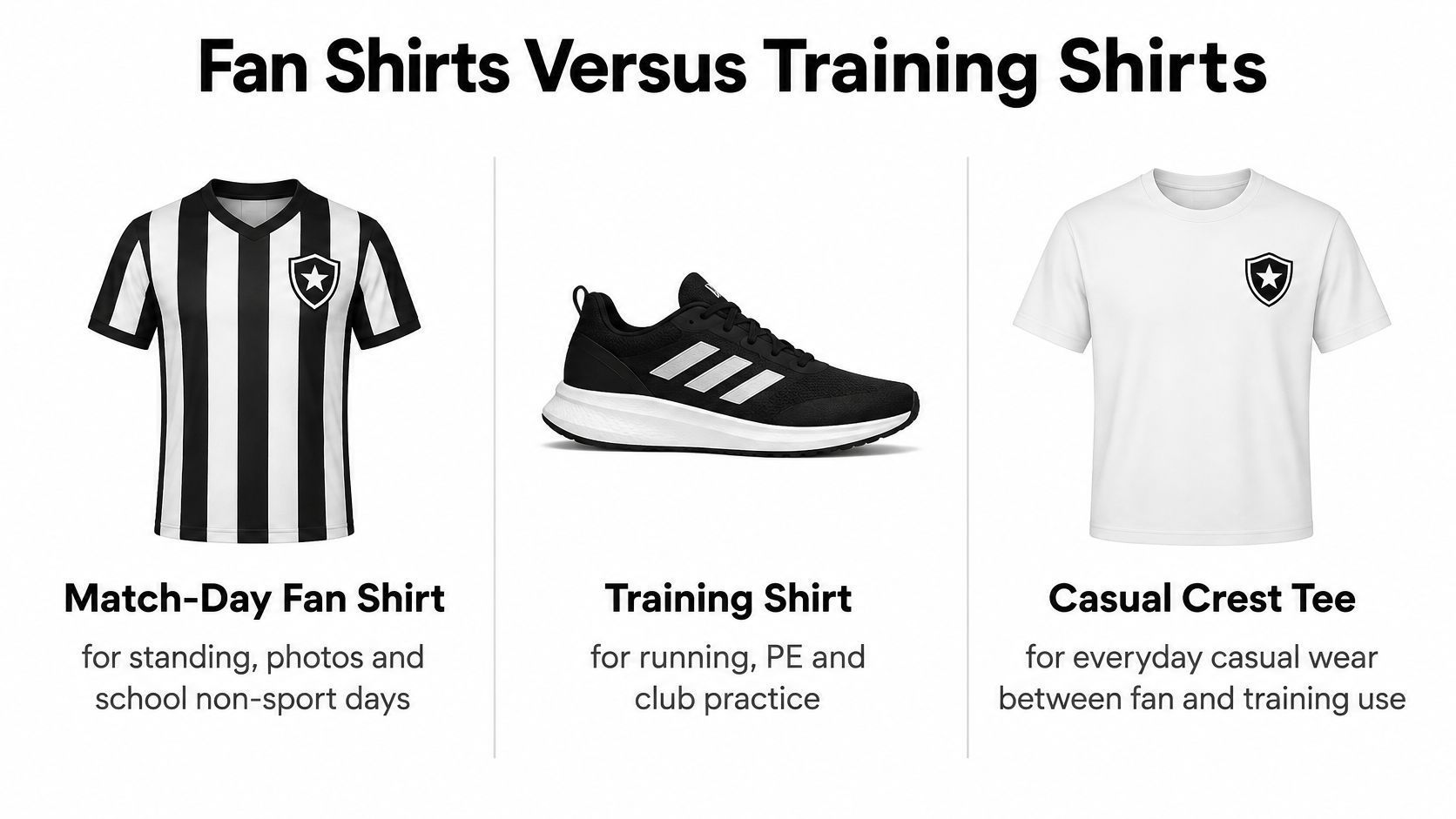
Start with the activity, not the crest. A match-day fan shirt is mainly for supporting, photographs and non-sport school days; a training shirt needs to work while a child runs, turns and sweats. A casual crest tee sits between those uses as everyday clothing.
The distinction is easier to see when you compare the jobs side by side.
Match the cloth to the effort
A sports-jersey review published in the Journal of Mechanical Engineering describes how knitted structures generally provide greater flexibility and moisture transport than woven fabrics, while fabric thickness, openness and fit affect comfort and drying.
Think of sweat entering tiny spaces between yarns, spreading towards the outside and then evaporating. A lightweight knitted polyester or performance blend is a sensible starting point for active use, with mesh or a more open knit in warm areas such as under the arms.
Moisture-wicking isn't a complete specification. Thick cloth can still feel hot, and a close-fitting cut can reduce the air space around the body. At the other extreme, a baggy shirt can flap, bunch and catch.
Which kids football shirt fits each use
| Use | Best garment | Fabric | Fit | Avoid |
|---|---|---|---|---|
| Match-day support | Replica home or away shirt | Printed polyester knit | Current fit or modest extra room | Hood cords and an excessively long hem |
| Training or PE | Performance football tee | Lightweight knitted polyester, with mesh in hot zones | Relaxed athletic, not baggy | Heavy cotton that feels wet during activity |
| School or casual | Crest T-shirt | Comfortable, breathable knit | Like a well-fitting everyday tee | A restrictive race cut |
| Gift with a known club | Official shirt from the preferred club | Clearly labelled replica fabric | Selected using height and chest | An age-only guess |
| Gift with a surprise club | Official labelled shirt in a confirmed size | Check composition when opened | Use the everyday T-shirt size as a cross-check | Buying excessively large so it lasts |
Test what the description can't tell you
Hold the fabric towards a lamp to inspect how open the construction looks, then pinch it to judge thickness. These are comparisons, not laboratory tests: printing, colour and lining can affect what you see.
Have your child lift both arms. The shirt shouldn't pull hard across the shoulders or drag the hem towards the chest, and a large sponsor print shouldn't feel like a stiff panel against the body.
A replica can be comfortable on the touchline yet unsuitable for sustained practice because of its cut, weight or decoration. For a concrete garment comparison, the USA training jersey guide can help you examine training-focused features rather than choosing by appearance alone.
Pick for the hardest use the shirt will face, not just the occasion on which it will first be opened.
Cords Seams and Play Safety Checks
A shirt can look harmless on a hanger and still snag during play. Check the neck and waist first: children's clothing safety standards restrict cords and drawstrings on play garments because they can catch or tighten. Reject neck cords, hood cords, dangling toggles and long decorative ties on a shirt intended for active wear.
A familiar badge does not remove that risk. A child may run, bend, reach and pull the shirt over their head, so inspect it as clothing for movement, not just as club merchandise.
Use this visual checklist when inspecting the shirt.
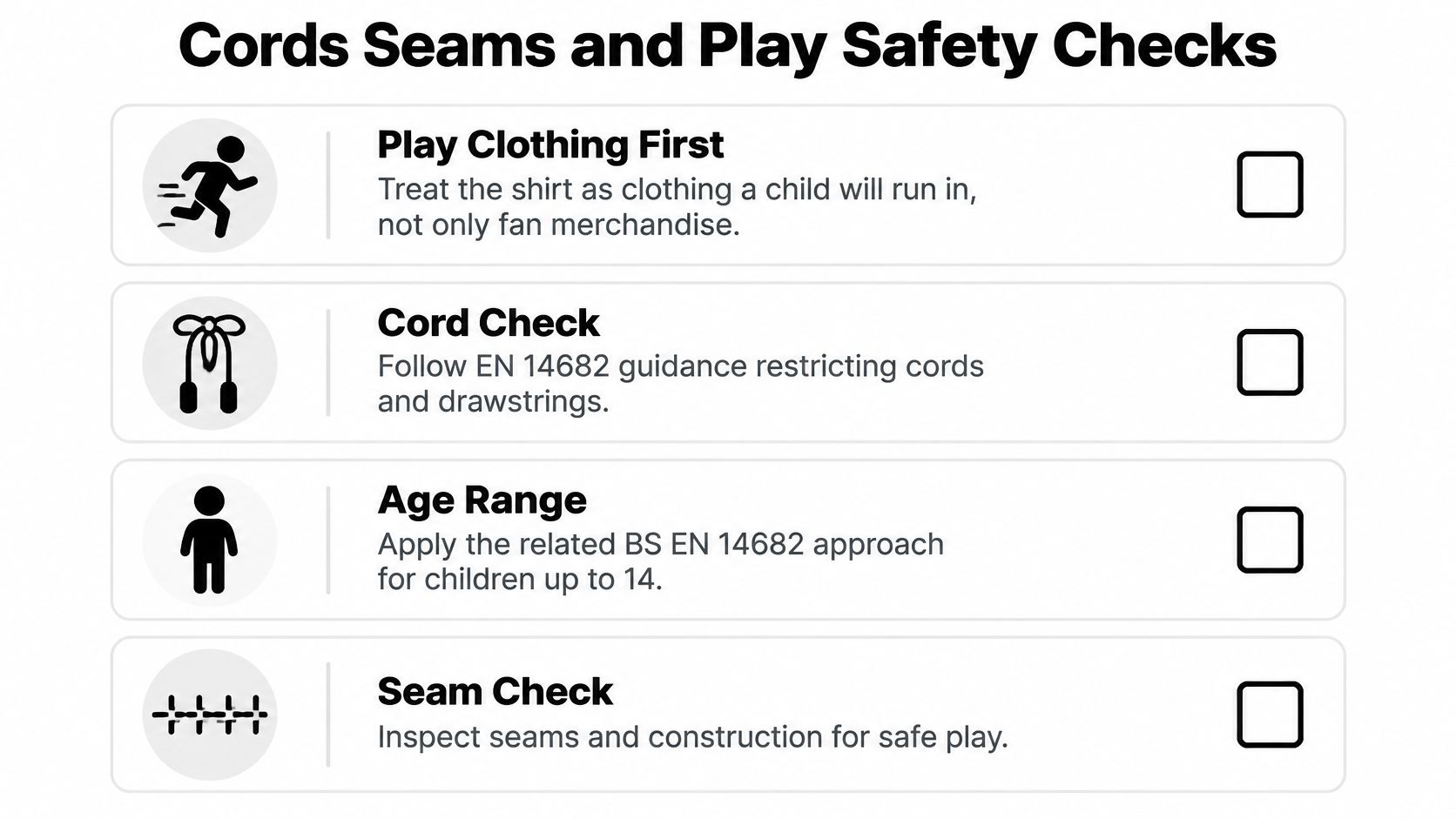
Inspect the parts that touch or detach
Turn the shirt inside out and trace the shoulder seams, underarms, cuffs and neckline with a finger. Look for scratchy thread ends, bulky joins and labels that rub when your child moves.
Now check the outside. Sponsor badges, crests and heat-applied numbers should sit securely, with no loose corners that invite picking or catch on nearby surfaces. Inspect gently rather than pulling at the decoration. If part is already coming away, set the shirt aside.
For personalised garments, the parent-safe custom kids apparel guide offers a companion reference for considering added decoration. Check a custom name or number as carefully as the original print.
Make the child move before deciding
Ask your child to raise both arms, turn their shoulders, jog briefly and change direction. Watch the shirt while they move, rather than relying only on whether it feels comfortable while standing still.
Sleeves should leave hands clear, the neckline should not pull against the throat, and the body should not twist enough to need constant straightening. If the shirt gets in the way, it is not a good choice for training, even if it looks right at rest.
Authenticity tells you where a shirt comes from. It doesn't certify that this particular garment fits your child safely.
Read the market-specific labels, fibre composition and care instructions, along with any applicable conformity information. These details help you inspect a garment, but a visual check by a parent cannot replace the manufacturer's compliance responsibilities.
Before the first wear, run through this short list:
- Cords and ties: No loose neck-area components or dangling decorations.
- Trim and seams: Secure badges, flat print edges and no irritating construction.
- Movement: Clear hands, unrestricted shoulders and no catching hem.
- Information: Readable composition and care labels appropriate to the garment.
If any check fails, set the shirt aside and arrange an exchange or return. A child should not have to remember to avoid a snag or irritating seam during a game.
How to Tell a Real Kids Shirt
An authentic football shirt is an official product from the club or brand responsible for it. A similar-looking crest in an online photograph isn't enough, and neat stitching alone can't establish authenticity.
Build a consistent picture from the labels, design and seller. Each check can reveal a reason to stop, but no isolated detail provides absolute proof.
Start with labels and season details
Look for a coherent set of brand, size, composition and care information. These details may appear across the neck label, inside side-seam labels and swing tags, so don't reject a shirt merely because the neckline doesn't contain everything.
A youth listing should explain its sizing clearly. If the seller photographs only an adult label while advertising children's sizes, ask for photographs of the actual youth garment before buying.
Next, compare the design with reliable images of the claimed season. Check the sponsor, collar, sleeve badges and shirt pattern together; a convincing crest doesn't explain a sponsor that belongs to a different design.
The football shirt authenticity checklist provides a broader reference for examining these details. Use clear close-ups rather than judging from a distant product photograph.
Separate warning signs from proof
Uneven stitching, blurred printing and misspelled branding warrant closer attention. However, a missing swing tag on a used shirt doesn't automatically make it fake, just as a tag on a supposedly new shirt doesn't automatically make it genuine.
Personalisation needs context too. A child's own name on the back can be legitimate custom printing; it isn't evidence of counterfeiting just because the name isn't on the squad list.
Use these buying checks:
- Seller identity: Look for a traceable business or seller history, clear contact details and usable return information.
- Actual garment photographs: Request readable labels and close-ups rather than accepting stock images alone.
- Consistent description: The advertised season, condition, size and included tags should agree with the photographs.
- Price context: Compare like-for-like condition and season, but don't treat either a bargain or a high price as authentication.
Accio's Amazon sales summary reported 538 monthly sales for a kids' soccer jersey listing in 2024, priced at $21.29; that demonstrates listing activity, not authenticity or a fair-price benchmark.
If the seller won't clarify a blurred crest, unexplained size or missing label, pause the purchase. A real shirt can still fail the fit test, while a shirt that fits perfectly can still be counterfeit. Those are separate purchasing decisions, and neither should excuse the other.
Match Day Training and Gift Examples
The practical question is whether the shirt suits the child's actual day. These hypothetical examples use sample measurements and assumed brand-chart results, not universal size conversions.
A football outfit can look ready for the pitch without telling you whether its cut suits sustained activity.
A weekend supporter becomes a midweek player
Say a 9-year-old measures 138 cm tall with a 66 cm chest. In this hypothetical brand chart, height selects 140, while chest would fit 128.
The parent chooses 140, then checks the delivered garment rather than adding another size automatically. For Saturday support and casual playground wear, a comfortable fan replica is a reasonable choice, provided the print feels flexible and the shirt passes the movement check.
Now suppose the same child joins midweek training. Their measurements haven't changed, but the clothing requirement has: the practice bag needs a lightweight performance knit with a relaxed athletic shape.
The replica can remain the weekend favourite. There's no need to reject it as a bad purchase just because a different garment is better suited to repeated running.
A birthday gift without a club preference
Consider a giver who knows the child currently wears 140 in a well-fitting everyday T-shirt but doesn't know which club would delight them. That label is a useful starting reference, especially if the parent confirms the shirt still fits, but it isn't permission to ignore the seller's sizing advice.
An official surprise shirt in the confirmed size makes more sense than guessing from the birthday age. Keep the labels attached while the recipient tries it on, and leave the giver's enthusiasm out of the keep-or-return decision if the garment pulls or hangs awkwardly.
For gift presentation and recipient considerations beyond sizing, the soccer gifts for kids guide offers additional ideas.
This video can provide a separate viewing break before making the final choice.
A child between youth and adult ranges
Suppose a 13-year-old is 160 cm tall, and their chest falls within a particular brand's adult XS chart. Compare that option with the largest suitable youth shirt rather than assuming the child must stay in children's clothing.
The adult shirt might accommodate the chest yet have sleeves or a body that are too long. The youth option might have a better length but insufficient shoulder room, so the final choice requires both the chart comparison and a try-on.
Across these cases, the useful pattern is consistent: measure the child, choose for the activity and verify the garment. The correct outcome isn't always the same size label or the same type of football shirt.
Choose a Shirt Your Child Can Wear
Write down your child's height, chest measurement and main use before opening a size selector. If any of those is unknown, resolve it before buying rather than filling the gap with an age-based guess.
For a known club, choose an official labelled shirt that suits the intended activity. Keep the distinction between collecting, casual wear and playing: a shirt can be a welcome gift without being the right garment for every training session.
Make the final choice on purpose
If you're buying for a surprise, our Kids Football Shirt Mystery Box is for children in sizes 128–158 and contains a 100% authentic football shirt in the right size. Every shirt is an official product from the club or brand that made it, with the original labels and tags still attached; you choose the size rather than the club.
Our fit is normal, and we advise ordering the size your child usually wears as a normal T-shirt. Use a shirt that fits now as that reference, not one they've outgrown or an oversized favourite kept for lounging.
A surprise should be about the club inside the box, not whether the child can wear what arrives.
Keep safety specific to the activity
Families buying clothing for several sports should avoid treating an official logo as a universal safety mark. For example, Bridle Up Hope Shop's guide to ASTM-certified helmets for young riders addresses a different, activity-specific equipment decision; a football shirt's branding makes no comparable protective promise.
When your shirt arrives, keep the packaging and tags while you inspect it. Confirm that labels are present, there's no neck cord, and your child can lift their arms and move freely.
If it twists, snags or restricts them, arrange a return rather than hoping they'll grow into a better relationship with the cut. A wearable shirt is the goal, not a plausible size label.
Our Kids Football Shirt Mystery Box pairs a club surprise with an authentic, originally labelled shirt in your child's selected size. Visit Mystershirt once you've checked their measurements and everyday T-shirt fit, then choose a size they can enjoy wearing now.