You've just opened your first club shirt, admired the crest, and then wondered where it should go. The wardrobe already holds match-day favourites, a retro purchase from a resale site, and perhaps a mystery box jersey you can't quite identify. Before long, the collection needs more than hangers. It needs a theme, a budget, a record of where each shirt came from, and a plan for keeping the fabric, badges, numbers, and signatures intact.
A serious soccer jersey collection sits between fandom, fashion, and sports memorabilia. The strongest collections aren't large. They're coherent, authenticated, properly stored, and built with enough discipline to avoid buying every attractive shirt that appears in your feed.
Table of Contents
- Why Soccer Jersey Collecting Became a Real Hobby
- Defining Your Collecting Style and Budget
- Where to Buy Authentic Jerseys Without Overpaying
- Authenticating Jerseys the Right Way
- Storing and Displaying Shirts So They Last
- Choosing Between Kids, Oversized, Retro, and Signed Shirts
- Insuring and Growing Your Collection Over Time
Why Soccer Jersey Collecting Became a Real Hobby
A shirt used to be an easy purchase after a big match or before a new season. Now, many collectors treat it as a historical object. The difference matters. If you see a jersey as merchandise, you focus on size, colour, and whether you'll wear it. If you see it as memorabilia, you also ask which season it represents, whether the design is authentic, how it was acquired, and how it should be preserved.
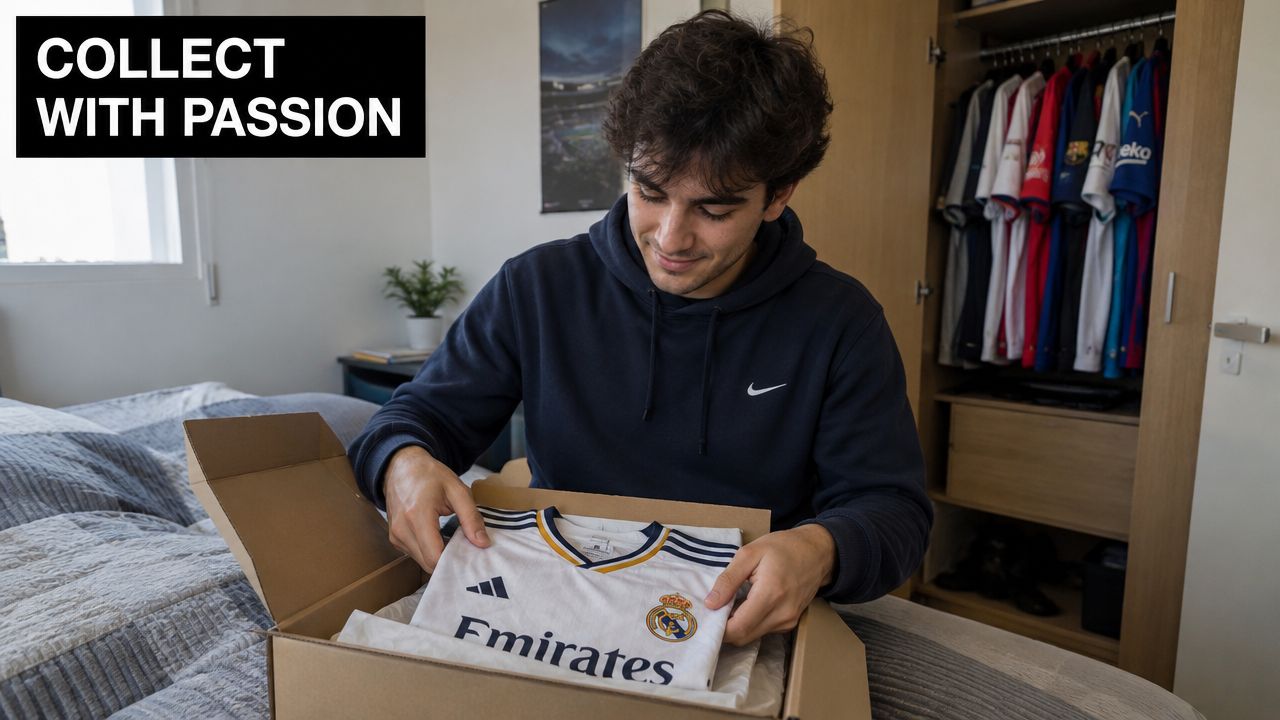
That shift has several causes. Global leagues made club identities more visible across borders, while retro shirt culture gave older designs a second life in streetwear and resale markets. Social platforms also turned buying into a shared activity. Collectors compare tags, debate player-issue details, trade duplicates, and open mystery boxes together. A surprise shirt can be fun, but experienced buyers still assess it against their theme rather than treating every unboxing as a win.
Museums have helped establish the cultural case for preserving shirts. The National Football Museum has displayed over 200 shirts in one exhibition, tracing the garment from thick Victorian wool through the replica boom of the 1970s, the polyester revolution of the 1980s, and the more expressive designs that followed Italia 1990. One UK museum also reported a shirt believed to date from the 1890s as possibly the country's oldest football shirt, as covered by Design Week's reporting on football shirt culture.
Collector's rule: Buy the story, not just the colourway.
The Madrid Legends project shows how far preservation can go. Its archive safeguards more than 5,000 football items, displays 600 pieces in Madrid, and covers over 100 years of football history, including match-worn shirts from UEFA, FIFA, CONMEBOL, Olympic Games, and LaLiga competitions, according to UEFA's account of the preservation project. Experts reportedly valued the collection at €198 million, while its founder Marcelo Ordás built it through an obsessive 30-year quest that began after receiving a shirt in 1990.
You don't need museum resources to collect intelligently. A focused archive of meaningful shirts can be more satisfying than an overflowing wardrobe. Collectors who also enjoy other preservation hobbies may find the same planning principles in this budget-friendly figure collection guide, especially around themes, storage, and resisting impulse purchases.
Defining Your Collecting Style and Budget
Start with a decision that has nothing to do with a particular shirt: what job should your collection perform? A wearable rotation, a wall display, a record of one club's history, and a resale-focused portfolio all require different buying habits.
Choose a scope before choosing a shirt
Pick one primary boundary. It might be a single club, a national team, a league, a tournament era, a manufacturer, or shirts connected to particular players. A narrow scope gives you a filter when a tempting listing appears. “I collect shirts I like” sounds flexible, but it usually produces duplicates, inconsistent quality, and a storage problem.
Then define your preferred format:
- Wearable collection: Prioritise comfortable modern replicas, durable prints, and sizes you'll use.
- Display collection: Focus on visual consistency, strong design, and frame dimensions.
- Historical collection: Look for season context, documented changes, and credible provenance.
- Trading collection: Buy items with clear demand, but only after checking authenticity and condition.
- Family collection: Consider kids' sizes, shared boxes, and shirts that can be passed on.
Your available space should influence the theme. Measure the wall, wardrobe, or shelving area before buying frames or oversized pieces. A shirt that looks manageable in a marketplace photograph can dominate a small room once mounted.
Set a cap that survives ordinary life
Use a written monthly limit and record the full purchase cost, including delivery, authentication, framing, cleaning, and storage materials. The exact amount depends on your circumstances. The useful rule is that a collection budget should be discretionary, not money needed for rent, bills, or emergency spending.
A practical one-page plan should contain:
- Theme: The club, era, competition, or player focus.
- Purpose: Wear, display, collecting history, trading, or a combination.
- Budget cap: Your monthly ceiling and an annual maximum.
- Storage plan: Hangers, archival boxes, frames, and available room.
- Starter list: Three shirts that define the collection, rather than ten impulse targets.
A small, deliberate collection can have more identity than a large random one. Leave room in the budget for opportunities, but don't let “rare” become a justification for ignoring condition, proof, or fit.
Where to Buy Authentic Jerseys Without Overpaying
No buying channel solves every collecting problem. Direct retail reduces authenticity anxiety but offers a narrow window of seasons. Resale markets open access to older and signed shirts, but shift the verification burden onto you. Mystery boxes add discovery, while swaps and sharing arrangements reduce the cost of experimentation.
Match the channel to the purchase
Direct retail works best for current releases and collectors who want a straightforward purchase from a club store, manufacturer, or authorised partner. You'll usually get the cleanest receipt trail and the easiest route for returns. The trade-off is selection. Once a season ends, the shirt you want may disappear from official stock.
Resale marketplaces and auctions suit collectors looking for retro designs, player versions, match-worn pieces, or shirts from less accessible leagues. Ask for close photographs before paying, inspect the seller's history, and treat a certificate as supporting evidence rather than automatic proof. Fees, shipping, cleaning, and authentication can materially change the final cost, so compare the total rather than the listing headline. For a broader discussion of how buyers assess shirt value, use this soccer jersey price guide.
Mystery boxes make sense when discovery is part of the hobby. They can help a new collector learn which clubs, eras, and manufacturers appeal to them, but the result is variable. Set rules before ordering. Choose an acceptable size, list exclusions, and decide whether you'll trade an unwanted shirt instead of forcing it into the main archive.
Swaps, rentals, and sharing groups are useful for families, friends, and collectors building a broad rotation. A shared purchase can spread the cost and create a practical way to test sizes or styles. Put ownership, condition, cleaning, and return expectations in writing, even among friends.
| Channel | Best For | Typical Cost | Main Risk |
|---|---|---|---|
| Direct retail | Current official releases | Retail pricing | Limited older-stock variety |
| Resale marketplace | Retro, rare, and signed shirts | Varies by condition and demand | Fakes, fees, and weak provenance |
| Mystery box | Discovery and controlled variety | Product-dependent | Receiving a shirt outside your theme |
| Swaps or sharing | Families, groups, and experimentation | Shared or exchanged cost | Unclear ownership or condition |
The best strategy is mixed. Use official retail for anchor pieces, resale for researched gaps, mystery boxes for affordable discovery, and swaps for duplicates or uncertain categories. Don't let one channel dictate the entire collection.
Authenticating Jerseys the Right Way
Authentication starts before payment, not after the parcel arrives. The sports memorabilia authentication market is projected to grow from USD 1.8 billion in 2026 to USD 6.2 billion by 2036, with investment and collection preservation representing 39.0% of end-use demand in 2026, according to Fact.MR's sports memorabilia authentication market report. Those figures point to a practical reality: collectors need better records because verification affects both confidence and future resale.
Use a repeatable inspection process
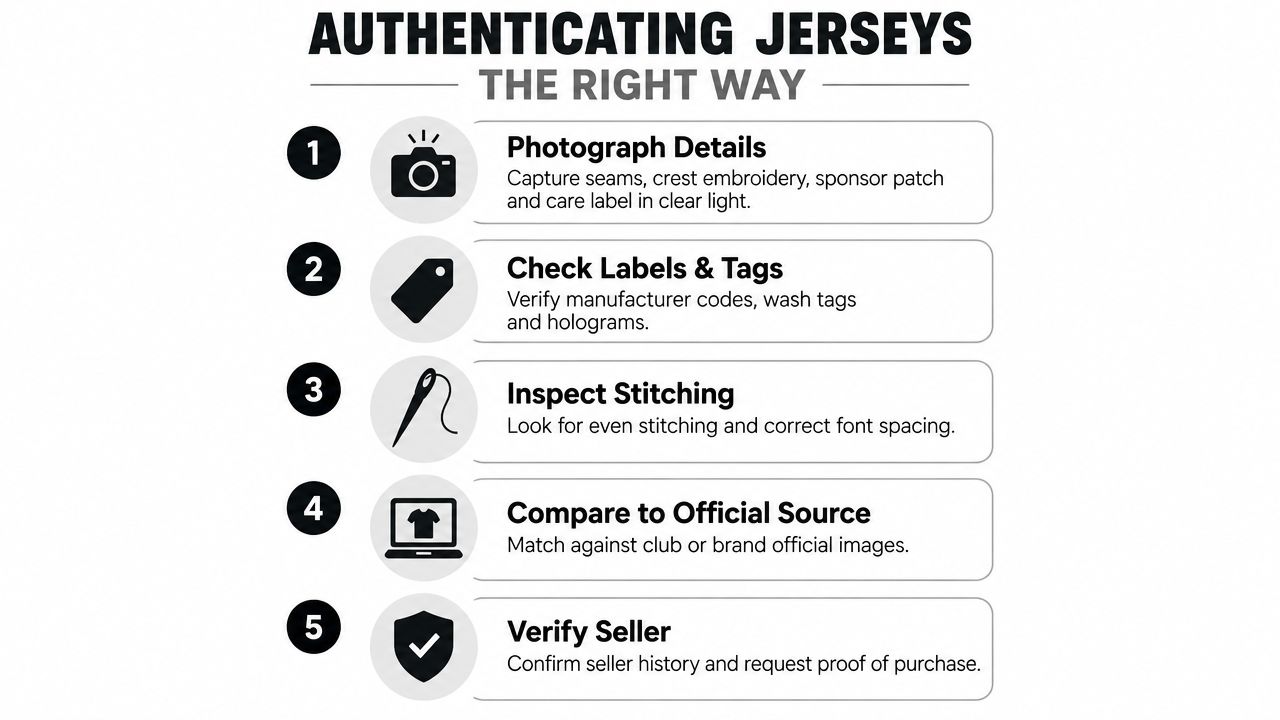
Photograph the details. Ask for, or take, clear images of every seam, crest, sponsor patch, size label, care label, sleeve cuff, numbers, and name set. Bright, angled light reveals uneven printing and sloppy embroidery that a flat product photograph can hide.
Check labels and tags. Compare manufacturer codes, wash tags, holograms, and internal labels with known legitimate examples. A correct-looking outer tag doesn't prove that the shirt itself is genuine. Fakers can combine authentic-looking components with incorrect fabric, fonts, or construction.
Inspect construction. Look closely at crest alignment, stitch density, sponsor placement, heat-pressed lettering, and the transition between panels. Common warning signs include an off-centre crest, plastisol transfers where a stitched badge should appear, mismatched sleeve cuffs, and polyester that feels noticeably lighter or cheaper than comparable shirts.
Compare against reliable references. Use official club or manufacturer images for overall placement, then compare the listing with trusted collector examples. Don't rely on one photograph. A seller should be willing to provide extra images of tags, flaws, and close-ups when asked.
Verify the seller and record the result. Review trade history, feedback patterns, return terms, and the seller's answers. Save receipts, original packaging, certificates of authenticity for signed pieces, and any match-specific evidence. Log the acquisition date, source, price, condition, photos, weight if relevant, and red flags in a spreadsheet.
Skipping the record-keeping step is a quiet mistake. Without an intake log, you'll eventually forget which seller supplied a shirt, whether a flaw existed on arrival, or where a certificate belongs. For a practical visual reference, compare your process with this guide on checking whether a football shirt is authentic.
A short video can also help you slow down and inspect construction before buying.
For high-value, match-worn, or signed shirts, third-party authentication and equipment-manager documentation add meaningful support. They don't replace your own inspection, but they create a stronger provenance chain.
Storing and Displaying Shirts So They Last
Storage and display are the same preservation problem viewed from different angles. A shirt hanging in direct sun is being stored badly, even if the frame looks expensive. A rare shirt kept in a damp box is not protected because it's out of sight.
Control the environment first
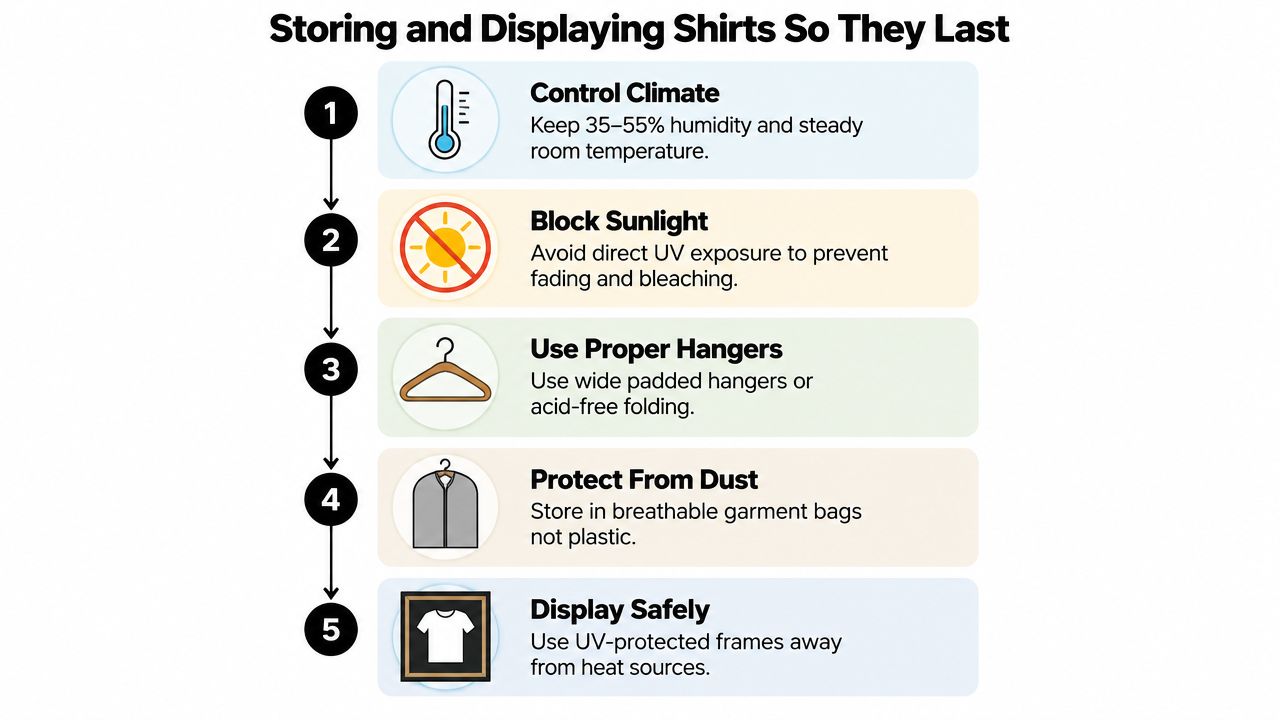
Expert guidance for match-worn football shirts recommends about 18 to 21°C and 40% to 50% relative humidity, alongside UV-protective framing and acid-free materials, as described in guidance on preserving sports memorabilia. Keep shirts away from attics, basements, garages, radiators, and rooms with sharp humidity changes. Direct sunlight, heat, moisture, and poor mounting accelerate fading, textile degradation, mould, and print damage.
Use wide, padded hangers for shirts that are displayed or accessed regularly. For long-term storage, fold the garment gently with archival tissue and place it in an acid-free box. Avoid sealing textiles in ordinary plastic, which can trap moisture. Keep a digital backup of receipts, certificates, photographs, and condition notes.
Choose the display tier carefully
A rotating rail suits shirts you wear and change frequently. Clip frames offer an accessible wall display for everyday pieces, but make sure clips don't pinch printed areas or pull the fabric. For a grail shirt, a UV-protected shadow box with acid-free backing provides better separation between the textile and the glass.
Before ordering a frame, measure a clean template shirt in the intended size and allow room for natural drape. Don't stretch the fabric to make it fit. Signed shirts deserve extra caution. Handle them with clean gloves when necessary, keep them away from glare, and choose a frame that won't press against the signature or sponsor print.
Display discipline: Rotate exposed shirts rather than treating a framed jersey as permanent wallpaper.
Keep a display log so you know which pieces have been exposed to light and when. A practical guide to displaying football shirt collections can help you plan rails, frames, and rotation. For broader textile-storage principles, this resource on how to protect clothes in long-term storage is also useful.
Preservation protects more than appearance. Creases, fading, warped numbers, and cracked sponsor graphics make a shirt harder to display, trade, insure, or sell. Spend first on environment and materials, then on decorative framing.
Choosing Between Kids, Oversized, Retro, and Signed Shirts
The right shirt type depends on what you value most. A kids' shirt may be affordable and emotionally important, while a signed retro piece may need specialist framing and a stronger provenance file. There's no universal hierarchy.
| Type | Price Range | Availability | Resale Demand | Display Fit | Best For |
|---|---|---|---|---|---|
| Regular adult | Broadest range | Usually strong | Broad buyer pool | Easiest to frame | New collectors and wearers |
| Kids | Often lower entry cost | Varies by club and season | More specialised | Smaller print area | Parents and compact displays |
| Oversized | Varies by release | Can be limited | Stronger when player-issue | Requires larger framing | Fashion-led collectors |
| Retro | Wide variation | Depends on authenticity and supply | Strong when tied to a recognised era | Visually distinctive | Nostalgia and heritage themes |
| Signed | Highly variable | Limited | Dependent on proof and player | Needs protected framing | Serious memorabilia collectors |
Regular adult shirts are the sensible baseline. They offer the broadest choice, work for wearing or framing, and usually make it easier to read names and numbers. If you're unsure where to start, build around pieces you can use rather than immediately chasing a premium format.
Kids' shirts suit parents creating a family archive or buying for a child who will outgrow the garment. The smaller print area can make names and numbers harder to appreciate in a frame, so inspect the layout before purchasing.
Oversized fits work well as fashion pieces, especially as jerseys move beyond traditional sportswear. They can be awkward to frame and may appeal to fewer buyers unless the shirt has player-issue significance. A relaxed fit isn't automatically a collectible premium.
Retro shirts carry strong emotional appeal, but the category has a wide authenticity range. Check labels, fabric, sponsor treatment, and construction carefully. Modern reissues can be excellent purchases, but they should be logged as reissues rather than represented as originals.
Signed shirts can anchor a collection, provided the signature has credible documentation. Store them as evidence-heavy pieces, not casual wall decoration.
A balanced starter mix might be 50% regular, 20% retro, 20% oversized, and 10% signed, but treat that as a planning example rather than a rule. Your theme should decide the ratio.
Insuring and Growing Your Collection Over Time
A collection becomes easier to protect when every shirt has a clear identity. Record the purchase price, condition, seller, photographs, certificates, and comparable resale listings. For unusual pieces, note why they matter, such as a match connection, player association, tournament history, or limited production context.
Build an insurance file
Create a folder for each important shirt and a master spreadsheet for the whole archive. Include front, back, label, crest, sponsor, signature, and flaw photographs. Keep receipts and provenance documents in both physical and digital form. Ask your home insurer whether the collection needs a personal-property rider or a specialist collectibles policy, and ask how signed items, storage conditions, and replacement values are treated.
Don't assume purchase price equals replacement cost. A shirt may become harder to replace, while another may become less desirable. Revalue the collection using current comparable listings, condition, authenticity, and rarity. Insurance decisions should follow documented evidence, not an optimistic estimate.
Use a controlled growth rhythm
A fixed monthly allowance prevents one exciting auction from consuming the money intended for several months of collecting. Divide potential purchases into three categories:
- Buy: A shirt that fits the theme, passes authentication, and stays within the planned cap.
- Hold: An interesting piece that needs more provenance, a better price, or a condition check.
- Trade: A duplicate or misaligned purchase that can fund a more meaningful addition.
Mystery boxes can sit in the controlled supplement category. They're most useful when you can set size and exclusion preferences, and when you already have a plan for duplicates. Sharing options can make sense for friends, teammates, or families who want variety without each person buying a complete standalone collection.
Use seasonal moments as research prompts rather than automatic buying triggers. Transfers, anniversaries, restocks, and tournament attention can all surface desirable shirts, but timing never replaces authentication or budget discipline. Trend coverage also points to the importance of heritage, narrative, and scarcity, rather than novelty alone, when judging longer-term collecting appeal, as discussed in recent soccer jersey trend analysis.
Every quarter, repeat the same maintenance loop: revalue, rephotograph, re-insure, and prune the wishlist. That routine keeps the collection financially documented and emotionally focused. It also creates a natural moment to sell pieces that no longer fit your theme before they occupy valuable space.
Mystershirt offers authentic football shirt mystery boxes in Premium, Retro, Kids, and sharing formats, with size selection and club, league, or colour exclusions to help shape a growing soccer jersey collection. Visit Mystershirt to choose a box that fits your collecting plan, then document the shirt as carefully as any other acquisition.