A red-and-white shirt walks onto the pitch, and the squares do most of the talking before the match has even settled. Few football designs identify a nation, a tournament, and a whole style of collecting as quickly as Croatia's checkered jersey.
Table of Contents
- The Origin of Football's Most Iconic Checkered Kit
- What Makes a Checkered Soccer Jersey
- Heritage Checks and Modern Checker Design Directions
- UEFA and FIFA Rules for Check Patterns on Match Kits
- Authentic vs Replica How to Tell the Difference
- How to Style Checkered Soccer Jerseys Off the Pitch
- Where Collectors Source Rare Checkered Jerseys
- Building Your Checkered Jersey Collection
The Origin of Football's Most Iconic Checkered Kit
Croatia's red-and-white checkered shirt first appeared in 1990, designed by Miroslav Šutej and worn in the country's first match as an independent nation on 17 October 1990, when Croatia defeated the United States 2–1. The design drew directly from the Croatian coat of arms, making the shirt more than team clothing. It placed national identity on the pitch in a pattern that could be recognized instantly.
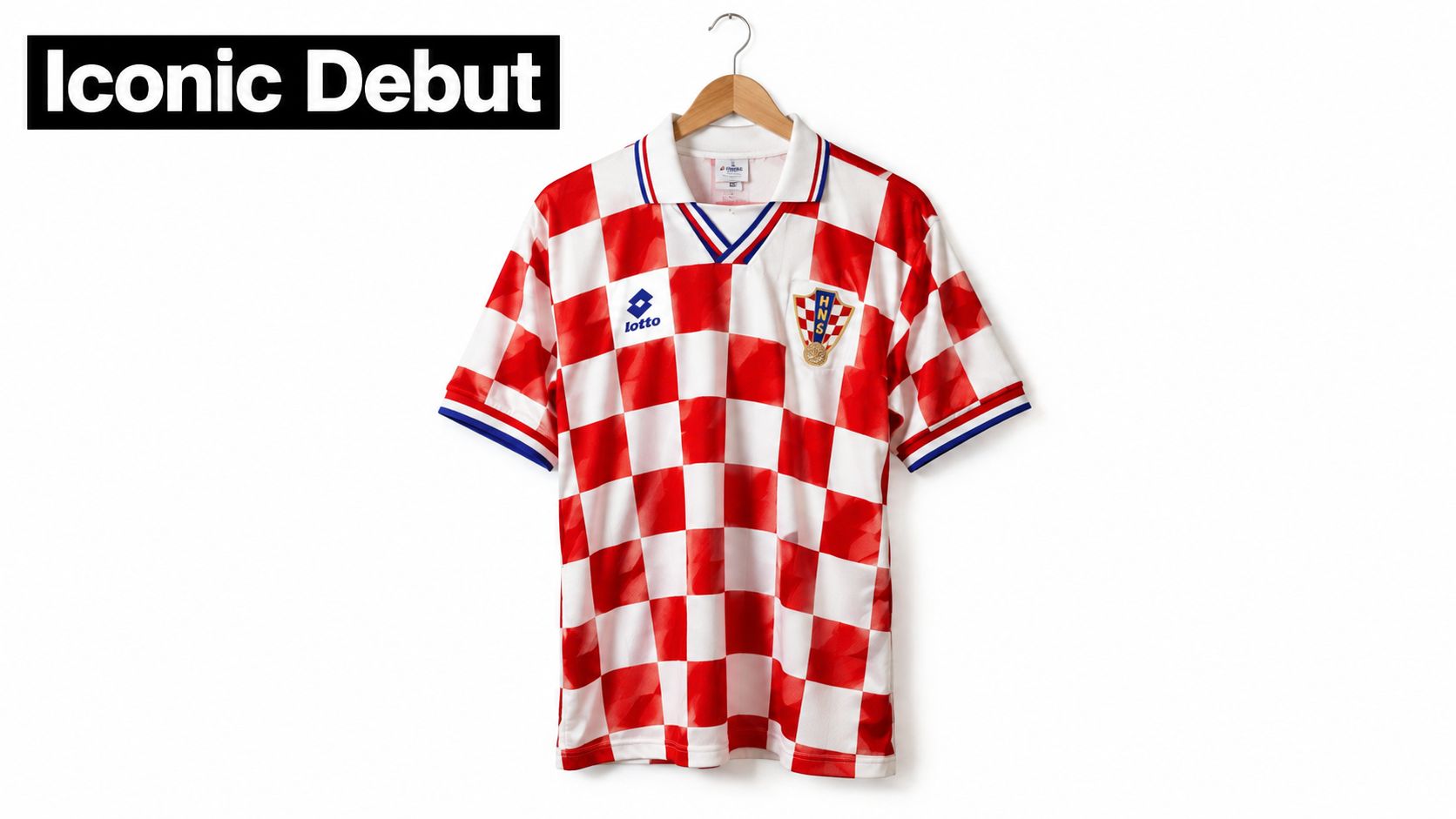
The squares worked because they were simple and unmistakable. A crest can disappear at distance, and a sponsor can change from one season to the next. Croatia's checkerboard remained visible from the stands, on television, and in photographs. It became a visual shorthand for the national team itself.
From national symbol to football icon
The shirt's international reputation grew at the 1998 FIFA World Cup in France, Croatia's tournament debut as an independent nation. The team finished third, while Davor Šuker won the Golden Boot, and the red-and-white pattern became associated with an unexpectedly deep run on football's largest stage. Nike had supplied Croatia from 2000 onward, helping carry the motif into later generations of kit design. This history of Croatia's national team and its shirts shows how closely the pattern became tied to the country's football story.
The shirt's cultural force comes from that combination of origin and performance. It wasn't designed as a retro fashion item, yet it became one. Fans who collect historical football kits often value Croatia shirts because the design records a national sporting identity rather than merely marking a club season.
Croatia's checkered language continued to evolve. The 2018 World Cup final in Russia marked the team's best World Cup result to date, and the dark navy-and-black away shirt offered a sharper, more contemporary interpretation. The jersey used enlarged, jagged-edged squares and appeared in victories over Argentina, Iceland, Denmark, Russia, and England in the semifinal. First presented in March 2018 and worn against Peru on 23 March, it showed that a heritage pattern could change shape without losing its identity. The history of Croatia's World Cup kits captures that transition from classic national emblem to modern global design language.
Collector's insight: A checkered shirt matters most when the pattern tells you where it came from, not just what decade it resembles.
What Makes a Checkered Soccer Jersey
A genuine checkered soccer jersey starts with repeating square geometry. The blocks should form a regular grid, rather than horizontal stripes, houndstooth, or an irregular geometric print. That distinction sounds obvious, but modern kit designers often blur the boundaries with partial checks, pixel effects, and broken grids.
Three visual decisions shape the shirt
Equal squares give a traditional checkerboard its rhythm. Designers can make the squares large and dramatic, reduce them into a finer texture, or distort their edges for a digital appearance. The underlying idea remains repetition across the body.
Color contrast determines how quickly the pattern reads. Red and white create Croatia's strong national signature, while blue and white produce a cleaner, lighter effect. Black and yellow create a more forceful visual clash. High contrast helps spectators distinguish the blocks at a distance, while tonal colors create a quieter shirt suited to lifestyle wear.
The third decision is the placement of the grid. A designer might keep the front fully checked, limit the pattern to the torso, or let it fade into sleeves and side panels. A collar, sponsor mark, and crest interrupt the geometry, so the best designs plan the grid around those elements instead of treating the shirt as a flat rectangle.
Why printing matters
Many modern checkered soccer jerseys use digital printing or sublimation on polyester performance fabric. Sublimation bonds the color into the fibers, allowing sharp square edges and smooth transitions across curved panels without adding a heavy surface layer. One technical example describes 100% polyester fabric at about 170 g/m², where the lower fabric mass helps keep matchwear light while the printed geometry stays crisp on the front panel. This football jersey printing example illustrates why the method suits complex graphics.
The fabric underneath still matters. A textured double-knit or pique-style structure can offer stronger dimensional stability and abrasion resistance than a looser knit, while polyester supports quick drying and ventilation. The checkerboard is therefore a visual layer. It doesn't automatically make a shirt heavier, hotter, or less athletic.
Look closely at the seams, cuffs, and sponsor area when comparing designs. A careful production template keeps squares aligned across body panels, while a rushed design may show awkward breaks where the grid meets a sleeve or side seam.
Heritage Checks and Modern Checker Design Directions
Heritage-driven checkered kits carry a clear national or club reference. Croatia's red-and-white šahovnica is the strongest example because the pattern comes from the country's coat of arms and has remained a constant part of the national team's visual identity. Other designs borrow the idea more loosely, using checks as a frame for a crest, a regional symbol, or a club color story.
Modern kits treat the checkerboard less like a fixed emblem and more like a design system. Pixelated blocks, vertical checker columns, faded gradients, and tonal grids can preserve the visual energy of checks without copying a traditional national shirt. That distinction matters to collectors. A heritage shirt communicates continuity, while a fashion-led release may communicate experimentation.
| Era | Team | Kit Year | Design Type |
|---|---|---|---|
| Heritage | Croatia | 1990 | National coat-of-arms-inspired red-and-white checks |
| Heritage | Croatia | 1998 | Traditional national checkerboard |
| Modern | Croatia | 2018 | Enlarged, jagged-edged dark checks |
| Modern | Various teams | 2026 projection | Vertical, pixelated, gradient, and tonal checker directions |
Reading the newer checkerboard
The pixelated checker breaks the clean grid into blocks that resemble a digital image. It can look futuristic, but it also creates a practical challenge: small changes in color may become muddy at distance. A vertical checker stretches the pattern into columns, bringing some of the movement of stripes while retaining square interruptions.
The gradient check is softer still. Instead of switching sharply between two fully contrasting colors, it lets the pattern fade across the shirt. That makes it easier to wear casually, though it can reduce the immediate recognition that makes a traditional Croatian shirt so powerful.
Trend reporting for projected 2026 kit directions identifies vertical checker patterns as a distinct design route, alongside geometric and futuristic football-fashion graphics. This design discussion of blue and yellow soccer jerseys reflects the wider shift away from checks as pure nostalgia. Clubs, brands, and streetwear labels increasingly use them for texture, identity, and crossover appeal.
The useful question isn't whether a modern checker is authentic. Ask what it's trying to do. Is it preserving a crest's heritage, improving visual flow across a performance shirt, or creating a collectible fashion object?
UEFA and FIFA Rules for Check Patterns on Match Kits
A checkered shirt has to work as match equipment, not just as artwork. Competition organizers need players, officials, broadcasters, and spectators to distinguish teams quickly. That makes contrast, dominant color, and pattern placement important parts of kit approval.
UEFA equipment rules allow repeated geometric patterns such as checks only under specific conditions. The design must present two colors with equal prominence, and additional restrictions can apply to the back and sleeves. This prevents a shirt from appearing visually dominated by one color in a way that creates confusion with an opponent or an official's kit. The UEFA equipment regulations provide the relevant framework.
What designers have to solve
A front panel may look clear in a studio photograph but become harder to read when players move, overlap, or appear under stadium lighting. Designers therefore need to consider:
- Dominant color: The two principal colors should remain visually balanced where the rules require it.
- Back visibility: Names and numbers need a sufficiently clear field, which can mean simplifying or interrupting the checker pattern.
- Sleeve treatment: A full grid may not be acceptable if it reduces contrast or conflicts with competition identification.
- Opponent separation: A pattern must remain distinguishable from the other team's shirt and from officials' clothing.
The 2026 World Cup guidance also permits a basic repeated pattern of stripes, hoops, or checks on outfield shirts when two colors are equally prominent, while applying further constraints to the back and sleeves. That guidance makes compliance a practical design issue for fans who want to customize shirts, not merely a concern for kit manufacturers.
Practical rule: A pattern can be visually attractive and still fail competition requirements if the back, sleeves, or dominant color create identification problems.
This helps explain why some pixelated or vertical checker designs appear on training, lifestyle, or pre-match tops rather than competitive shirts. The creative team can use a freer graphic language when the garment doesn't need to satisfy the same match-day visibility conditions. For a collector, the label “match issue” should therefore mean more than a premium price. It should describe a shirt built for a particular equipment environment.
Authentic vs Replica How to Tell the Difference
The word authentic can describe different product tiers, so begin with the seller's terminology. A player version is usually cut closer to the body and may use more advanced construction, while a stadium or fan replica is designed for everyday comfort. Neither category is automatically counterfeit.
Start with construction
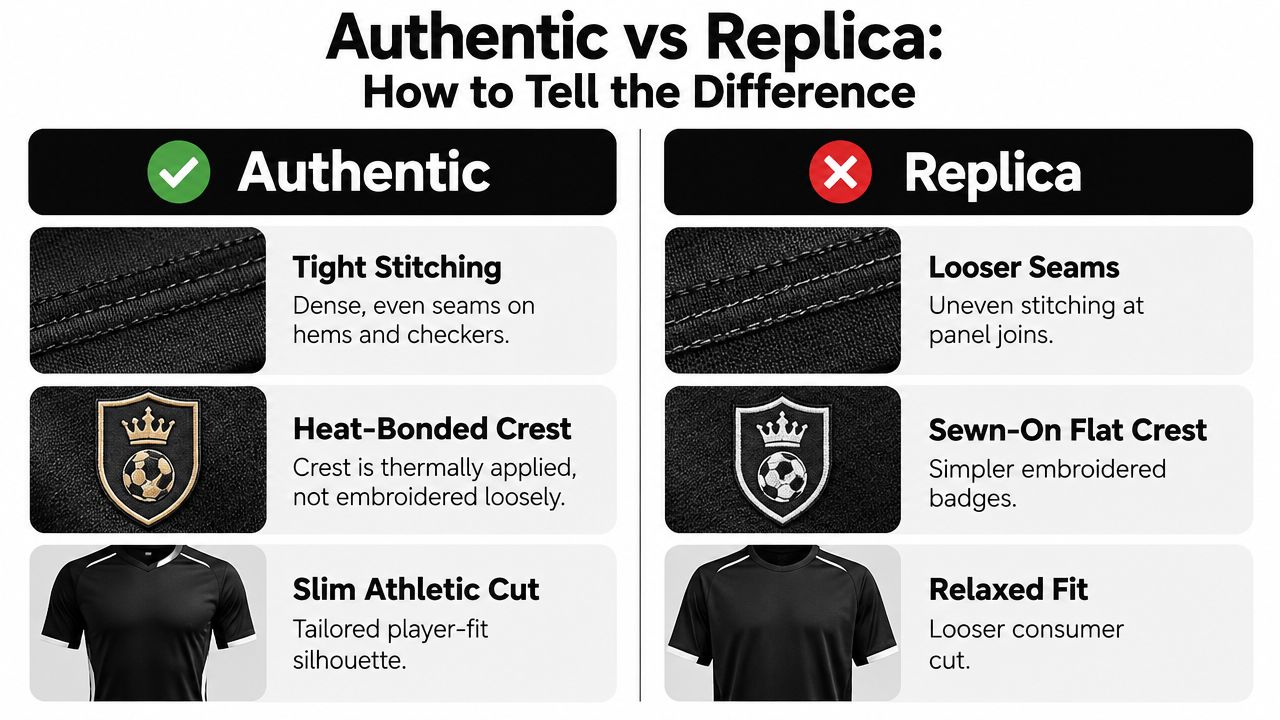
Authentic match shirts often use bonded or ultrasonically welded seams, breathable mesh zones, and heat-applied details. Replicas commonly use conventional stitching and may have a roomier fit. These differences aren't universal across every brand or season, so compare the shirt with official product photographs from the same release rather than relying on one feature.
The crest gives you another clue. A heat-applied badge can be completely legitimate, particularly on a player version. A loose, unevenly sewn crest, distorted lettering, or a badge with incorrect proportions is more concerning than the simple question of whether it's embroidered.
A practical verification routine
Inspect the grid first. Check whether the squares align cleanly across the front, shoulder, and side panels. Counterfeit manufacturers often struggle with registration, producing uneven blocks or a pattern that drifts around the seams.
Read every label. Inner tags may include a product code, QR code, NFC feature, or serial reference, depending on the brand and season. Treat these as supporting evidence, not absolute proof. A copied code can still appear on a fake shirt.
Check the finish. Look at sponsor lettering, collar construction, care instructions, and the quality of the fabric. Heat-pressed logos should sit smoothly, while peeling edges, blurred details, and incorrect fonts deserve caution.
Review the seller. Authorized retailer information, a clear return policy, detailed photographs, and consistent provenance are more useful than a vague claim that a shirt is “rare.” This football shirt authentication guide offers a practical checklist for examining labels, badges, and construction.
Don't judge a shirt by price alone. A low price may reflect a standard replica, a used garment, or a damaged item. A high price doesn't guarantee authenticity. Match the shirt's product code, season details, sponsor style, and measurements to reliable reference images before buying.
How to Style Checkered Soccer Jerseys Off the Pitch
A checkered jersey already has a strong visual voice, so the outfit works best when everything around it stays controlled. A Croatia-style red-and-white shirt pairs naturally with raw denim, white sneakers, and a neutral overshirt. The shirt remains the focal point, while the rest of the clothing supports its colors without competing for attention.
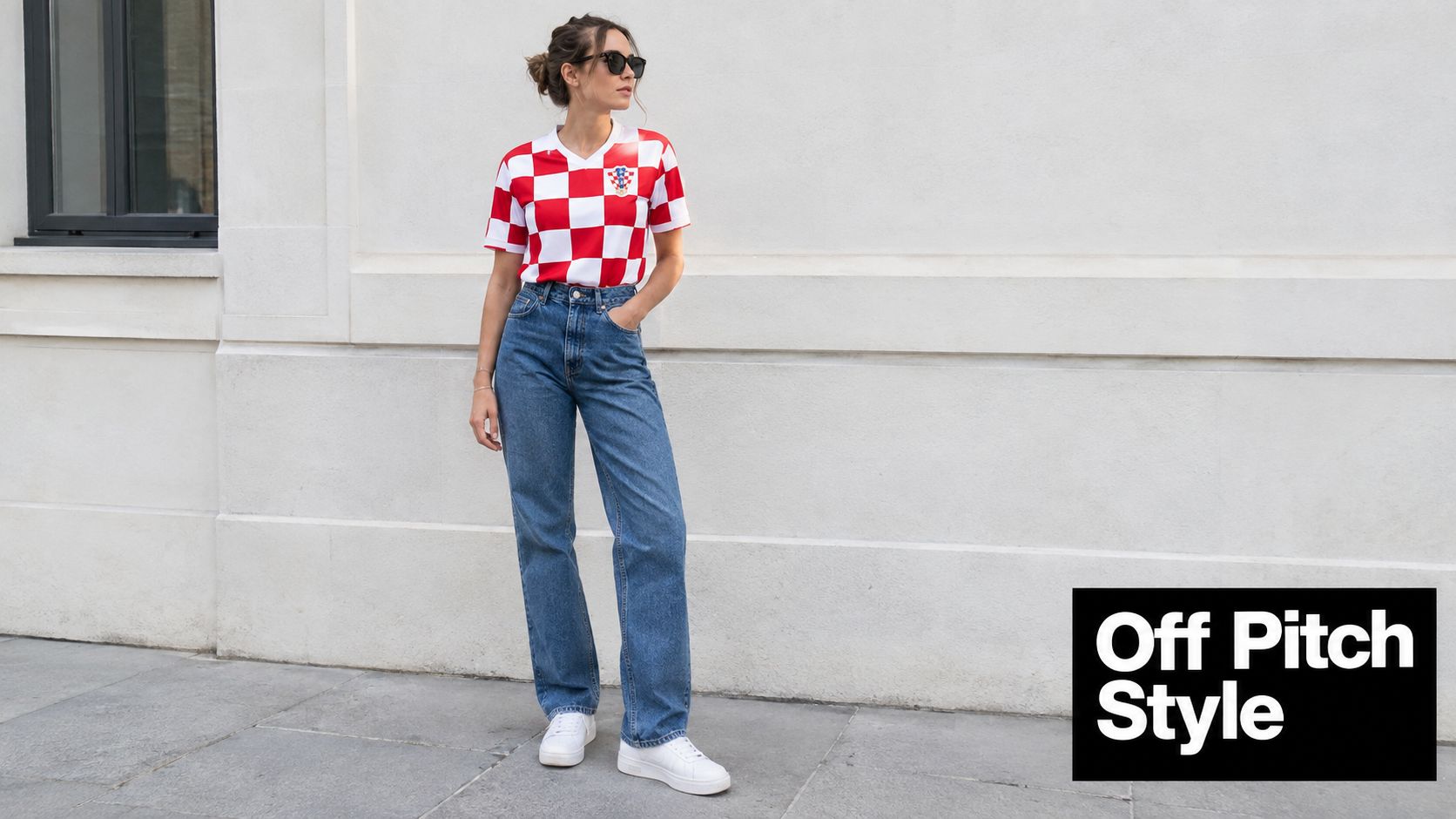
Fit changes the mood. A closer cut feels like match-day clothing, especially with jeans or athletic trousers. An oversized shirt becomes more streetwear-oriented, while a French tuck can give a relaxed shirt a clearer shape without making it look formal.
Keep the color story simple
Choose bottoms that pick up one color from the shirt or retreat into a neutral. White, black, navy, denim, and grey are dependable choices because they let the checkerboard remain legible. Adding several competing bright colors can make the outfit feel accidental rather than styled.
A darker pixelated or tonal checker works well beneath a bomber jacket, paired with fitted joggers and retro trainers. A lighter blue-and-white design can sit comfortably with beige trousers and a simple cap. Accessories should stay understated. A clean watch, plain cap, or restrained trainers add context without creating another focal point.
For social settings that aren't match-related, remove some of the football signals. Skip a scarf, avoid stacking several club items, and let the shirt work as a patterned top. Tucking it into high-waisted trousers creates a more deliberate silhouette, while wearing it open over a plain tee makes the jersey feel closer to casual fashion.
The strongest outfits share one principle: the shirt leads, everything else edits itself down.
A visual styling reference can help you judge proportions, layering, and footwear choices before trying the look yourself.
Where Collectors Source Rare Checkered Jerseys
Collectors usually choose between certainty, selection, and discovery. Official retail gives you the clearest provenance but usually focuses on current releases. Vintage specialists and auction platforms can uncover older Croatia shirts, Juventus checks, or limited club designs, yet condition and authentication require more attention.
| Route | Main advantage | Main risk | Best suited to |
|---|---|---|---|
| Official retail | Clear product history | Limited access to older shirts | Buyers wanting current releases |
| Vintage specialist | Curated older stock | Higher asking prices | Collectors seeking a specific era |
| Resale marketplace | Broad selection | Counterfeits and unclear condition | Experienced buyers |
| Mystery-box service | Surprise and discovery | You can't select the exact shirt | Budget-conscious collectors open to variety |
Secondhand platforms reward patience. Ask for close photographs of the neck tag, wash label, crest, sponsor, and inside seams. Request measurements rather than relying on a size label, especially for older shirts. Confirm whether the item is described as authentic, a replica, a reissue, or a fan-made custom piece.
Condition affects both enjoyment and long-term collectability. Faded sponsor print, cracking, pulled fabric, missing tags, and heavy odors should appear in the description. A seller who refuses detailed photographs or avoids questions about provenance creates unnecessary risk.
The role of surprise boxes
A mystery-box service changes the purchase from targeted acquisition to themed discovery. Mystershirt offers Premium, Retro, Kids, and other football-shirt boxes containing authentic jerseys with labels, and customers can list clubs, competitions, or colors to avoid. The service is useful for someone who wants to discover a checked or geometric shirt without paying a specialist's premium for one exact historical release.
That model isn't a substitute for a confirmed Croatia 1998 purchase. It suits a different collector, someone who values an authentic shirt, a controlled theme, and the surprise of an unfamiliar club. Before ordering, check the available size, exclusions, return terms, and whether the product lets you specify preferences.
A sensible sourcing mix matches your goal:
- Specific target: Use an established vintage seller or a marketplace with strong buyer protection.
- Low tolerance for risk: Choose a retailer with clear authentication and returns.
- Open-ended collecting: Consider a themed surprise box, then document what arrives.
- Rare historical shirt: Verify labels, sponsor details, fabric, and provenance before payment.
Building Your Checkered Jersey Collection
A strong collection doesn't need to begin with the rarest shirt. Start with a theme that gives your purchases a relationship to one another. You might focus on national identity, tournament history, club checks, experimental graphics, or the movement from classic squares to pixelated and vertical designs.
Build in layers
A foundational collection could begin with Croatia's early national-team identity and its celebrated 1998 era. From there, club classics add a different kind of history, while modern experimental shirts show how designers are updating the checkerboard for current football and streetwear.
Think of the collection as three shelves:
- Heritage pieces: Shirts where the pattern carries a national or club tradition.
- Performance-era designs: Match shirts that show how materials, printing, and panel construction changed.
- Contemporary experiments: Pixelated, vertical, gradient, or tonal checkers that treat the pattern as a flexible graphic language.
Set a budget that you can maintain without rushing. Authenticity and condition usually matter more than owning a large number of shirts, especially when a smaller collection has clear documentation. Record the purchase date, seller, product code, condition, size, and any available provenance. A simple spreadsheet or collection app can prevent duplicate purchases and make trade discussions easier.
The guide to building a soccer jersey collection can help you think about themes, storage, and long-term organization.
Wear some, preserve others
Rotate frequently worn shirts and display pieces. Wash jerseys according to the care label, turn them inside out before laundering, avoid harsh heat around printed details, and store valuable items away from direct sunlight. Fold shirts with care or use padded hangers that don't stretch the shoulders. Keep signed or especially fragile pieces separate from everyday wear.
Your collection should reflect your taste, not an imaginary checklist. One fan may value Croatia's national story, another may prefer Juventus-style club checks, and another may collect only modern pixel graphics. Define the pattern language that interests you, then buy slowly enough to understand what each shirt adds.
Mystershirt offers authentic football-shirt Mystery Boxes in Premium, Retro, Kids, and themed formats, with options to choose a size and list clubs, competitions, or colors to avoid. If you want to add an unexpected checked design to your collection, visit Mystershirt and explore the available boxes.