If you can't choose the shirt, what should you still be able to choose before buying a mystery box? That's the question missing from many conversations about mystery boxes for men. The reveal should be unpredictable, but the size, product category and purchase terms shouldn't be.
For football fans, the useful distinction is controlled surprise: you set the boundaries that matter, then accept chance within them. A box can introduce you to an unfamiliar club or an unexpected design without promising your next favourite shirt.
Table of Contents
- What Is Inside a Mystery Box for Men
- Single Box or Monthly Subscription Compared
- Setting Preferences Without Losing the Surprise
- Managing Fit Risk Before and After Delivery
- Order Your Mystery Box Step by Step
- Authentic Shirts, Replicas and Resale Value
What Is Inside a Mystery Box for Men
A football-shirt mystery box is a sealed box containing one or more authentic shirts you haven't picked individually, selected within the limits available when you order. You choose the format and size, and may be able to exclude unwanted teams or select a theme. The exact shirt stays hidden until opening.
Not all mystery boxes contain the same type of item. Before comparing designs or imagined resale values, establish whether you're buying a wearable shirt, an older collectible, a signed item or something for a group.
Mystery box formats and what each contains
The controls below are useful selection criteria, not universal promises. A theme or era is only a firm boundary when the chosen listing explicitly offers it.
| Format | What You Receive | Best For | Control You Keep |
|---|---|---|---|
| Single-shirt box | One authentic shirt from a recent season, from a club anywhere in the world | Personal collection or a one-off gift | Size, excluded clubs, competitions or colors |
| Two-shirt box | Two authentic shirts from recent seasons | Fans who want more variety for one recipient | Size and exclusions for the whole order |
| Themed box | Shirts built around one league, one era or one country | Collectors focused on a specific league or period | The theme chosen at ordering |
| Retro box | Shirts from past eras | Vintage collectors and buyers who prefer older designs | Era where offered, and size |
| Shorts or signed-item box | Shorts or a signed shirt in the same sealed format | Gifts for a specific fan | The item type chosen at ordering |
| Sharing box | Several shirts meant for a group to open together | Friends, teammates or groups | Group format and sizes per person where supported |
Say you're buying for yourself and only want shirts from a particular league. A league-themed single-shirt format keeps the discovery within that interest. A teammate arranging an unboxing for a group instead needs to establish how many shirts are included and how individual sizes are recorded.
The surprise should be which football shirt arrives, not whether the contents match the advertised category.
A mystery purchase isn't automatically better than choosing clothing directly. If a recipient wants a specific visible item, you could explore the clothing collection at Idaho Pawn & Gold Exchange as a comparison-shopping resource.
Start with the occasion: personal collection, a gift for one person, or a group experience. That decision narrows the formats more usefully than choosing whichever box looks most impressive.
Single Box or Monthly Subscription Compared
The difference between a single box and a subscription is primarily commitment, not the appeal of the reveal. A one-time purchase suits a trial or a fixed occasion. A monthly arrangement suits someone who actively wants regular additions, including shirts they wouldn't have selected themselves.
Don't confuse an ongoing collection habit with a one-off gift idea. Someone can enjoy opening a surprise without wanting another delivery the following month.
| Decision | Single box | Monthly subscription |
|---|---|---|
| Purchase pattern | One purchase and shipment | Recurring boxes |
| Best fit | A gift, trial or specific occasion | An ongoing collecting habit |
| Timing consideration | Check delivery against the occasion | Check the recurring shipment schedule |
| Administration | Review the individual order | Manage details and cancellation through the subscription account |
Understand the recurring terms
Our subscription requires a minimum commitment of two months, and shipments are scheduled monthly based on the customer's subscription date. Subscribers receive advance notice of significant changes to the terms. Accounts are managed through Recharge, where customers can update their details or cancel, subject to the commitment terms.
The football-shirt mystery subscription guide provides context for deciding whether recurring deliveries suit your collecting habits.
For a birthday purchase, work backwards from the date the gift must be in your hands. Don't assume that starting a subscription shortly before the occasion means its shipment will arrive in time, and don't confuse dispatch with delivery.
Choose a single box for a fixed occasion. Choose recurring deliveries only when you want the ongoing purchases themselves, rather than treating the subscription as a different checkout option.
Setting Preferences Without Losing the Surprise
Wanting reassurance doesn't mean you dislike surprises. A 2022 consumer-behavior study found that, on average, men were less likely than women to choose a surprise offering. That's a group-level finding, not a rule about every buyer.
The practical response is to separate uncertainty you enjoy from uncertainty you don't. Discovering an unfamiliar away kit might be exciting; receiving a rival club's shirt might make the purchase unusable. Those outcomes deserve different treatment.
Set boundaries rather than choosing the result
At ordering, our text box lets you name clubs, competitions or colors to avoid. Write the exclusions plainly so there's no ambiguity about what you mean. If you mean a particular club, use its name rather than a nickname that could describe another team.
Use these controls with a purpose:
- Size: Choose the recipient's appropriate size, supported by measurements rather than guesswork.
- Club exclusions: Remove teams the recipient wouldn't wear, even for training or casual use.
- Competition exclusions: Identify a competition you don't want represented, rather than listing its clubs individually.
- Color exclusions: Name colors that are genuine deal-breakers, not merely less preferred.
- Theme and format: Select a league, era or country only when that option is explicitly offered by the chosen format.
Excluding a rival club can preserve a broad range of possible outcomes. Excluding nearly every league, most colors and all unfamiliar teams leaves much less room for discovery.
A useful boundary removes a disappointing outcome. An unnecessary boundary tries to turn a mystery purchase into a specific-shirt order.
Consider a gift for someone who follows football internationally but refuses to wear their local rival's crest. That club exclusion matters more than your own preference for a particular shade of blue. The aim is to reflect the recipient's identity, not redesign their wardrobe around your tastes.
Check what actually matters
Before ordering, ask:
- Who is the recipient? Think about what they wear, collect and follow.
- What would ruin the gift? Separate firm objections from mild preferences.
- Which constraints can go? Leave room for an unfamiliar club or unexpected design.
Also distinguish a preference from a guarantee. Don't assume that writing a desired club in an exclusions field turns it into a promised selection. A well-chosen mystery box remains a chance purchase, just with fewer unacceptable outcomes.
Managing Fit Risk Before and After Delivery
You can appreciate a shirt's design and still be unable to wear it. Because you can't try on the hidden item before buying, fit deserves more preparation than the unboxing itself.
The Atwix ecommerce returns overview places online apparel return rates at approximately 24.4% of orders and reports that 53% of apparel sellers identify size and fit as the leading cause. Those are broader apparel figures, but they make a useful practical point: a size label alone isn't enough.
Measure a shirt that already fits
Use a soft measuring tape and a shirt the recipient wears comfortably. Lay it flat on a firm surface, smooth it without stretching, and record:
- Chest width: Measure straight across from armpit to armpit. Note that this is flat width, not full chest circumference.
- Body length: Measure from the high shoulder beside the collar to the hem.
- Sleeve length: Measure from the shoulder seam to the cuff, noting whether the sleeve has a conventional or raglan construction.
Compare like with like. A body-measurement chart and a garment-measurement chart aren't interchangeable, so establish which the seller uses. The authentic soccer jersey sizing guide can help you interpret sizing before choosing a label.
Adult and youth grading, regional conventions, and athletic versus relaxed cuts all affect the comparison. Older designs may also have different proportions from current shirts. Don't assume every retro shirt is roomy or every modern shirt is slim.
Fit rule: If the relevant measurements sit between sizes, lean larger for a relaxed fit. Choose smaller only when the dimensions still allow comfortable movement and a close fit is wanted.
Inspect before removing anything
Try the shirt on carefully with its labels attached. If something's wrong, describe whether it's too small, too large, an unsuitable cut or a different item from what was ordered.
Our Premium subscribers can request a free exchange within 14 days of delivery if the size is incorrect or the wrong shirt was received, subject to stock availability. That's a specific subscriber policy, not a blanket promise covering every reason for dissatisfaction.
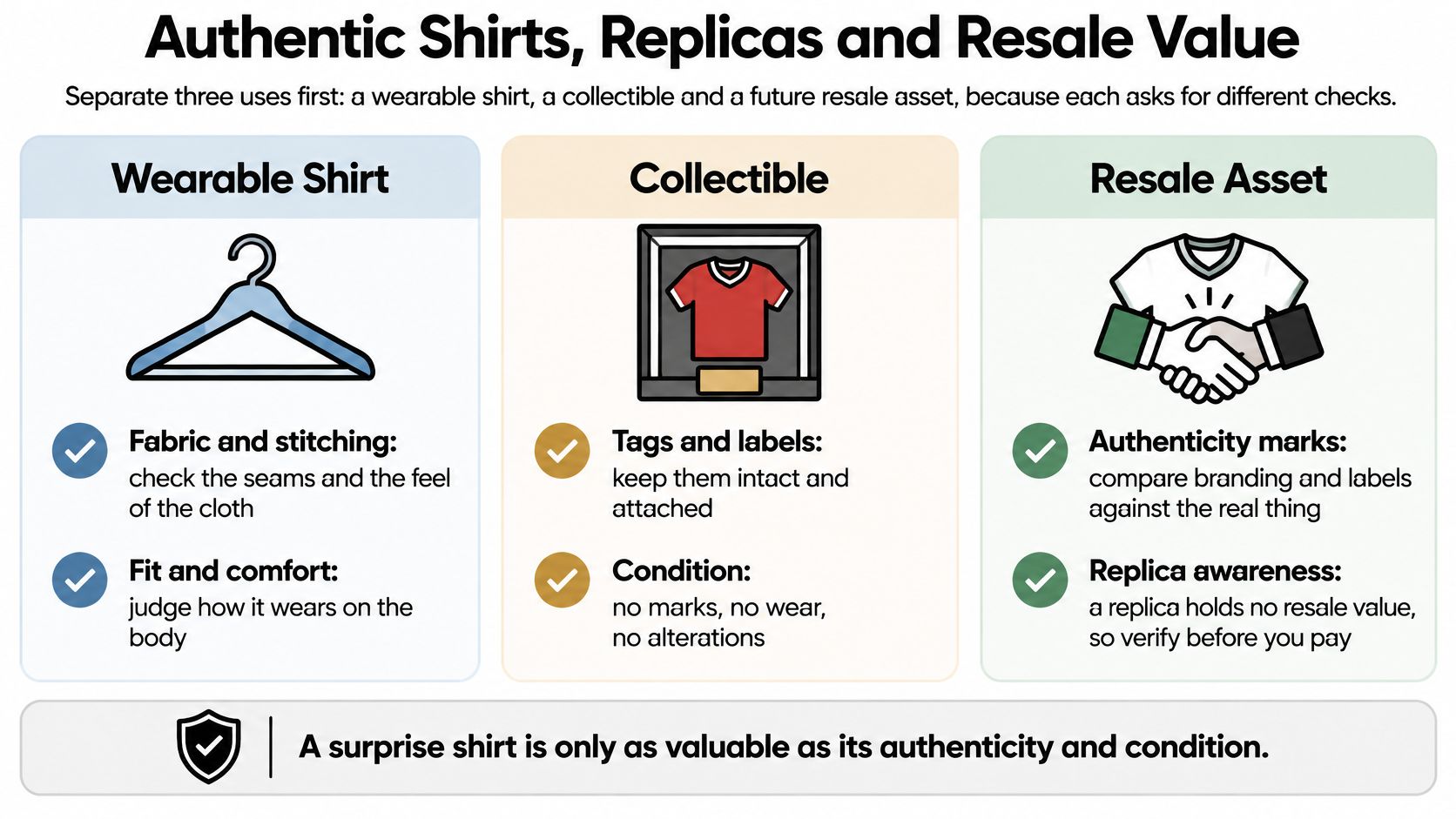
Separate three uses first: a wearable shirt, a collectible and a future resale asset, because each asks for different checks.
For a discreet gift purchase, measure a shirt the recipient already wears rather than asking them to take fresh measurements. Record the garment's size and cut alongside the dimensions.
Order Your Mystery Box Step by Step
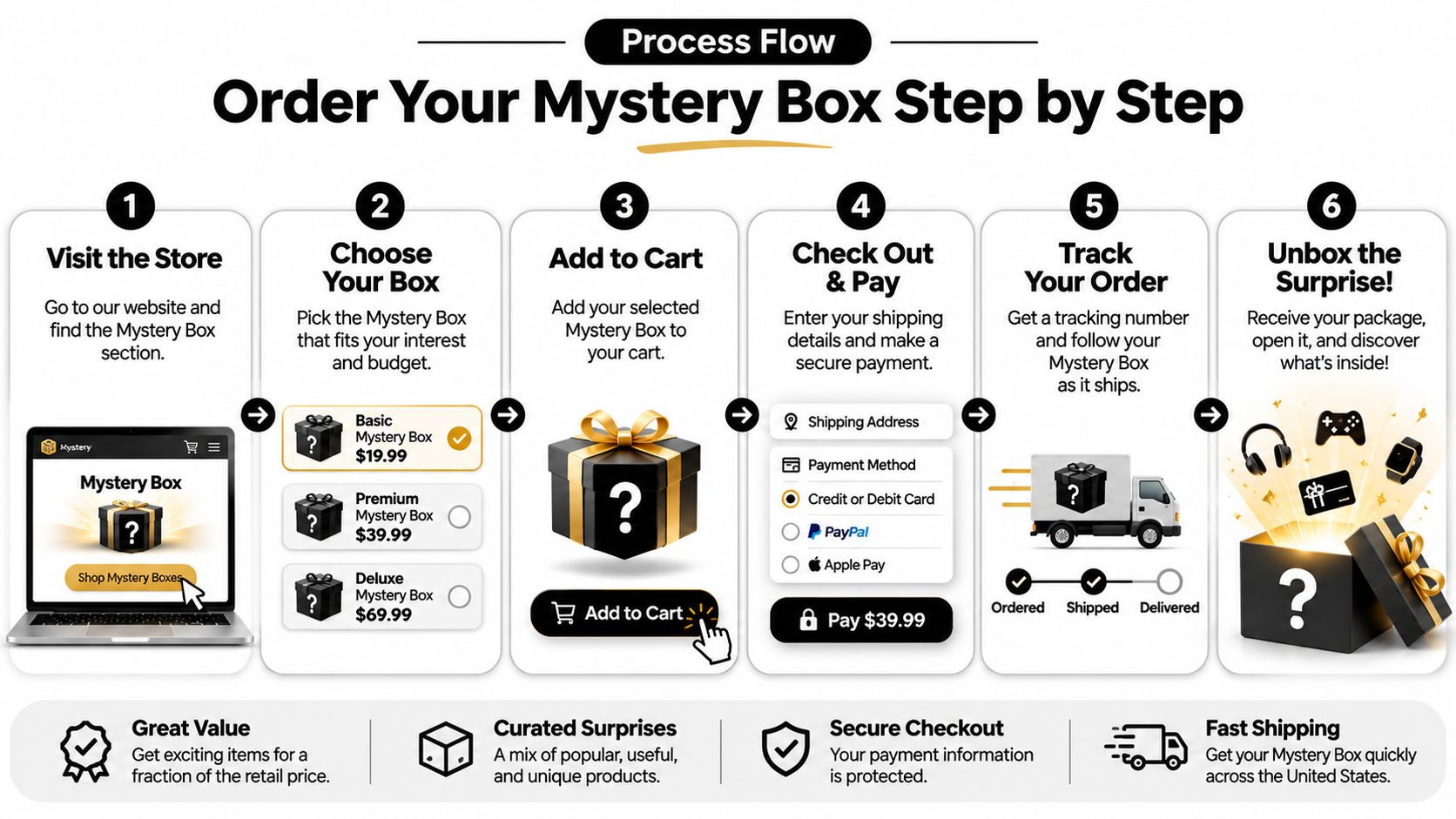
A mystery box works like a controlled experiment: you fix the variables you care about in advance, then accept chance on everything else. Ordering is where that control happens. Mystershirt's ordering process has four stages: choose a box, choose a size, say which clubs, competitions or colors to avoid, and receive the order. The checklist below walks through those same four stages, adding the timing and arrival checks that make each one easier to manage.
Use this visual as a quick reminder of the journey from selection to opening.
Make the purchase deliberately
-
Match the format to the purpose.
This is the "choose a box" stage, and it decides more than the price. Ask whether the purchase is for someone's own collection, an individual gift or a shared opening. Read the contents description rather than judging by the box photograph. Choosing on price alone can leave you with the wrong item category or too few shirts for the occasion. -
Enter the recipient's size.
Keep your measurements beside you when selecting the size field. For a gift, confirm you haven't accidentally used your own saved preference. If ordering for several people, prepare a name-and-size list so you can check each selection before payment. -
Write concise exclusions.
Enter the clubs, competitions or colors that are unacceptable in the text box provided during ordering. This is the strongest control you have, so use it precisely. Avoid vague requests such as something nice or a famous team, which don't define a useful boundary. Read your entry once from the perspective of the person selecting the shirt: could they identify what to leave out? -
Confirm the arrangement, then check the delivery.
Before paying, check whether you're placing a one-time order or accepting recurring payments, and review the delivery address carefully, especially if the parcel goes directly to the recipient. For a fixed celebration, allow for delivery time rather than planning around dispatch alone. Save the order confirmation, and when the box arrives, compare the contents with the format, size and exclusions you entered. If there's a problem, photographs of the item and labels give customer support something concrete to assess.
Choose the experience the recipient wants
The four stages control what can be controlled. Everything beyond them stays chance, and the right recipient is someone who enjoys that part.
A shared opening works best when everyone understands that the shirts are surprises, not preselected club gifts. Establish who receives which package before opening rather than relying on an informal swap afterwards.
If the recipient dislikes uncertain possessions but enjoys doing things with friends, a different kind of gift may fit better. You could give an escape room experience through Chronos One Escape Rooms Eltham instead of buying surprise clothing.
For a football-shirt purchase, the Premium Mystery Box and Retro Mystery Box are Mystershirt's two bestsellers and useful starting points; signed shirts, shorts and sharing boxes offer other formats. Choose between them by the recipient's interests, because no format guarantees a more desirable reveal. The exclusions you write shape the odds, and the rest is the surprise they signed up for.
Authentic Shirts, Replicas and Resale Value
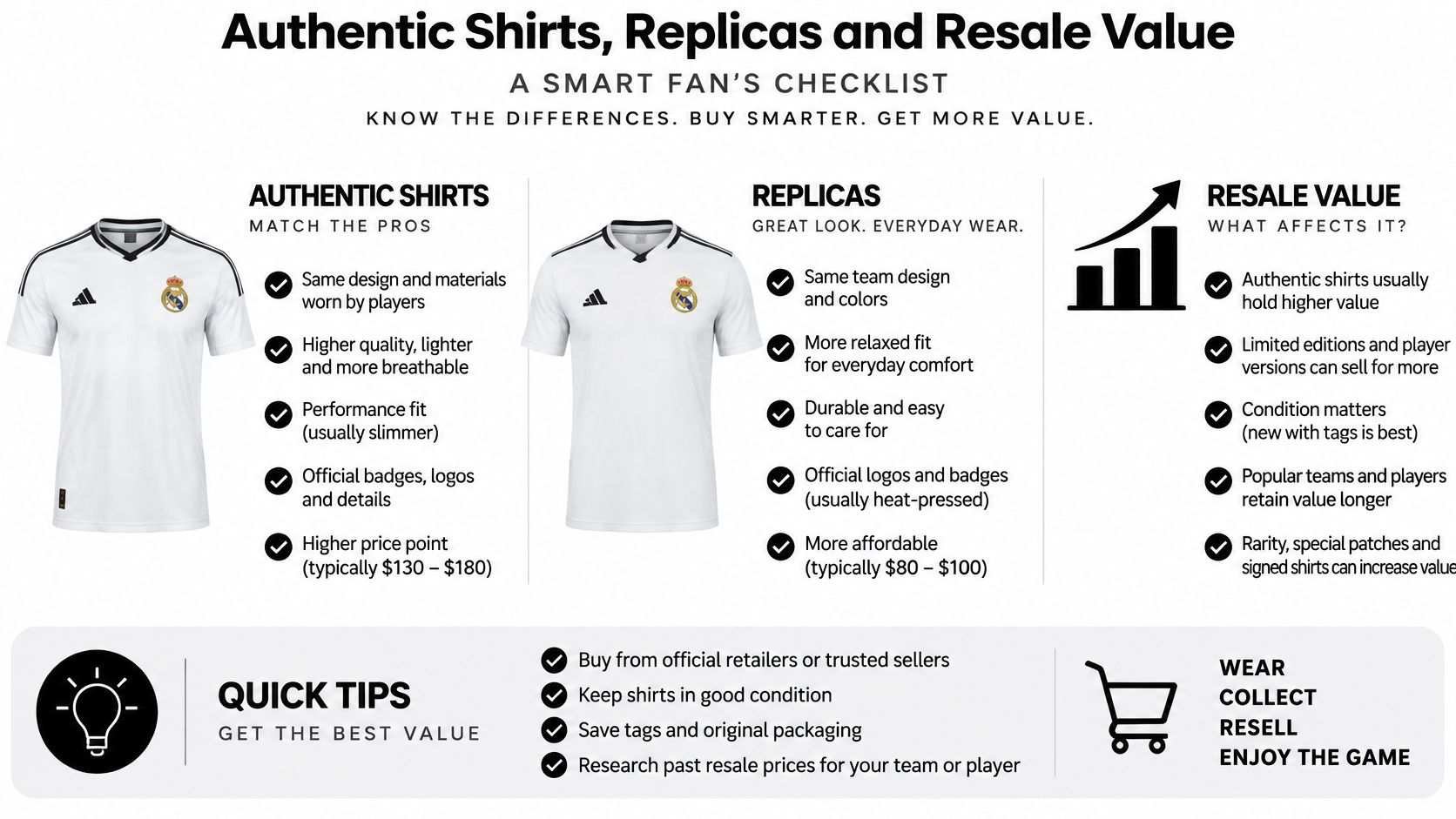
Separate the intended uses: a wearable shirt, a collectible and a future resale asset require different judgments. A shirt can be genuine, comfortable and enjoyable without being rare or likely to increase in value.
Football jerseys have a wider fashion audience, but exceptional sales aren't a sensible baseline. FashionUnited's coverage of StockX's 2025 trends reported that a collaborative FC Barcelona jersey averaged $877 on the platform. That particular collaboration doesn't establish the value of an ordinary surprise shirt.
Check provenance, not just presentation
Inspect the printed or stitched labels, product tags, crest, sponsor print, seams and fabric. Compare product codes and construction with reliable references for that specific model. Packaging and certificates can support provenance, especially for signed items, but neither should replace checking the garment itself.
- Labels and codes: Look for consistency between the garment, tags and identified model.
- Construction and condition: Check for loose seams, peeling prints, stains, repairs and alterations.
- Supporting evidence: Retain the receipt and any documentation accompanying a signature or special edition.
The terminology needs care: an officially licensed fan replica can be genuine. In football retail, replica often distinguishes a supporter version from a player-specification version, not an authentic item from a counterfeit. The replica versus authentic shirt guide helps clarify that distinction.
Decide what value means to you
For wearing, prioritize fit and enjoyment. For collecting, preserve labels and documentation, and store a clean, dry shirt flat, away from sunlight and damp; don't seal damp fabric in packaging.
For resale, consider authenticity, condition, rarity, player association, design era, demand and provenance. Don't budget on appreciation. Treat the purchase as something you're happy to own even if its resale value never rises.
If a recipient wants a visible, chosen keepsake instead, browsing gifts for him from ECI Jewelers offers a contrasting gift-shopping approach. The right choice depends on whether they value discovery or certainty.
Mystershirt offers authentic football-shirt mystery boxes, including Premium, Retro and group-sharing options. Visit Mystershirt to choose your format, select the recipient's size and record the exclusions that matter, while leaving the exact shirt as the surprise.