You're probably in one of two situations right now. You've got first orders coming in, people are posting their unboxings, and the brand feels alive, but second orders don't arrive at the same pace. Or you've already learned the harder lesson. A mystery product can create a great first purchase and still fail to build a repeat customer base if the experience after delivery feels random, unsupported, or forgettable.
That gap matters more in football shirt commerce than in many other categories. A buyer isn't only judging packaging and delivery. They're judging club relevance, collector value, shirt condition, authenticity, and whether the surprise felt fun or risky. If the first box lands well, you've got momentum. If the first reveal feels underwhelming, the customer won't always tell you. They'll just never buy again.
Table of Contents
- Beyond the First Box Why Repeat Customers Are Your Goal
- The Post-Unboxing Golden Hour Your First Move
- Crafting an Email Sequence That Drives Repurchases
- Measuring What Matters KPIs for Repeat Business
- From Gamble to Game Advanced Loyalty for Collectors
- Your Playbook for Building a Loyal Squad
Beyond the First Box Why Repeat Customers Are Your Goal
Most brands talk about the first conversion as if that's the finish line. It isn't. In a niche D2C business, the first order buys attention. The second order proves that the product experience, service, and follow-up were effective.
The economics make the case clearly. Repeat customers account for approximately 65% of a typical business's total revenue and spend 67% more per transaction than first-time buyers according to customer retention statistics compiled by LoyaltyPass. The same source notes that acquiring a new customer costs 5 to 25 times more than retaining an existing one, and that a 5% increase in retention can boost profits by 25% to 95%.

For a mystery box brand, those numbers hit differently. The first purchase is powered by curiosity. The repeat purchase is powered by trust. If customers believe the next box will still feel authentic, relevant, and worth their money, they come back. If they don't, acquisition spend becomes a treadmill.
Why retention matters more in a surprise-product business
Mystery products create a built-in tension. Surprise can increase interest, but it also raises perceived risk. That means retention can't rely on novelty alone. It has to rely on consistency around the parts customers can control: quality, authenticity, avoidance preferences, support, and post-purchase communication.
A repeat customer also tends to be easier to serve well. They understand the product format. They know how sizing works. They've already crossed the trust barrier that stops many first-time buyers. That's one reason football shirt brands should think less like one-off gift sellers and more like relationship businesses.
Practical rule: Don't judge marketing efficiency by first-order volume alone. Judge it by how many first-time buyers become people you can sell to again without restarting the trust cycle.
There's another operational benefit. Returning buyers give you cleaner data. You learn which categories they reorder from, which preferences matter most, and which support issues predict churn. That lets you improve curation, email timing, and merchandising with a lot more confidence than broad top-of-funnel testing.
If you want a grounded look at how football shirt businesses work behind the scenes, this breakdown of the business behind football shirts is useful context. It's a reminder that long-term growth in this category comes from product trust and customer fit, not hype alone.
What changes when you optimize for the second order
When retention becomes the target, teams make better decisions. They stop pushing generic discounts after every sale. They tighten fulfilment quality. They collect better preference data. They handle complaints faster because they understand that one support interaction can decide whether a buyer ever returns.
That's the shift. A repeat customer isn't a bonus sale. It's the unit of durable growth.
The Post-Unboxing Golden Hour Your First Move
The first meaningful retention moment happens right after the box is opened. Not a week later. Not when the next campaign goes out. The customer has just decided whether the reveal felt exciting, disappointing, confusing, or better than expected. Your follow-up has to meet that emotional state while it's still fresh.

The mistake I see most often is sending a bland delivery confirmation plus a standard review request. That's admin, not retention. A mystery product needs a more deliberate post-delivery sequence because the reveal itself is the experience.
What to do in the first follow-up
Your first message should do three jobs at once:
- Acknowledge the reveal: Reference the unboxing moment, not just the order.
- Invite reaction: Ask whether the shirt matched what they hoped for.
- Open a support door quickly: Make it easy to say “this wasn't for me” before disappointment hardens into churn.
The category has a specific problem that generic ecommerce advice tends to ignore. The available research highlights an underserved angle around the “disappointment risk” threshold in authentic sports merch, noting that mystery jersey buyers can feel underwhelmed even when the item itself has high perceived value, and that authenticity guarantees can raise expectations and make the reveal riskier according to this analysis of surprise-product dynamics in sports merchandise.
When the product is a surprise, customer service becomes part of the product.
That changes the tone of post-purchase care. You're not only checking satisfaction. You're managing emotional variance. A buyer who loves the reveal might share it publicly. A buyer who feels lukewarm might say nothing unless you invite a response.
How to reduce disappointment without killing the mystery
Don't try to eliminate surprise. Shape it.
Use a short response path after delivery:
-
Loved it
Prompt social sharing, outfit photos, or a follow-up browse toward related boxes. -
Good, but not my favorite
Ask one fast preference question. Club aversions, shirt era, color dislikes, or whether they prefer retro over current. -
Not for me
Route directly to support with a clear resolution path.
That structure keeps the experience feeling premium instead of defensive. It also gives you real first-party data that improves future curation.
For brands building this layer, SelfServe's post-purchase insights are worth reading because they frame post-purchase as an experience system, not a transactional afterthought. That's the right lens for mystery commerce.
What works better than a coupon
A weak first follow-up says “here's 10% off your next order.” A stronger one says “tell us how the reveal landed, and we'll make the next box smarter.” One protects short-term conversion. The other builds a repeat customer.
Good post-unboxing retention usually includes:
- A reaction capture email or SMS: Short, low-friction, mobile-friendly.
- A preference update flow: Let customers refine avoid lists after the first order.
- A human support route: Especially for duplicates, wrong fit expectations, or strong club dislikes.
- A relevant next step: Not every buyer wants another identical box. Some may prefer a different format, such as a more style-led streetwear mystery box option.
The brands that keep people coming back don't treat disappointment as a support ticket category. They treat it as retention data.
Crafting an Email Sequence That Drives Repurchases
One email won't turn a first-time buyer into a repeat customer. A useful sequence does. It should reflect how mystery box buyers think after the reveal. They move from excitement, to evaluation, to comparison, to curiosity about what the next box could contain.
The technical framework is straightforward. Rework's repeat purchase strategy guide recommends a three-step approach: calculate repeat purchase rate and time to second purchase by product category, build a 60-day post-purchase email sequence designed to educate and engage, and implement RFM segmentation with distinct messaging for groups such as Champions, Loyal Customers, and At-Risk buyers.
Start with category-level timing
Many brands get lazy in this area. They write one “buy again” flow for everyone. That doesn't fit a catalog with different motivations.
A customer who bought a retro-focused gift behaves differently from a collector who wants another surprise for their own wardrobe. A parent buying for a child behaves differently from a shirt enthusiast looking for rare club variety. Segmenting by product category and buyer intent improves the quality of every message that follows.
Working rule: If your post-purchase flow sounds the same for gift buyers, retro collectors, and sharing-box customers, it's too generic to drive meaningful repeat business.
If you want a broader perspective on lifecycle thinking, Mara's insights on lifecycle email for SaaS are useful even outside software. The core lesson applies here too. Good lifecycle email responds to user state, not just calendar timing.
A practical 60-day sequence
Below is a simple framework that works well for a mystery box business because it mixes reassurance, feedback, social proof, and timely re-entry points.
| Day | Email Purpose | Subject Line Idea | Call to Action |
|---|---|---|---|
| 0 | Confirm the experience and set expectations | Your shirt is on the way | Track your order |
| 3 | Build anticipation before delivery | Ready for the reveal? | Update your preferences |
| 7 | Capture the unboxing reaction | How did your reveal go? | Share feedback |
| 12 | Reinforce value with product context | The story behind shirts like yours | Explore similar styles |
| 18 | Showcase community and user-generated content | What other collectors unboxed | View recent reveals |
| 25 | Introduce adjacent product types | Want a different kind of surprise next time? | Browse another box category |
| 35 | Use RFM logic for early repeat intent | Your next box can be more tailored | Set your avoid list |
| 45 | Win back lukewarm buyers with support-led messaging | Didn't love your first reveal? Let's fix that | Update preferences or contact support |
| 60 | Ask for the second order with relevance | Ready for your next shirt? | Shop your next box |
A few execution notes matter more than fancy copy:
- Keep the early emails conversational: Delivery-phase messages should feel helpful, not promotional.
- Use post-purchase feedback in later emails: If the buyer preferred retro, stop pushing current-season styling.
- Separate high-intent repeaters from hesitant buyers: Don't send the same ask to someone who clicked three times and someone who ignored everything.
- Let support and marketing share data: A duplicate complaint should change future messaging.
RFM segmentation becomes powerful once the flow is live. Your best segments should get early access, collector-oriented messaging, and stronger curation cues. At-risk customers should get lower-pressure outreach, not another blast of hype.
The sequence works when each email earns the next one.
Measuring What Matters KPIs for Repeat Business
You can't improve repeat business with vibes. You need a small dashboard that tells you whether the first purchase created loyalty, indifference, or silent churn.

Repeat purchase rate often serves as an initial benchmark. ZipDo's retention roundup states that the global average repeat purchase rate is 21.5%, while e-commerce and retail businesses typically fall between 25% and 30%. The same source notes that CSAT scores above 80% are linked to a 30% higher retention rate, and that the probability of selling to an existing customer is 60% to 70%, compared with 5% to 20% for a new prospect.
Those numbers are useful, but only if you connect them to your own business model.
The numbers worth checking every week
Repeat business in a mystery box brand usually becomes clearer when you track four metrics together.
| KPI | Simple definition | Basic formula | What it tells you |
|---|---|---|---|
| Repeat Purchase Rate | Share of customers who bought more than once | Repeat customers ÷ total unique customers | Whether first orders are turning into relationships |
| Time to Second Purchase | How long it takes a buyer to return | Average days between first and second order | Whether your follow-up timing matches buyer behavior |
| Customer Lifetime Value | Revenue produced across the customer relationship | Total customer revenue over time | How much room you have to invest in retention |
| Customer Satisfaction | How happy buyers are after delivery | Survey-based score after purchase | Whether the product and support experience actually landed |
A wider KPI checklist can help if your reporting is still messy. Arlo Inc.’s overview of key e-commerce performance indicators is a practical reference for teams that need to tighten how they define and review metrics across acquisition, conversion, and retention.
Here's a useful training point for teams. Repeat purchase rate tells you how many buyers come back. Time to second purchase tells you when your relationship either gains momentum or loses it. If you only track one, you'll miss the operational reason behind the number.
A quick explainer is worth watching if your team needs a visual reset on retention metrics:
How to read the metrics instead of just reporting them
A low repeat purchase rate can mean different things. It might mean the first reveal wasn't satisfying enough. It might mean support didn't catch disappointed buyers. It might mean your second-order ask arrived too late or with the wrong product angle.
Use interpretation rules like these:
- RPR is weak, CSAT is healthy: Your follow-up and merchandising likely need work more than the product itself.
- RPR is weak, CSAT is weak: Start with curation quality, support handling, and expectation setting.
- Time to second purchase is long: Your sequence may be too passive or too generic.
- CLV is concentrated in a small segment: Build specific treatment paths for loyal collectors instead of averaging everyone together.
The best retention dashboards don't prove that reporting exists. They tell the team what to change next.
For mystery products, I'd also keep one internal metric that many teams skip: reason-coded dissatisfaction. Track whether the issue was duplicate ownership, disliked club, wrong aesthetic, or general surprise mismatch. That's where a lot of repeat customer leakage starts.
From Gamble to Game Advanced Loyalty for Collectors
Generic loyalty programs usually fail in collector categories because they reward spending while ignoring identity. Football shirt buyers often care about era, club story, national teams, kit design, nostalgia, and authenticity. If your loyalty model reduces all of that to points-per-order, it feels flat.

The better approach is to move the experience from gamble to game. A gamble feels like the customer is hoping not to lose. A game feels like the customer is making progress.
Collectors don't behave like generic loyalty members
The biggest retention mistake in mystery commerce is assuming every second purchase comes from the thrill of surprise. Sometimes it does. Sometimes it doesn't. Many buyers want the reveal, but they also want a collection that makes sense to them.
That's why loyalty has to account for collector psychology. A customer may return because they trust your curation, because they want a different shirt category next time, because they enjoy the community around unboxings, or because they feel they're building something over time.
Personalization's true impact becomes evident. According to Ringly's ecommerce retention analysis, personalized post-purchase engagement increases retention by 30% compared to non-personalized campaigns, and the same source frames RFM and predictive CLV models as the technical backbone for improving repeat customer rates.
What to reward in a collector loyalty system
Instead of only rewarding order value, reward behaviors that signal collector intent.
- Preference completion: Give customers a reason to update avoid lists, shirt eras, or style leanings after each order.
- Collection progression: Acknowledge milestones like first retro box, first national team shirt, or completing a themed run.
- Community participation: Reward photo uploads, unboxing posts, and referral activity.
- Category exploration: Encourage buyers to try adjacent products that fit their profile rather than pushing the same offer every time.
This kind of system feels more natural because it recognizes the hobby. It doesn't treat buyers like points accounts.
A strong collector loyalty program doesn't ask, “How much did this customer spend?” first. It asks, “What kind of collector are they becoming?”
Personalization should shape the next surprise
Personalization in a mystery business shouldn't remove uncertainty. It should improve the odds that the surprise feels relevant.
That can mean:
| Customer signal | Better next-step action |
|---|---|
| Avoid list keeps expanding | Offer a more guided curation path |
| Buyer clicked retro content repeatedly | Feature retro-led follow-ups first |
| Support ticket mentioned duplicate concerns | Emphasize profile refinement before next order |
| Gift buyer never engaged post-delivery | Shift messaging toward occasion-based repurchase or referral |
A loyalty engine also gets stronger when it recognizes that not every repeat customer wants another shirt immediately. Some buyers may prefer complementary products that extend the collection without repeating the same decision. That's why broader football merchandise options, like accessory bundles for collectors, can play a useful role inside retention strategy.
Advanced loyalty for this category should also include human touches that software can't fake well: curated notes, collector-themed campaigns, and support replies that show someone understood why a reveal missed the mark.
The end goal isn't merely more orders. It's a brand relationship where customers feel that every next purchase is more informed than the last one.
Your Playbook for Building a Loyal Squad
A repeat customer base doesn't come from one tactic. It comes from stacking the right behaviors in the right order.
Start where the emotion is strongest. The first post-unboxing contact matters because that's when delight, uncertainty, or disappointment is still active. If you handle that moment well, you earn better data and a better chance at the second sale.
Then build the relationship deliberately. A 60-day lifecycle sequence works because it gives you room to reassure, educate, gather preferences, and make a relevant second offer instead of firing off one generic discount. Measurement keeps the system honest. If repeat purchase rate, time to second purchase, and satisfaction aren't moving together, something in the experience is breaking.
The final layer is loyalty that fits the category. Collector businesses do better when they reward progress, identity, and participation. That's how a mystery product stops feeling like random chance and starts feeling like a hobby customers want to continue with you.
If you're deciding what to do first, don't overhaul everything at once. Fix the first post-delivery touchpoint. Ask for the reaction. Capture the reason behind any disappointment. Use that data in the next email. Small retention systems beat big retention plans that never get launched.
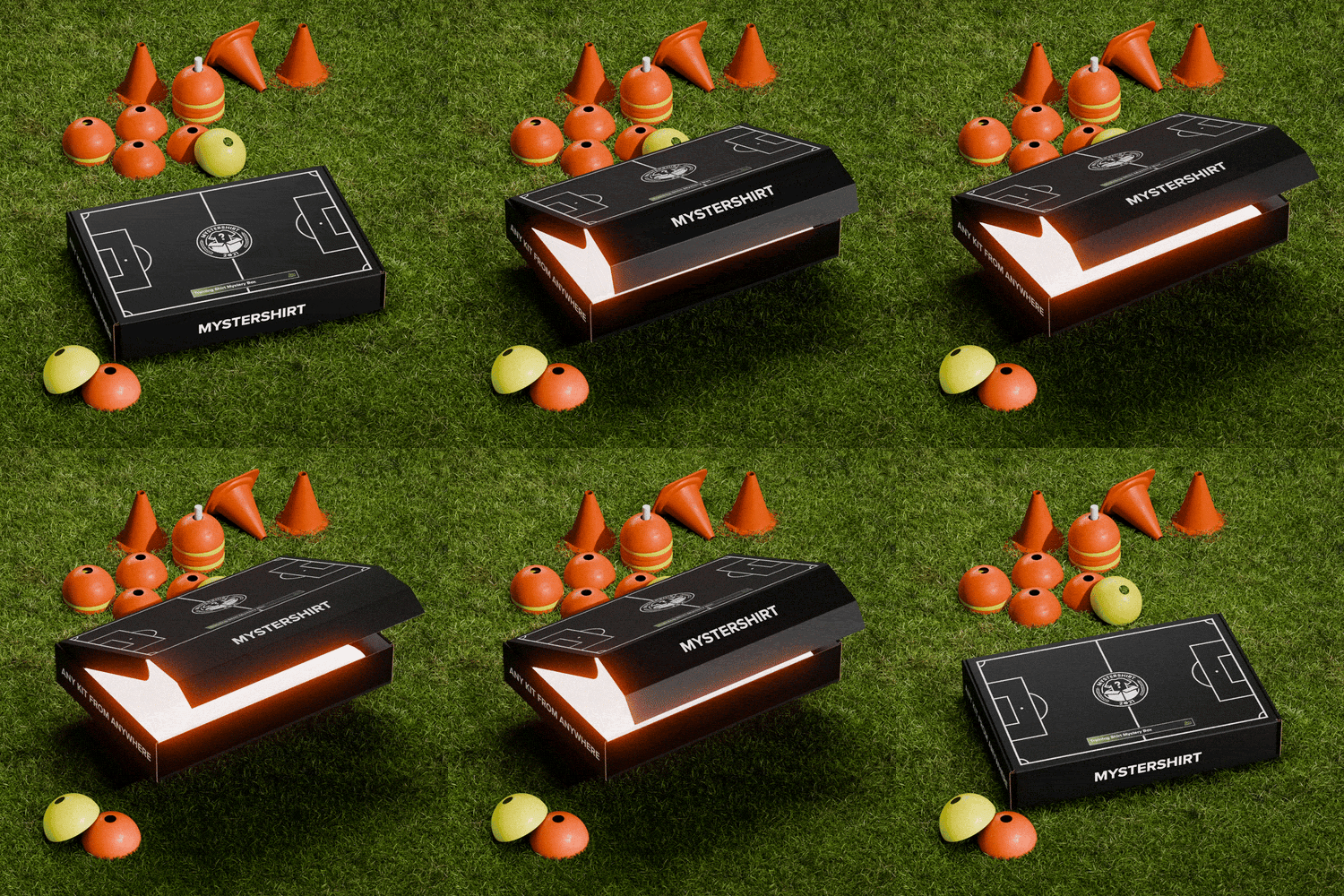
If you want to put this into practice with a brand built around authentic football shirt discovery, Mystershirt is a strong example to study. Its mystery-box model, broad shirt selection, and collector-friendly buying experience show exactly why repeat customer strategy matters so much in this category.